





 Login
 Blog
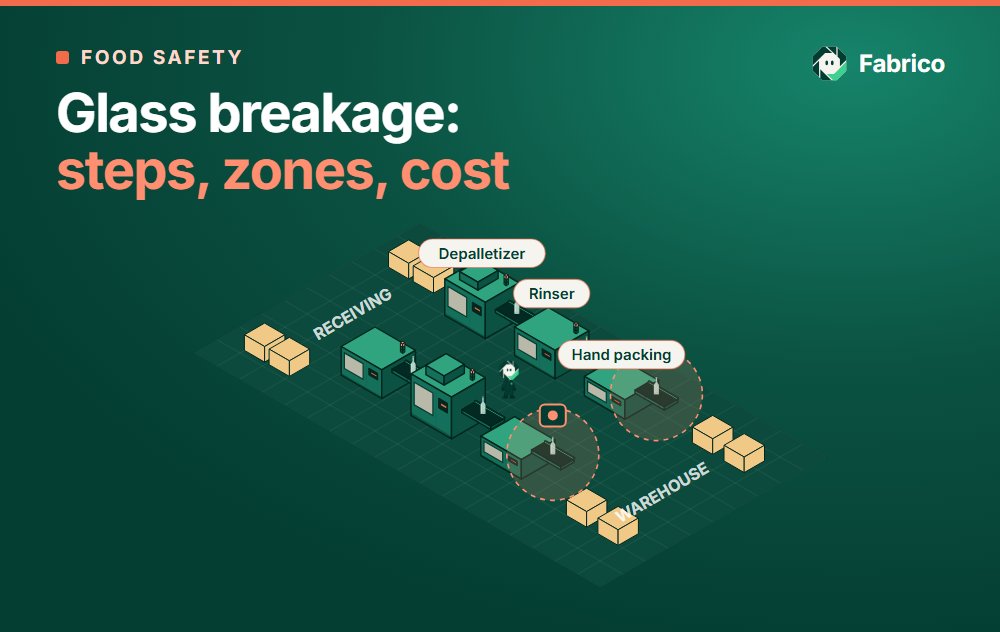
Glass breakage procedure on a filling line: steps, zones, cost

In short
- The first 10 minutes: stop, tape off the zone, hold everything open inside it, clean without compressed air or a pressure hose, and restart only with a signature.
- The zone depends on the station: at the filler and capper you destroy every open bottle in the zone. At the labeller it is usually just the broken bottle and the damaged ones.
- Minutes cost the most: in the worked example below, 93% of the cost of one filler breakage is the stopped line, not the wine thrown away.
- The record drives everything after: log "glass breakage" by machine, with a sub-reason, the glass lot number, and the discarded product as scrap.
- Every cause has a first check: temperature gap, star-wheels, conveyor back-pressure, glass lot, capping pressure.
A bottle has just broken on the filler. In the first 10 minutes, do six things:
- stop the filler and the machines either side of it;
- tape off the zone;
- call the shift leader and the authorised QA person;
- hold every open bottle in the zone;
- clean from the outside in, with no compressed air and no pressure hose;
- restart only after a written inspection and a signature.
In the example, the discarded wine is not the big loss. The big losses are the minutes and the risk that a shard reaches a customer.
The same procedure works in any plant that fills glass: wine, beer, mineral water, spirits, and jars of sauces, compotes, honey or baby food.
Below you get the procedure minute by minute and a quarantine table for every station. You also get a worked cost of one breakage in euro and a failure-mode table with the first check for each cause.
If you track losses on these lines, see also OEE for brewery packaging lines and OEE for food canning lines.
What BRCGS, IFS and the law ask for
No standard hands you a radius in metres. They all ask for the same building blocks: a written procedure, trained people, quarantine, clean-down, inspection, a signed restart and a record. Here is what the key documents say.
- BRCGS Food Safety Issue 9, clause 4.9.3.3: a procedure for breakage of glass or other brittle items. It covers staff training, quarantine of the products and production area potentially affected, cleaning, inspection and authorisation to continue production. It also covers changing workwear and inspecting footwear, naming the staff authorised to do these steps, recording the incident and safe disposal of contaminated product (BRCGS, Global Standard Food Safety, accessed 26.11.2026).
- BRCGS clauses 4.9.4.2 and 4.9.4.3, products packed into glass: removal of all at-risk products near the breakage, where the zone may differ by equipment or area of the line. Cleaning that does not spread fragments further, so no high-pressure water or air. Dedicated, colour-coded cleaning equipment and lidded waste containers.
- A documented inspection after cleaning, and authorisation to restart. Every container breakage on the line is recorded, periods with no breakage are recorded too, and the records are reviewed for trends.
- IFS Food version 8, clauses 4.12.6 to 4.12.10: potentially contaminated products are isolated and handled only by authorised personnel. After turning, blowing or rinsing glass containers, no contamination risk may remain. The procedure defines the scope of goods to isolate, the authorised personnel, cleaning and, if needed, disinfection, and the release of the line. Every breakage is recorded (IFS Food v8, accessed 26.11.2026).
- Regulation (EC) No 178/2002, Articles 14 and 19: unsafe food must not be placed on the market. Where part of a batch is unsafe, the whole batch is presumed unsafe unless a detailed assessment finds no evidence that the rest is. If the food has already left the operator's control, the operator starts a withdrawal at once and informs the authorities (EUR-Lex, 178/2002, accessed 26.11.2026).
- Regulation (EC) No 852/2004: food must be protected against contamination at every stage (Annex II, Chapter IX). Article 5 requires a permanent procedure based on HACCP principles (EUR-Lex, 852/2004, accessed 26.11.2026).
- In Bulgaria, the Food Act: Article 4(1) requires food to be fit for consumption in its physical qualities as well and not dangerous to health. Official control under Article 109 sits with the Bulgarian Food Safety Agency (БАБХ). The exception is bottled natural mineral, spring and table waters, which Article 110 gives to the regional health inspectorates (Food Act, lex.bg, accessed 26.11.2026). A Bulgarian mineral water plant answers to its regional health inspectorate, not the food safety agency.
- Codex and FAO: the FAO good hygiene practice toolbox, built on the Codex General Principles of Food Hygiene CXC 1-1969, says products affected by a deviation are potentially unsafe. The corrective action decides what happens to all of them, looks for the root cause and is documented and reviewed for trends (FAO, GHP and FAO, corrective actions, accessed 26.11.2026).
A glass and brittle plastic policy is wider than the breakage procedure. BRCGS clause 4.9.3.2 asks for a register of every glass and brittle item in open-product areas, apart from the product packaging itself: lamps, sight glasses, gauges, covers, plastic star-wheels and guides.
For each item: location, number, type, condition and a check at a set frequency. This guide covers the part that stops the line: the broken container.
The practical point: the procedure is yours, but the record has to answer five questions. Who stopped the line, how much product you held, how you cleaned, who inspected and who signed the restart. Without that record, you cannot show which product the glass could have reached, so more of the batch stays on hold.
The first 10 minutes after a breakage on the filler
- Minute 0-1: stop. Stop the filler and the capper. If the bottle burst under pressure (beer, sparkling water, sparkling wine), stop the rinser too. The IFS foreign body guideline notes that shards can scatter over a wide area. Nobody reaches into the machine by hand.
- Minute 1-2: tape off. Put tape or a portable sign around the zone from the table below. People from the next machines do not walk through it: glass travels on shoe soles.
- Minute 2-3: call. The shift leader and the authorised QA person come to the line. Someone brings the glass kit: brush, dustpan, vacuum, lidded bin, tape and "on hold" tags. The kit has a colour used nowhere else in the plant.
- Minute 3-5: hold the product. Every open bottle in the zone goes for destruction. Closed bottles that left the capper after the moment of breakage are held, tagged with time, machine and valve number. If you do not know exactly when it happened, hold everything since the last recorded check. Note the glass lot from the pallet label as well.
- Minute 5-8: clean down. From the outside in, floor first, then the machine. No compressed air and no pressure hose: both spread the fragments. Rinse the affected valves following the filler maker's instruction. Everything goes into the lidded bin.
- Minute 8-10: inspect and sign. Change gloves and aprons, check shoe soles. The authorised person inspects the machine, star-wheels and conveyor, signs the record and releases the line. The first bottles after restart get a separate check.
Ten minutes is enough for a small breakage and a prepared crew. A burst inside the filler with valve rinsing takes longer: the worked example below assumes 35 minutes. The goal of the first 10 minutes is not to restart. It is to make sure nobody spreads the glass and no open bottle leaves unchecked.
Quarantine zone by station
BRCGS lets the zone differ from machine to machine, and that makes sense. A bottle that breaks on the depalletiser still has to pass the rinser and inspection. A bottle that breaks on the filler lands among open wine.
The table gives starting values for your own risk assessment, not a norm. Confirm them on your line.
| Station | Zone (starting value) | What you discard | Who signs the restart |
|---|---|---|---|
| Depalletiser | The pallet layer plus 2 m of conveyor | Empties from that layer and from the conveyor inside the zone | Shift leader |
| Rinser | The whole machine plus 1 m before and after | Every empty bottle in the machine and its star-wheels | QA |
| Filler | The carousel, infeed and outfeed star-wheels, 3 m of conveyor before it | Every open bottle in the zone, full or empty; product in the affected valves; bottles closed after the break | QA and shift leader |
| Capper | The capping head, the transfer from the filler, 2 m after it | Every bottle between filler and capper; bottles closed after the break | QA |
| Labeller | 1-2 m around the spot | The broken bottle and any with visible damage or product on them | Shift leader |
| Case packer | The case and the cases next to it | The whole case; neighbouring cases are opened and checked | Shift leader |
How to find your own radius: after every breakage, log the distance to the farthest fragment you found. After 10-15 breakages at one station you have a real number for it, instead of a number from habit.
Two situations always widen the zone. The first is a burst under pressure with carbonated products. The second is a breakage nobody saw: a shard found on the conveyor with no known origin. Then the zone is the whole line from rinser to capper, and the hold covers production since the last recorded check.
Clean-down, inspection and restart sign-off
Clean-down
- Dedicated tools in one colour: brush, dustpan, hand brushes, vacuum. They are stored apart from other cleaning equipment (BRCGS clause 4.9.4.2).
- A lidded glass bin at every line, not the general waste bin.
- No compressed air and no pressure hose on the machine.
- Filler valves around the spot are rinsed following the maker's instruction. How many valves is set by the risk assessment written into the procedure, not by the shift on the day.
- Catch trays under the line are emptied and checked. The IFS foreign body guideline asks directly whether there are installations for catching breakage beneath the lines and whether they are checked frequently (IFS, Foreign Body Management guideline v3, accessed 26.11.2026).
Inspection
- The inspection is written down: machine, star-wheels, guides, conveyor, and the floor 2 m around the zone.
- People change gloves and aprons and check their soles before going back to the line.
- Discard a set number of bottles after restart too, for example one full turn of the filler. The IFS guideline asks whether enough bottles are removed before and after a breakage.
Sign-off
The restart is signed by a person named, by name or job title, for every shift. The IFS guideline asks whether the line can only be released by a qualified member of staff after a glass breakage.
If the night shift has no such person, the line waits. That is the most expensive gap in the procedure and the easiest to close: train at least one person per shift.
If you already run line clearance with video evidence after changeovers, use the same form for the post-breakage signature. One place for records beats two.
How to record the stop so the data is useful
The procedure stops the glass. The record stops the next breakage. If "glass breakage" disappears into "cleaning" or "other", you will never see that most of your breakages come from the same star-wheel.
- Reason by machine: "glass breakage" is its own reason on every machine: depalletiser, rinser, filler, capper, labeller, packer. The machine is where the bottle broke, not where the shard turned up.
- Sub-reasons: thermal shock, star-wheel or guide, bottle-to-bottle impact, glass defect, pressure or capping, unknown. The operator picks one at the time; QA confirms or changes it after looking at the fragments.
- Unplanned stop: a breakage is unplanned downtime. The glass check at the start of the shift is planned. Keep them apart, or your availability figure is wrong.
- Discarded product is scrap: log it by product with the reason "glass breakage", in units, full and empty bottles separately. That keeps quarantine scrap apart from fill-level or label scrap.
- Glass lot: the number from the pallet label. Without it there is no claim against the supplier.
- Zero is a record too: BRCGS wants a record even when a shift has no breakage. One tick per shift is enough.
How to lay out the codes themselves on a filling line is covered in downtime codes for a beverage filling line. The general rules for a reason list are in downtime reason code design. This page adds two things: "glass breakage" carries sub-reasons, and the discarded product belongs to the same record.
If you run MES for beverage manufacturing, check that the stop and the scrap link into one record instead of sitting in two tables. On older lines with no machine signal, output can be counted by camera; see how that works in practice in camera OEE on a bottled water line.
Worked example: the cost of one breakage on a 0.75 L wine line
The numbers are an example, not a customer's data. Swap in your own; the arithmetic stays the same.
- Line: still wine in 0.75 L bottles, 6,000 bottles an hour, so 100 a minute.
- Time: two 8-hour shifts, 21 working days. That is 42 shifts and 20,160 planned minutes a month.
- Value of a stopped minute: 45 EUR, which is 100 bottles at a 0.45 EUR contribution per bottle (price minus variable cost). This holds if the line is the bottleneck and you sell everything you bottle. If you recover the time with overtime, use the overtime cost instead.
- Unit cost: a full bottle costs 1.40 EUR (wine, glass, closure), an empty bottle 0.35 EUR.
- Labour: 12.0 EUR an hour, the average hourly labour cost in Bulgaria in 2025 according to Eurostat (accessed 26.11.2026).
- Breakages: 4 a month at the filler or capper (35 minutes stopped) and 6 a month at the labeller or packer (8 minutes).
| Cost line | Filler breakage | Labeller breakage |
|---|---|---|
| Stopped line | 35 min × 45 = 1,575 EUR | 8 min × 45 = 360 EUR |
| Discarded product | 60 full × 1.40 + 40 empty × 0.35 = 98 EUR | 4 full × 1.40 = 5.60 EUR |
| Clean-down labour | 3 people × 35 min = 105 min; 105/60 × 12.0 = 21 EUR | 2 people × 8 min = 16 min; 16/60 × 12.0 = 3.20 EUR |
| Total per event | 1,694 EUR | 368.80 EUR |
| Events per month | 4 | 6 |
| Per month | 6,776 EUR | 2,212.80 EUR |
Total per month: 6,776 + 2,212.80 = 8,988.80 EUR. Per shift: 8,988.80 / 42 = 214.02 EUR. Per year, if the line runs like this for 12 months: 8,988.80 × 12 = 107,865.60 EUR.
The line stands for 188 minutes a month (4 × 35 + 6 × 8). That is 0.93% of 20,160 planned minutes. A small share, a large sum.
What the numbers say
- Minutes are 93% of the cost of a filler breakage (1,575 of 1,694 EUR). The wine and glass thrown away come to 98 EUR.
- 15 minutes faster on every filler breakage (35 down to 20) saves 15 × 45 = 675 EUR per event, 2,700 EUR a month and 32,400 EUR a year.
- Twice as many bottles discarded (120 full instead of 60) costs 60 × 1.40 = 84 EUR more per event, 336 EUR a month and 4,032 EUR a year.
- The lesson: do not save on the zone. Save on the minutes: a kit at the line, a trained person to sign off on every shift, and a clear split of who does what.
Root causes and the first check for each
A repeat breakage at the same spot is not bad luck. The shape of the crack points to the cause. The WSU Extension sheet on jar breakage (accessed 26.11.2026) describes three patterns:
- Thermal shock gives a crack running around the base or lower part, sometimes extending up the side.
- Impact gives cracks radiating from the point of contact.
- Pressure from inside starts on the side as a vertical crack that splits into two forks.
The sheet is written for home canning, but the patterns are a useful first read on the line too. Keep the fragments in a closed box and look at them before you confirm the sub-reason.
| Cause | What you see | First check | Owner |
|---|---|---|---|
| Thermal shock: hot fill, tunnel pasteuriser, cold bottles from an unheated store in winter | Crack around the base or lower part | Temperature gap between bottle and product or rinse water; how long the bottles sat in a warm room first | Process technologist |
| Star-wheel or guide out of position | Breaks at the same transfer point, scuffs at the same height | Settings against the format sheet after the last changeover; worn pockets | Maintenance |
| Bottle-to-bottle impact at transfers | Cracks radiating from an impact point, scuff marks | Accumulation back-pressure, speed mismatch between conveyors, gaps at transfers | Maintenance and line manager |
| Supplier glass defect | Breaks across several machines, clustered around one lot | Link breakages to the lot on the pallet label; hold the lot and ask the supplier for its QC data | QA and purchasing |
| Pressure or capping: beer, sparkling water, sparkling wine | Vertical crack on the side that forks | Capping or crowning force, fill level, carbonation | Maintenance and technologist |
Thermal shock has a standard test method. ASTM C149 (accessed 26.11.2026) measures how glass containers resist sudden temperature changes in washing, pasteurisation and hot-pack processes. Ask your supplier for results under it for your bottle or jar model, especially if you hot-fill sauces, compotes or baby food.
On bottle-to-bottle impact, the IFS guideline asks whether line settings and materials are optimised to minimise collisions between containers. On supplier glass, it asks whether container dimensions, weights and tolerances are monitored and whether the supplier is audited. Expect the same questions from an auditor once breakages repeat.
What to decide: whole line or zone, glass or PET
Stop the whole line or only the zone
- Stop the whole line when there is open product in the zone (rinser, filler, capper) or when you do not know how far the fragments went.
- Stop only the zone when the bottles are closed (labeller, packer) and the buffer between the zone and the filler covers the clean-down. In the example a labeller breakage takes 8 minutes. If the accumulation table holds 10 minutes, the filler keeps running: 6 × 360 = 2,160 EUR a month, 25,920 EUR a year stays in the plant.
- Write the rule once, into the procedure, with the line manager and QA. The shift does not decide it on the spot.
Glass or PET
Changing the container is not a plant decision alone. For wine, spirits, baby food and jarred food, the market and the customer decide before engineering does. For water and soft drinks the choice is real.
Glass is not in retreat either. FEVE (accessed 26.11.2026) reports that European food and beverage glass container production grew 2% in 2025, to 20.3 million tonnes and 73.3 billion units.
Set the yearly cost of breakage against the cost of switching: new formats, new filling equipment, and customers who want glass.
In the example, each filler breakage costs 1,694 EUR. At 2 a month that is 40,656 EUR a year; at 6 a month, 121,968 EUR. Every minute saved on such a breakage is worth 4 × 12 × 45 = 2,160 EUR a year.
If the yearly breakage cost is a small fraction of the switching cost, fix the procedure and the machines before you think about PET.
Who decides what
| Decision | Who | When |
|---|---|---|
| Zone by station | QA | When the line changes, and after 10-15 logged breakages at a station |
| Whole line or zone | Line manager and QA | Once, in the procedure |
| Star-wheels, guides, back-pressure | Maintenance | At the second breakage in the same spot |
| Claim against the supplier | Purchasing and QA | When breakages cluster around a lot |
| Glass or PET | Plant manager | With a new product or a new large customer |
Questions for the glass supplier
- What are the thermal shock results under ASTM C149, or an equivalent method, for this model and this lot?
- How do you trace a lot back to furnace and mould, so that a breakage can be linked to a specific mould?
- What are the tolerances for wall thickness, weight and dimensions, and how do you check them?
- If you offer a lighter model, what data do you have on its pressure and thermal shock resistance? FEVE reports that the standard still wine bottle reached 443 g in sales in 2025.
- What data do you need from the plant to accept a claim for breakages in a lot?
Questions for the machine service team
- Is there a settings sheet for star-wheels and guides for every format, and who checks it after a changeover?
- What is the maker's procedure for rinsing the valves after a filler breakage, and how long does it take?
The procedure on one card
Print the card and put it next to the filler, beside the glass kit. The minutes on it are for the first response, not for the full clean-down.
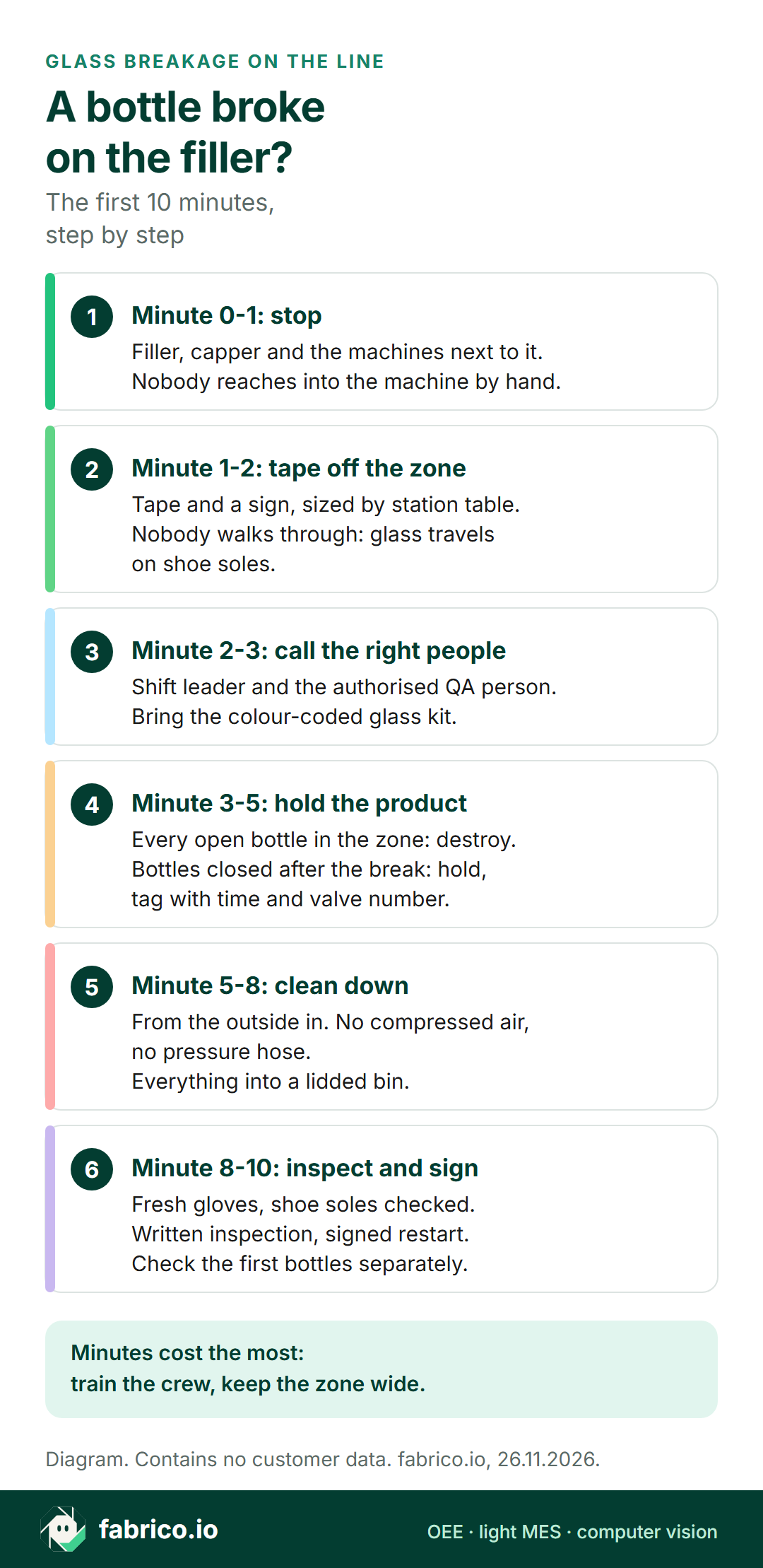
Text version of the diagram
- Minute 0-1: stop the filler, the capper and the machines next to them; nobody reaches into the machine by hand.
- Minute 1-2: tape off the zone with tape and a sign sized from the station table; nobody walks through.
- Minute 2-3: call the shift leader and the authorised QA person and bring the colour-coded glass kit.
- Minute 3-5: every open bottle in the zone goes for destruction; bottles closed after the break are held and tagged with time and valve number.
- Minute 5-8: clean from the outside in, no compressed air and no pressure hose, everything into a lidded bin.
- Minute 8-10: fresh gloves, soles checked, written inspection and signed restart; check the first bottles after restart separately.
Where Fabrico fits
Fabrico is an OEE platform and light MES. For glass breakage that means:
- The operator picks "glass breakage" and the sub-reason on the right machine in a few taps, and the stop counts as unplanned.
- Discarded bottles are logged as scrap by product and reason, and the Financial impact module prices the loss in euro and ranks stops by financial impact.
- Where a camera covers the line, the minute of the stop opens from the shift timeline and streams on request; it is not stored in Fabrico. The team can see where the bottle broke. The camera does not detect breakage or glass: a person picks the reason.
- A work order for maintenance is raised from the logged stop in one tap.
More on OEE with computer vision. Pricing is one quote per plant, by machines and modules: pricing.
Frequently asked questions
Does the whole line have to stop if a bottle breaks at the labeller?
Not always. If the bottles there are closed and the buffer between labeller and filler covers the clean-down, stop only the zone. If you do not know how far the fragments went, stop the whole line.
How many bottles should be discarded around a filler breakage?
Every open bottle in the zone, full or empty, plus bottles closed after the break. Neither BRCGS nor IFS gives a number: the size comes from your risk assessment, and the logged distance to the farthest fragment tells you whether it is right.
How small a glass fragment is dangerous?
In the US, the FDA (accessed 26.11.2026) treats hard or sharp objects of 7 to 25 mm in ready-to-eat food as a hazard, and smaller ones as a concern for special-risk groups such as infants. For baby food in jars, do not rely on size: the zone and the hold remain the main protection.
Who can sign the restart after a breakage?
A person named in the procedure, by name or job title, for every shift and trained for it, for example someone from QA or the shift leader. BRCGS and IFS both expect the authorised people to be named in advance.
Do shifts with no breakage need a record?
Yes, if you are certified to BRCGS: clause 4.9.4.3 asks for a record of periods with no breakage too. One tick per shift is enough and shows the check was done.
How can you tell thermal shock from impact?
Look at the fragments. A crack around the base points to thermal shock, cracks radiating from one point to impact, and a vertical crack that forks to pressure from inside. Confirm the sub-reason only after that look.
See your breakages in euro. The demo shows how a "glass breakage" stop is logged by machine and reason, how discarded product goes in as scrap and how the loss is priced in euro.
Latest from our blog




Real Fabrico tiles, sample data.