


 Login
 Blog

Lights-Out Manufacturing: How to Tell a Cell Can Run Unattended

In short: lights-out manufacturing means machines produce with nobody on the floor, and a cell is ready for it when measured data says it will keep running through the unattended window. Test six gates per machine on attended shifts before the first night: run time between stops that need a person, micro-stops, material on hand, part ejection, a quality guard and alarms that reach a phone.
- The core number: run hours between stops that need a person, against the window. At three times the window, about 71.7% of nights run clean.
- In the worked example, 2 of 8 closure presses qualify for full lights-out and 3 for a ghost shift with one roaming technician.
- A press that stops at 02:00 and waits until 06:00 loses EUR 640.38 of margin and energy there.
- A staffed night can still make more margin. Fix the failing machines first, then compare.
Picture a first lights-out night that goes wrong. The robots and the software work. A press that looked reliable on day shift stops at 01:40 with a part stuck in the mould and stands until the morning crew walks in. The machine was never tested against the length of the night.
The aim is a decision a plant, production or engineering manager can defend: which cells run alone, and which do not. The page turns readiness into six measured gates, works them through on an eight-press caps and closures moulding shop, prices an unattended night in euros, and ends with a choice between staying attended, a partial ghost shift, full lights-out and fixing the machine first.
Full or partial lights-out: what changes when nobody is on the floor
Full lights-out means nobody is in the building for the window. Partial lights-out covers everything in between: a cell that runs alone over the lunch break, a ghost shift where one roaming technician answers alarms for several machines, or unattended weekends after a staffed week. The machines are the same; what changes is how long a stop can wait before someone arrives.
On a staffed shift that wait is a few minutes. On a ghost shift it is the walk from wherever the technician is. In full lights-out it is the rest of the night. The readiness test is mostly about that one difference.
People do not disappear in partial lights-out; they work alone. In Great Britain the Health and Safety Executive guidance on lone working states that an employer must manage any health and safety risks before people can work alone. A roaming technician who restarts moulding machines at night needs a risk assessment, a way to raise help and a rule on which jobs wait until morning. Check the rules where your plant is.
| Job a person does at night | Staffed night | Lights-out answer |
|---|---|---|
| Clear a stuck part or a jam | Setter at the machine | Ejection check stops the cycle; the stop waits |
| Refill resin, colour, boxes | Material handler | Silo feed, bigger hoppers, conveyor to a box changer |
| Catch short shots or flash | Operator checks parts | Weight or cavity pressure check rejects or stops |
| Notice an alarm | Someone hears it | Notification to a phone, tested |
| Restart after a fault | Setter, minutes later | Roaming technician, or the morning shift |
On a lights-out cell, automation takes over the first three jobs. The International Federation of Robotics World Robotics 2025 release reports that industrial robot installations in Europe fell 8% to 85,000 units in 2024, still the second highest on record, with 67,800 of them in the European Union. Robots can pick parts and stack boxes; the open question is whether the process behind them is steady enough to leave alone. For the robot choice itself, see cobot vs traditional robot.
The readiness test: six gates measured on attended shifts
Every gate below is measured while people are still there, over at least four weeks of normal production on the machine and the job you plan to run at night. Thresholds are written for an 8 hour window, 22:00 to 06:00. They are example rules, not a standard; tighten them for longer windows such as a weekend.
| Gate | Full lights-out | Partial: ghost shift |
|---|---|---|
| 1. Run hours between stops that need a person | 24 h or more (3 x window) | 8 h or more (1 x window) |
| 2. Micro-stops per run hour | 2 or fewer | 4 or fewer |
| 3. Material on hand | Window plus 2 h: 10 h | Half the window: 4 h, topped up once |
| 4. Part ejection confirmed every cycle | Required | Required |
| 5. Quality guard rejects drift or stops | Required | Or an hourly part check |
| 6. Alarm reaches a phone, tested | Required | Required |
The order matters. Gates 4 and 6 are yes or no and protect the mould and the night: a machine that cannot confirm ejection, or whose alarm goes nowhere, does not run alone however good its other numbers are. Gate 1 decides between partial and full. Gates 2, 3 and 5 decide whether a machine that passes gate 1 needs a person on site anyway.
Gate 1 in numbers: run time between stops that need a person
Stops differ in what they cost at night. A stop that clears itself, or that the machine recovers from, costs seconds. What decides the night is a stop that needs a person: a stuck part, a robot gripper fault, a temperature alarm, an empty dryer. Count only those, and divide the run hours by their number. That is the machine's mean run time between stops that need a person, written M below. The general metric is covered in mean time between failures; this is the same idea restricted to what a lone night can absorb.
If those stops arrive at a steady rate, the NIST/SEMATECH e-Handbook of Statistical Methods gives the arithmetic. For the exponential model, reliability over a time t is R(t) = e to the power of minus lambda t, the mean time to fail is 1 / lambda, and the model works well for inter-arrival times of events. With the window T and M = 1 / lambda:
- Chance of a clean night: e^(-T / M).
- Expected run hours when nobody restarts the machine: M x (1 minus e^(-T / M)). A stop ends the night, so the machine runs until the first stop or the end of the window, whichever comes first.
| M against the window | M for an 8 h night | Clean nights | Window that runs |
|---|---|---|---|
| 0.5 x window | 4 h | 13.5% | 43.2% |
| 1 x window | 8 h | 36.8% | 63.2% |
| 2 x window | 16 h | 60.7% | 78.7% |
| 3 x window | 24 h | 71.7% | 85.0% |
| 5 x window | 40 h | 81.9% | 90.6% |
Two readings matter. At M equal to the window, only 36.8% of nights run clean, but the machine still runs 63.2% of the window on average, because most stops come late enough. That is why a ghost shift works at 1 x: a technician shortens the stops that do come. At 3 x, 71.7% of nights are clean and the machine runs 85.0% of the window alone, which is where full lights-out starts to pay without anyone there.
Three cautions before trusting M:
- Count enough stops. Ten or more stops that needed a person, on the job you plan to run at night. Four weeks of a press that stops once a day is plenty; four days is not.
- Watch the first hours after a mould change. NIST notes that the exponential model fits the long flat part of the bathtub curve, not the early failures. If a press stops more in the first hours after a mould or colour change, start unattended runs on a job that has already run for a shift.
- Tag the stop, not just the duration. A 20 minute stop can be a planned break or a stuck part. Only the reason tells you whether it needed a person.
Gates 2 to 6: micro-stops, material, ejection, quality and alerts
Micro-stops: the warning before the jam
Micro-stops clear themselves: a part that drops late, a robot that waits for a sensor, a conveyor that backs up for a few seconds. They cost speed, not a visit, so they do not count in M. They matter at night for two reasons. They cut output, and a rising rate is often the first sign of a jam that will need a person. A press with 4 micro-stops an hour on day shift is a press that is close to its edge. The difference between short stops and slow cycles is laid out in reduced speed loss vs minor stops.
Material: hours on hand, not kilograms
Express every input in hours of running: resin in the dryer and hopper, colour masterbatch, labels or liners if the cell adds them, and empty boxes or octabins at the end. Divide what is on hand at 22:00 by consumption per hour at the night's job. The smallest number is the cell's material autonomy. A press fed from a silo by a central conveying system usually passes; a press fed by hand from an octabin can run out of a small hopper long before the dryer does. Leave two hours of margin for full lights-out, because a dryer that empties also lets wet resin through first.
Ejection: protect the mould first
A part that sticks in a cavity and closes with the next shot can damage the mould, and a mould in repair costs far more than one night of output. Every cycle on an unattended press needs proof that the parts left: a part-drop sensor under the mould, a light curtain on the chute, or a robot that confirms each pick. If the proof is missing, the press stops. That stop is in M; a damaged mould is not.
Quality guard: drift found at 06:00 is scrap
On a staffed shift an operator sees short shots, flash or a colour streak within the hour. At night nobody does, and a drift at 01:00 can fill boxes until the morning check, when the whole night's output from that press goes into quarantine. A guard is anything that rejects bad shots or stops the press without a person: a weight check, cavity pressure monitoring, or an inline inspection camera. Without one, full lights-out carries a scrap risk that grows with the square of the window, because a drift can start at any hour and runs until morning. How scrap shows up in OEE is covered in OEE for injection moulding.
Alerts: monitoring, not remote control
An alert brings a person; it does not fix the machine. The OPC Foundation page on EUROMAP 77, the OPC UA interface between injection moulding machines and MES, says the central computer would not actually control the injection moulding machine, and that no direct control functions or functions needed for safe operation will be provided. Plan the night on that basis: the alarm reaches a phone, someone answers, and the restart happens at the press.
Test the chain at the hour it will be used. Trigger a stop at 02:00 on a staffed night and time how long it takes for the right phone to ring and the person to arrive. Send only the alarms that need a person, or the phone gets muted by the third night; alerts that drive action covers how to keep the list short.
Worked example: eight closure presses scored for unattended nights
Sample figures for illustration only. A moulding shop makes caps and closures for a beverage brand on eight presses with robot pickers and conveyors to the box stations. It runs two staffed shifts, 06:00 to 22:00, Monday to Friday, and wants to use the 8 hour night. Four weeks of attended data give each press its gate numbers. Ideal output is cavities x 3,600 / cycle seconds, so P1, a 48 cavity mould on a 3.2 second cycle, has an ideal of 54,000 closures an hour.
| Press, mould | Run hours between stops that need a person | Gates failed | Verdict |
|---|---|---|---|
| P1, 48 cavities, 3.2 s | 31 h | None | Full lights-out |
| P2, 32 cavities, 3 s | 26.5 h | None | Full lights-out |
| P3, 64 cavities, 4 s | 12.4 h | No quality guard; 12.4 h under 24 h | Partial |
| P4, 48 cavities, 3.6 s | 9.1 h | 9.1 h under 24 h; 3.8 micro-stops an hour | Partial |
| P5, 24 cavities, 2.4 s | 17.8 h | Material 6 h, hand-fed octabin; 17.8 h under 24 h | Partial |
| P6, 72 cavities, 4.5 s | 3.6 h | 3.6 h; no ejection check; no quality guard | Automate first |
| P7, 32 cavities, 3.2 s | 6.3 h | 6.3 h; alarm goes nowhere | Automate first |
| P8, 16 cavities, 4.8 s | 2.2 h | 2.2 h; 6.9 micro-stops an hour | Stay attended |
Four groups fall out:
- P1 and P2, full lights-out candidates. Both run more than three nights' length between stops that need a person, have silo feed, part-drop sensors and a weight check that stops the press.
- P3, P4 and P5, partial. P3 is reliable but has no quality guard, so a roamer checks its parts each hour. P4 stops often enough that a night alone would cost a third of the window. P5 runs out of material at 04:00 unless someone tops up its octabin.
- P6 and P7, automate first. P6 has stuck parts and no way to know: a part-drop sensor and the sticking cavity's cause come before any night. P7's alarm is not routed to anyone. Both failures have one named fix each.
- P8, stay attended. A two-shot sport closure mould with stops spread over nine causes and frequent colour changes. No single fix moves it past a gate, so it keeps its staffed shifts.
What one unattended night is worth, in euros
The margin per closure. The sample price is EUR 12.40 per 1,000 closures. The margin comes from a sourced range: the NYU Stern margin dataset by industry (Aswath Damodaran, data as of January 2026, 19 US packaging and container firms) gives a gross margin of 24.27%. Gross margin still carries the plant's fixed costs, so it understates what one extra night adds; the example stays on the safe side. EUR 12.40 x 24.27% = EUR 3.01 per 1,000 closures.
P1 for one hour. 54,000 ideal x 96% performance x 99.6% quality = 51,632.6 good closures, worth 51.6326 x EUR 3.01 = EUR 155.41 of margin an hour. Its M is 31.0 hours, so the chance of a clean night is e^(-8 / 31) = 77.3%, and it runs 7.05 of the 8 hours on average with nobody there.
A stop at 02:00 that waits until 06:00. Four hours of lost margin: 4 x EUR 155.41 = EUR 621.66. The heaters, hot runner and dryer stay on while the press stands. At a sample 26 kW and the Eurostat EU average non-household electricity price of EUR 0.1800 per kWh in the first half of 2026, that adds 4 x 26 x 0.18 = EUR 18.72. Total EUR 640.38. Energy is the small part: across the EU range of EUR 0.0928 to EUR 0.2666 per kWh it is EUR 9.65 to EUR 27.73. The money is in the margin that did not get made.
Why the quality guard matters: P3 run fully alone. P3 makes EUR 161.67 of margin an hour and would run 5.90 hours alone: EUR 953.08. But it drifts about 1.2 times per 100 run hours, and with no guard a drift runs until 06:00. Expected bad hours: 0.012 x 8 x 8 / 2 = 0.384. A quarantined closure loses its selling price, the margin counted plus the cost already spent: 0.384 x 57,600 x 94% / 1,000 x EUR 12.40 = EUR 257.81 a night of expected scrap. With a roamer checking parts each hour, a drift runs half an hour on average, and the risk falls to EUR 32.23.
Four plans for the night. Night labour is priced at the Eurostat euro area industry rate of EUR 40.3 an hour: each person is paid 8.5 hours, the window plus a 30 minute handover to the day shift, so one roamer costs EUR 342.55 and two setters EUR 685.10. In the sample, the roamer reaches a stopped press in 15 minutes on average and the setters in 3; each press keeps its own measured repair time.
| Plan | Presses, people | Net EUR a night | EUR a year, 250 nights |
|---|---|---|---|
| Full lights-out | P1, P2; nobody | 1,839.96 | 459,991.13 |
| Ghost shift | P1 to P5; one roamer | 4,708.85 | 1,177,212.31 |
| Staffed night | All eight; two setters | 6,456.82 | 1,614,204.49 |
| Ghost shift after fixing P6, P7 | Seven presses; one roamer | 6,563.15 | 1,640,788.50 |
Reading it. Full lights-out on two presses earns EUR 1,849.53 of margin and loses only EUR 9.56 to standing heaters: EUR 1,839.96 a night with no night labour at all. The ghost shift earns more, EUR 4,708.85 after the roamer and P3's scrap risk, because three more presses run and the roamer cuts stops short. The staffed night beats both at EUR 6,456.82: two setters cost less than the margin of the extra presses and the faster restarts.
Fixing P6 and P7 changes the order. If the ejection check, the sticking cavity and the alarm route lift their M to a sample 9.0 and 8.6 hours, both join the ghost shift and add EUR 1,854.30 a night. The roamer then covers seven presses, about 4.4 stops a night that need a visit, and the plan nets EUR 6,563.15, slightly ahead of the staffed night with one person instead of two. That is close enough that the real decider is whether two night setters can be hired and kept. These numbers are large because every extra closure is valued at margin, which holds only if the brand takes the extra volume; with flat demand the gain shows up as fewer staffed hours instead.
Stay attended, partial, full lights-out or automate first: options, costs and who picks which
The ranges below come from the sourced inputs above: EUR 12.0 to EUR 56.8 an hour for labour across EU countries in 2025 (Eurostat) and EUR 0.0928 to EUR 0.2666 per kWh for non-household electricity in the first half of 2026. The press figures are sample figures.
| Option | Cost range | Choose it if |
|---|---|---|
| Stay attended | Two night setters: EUR 204.00 to EUR 965.60 a night. Sample: EUR 685.10 | Night staff can be hired; machines fail gate 1, 4 or 6 with no single fix; frequent mould or colour changes |
| Partial: ghost shift | One roamer: EUR 102.00 to EUR 482.80 a night, plus scrap risk on unguarded machines. Sample: EUR 342.55 and EUR 32.23 | Machines pass gates 4 and 6 and run at least the window between stops that need a person |
| Full lights-out | No night labour. Cost is stops that wait: lost margin per hour plus standing energy of EUR 2.41 to EUR 6.93 an hour at 26 kW. Sample stop at 02:00: EUR 640.38 | All six gates pass at full thresholds on the job planned for the night |
| Automate first | Worth up to the margin it adds. Sample: fixing P6 and P7 adds EUR 1,854.30 a night, EUR 463,576.19 a year, a ceiling for the fix budget at your payback rule | A machine fails one or two gates for a named, fixable cause |
Who usually picks which. A plant manager who cannot fill a night shift starts with a ghost shift on the machines that pass gates 1, 4 and 6, and moves the best of them to full lights-out once a quarter of nights confirms the numbers. An engineering manager with a few machines that fail on one cause should spend on that cause before arguing about staffing. A production manager on high-mix work with daily changeovers usually stays attended: M resets with every new job.
Questions for your own team, or for any vendor of robots, auxiliaries or monitoring software:
- Which stops in the last four weeks needed a person, and what is the run time between them on the job we plan for nights?
- How does the machine prove every shot left the mould, and what happens if it cannot?
- What catches a short shot, flash or a colour drift without a person, and does it reject or stop?
- How many hours of every input are on hand at 22:00, and which one runs out first?
- Who gets the alarm at 02:00, how long until they are at the machine, and has that been tested?
- Will the extra night output sell, or should the gain be counted as fewer staffed hours? Ask finance before the first night.
Want the stop list, micro-stops and alerts for a moulding hall on one screen? Book a demo.
A staged path from ghost shift to weekends, with exit criteria
Nobody should go from two staffed shifts to an empty building in one step. Each stage below runs on its own exit criteria, measured, before the next one starts.
| Stage | Who is on site | Exit criteria to move on |
|---|---|---|
| 0. Measure | Normal staffed shifts | Four weeks of tagged stops; six gates scored per machine |
| 1. Ghost shift | One roamer for the passing machines | Four weeks: measured night run hours within 10% of the gate 1 forecast; no mould damage; no quarantined night |
| 2. Unattended nights | Nobody on the full-lights-out machines; roamer elsewhere or on call | Clean-night share at or above the forecast; every alarm answered within the agreed time |
| 3. Unattended weekends | On call only | Gate 1 re-scored for the longer window: 3 x 56 h means M of 168 h for full lights-out |
Stage 3 is a deliberate stopping point. From Friday 22:00 to Monday 06:00 the window is 56 hours, so full lights-out needs an M of 168 hours on the weekend job. Score each machine against that before the first weekend. Where it falls short, a partial weekend with one technician for a few hours each day is the fallback.
The same test on CNC machining and stamping
Lights-out machining uses the same six gates with different causes. On a machining centre, the stops that need a person are tool breakage, chip build-up and pallets that run out; material autonomy is the pallet pool or bar feeder; the quality guard is in-process probing and tool life monitoring. On a stamping press, it is coil length, scrap removal and die protection sensors. The arithmetic for M and the clean-night share is identical. For the signals a CNC shop already has, see CNC machine monitoring.
Measuring the gates before the first night
Every number in the worked example came from attended shifts, and that is the only safe place to get it. Four measures settle most debates:
- Stops with a reason: start, duration and cause, so stops that needed a person can be counted apart from breaks and changeovers.
- Micro-stops kept apart from long stops: as a count per hour, not hidden in a lower speed.
- Output by hour: to see whether a press slows down before it stops.
- Night versus day: once the ghost shift starts, the same figures split by shift, so the forecast can be checked.
With OEE software, the stop and its duration come from the machine signal and the operator adds the reason on a tablet or phone, so four weeks of tagged stops is a report, not a project. The walkthrough below shows the line screen and how a stop waits for its reason.
Demo data is synthetic. Book a demo.
Plays from YouTube. Google may set cookies when you press play. Privacy policy.
Where Fabrico fits in a lights-out trial
Fabrico is light MES and OEE software for the plant floor. In a lights-out trial its role is the measured stop record and the alerts:
- Stops on a connected machine are recorded with the time they started and how long they lasted, and operators tag the cause on a tablet or phone. Run time between stops that needed a person comes from that list: filter the reasons that needed a visit and divide the run hours by their count. Any list exports to Excel, and Fabrico also has a REST API and webhooks. The OEE and light MES solution page shows the screens.
- Micro-stops are detected from the machine signal, including stops too short for anyone to write down, and reported apart from long stops.
- Line status shows whether a line is running or stopped and how long the current stop has lasted. Push, in-app and email notifications follow rules for who is told about what, so a stop in the night can reach the roamer's phone. The restart still happens at the machine.
- Signals come from the machine's PLC, or from an IoT device with external sensors on older machines. Where a step has no usable machine signal, such as a hand-pack table at the end of the hall, the camera add-on counts output; see MES and OEE with cameras. Where the camera add-on covers a station, the video for the minute of a stop can be opened from the shift timeline, streamed on request and not stored in Fabrico.
For the software choice in a moulding plant, OEE software for injection molding compares the options, and MES for plastics injection moulding covers the wider MES scope. For what a staffed night shift can see, read night shift downtime visibility.
Sources, accessed 17.11.2026: NIST/SEMATECH e-Handbook, exponential model; OPC Foundation, EUROMAP 77; HSE, lone working; IFR World Robotics 2025; NYU Stern margins by sector; Eurostat hourly labour costs; Eurostat electricity prices.
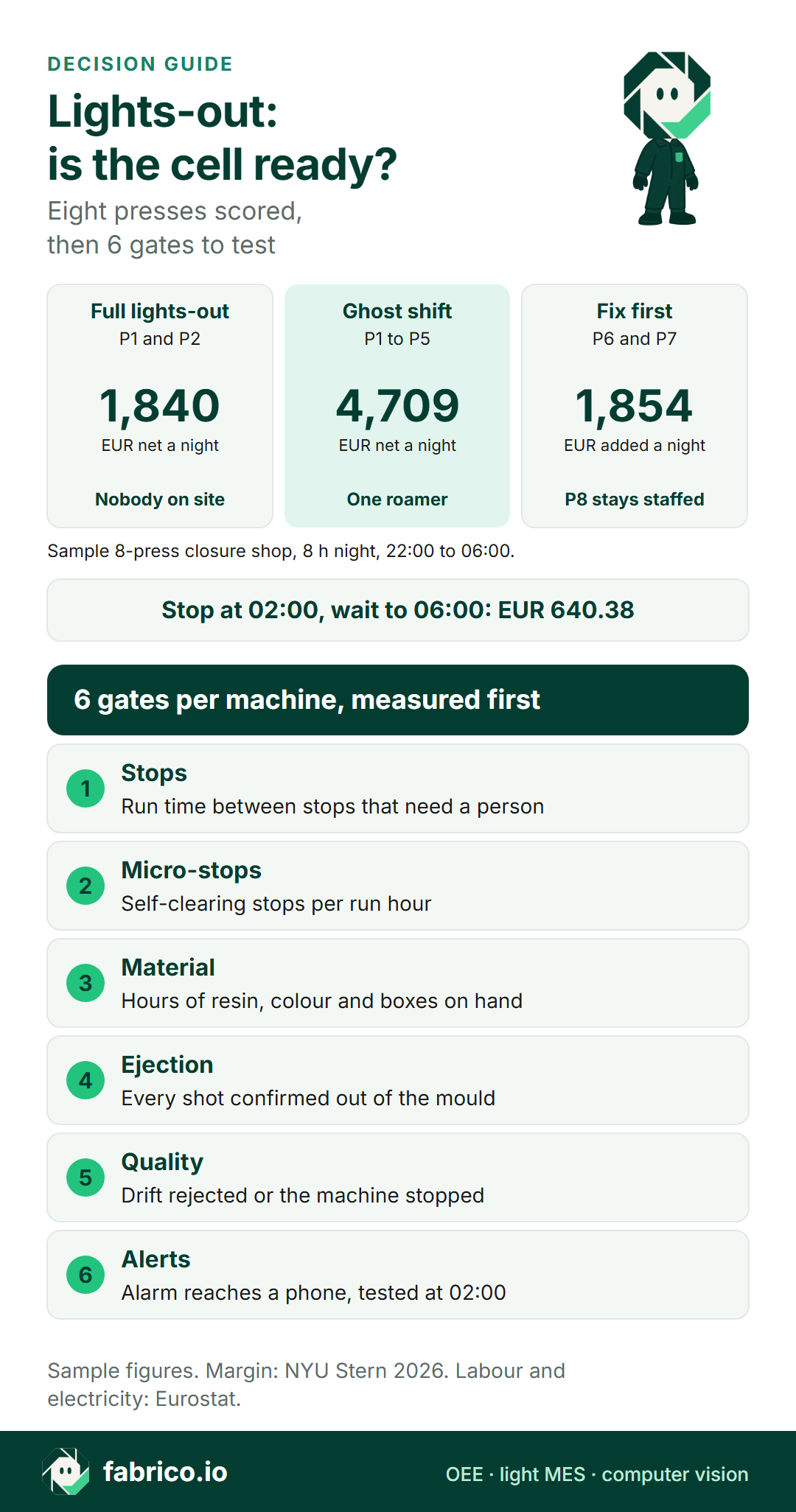
Text version of this infographic
- Full lights-out: P1 and P2, EUR 1,840 net a night.
- Ghost shift: P1 to P5, EUR 4,709 net a night.
- Fix first or stay attended: P6, P7, P8.
- A stop at 02:00 that waits until 06:00: EUR 640.38.
- Gate 1, Stops: Run time between stops that need a person.
- Gate 2, Micro-stops: Self-clearing stops per run hour.
- Gate 3, Material: Hours of resin, colour and boxes on hand.
- Gate 4, Ejection: Every shot confirmed out of the mould.
- Gate 5, Quality: Drift rejected or the machine stopped.
- Gate 6, Alerts: Alarm reaches a phone, tested at 02:00.
- Sample figures. Margin: NYU Stern, January 2026. Labour: Eurostat 2025. Electricity: Eurostat 2026.
Lights-out manufacturing: questions before the first night
What is lights-out manufacturing?
Lights-out manufacturing means machines keep producing with nobody on the shop floor, usually through a night or a weekend. Partial lights-out means some cells run alone between staffed shifts, or one roaming technician answers alarms for several machines.
What is the difference between lights-out machining and a ghost shift?
Lights-out machining means CNC machines running with nobody in the building. A ghost shift keeps one or two people on site who do not tend machines but answer alarms, top up material and check parts. A ghost shift is a sensible first step, because it tests the forecast with someone on hand.
How do I know a machine is ready to run unattended?
Measure it on attended shifts first. Count the run hours between stops that needed a person, the micro-stops per hour and the hours of material on hand, and confirm that part ejection is checked, quality drift is caught and alarms reach a phone. A machine that runs at least three times the unattended window between stops that need a person runs about 72% of nights without one.
What does it cost when a machine stops at night with nobody there?
The margin it would have made until someone arrives, plus the energy its heaters use while it stands. In the sample closure press on this page that is EUR 155.41 of margin an hour, so a stop at 02:00 that waits until 06:00 costs EUR 640.38 including energy.
Is lights-out cheaper than a staffed night shift?
Not always. In the worked example a staffed night on all eight presses makes more margin than a ghost shift on five of them. Lights-out wins where a night crew cannot be hired, or after the machines that fail the test are fixed and added to the ghost shift.
Can alerts restart a machine remotely?
An alert tells a person; the restart happens at the machine. The EUROMAP 77 interface for injection moulding machines, for example, monitors status and process data and provides no direct control functions or functions needed for safe operation.
Want to see stops, micro-stops and alerts on a live line screen? Book a demo.
Related articles














Real Fabrico tiles, sample data.