


 Login
 Blog

Capturing the "Invisible" 15%: Why Your PLC Data Isn't Giving You the Full OEE Truth

Most high-speed manufacturers believe that connecting their PLCs to a dashboard provides a complete picture of their factory’s health.
In reality, machine signals only capture the "When" of a stop, leaving the "Why" buried in the Hidden Factory where it continues to drain your profitability.
Key Takeaways
-
Machine signals are only 1/3 of the truth. 100% visibility requires a combination of PLC data, operator context, and Computer Vision.
-
Micro-stops are the silent profit killers. Traditional sensors often miss the high-frequency, short-duration stops that represent up to 15% of lost capacity.
-
Integrated Action is the ROI multiplier. Data is only valuable if it natively triggers a maintenance response in a Field-Ready CMMS.
The Sensor Fallacy: What Your PLCs Are Hiding
Why is machine data not enough for OEE?
Machine data provides accurate timestamps for downtime, but it lacks the contextual intelligencе such as material quality, operator waiting time, or specific mechanical frictionrequired to perform effective Root Cause Analysis (RCA) and eliminate recurring losses.
For Mike, the maintenance manager, PLC data is often frustratingly vague.
A "Motor Fault" signal might be the result of a mechanical jam, a power surge, or an operator error, but the sensor cannot differentiate between them.
This leads to "Investigation Waste," where your team spends more time arguing about what happened than fixing the underlying cause.
The Visibility Trifecta: Fabrico’s Framework for Machine, Operator and Camera Data
To reclaim the Hidden Factory, you must move beyond sensors and implement what we call the Visibility Trifecta.
-
Direct PLC/IoT Connectivity: This provides the millisecond-accurate baseline for Availability and Performance.
-
Operator Interface: A technician-friendly mobile app allows Tom, the technician, to add the "Human Context" that sensors cannot see.
-
Inefficiencies Zoom-In (Computer Vision): AI-powered cameras capture visual proof of the event, allowing you to see exactly why the line slowed down or stopped.
By unifying these three data streams, Fabrico ensures that plant leadership is making decisions based on absolute facts, not "Pencil Whipped" logs.
From Visual Truth to Mobile Action
The most powerful feature of one platform for data and action is the speed at which it moves from identifying a loss to documenting a permanent fix.
When the Inefficiencies Zoom-In module detects a recurring micro-stop, it doesn't just update a chart; it triggers a prioritized Work Order.
Tom receives the alert on his mobile device, along with a 10-second video clip of the failure and the relevant digital SOP.
This puts the stop, the video and the repair task in one system for the technician.
Comparison Matrix: Traditional Monitoring vs. The Fabrico platform
| Feature | Standard PLC Dashboards | Manual Operator Logs | Fabrico (OEE + CV + CMMS) |
| Data Integrity | High (Timing Only) | Low (Subjective) | Machine signal + camera record |
| Micro-stop RCA | Data-Only / Guesswork | Mostly Ignored | Video of the moment the line stopped |
| Maintenance Link | None / Siloed | Manual Request | Native (Integrated CMMS) |
| Mobile UX | N/A | Paper / Desktop | Field-Ready Native App |
| Decision Latency | High (Hours/Days) | Very High | A stop can open a maintenance task |
| Primary Goal | Reporting | Compliance | Every loss shown in money |
The Strategic ROI: Engineering a Predictable Bottom Line
For plant leadership, the "Visibility Trifecta" is the foundation for a more profitable cost-per-unit.
By identifying "Bad Actor" assets through real-time data and visual evidence, they can move their team to Condition-Directed Tasks.
This reduces the Maintenance Cost per Unit and ensures that your capital assets reach their full residual value.
See how Fabrico unifies OEE and maintenance in one platform.
Request a demoRelated articles





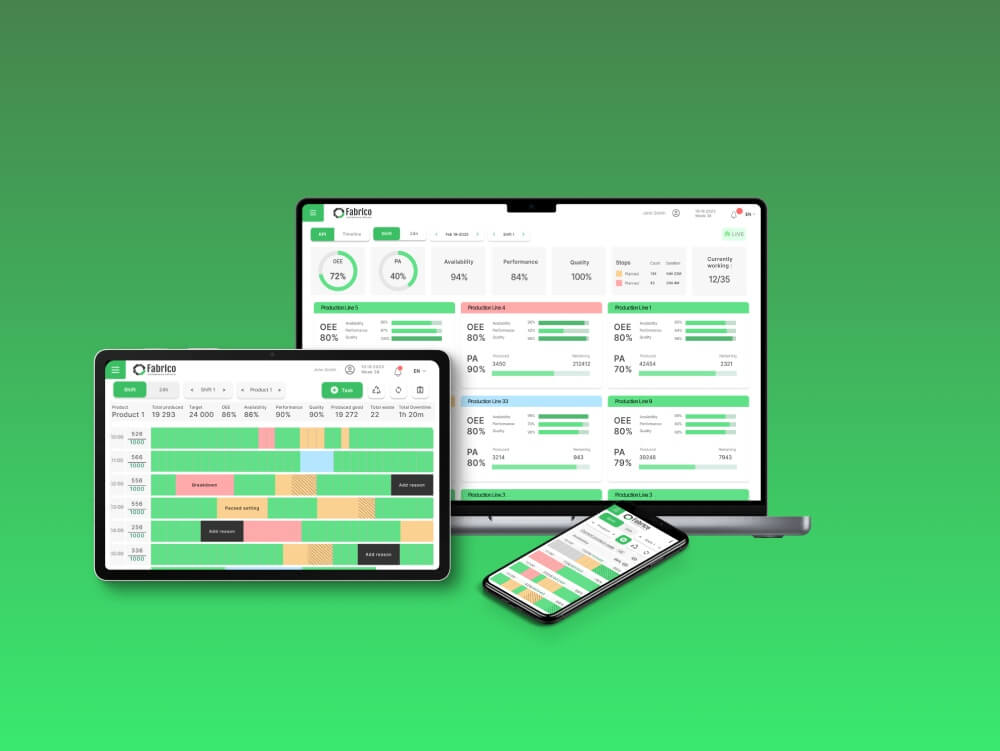


Real Fabrico tiles, sample data.