





 Login
 Blog

Production Count Reconciliation: Line Count vs ERP Booking

In short
- Count in bars, compare in pairs: convert every count to the smallest unit, then compare each count point with the next one, not the wrapper with the ERP. The gap then sits between two machines.
- Four buckets: every unit of gap is a count error, a real loss, a timing difference or unexplained. Only the last one needs a hunt.
- Two counts, two jobs: OEE uses the machine count at the constraint. The ERP books the closed, labelled case. Neither replaces the other.
- Tolerance in booking units: green up to 2 cases unexplained per shift, amber up to 6, red above 6 or the same sign three shifts running.
- The money is in the product, not the clerk: in the worked example the unexplained gap costs EUR 218.50 a shift and EUR 165,186 a year. The hour spent chasing it costs EUR 17.10.
Production count reconciliation is the daily check that the units a line made, minus every unit removed with a reason, equal the units booked in the ERP. The wrapper, checkweigher, cartoner, case packer and ERP never agree because each counts a different thing, in a different unit, at a different moment.
The fix is a count ledger: one row per count point, every count converted to the smallest unit, each point compared with the next, and every gap sorted into a bucket. Below: the ledger, one worked shift on a Polish chocolate bar line, a tolerance rule and what the gap costs.
Why every count point gives a different number
Each count point answers a different question. The flow wrapper counts machine cycles. A cycle can carry no bar, or the same bar a second time. The checkweigher counts bars it weighed. The cartoner counts boxes, the case packer counts cases and the ERP books cases against a material number, at a time someone chooses.
So the raw gap between first and last count is never one problem. It is four kinds of difference added together:
- Count errors: the counter is wrong and no product moved. Empty cycles, double triggers, re-fed units counted twice, a wrong unit conversion.
- Real losses: product left the line with a reason. Start-up scrap, checkweigher rejects, QA samples, damaged cartons.
- Timing: the product exists but is booked later. Holds, a partial case at changeover, loose units in a hopper, a booking cut-off.
- Unexplained: what is left once the first three are counted. This is the only bucket that needs a search.
Why shop floor data and the ERP disagree in general, by timing and level of detail, is covered in why shop floor data conflicts with ERP. This page follows one line's counts, point by point, down to the booked case.
The line count is also the first entry in a stock record, and stock records drift. In a study of nearly 370,000 inventory records in 37 stores of one retailer, DeHoratius and Raman found 65% to be inaccurate.
A 2004 MIT doctoral thesis on inventory inaccuracy finds inventory performance highly sensitive to stock loss "not detected by the information system". On a packing line, every bar pulled off a conveyor without a log entry is exactly that.
The count ledger: one row per count point
The ledger is a single table the plant fills in once and reviews whenever a pack format or machine changes. For each count point it states what is counted, the unit, the error to watch, who owns the number and which decision uses it.
| Count point | Counts (unit) | Error to watch | Owner | Used for |
|---|---|---|---|---|
| Flow wrapper | Cycles (bars) | Empty cycles, re-wrapped bars counted twice | Line lead | OEE at the constraint |
| Checkweigher | Bars weighed: pass, reject | Touching bars read as one, reject bin never counted | Quality | Quality rate, rejects |
| QA log | Bars sampled, cases held | Samples not written down, hold released off the books | Quality | Release, recall scope |
| Cartoner | Boxes of 24 bars | Loose bars at changeover, rejected cartons, boxes filled by hand | Line lead | Box count, carton use |
| Case packer | Cases of 12 boxes | Double trigger at a backed-up outfeed, partial case | Line lead | Pallet build |
| Palletiser and label | Pallets, cases per pallet | Partial pallet booked as full, reprinted label | Warehouse | Goods receipt |
| ERP booking | Cases per material | Old pack data, late booking, hold stock | Planner, finance | Stock, cost, invoices |
"Owner" means the person who can explain the number, not the person who types it. When a gap lands between two points, the two owners meet, and nobody else needs to.
"Used for" ends the argument. OEE never takes its count from the ERP column. Finance never takes stock from the wrapper column. Each count is right for its own decision and wrong for the others.
The ledger works the way a KPI standard does. ISO 22400-2, as listed by BSI, describes each manufacturing KPI by its formula and corresponding elements, its unit and its user group. A count with no stated unit and no owner is not ready to feed a KPI.
Pack levels need their own identity
GS1 defines trade items as products "priced, ordered or invoiced at any point in the supply chain", and the GTIN identifies each of them. The bar, the box and the case are separate trade items when each is sold or ordered on its own.
The pallet is a logistic unit. GS1 describes the SSCC as the code for any combination of trade items packed together for storage or transport, such as a case or pallet. A booking made by scanning the SSCC ties one ERP line to one physical pallet. A booking typed by hand does not.
Where units get lost or double-counted
Eight sources to check first. The direction matters: some make the line count too high, some move the ERP count between days.
| Source | Effect on the gap | How to spot it | Fix |
|---|---|---|---|
| Start-up scrap | Line count high | Gap grows after start-up and film splices | Log scrap by reason at the wrapper |
| Checkweigher rejects | Line count high | Reject counter vs reject bin weight | Count rejects from the machine, weigh the bin daily |
| QA samples | Line count high | Lab log vs the sample plan | Plan samples in bars per hour, log at the pull |
| Rework re-fed | Counted twice | Wrapper count rises, cases do not | Log re-fed units or give rework its own infeed count |
| Unit conversion | Either way | ERP bars per case differs from the pack spec | Check pack data at every format change |
| Partial case at changeover | ERP low today, high tomorrow | Partial case tags in the hold area | Count partials as timing, with a tag |
| Holds | ERP low until release | Hold log vs released cases | Hold log with case count and batch |
| Sensor double counts | Line count high | Count jumps during jams and back-ups | Move or tune the sensor, check against a hand count |
Rework is the quiet double count
A bar with a bad seal is pulled at the wrapper outfeed, unwrapped and fed back to the infeed. The wrapper counts it twice. Nothing is lost, yet the wrapper now shows more bars than will ever reach a case.
Log every re-fed unit, or count rework at its own infeed. Otherwise the line looks faster than it is and the gap looks bigger than it is.
Unit conversion breaks at format changes
The ERP converts cases to bars with the pack data in the material master: 24 bars per box, 12 boxes per case. A promotion pack with 20 bars per box, run under the old master data, books 48 phantom bars on every case.
The same trap sits at pallet level. If the ERP books pallets at a standard 60 cases and the last pallet of an order holds 50, every hand-keyed "full pallet" adds 10 cases that do not exist.
Rejects and samples are also legal counts
Under Council Directive 76/211/EEC on prepackages, the actual contents "shall not be less, on average, than the nominal quantity". The checkweigher reject count is part of showing that, so the reject bin belongs in the ledger, not in a corner.
Holds matter for food safety records too. Article 18 of Regulation (EC) No 178/2002 requires food business operators to have systems and procedures to identify the businesses their products were supplied to. A held case that is released off the books makes that answer slower in a recall.
Sensor double counts follow the jams
A photo-eye at a backed-up conveyor sees a case stop, rock and pass again. Two counts, one case. The tell is a counter that jumps during jams. How the sensor works, and how to place it, is covered in photo-eye output counting.
Worked example: one shift on a chocolate bar line in Poland
The numbers below are an example, not a customer's. They are built so every line can be redone with a calculator.
- Line: flow wrapper, checkweigher, cartoner (24 bars per box), case packer (12 boxes per case, so 288 bars per case), palletiser. The ERP books cases.
- Product: a 45 g plain chocolate bar.
- Pattern: 8-hour shifts, 3 a day, 21 days a month. That is 63 shifts a month and 756 a year.
The counters at shift end
| Count point | Raw count | In bars |
|---|---|---|
| Flow wrapper | 179,202 cycles | 179,202 |
| Checkweigher | 174,252 weighed, 2,300 rejected | 171,952 passed |
| Cartoner | 7,153 boxes, 18 rejected | 171,672 boxed |
| Case packer counter | 596 cases | 171,648 |
| ERP booking | 590 cases | 169,920 |
First count against last, the gap is 179,202 minus 169,920: 9,282 bars, or 5.18% of the wrapper count. Nobody can act on "5.18% somewhere". So the ledger compares pairs.
Pair by pair
- Wrapper to checkweigher: 179,202 minus 174,252 leaves 4,950 bars. The log explains 600 empty cycles at start-up and splices, 1,400 re-wrapped bars counted twice and 1,800 bars of start-up scrap. That is 3,800. 1,150 bars are unexplained.
- Checkweigher to cartoner: 171,952 passed, minus 240 QA samples, minus 40 loose bars left in the hopper at changeover, leaves 171,672 bars. The cartoner shows 7,153 boxes of 24: also 171,672. Gap: zero.
- Cartoner to case packer: 7,153 boxes, minus 18 rejected cartons (432 bars), minus 7 boxes in a partial case, leaves 7,128 boxes: 594 cases. The counter says 596. The hand count and the pallet labels say 594: two double triggers. Gap in bars: zero, but one counter to fix.
- Case packer to ERP: 594 closed cases, minus 4 cases on QA hold, gives 590 booked. Gap: zero.
All 1,150 unexplained bars sit between the wrapper and the checkweigher. The search is now one conveyor and two owners, not a whole line. Likely causes in that stretch: bars pulled at a jam and not logged, floor drops, or two touching bars weighed as one.
The four buckets for this shift
| Bucket | Lines | Bars | Share of wrapper count |
|---|---|---|---|
| Count errors | Empty cycles 600, re-wraps 1,400 | 2,000 | 1.12% |
| Real losses | Start-up 1,800, rejects 2,300, samples 240, cartons 432 | 4,772 | 2.66% |
| Timing | Hold 1,152, partial case 168, loose bars 40 | 1,360 | 0.76% |
| Unexplained | Between wrapper and checkweigher | 1,150 | 0.64% |
| Total | Wrapper minus booked | 9,282 | 5.18% |
Check the sum: 2,000 plus 4,772 plus 1,360 plus 1,150 is 9,282. The hold is 4 cases of 288 bars, the partial case is 7 boxes of 24 bars, and the rejected cartons are 18 boxes of 24 bars.
What the gap costs
The bar value comes from official statistics, not a guess. Statistics Poland (GUS) reports that Polish producers sold 53,457 tonnes of plain chocolate blocks, slabs and bars in 2024 (PRODCOM 10.82.22.39), worth PLN 983,992 thousand.
- PLN 983,992,000 / 53,457,000 kg = PLN 18.41 per kg.
- A 45 g bar: 18.41 x 0.045 = PLN 0.83.
- At the Eurostat 2024 average rate of PLN 4.3058 per euro: EUR 0.19 per bar.
That is an average ex-works sold value, not a margin. For labour, Eurostat labour cost levels (lc_lci_lev) put Polish manufacturing at EUR 17.10 per hour in 2025.
| Cost line | Per shift | Per month (63) | Per year (756) |
|---|---|---|---|
| Unexplained: 1,150 bars x EUR 0.19 | EUR 218.50 | EUR 13,765.50 | EUR 165,186 |
| Known losses: 4,772 bars x EUR 0.19 | EUR 906.68 | EUR 57,120.84 | EUR 685,450.08 |
| Chasing the gap without a ledger: 1 hour x EUR 17.10 | EUR 17.10 | EUR 1,077.30 | EUR 12,927.60 |
Known losses are valued before any rework recovery: rejected chocolate can be melted back. They already have owners and reasons, so they are a scrap-reduction topic, not a reconciliation topic.
The labour is not the cost. In this example the unexplained bars cost almost 13 times the hour spent chasing them (218.50 / 17.10 = 12.8). Cutting the hour saves little. Finding the bars saves a lot.
The unexplained bars are either product that left without a record or a booking that is wrong. Either way, finance writes the difference off at the next stock count, months after anyone could still find it.
If the line brings the unexplained gap down to the green ceiling of 2 cases (576 bars), 574 fewer bars a shift go unexplained. In this example that is EUR 109.06 a shift, EUR 6,870.78 a month and EUR 82,449.36 a year, if the gain holds.
Count errors cost no product but distort reports. The 2,000 extra cycles put the wrapper count 1.13% above the 177,202 distinct bars it wrapped. Timing costs nothing if the hold is released and booked next shift, and the full value if it is forgotten.
The pallet trap from earlier, in money: 10 cases booked that do not exist are 2,880 bars, EUR 547.20 of stock on paper only.
Which count to trust for OEE and which for booking
Use the machine count at the constraint for OEE, and the closed, labelled case for booking. Here the wrapper is the constraint. The definitions behind good and total count are in good count vs total count. This section only shows what the choice does to one shift.
| Quality rate built from | Good / total | Result |
|---|---|---|
| Booked bars / raw wrapper cycles | 169,920 / 179,202 | 94.82% |
| Checkweigher passes / raw wrapper cycles | 171,952 / 179,202 | 95.95% |
| First-pass good / cycles with product | 170,552 / 178,602 | 95.49% |
Same shift, three quality rates, 1.13 points apart. Only the last one is right for OEE:
- Cycles with product: 179,202 minus 600 empty cycles is 178,602. The re-wraps stay in, because the machine did that work.
- First-pass good: 171,952 passes minus the 1,400 re-wrapped bars is 170,552. A bar that needed a second wrap was not good the first time.
- Booked bars: they move with holds and booking times. Today's 4 held cases may be booked tomorrow and lift tomorrow's "quality".
The reverse also holds. The wrapper cannot book stock: it knows nothing about holds, rejected cartons or the partial case. The ERP books what can be shipped.
Some stations have no usable counter signal: a hand pack-off, an old case packer. There a camera can count output. How that works is in AI visual counting in manufacturing, and whether a counter alone is enough is in production counter vs OEE software.
A daily tolerance rule in booking units
The ERP sees whole cases. A tolerance tighter than one case cannot be checked at booking, so the rule is set in cases. This is a starting rule for the example line, not an industry standard. Tune it on the plant's own data.
- Green: unexplained up to 2 cases (576 bars, 0.33% of the 177,202 bars wrapped). Log it, no action.
- Amber: over 2 and up to 6 cases (1,728 bars, 0.98%). The owners of the segment find it before the next booking.
- Red: over 6 cases, or the same sign three shifts running. Stop booking adjustments, hand count the hold area and the last pallet, check the counters and the pack data.
The example shift: 1,150 bars is 3.99 cases. Amber. The wrapper and checkweigher owners find it today.
The sign test
Counting noise goes both ways and averages out over a week. A gap that keeps the same sign is systematic: a sensor, wrong pack data or a habit, such as pulls that never get logged.
Three shifts with a positive unexplained gap of any size is a stronger signal than one big shift. Treat it as red even when each shift is green.
Tune it after 20 shifts
Look at the unexplained column after 20 shifts. If green is missed on most shifts, one count point is wrong. Fix that point before widening the band. A wider band only hides the error.
Freeze every counter at the same minute, at shift end, and book at that minute. Each minute between the counter read and the booking moves product into the timing bucket.
How to run the reconciliation in 15 minutes a shift
With the ledger in place, the hour in the cost table drops to about 15 minutes.
The routine fits on one sheet: one column per count point, one row per bucket, one signature per segment owner. A line that does it every shift stops arguing about numbers at the morning meeting and starts working on the one segment that is amber.
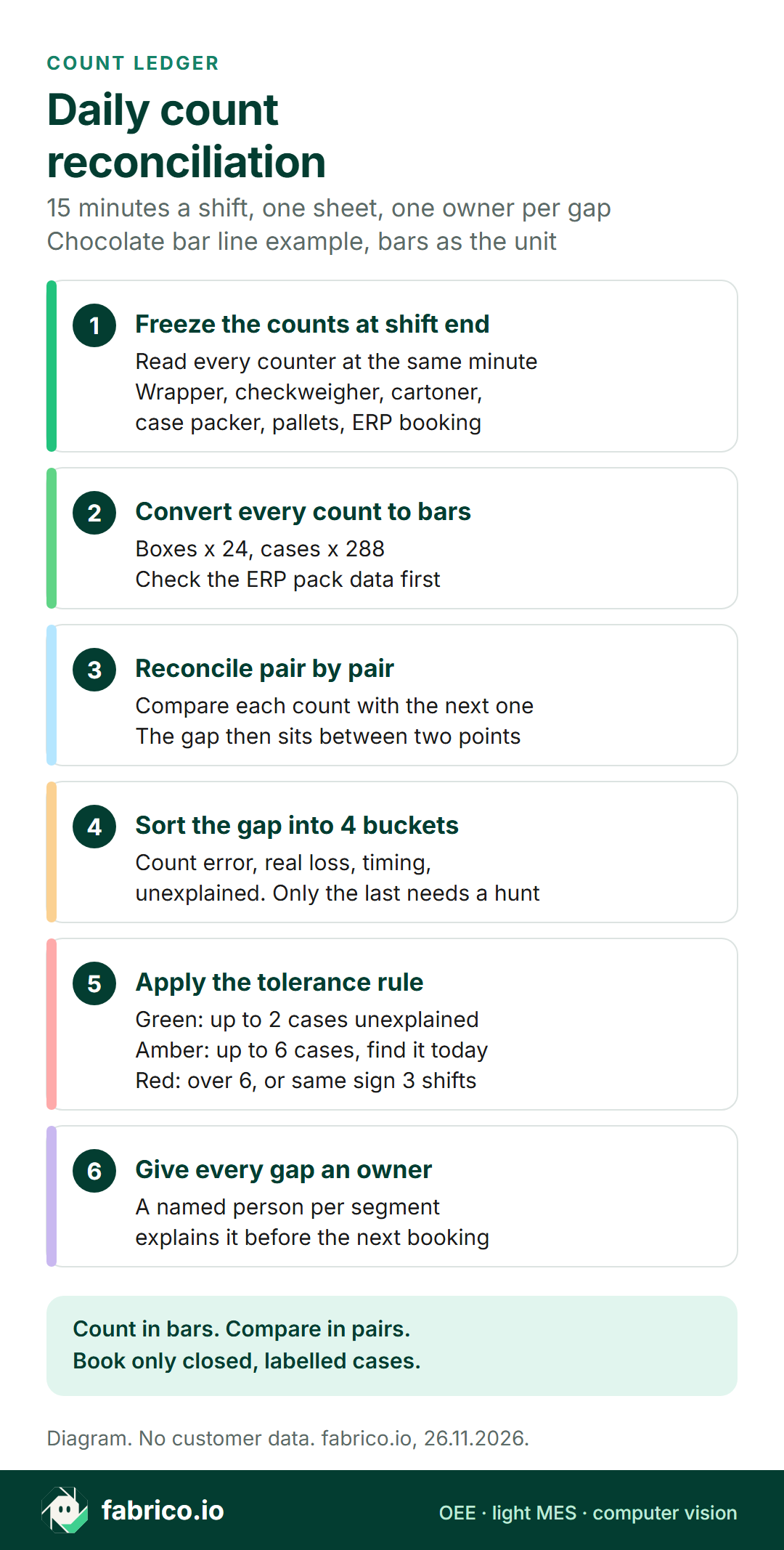
Text version of the diagram
- Freeze the counts at shift end: read every counter at the same minute, wrapper, checkweigher, cartoner, case packer, pallets and ERP.
- Convert every count to bars: boxes x 24, cases x 288, after checking the ERP pack data.
- Reconcile pair by pair: compare each count with the next one, so the gap sits between two points.
- Sort the gap into four buckets: count error, real loss, timing, unexplained.
- Apply the tolerance rule: green up to 2 cases, amber up to 6, red above 6 or the same sign three shifts running.
- Give every gap an owner: a named person who explains it before the next booking.
Three habits keep it to 15 minutes:
- Samples and holds are logged at the pull, in bars and cases, never estimated at shift end.
- Every re-fed unit is logged or counted at a separate infeed.
- Pack data is checked at every format change, before the first case is booked.
At month end, the shift sheets add up to a month ledger. Finance then sees a stock difference already split into losses, timing and unexplained, instead of one write-off line.
Decision: how to capture the counts
The ledger is the method. The open question is how the counts reach it. Four options, from lightest to heaviest:
| Option | Covers | Cost basis | Fits |
|---|---|---|---|
| Tally sheet and spreadsheet ledger | All points, by hand | Staff time: 1 hour a shift is EUR 12,928 a year at Polish 2025 labour cost | One line, a 4-week baseline |
| Machine counters into line software | Wrapper, rejects, cartoner, case packer from signals; samples and holds entered | Ask the vendor for a price per line per month | 2+ lines, or amber and red most weeks |
| Camera counting where there is no signal | Hand pack-off, old case packers | Ask the vendor for a price per line per month | Single stations with no usable counter |
| Full MES with booking from the line | Orders, materials, goods receipt | Ask the vendor; priced as a project | Many sites, many SKUs, strict release rules |
Line software that reads machine signals, such as OEE software or a light MES, stores each counter per shift, so the counter columns of the ledger start filled in and only samples, holds and re-feeds are typed.
The OEE screens your counts feed, in Fabrico. The video shows the software, not the camera. Book a demo.
Plays from YouTube. Google may set cookies when you press play. Privacy policy.
For a plant that mainly needs per-shift counts by line and product, production tracking software covers the ledger columns without the weight of a full MES.
Where stations have no counter, OEE with camera counting fills the gap at that point. For a wider comparison of vision-based options, see computer vision OEE software.
Who should pick which
- One line, counts unknown: start with the tally sheet for 4 weeks. It shows which count point is wrong before any money is spent.
- Several lines, signals at most machines: machine counters into line software. The counter columns arrive filled in, so the shift hour goes on finding the gap, not on copying numbers.
- One blind station: camera counting at that point only.
- Booking straight from the line across sites: a full MES project, with the ERP team in the room from day one.
Questions to ask a vendor
- Which counter is read at each machine, and are empty cycles kept apart from cycles with product?
- Can QA samples, holds and re-fed units be entered at the line with a reason, in the same shift record?
- Where is the bars-per-box and boxes-per-case data kept, and who changes it at a format change?
- What happens to counts when the network drops for an hour, or a day?
- How does count data leave the system, and who stays responsible for the ERP booking?
- Where a station has no signal, how is output counted, and how is that checked against a hand count?
- What is the price per line per month, and what is included at that price?
Where Fabrico fits
Fabrico is made by the publisher of this article. It measures the line side of the counts; the booking stays in the ERP.
- Output is counted from the line PLC or a Fabrico IoT device. Where a station has no usable signal, the camera add-on counts output.
- Good and total count, with scrap recorded by product and reason. A reject signal from the line PLC can be counted like any machine signal, or the reject count can be entered.
- OEE by line and shift, read at the core machine, and a line screen with actual against target hour by hour.
- With the selling price and margin of each product entered, losses are priced in money.
- The gateway buffers machine data up to 30 days if the network drops.
- Fabrico has a REST API, webhooks and Excel export. Integrations exist for SAP, Microsoft Dynamics and Oracle.
Plant pricing is one quote by machines and modules: see pricing.
Sources, accessed 26.11.2026: Eurostat, Labour cost levels by NACE Rev. 2 activity (lc_lci_lev); Eurostat, Euro exchange rates, annual data (ert_bil_eur_a); Statistics Poland (GUS), Production of industrial products in 2024; GS1, Serial Shipping Container Code (SSCC); GS1, Global Trade Item Number (GTIN); BSI, BS ISO 22400-2 KPIs for manufacturing operations management; EUR-Lex, Regulation (EC) No 178/2002, Article 18; EUR-Lex, Council Directive 76/211/EEC on prepackages; DeHoratius and Raman, Inventory Record Inaccuracy: An Empirical Analysis, Management Science 54(4), 2008; Kang, Information inaccuracy in inventory systems, MIT PhD thesis, 2004.
Frequently asked questions
What is production count reconciliation?
It is the check that units made, minus units removed with a reason, equal units booked in the ERP. Done well, it compares each count point with the next and sorts every difference into count error, real loss, timing or unexplained.
Why do line and ERP counts differ by bucket?
The line counts machine cycles in single units; the ERP books closed cases at a chosen time. Empty cycles, rework counted twice, scrap, samples, holds, partial cases and unit conversion errors all sit between the two.
Which count should OEE use?
The machine count at the constraint, with empty cycles removed, and first-pass good from the first quality check. Never the ERP booking: it moves with holds and booking times.
What is an acceptable count variance per shift?
Set it in booking units, since the ERP cannot see less than one case. A practical start is up to 2 cases unexplained as green and up to 6 as amber, then tuning on 20 shifts of the plant's own data.
How do I stop rework being counted twice?
Log every re-fed unit at the moment it goes back into the infeed, or give rework its own infeed counter. Then remove it from total count before comparing with the next count point.
Should QA samples count as scrap?
Record them as their own reason, not as scrap, so the reject rate stays true. They still leave the booking count, so they belong in the real losses bucket of the ledger.
How often should counts be reconciled?
Every shift, at the same minute the counters are read and the booking is made. The month-end stock count then confirms a ledger that is already split by bucket.
See every count point of one line in one shift record. A demo shows output counted from the machine signal, scrap by product and reason, and OEE by line and shift from the core machine.
Latest from our blog






Real Fabrico tiles, sample data.