


 Login
 Blog
Equipment Downtime Tracking Software: The Buyer's Guide for 2026

Key Takeaways
-
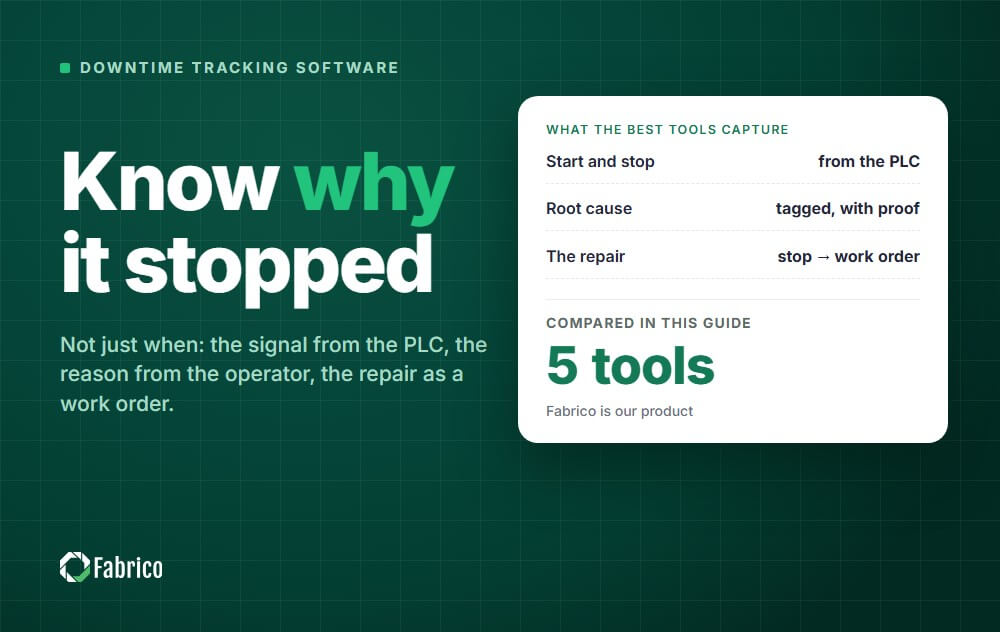
Effective downtime tracking is not just about logging stop times. It's about having a real-time, automated system to diagnose all production losses, including "hidden" losses from slow cycles and micro-stops. If you are comparing tools, our 5-tool downtime tracking software comparison is the place to start.
-
A simple "downtime tracker" is a dead end. It's a diagnosis with no cure, leaving you in a manual scramble to respond to problems. For what camera-based detection adds on top of sensors, see computer vision for OEE.
-
The answer is an MES and OEE platform with maintenance (CMMS) built in. It combines the automated, real-time diagnosis of downtime with the powerful, integrated cure of a modern maintenance management system.
The Problem with a Simple "Downtime Tracker"
Mike, a Plant Manager, invested in a simple downtime tracking tool. He now has a more accurate log of his major stops, but he's more frustrated than ever.
The data is always a day late, telling him about problems he can no longer fix. He's completely blind to the "hidden factory" of slow cycles and micro-stops that are killing his efficiency.
And worst of all, when a machine does go down, the alert is a dead end. His team is still stuck in a chaotic scramble of phone calls and radios to get the right technician to the right machine.
He's tracking the problem better, but he's not solving it any faster.
Solving it faster starts with better data. Fabrico's downtime tracking software logs stops straight from connected machines, short stops included, and operators tag the cause on a tablet or phone, so the reason does not arrive a day late.
The 3 Pillars of a True Downtime Solution
A complete solution doesn't just track downtime; it gives you the tools to eliminate it. It must be built on three integrated pillars.
Pillar 1: An Automated OEE Diagnosis (To Find Every Lost Minute)
World-class downtime tracking is not just about logging major stops; it's about finding every second of lost production. A true solution must start with a powerful OEE (Overall Equipment Effectiveness) module.
This allows you to automatically track:
-
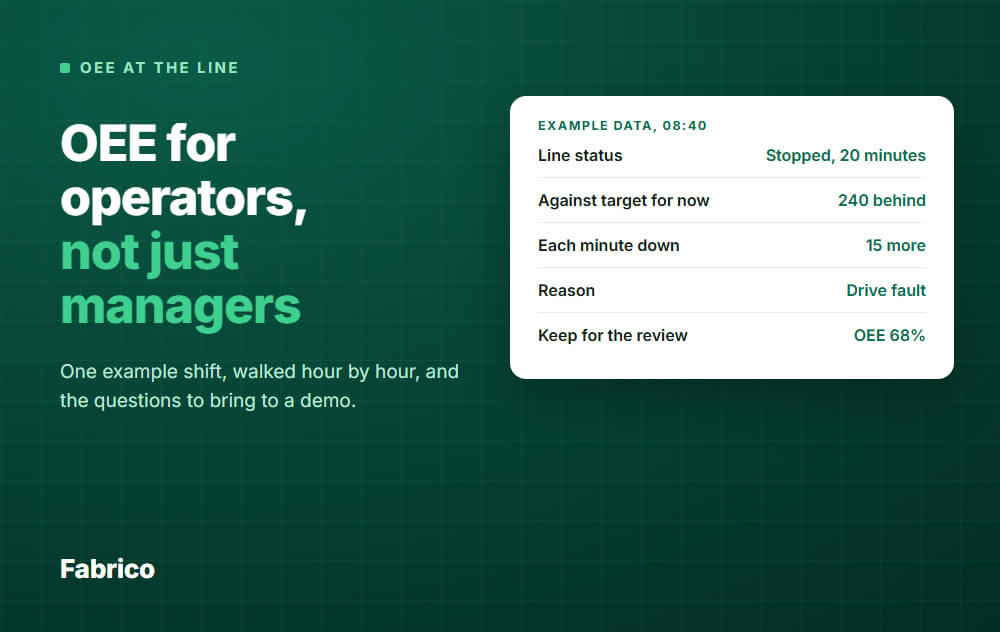
Real-Time Downtime: Instantly see when a machine stops, with live alerts that are accurate to the second.
-
Performance Loss: Uncover the "hidden factory" of lost capacity from slow cycles and thousands of unlogged micro-stops.
-
Root Cause Logging: Use simple, operator-friendly tablets to categorize every downtime event with a single tap, providing clean, consistent data for analysis.
Pillar 2: An Integrated CMMS Cure (To Slash Your Response Time)
This is the game-changing component that separates a simple "tracker" from a true "solution." A diagnosis is useless without a cure.
A complete solution must have an integrated CMMS (Computerized Maintenance Management System) to turn the diagnosis into action.
This is the Fabrico workflow. A real-time OEE alert shows an unplanned stop (the diagnosis). A stop reason can be configured to open a maintenance task automatically; people can also create tasks by hand (the cure).
Alerts reach the right technician by stop reason, with the details of the job.
Pillar 3: A Data-Driven Improvement Engine (To Prevent Future Downtime)
The ultimate goal is not just to fix downtime faster, but to prevent it from happening in the first place.
A true solution uses the rich historical data from both your OEE diagnostics and your CMMS responses to provide a powerful improvement engine. This allows you to:
-
Instantly Analyze Your "Bad Actors": Use powerful Pareto analysis to see your top 5 worst-performing assets and most common failure modes.
-
Build a Data-Driven PM Program: Use this failure data to optimize your preventive maintenance schedule, fixing problems before they ever stop your line.
-
Prove Your ROI: Track crucial "Response KPIs" like Mean Time to Repair (MTTR) and Mean Time Between Failures (MTBF) to prove the financial impact of your efforts to leadership.
A Quick Comparison: Tracker vs. Integrated Solution
The difference is not just in features; it's a completely different philosophy.
| Feature | Simple Downtime Tracker | Integrated Platform (Fabrico) |
| Data Source: | Manual Entry / Simple Sensors | Automated OEE (Availability, Performance, Quality) |
| "Hidden" Losses: | Blind to them | Fully Visible |
| Response Workflow: | Manual (Phone Calls, Radios) | Automated (Instant CMMS Work Order) |
| Improvement Engine: | None | Data-Driven PMs & Reliability Analytics |
| Primary Goal: | Log stop times. | Eliminate all sources of production loss. |
How to Measure Equipment Downtime: The Metrics That Matter
You cannot reduce machine downtime you do not measure. Before choosing equipment downtime tracking software, know the numbers it should calculate for you, because these are what turn a raw log of stops into a plan for eliminating them.
Downtime rate and availability. Availability is the share of planned production time a machine actually runs; the downtime rate is its mirror image, the percentage of that time lost to stops. Availability is one of the three factors in an OEE score, so tracking it is the entry point to measuring machine downtime honestly.
Mean time between failures (MTBF). MTBF is the average running time between one breakdown and the next. A rising MTBF means your assets are getting more reliable; a falling one is an early warning that a machine is drifting toward a bigger failure.
Mean time to repair (MTTR). MTTR is the average time to get a stopped machine running again, from the moment it goes down to the moment it is back in production. It measures how fast your response is, which is exactly what an integrated work-order workflow is built to shorten.
Cost of downtime. Every minute of unplanned machine downtime has a price: lost output, idle labor, scrapped work in progress, and sometimes missed shipments. Multiplying downtime minutes by a per-minute cost turns an operational problem into a financial case leadership can act on.
Downtime by cause (Pareto). The most useful downtime report is not the total; it is the ranked list of causes. A Pareto view of your worst assets and most frequent failure modes shows where a small number of fixes will recover the most lost time. See what to test in real-time downtime Pareto software.
Frequently Asked Questions (FAQ)
How does the software connect to our machines?
A modern, flexible platform uses a hybrid approach. It can connect directly to the PLCs of your newer machines while using non-intrusive technologies like Computer Vision to automatically track the status of your older, legacy equipment.
What if we already have a standalone CMMS?
While some point-to-point integrations are possible, they are often brittle, limited, and expensive to maintain. A native, all-in-one platform ensures a seamless, unbreakable connection between your diagnosis and your cure, with no extra integration project required.
How long does it take to get started?
Start with a pilot on one critical bottleneck machine. Installing and connecting the devices on your machines takes about one month, and the full rollout is complete in 3 to 4 months.
Stop Just Tracking Downtime. Start Eliminating It.
Don't settle for a tool that only gives you a better view of your problems.
Invest in a true, integrated solution that connects your real-time diagnosis to an instant, systematic cure, and gives you the data you need to prevent problems from ever happening again.
Ready to see what a complete downtime solution looks like in action?
Frequently Asked Questions
What is equipment downtime?
Equipment downtime is any period when a machine or line is not running when it should be. It includes both planned downtime, such as scheduled maintenance and changeovers, and unplanned downtime from breakdowns and faults. Downtime directly lowers OEE and production output.
What is the difference between planned and unplanned downtime?
Planned downtime is scheduled and expected, such as maintenance, changeovers, or breaks, so it can be managed. Unplanned downtime is unexpected, caused by breakdowns or faults, and is usually far more costly because it disrupts schedules and is harder to recover from.
How do you reduce equipment downtime?
Reduce downtime by tracking its causes to fix recurring problems, shifting to preventive and condition-based maintenance, keeping critical spare parts on hand, and improving real-time visibility into machine status. Accurate measurement comes first, since you cannot reduce downtime you do not track.
Curious what honest, real-time OEE looks like on your floor?
Request a demoRelated articles






Real Fabrico tiles, sample data.