


 Login
 Blog

OEE and ISO 22400: How the Standard Defines Manufacturing KPIs

Key takeaways
- ISO 22400 is the international standard that formally defines manufacturing operations KPIs, including OEE.
- The standard specifies exact formulas, time-state definitions, and naming so two plants can compare apples to apples.
- It defines 34 KPIs across production, quality, maintenance, and inventory. OEE is one of them.
- If your OEE platform follows ISO 22400, your numbers are auditable and benchmarkable. If it doesn't, every comparison needs a footnote.
- Most enterprise procurement teams expect ISO 22400-aligned KPI definitions in the RFP response.
Short answer: ISO 22400 is the international standard for manufacturing operations management KPIs. Part 2 (ISO 22400-2) defines 34 standardized KPIs, including OEE, with exact formulas and unambiguous time-state definitions. If your OEE software reports against ISO 22400, the numbers are auditable, comparable across sites, and accepted by enterprise procurement.
If it does not, you carry the burden of explaining why your formula is different every time someone asks. See also ISO 22400 vs ISO 9001.
What ISO 22400 is and what it covers
ISO 22400 is published by the International Organization for Standardization and titled "Automation systems and integration. Key performance indicators (KPIs) for manufacturing operations management." It has multiple parts:
- Part 1, overview, concepts, and terminology.
- Part 2, definitions and descriptions of the 34 KPIs.
- Subsequent parts cover exchange formats and supporting concepts.
The standard exists because the same KPI name ("availability," "OEE," "throughput") can mean different things at different plants. ISO 22400 forces a common vocabulary so a corporate operations team can compare lines across geographies without manually reconciling formulas.
How ISO 22400-2 defines OEE
ISO 22400-2, the part titled Definitions and descriptions, is where OEE is defined. It keeps the familiar three factors but gives them its own names and builds them from precisely defined time elements:
- Planned busy time (PBT): the planned operation time minus the planned downtime, for example planned maintenance.
- Actual production time (APT): the time a work unit is actually producing, value-adding functions only.
- Planned run time per item (PRI): the planned time to produce one unit.
- Produced quantity (PQ) and good quantity (GQ).
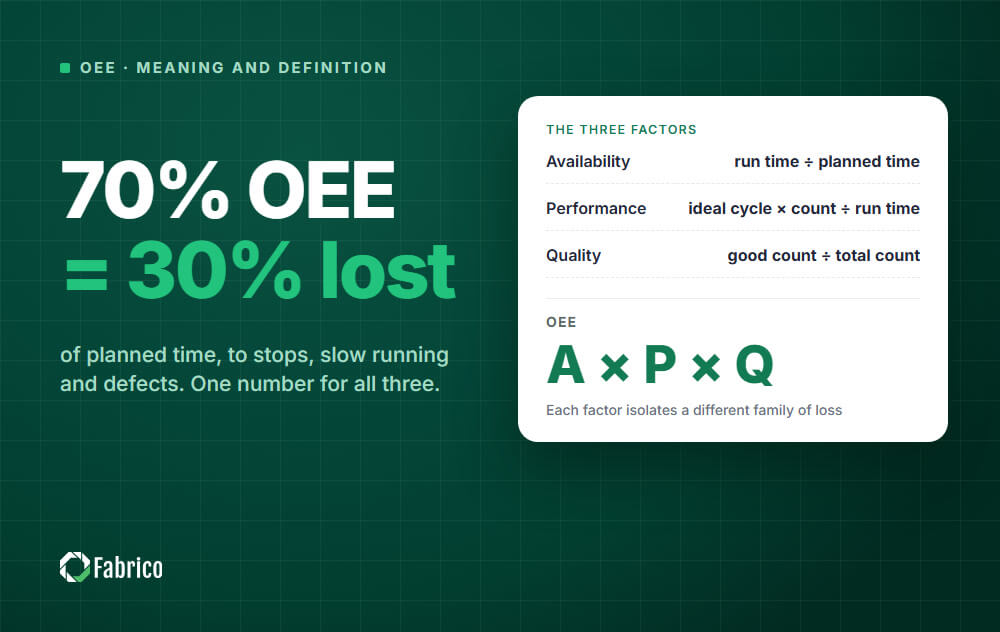
With these, ISO 22400-2 calculates the OEE index as availability × effectiveness × quality ratio:
- Availability = APT / PBT
- Effectiveness = PRI × PQ / APT, the factor most OEE guides call performance
- Quality ratio = GQ / PQ
Because every input has a precise definition, two plants applying ISO 22400-2 share one definition of what counts as production time. Annex B of the standard also gives an alternative OEE calculation based on a loss time model.
Why this matters for enterprise procurement
Enterprise buyers look for ISO 22400 alignment for three reasons: auditability, benchmarking across plants, and protection against vendor lock-in.
- Auditability. Internal audit and external compliance reviews can verify the KPI calculations against the standard.
- Benchmarking. Corporate operations teams need to rank plants. If every plant uses a different formula, the ranking is fiction.
- Vendor lock-in protection. If you ever switch OEE platforms, ISO 22400 ensures the new vendor reports the same number for the same input data.
This is why the OEE software RFP template often includes a line item asking the vendor to confirm ISO 22400 alignment.
The 34 KPIs in scope
OEE gets the attention but ISO 22400 Part 2 covers a broader set, including:
- Worker productivity, allocation ratio, throughput rate, allocation efficiency.
- Performance rate, availability, quality ratio.
- MTBF, MTTR, MTTF, maintenance success ratio.
- Scrap ratio, rework ratio, fall-off ratio.
- Inventory turns, finished-goods ratio.
Most plants do not implement all 34. A common pragmatic subset is OEE, MTBF, MTTR, throughput rate, scrap ratio, and worker productivity.
Implementing ISO 22400 in practice
Three things to check on your current setup:
- Time-state mapping. Does your OEE platform let you classify time states (planned vs unplanned, scheduled vs unscheduled) in a way that matches the standard?
- Formula transparency. Can you see the exact formula the platform uses, with documented inputs?
- Naming consistency. Are the labels in your dashboards aligned with the standard's terminology, so an auditor recognizes them?
Fabrico calculates availability, performance and quality for each line and shift, live from machine signals. In a demo, ask to see how its time states and stop reasons map to the ISO 22400-2 time elements on one of your own lines.
See how Fabrico captures this automatically, explore what OEE is or book a demo.
Related reading
Frequently asked questions
Is ISO 22400 mandatory?
No. It is a voluntary standard. But many enterprise manufacturers require alignment with it in vendor RFPs because it eliminates ambiguity in KPI definitions.
Does ISO 22400 change the OEE formula?
It does not change the Availability x Performance x Quality structure. It tightens the definitions of the inputs so every plant calculates the same way.
How does ISO 22400 relate to OEE world-class benchmarks?
The 85% world-class number predates ISO 22400. Using ISO 22400 definitions makes the benchmark meaningful because everyone agrees what the inputs are.
Is ISO 22400 the same as ISO 50001?
No. ISO 50001 is about energy management. ISO 22400 is about manufacturing operations KPIs. Different scope, both useful.
Can a small manufacturer adopt ISO 22400?
Yes. The standard is platform-agnostic. Adopting the time-state definitions and a small subset of KPIs is enough to get the benchmarking benefit.
See how Fabrico unifies OEE and maintenance in one platform.
Request a demoRelated articles






Real Fabrico tiles, sample data.