


 Login
 Blog
MES for Automotive Suppliers: Tier 2 and Tier 3 Plant Guide

Key takeaways
- A tier 2 or tier 3 automotive plant needs an MES for two audiences: the customer, who wants evidence of capacity and quality, and the plant, which needs to know why the line missed its count.
- Full MES functions in automotive supply include part traceability, SPC and control plan checks, error-proofing records, work instructions, scheduling to call-offs and line performance.
- Start with production data and line OEE at the bottleneck, measured against the cycle time you quoted.
- Know your break-even OEE: the level below which the call-off needs overtime.
- Light MES puts line OEE and downtime first; full traceability and process records belong where a part family or customer requires them.
The customer's call-off went up again on Monday. On the bracket line the weld cell is the bottleneck, and this morning it lost time to tip dressing, a fixture sensor that kept faulting and a part number change that ran long. On Friday the customer's supplier quality engineer will ask whether the line can hold the new volume, and the answer will come from a spreadsheet built that afternoon. An MES for automotive suppliers should turn that answer into a number nobody has to build by hand.
This guide covers what tier 2 and tier 3 plants need from an MES, the functions, which to start with, how to measure line OEE, light MES against a full suite, how to choose and the common mistakes.
What an automotive supplier needs from an MES
Tier 2 and tier 3 plants stamp, machine, mould, weld and assemble parts for tier 1 suppliers and carmakers. They work to customer requirements that a general manufacturer rarely sees: an IATF 16949 quality system, customer-specific requirements, control plans, PPAP at launch, and often a run-at-rate or capacity check that proves the line can make the quoted volume at the quoted cycle.
After launch the pressure moves to delivery. Call-offs arrive by EDI and change often, and customers score suppliers on delivery and quality. A late shipment that stops a customer line is serious: in the largest automotive plants, Siemens put the cost of a lost hour at 2.3 million USD in 2024.
So the MES has two jobs. Give the customer evidence: capacity, process records and, where required, traceability. And give the plant the truth about its own lines: why the bottleneck missed its count, and what that cost.

The MES functions an automotive supplier can use
ISA-95 places the MES at Level 3, between the line controls and the ERP. For a supplier its functions look like this:
| Function | What it does for a supplier | Where it usually starts |
|---|---|---|
| Production data collection | Cycles, counts and states per station | The bottleneck station, first |
| Performance analysis (OEE) | Line OEE against the quoted cycle, capacity evidence by shift | The same line, first |
| Part traceability and genealogy | Serial or lot of each part and its components | Safety-relevant parts, where the customer requires it |
| Quality and SPC | Control plan checks, measurements, reaction plans | Characteristics on the control plan |
| Error-proofing records | Proof that error-proofing devices were checked | Where the customer audits it |
| Work instructions | The right revision at each station | Launches with many variants |
| Scheduling to call-offs | Sequence by call-off and changeover cost | When call-offs change daily |
Traceability and process records are about proof. Production data and OEE are about output. A plant that is short on output gets little from proving a line that cannot hold its rate.
Where the time goes on a supplier's line
- Weld cells: tip dressing and tip changes that overrun, fixture clamp and part presence sensor faults, robot faults, wire or gas changes.
- Presses: die changes, coil changes, misfeeds, double-blank detection. See OEE for stamping press operations.
- Machining cells: tool changes, offsets after a gauge check, first-off approval after a changeover.
- Assembly stations: bowl feeder jams on nuts and clips, error-proofing faults when a component is missing, press-fit force rejects.
- End of line: leak or function test rejects and retests, gauge checks, label printing.
- Between stations: starved for components from the press shop, blocked by a full rack or a quality hold.
Part number changes are a big loss on a mixed line; code them as stops, not planned time, so overruns show. Quality losses are scrap, rework and retests; a part that passes on the second test is not first-pass good.
Start with production data and line OEE
Line OEE is measured at the bottleneck, because that station sets the line's output. Per-station data then shows which station starved or blocked it. Our guide on how to calculate OEE across multiple machines covers the method.
- Availability: run time over planned production time. Part number changes, waiting for components and quality holds are stops with their own codes.
- Performance: the ideal is the cycle time you quoted and proved at launch, not takt. Takt is demand; the cycle is capability, as our guide to OEE from takt to traceability explains.
- Quality: first-pass good parts over total parts. Rework and retest passes are not first-pass good.
The data comes from the cell PLC and robot controller (state, cycle, count), the test stand (pass, fail, retest), the operator, who confirms a stop reason in one tap, and a camera where a station needs evidence of what happened during a stop the PLC reports only as "stopped".
What one shift on the bottleneck costs
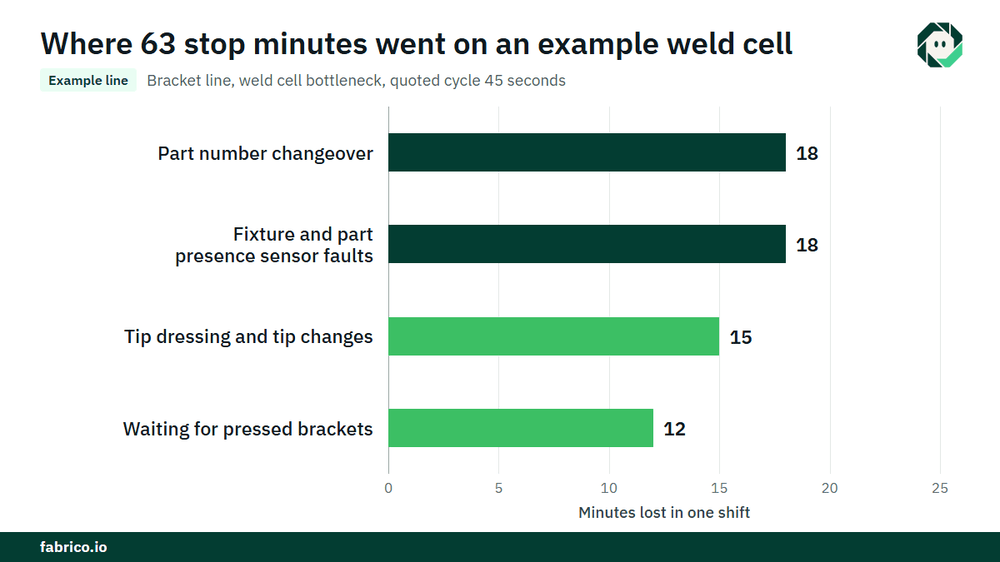
Sample line (illustrative numbers, not a customer): a bracket line whose weld cell is the bottleneck, with a quoted cycle of 45 seconds. Planned production time is 450 minutes, or 27,000 seconds. Stops add up to 63 minutes, so run time is 387 minutes, or 23,220 seconds.
- Availability = 387 / 450 = 86.0%.
- Ideal count = 23,220 / 45 = 516 parts. The line made 473. Performance = 473 / 516 = 91.7%.
- Nine parts needed rework, so first-pass good is 464. Quality = 464 / 473 = 98.1%.
- OEE = 0.860 x 0.917 x 0.981 = 77.3%. Check: 464 x 45 seconds = 20,880 seconds, and 20,880 / 27,000 = 77.3%.
The call-off needs 450 parts a shift. That is 450 x 45 = 20,250 seconds of ideal time, and 20,250 / 27,000 = 75.0%. Below 75.0% OEE the line cannot ship the call-off without overtime. This shift cleared it by 14 parts.
| Stop cause on the weld cell | Minutes | Parts lost | Value |
|---|---|---|---|
| Part number changeover | 18 | 24 | $144 |
| Fixture and part presence sensor faults | 18 | 24 | $144 |
| Tip dressing and tip changes | 15 | 20 | $120 |
| Waiting for pressed brackets | 12 | 16 | $96 |
| Total stops | 63 | 84 | $504 |
At a contribution of $6.00 a part (€6.00 in a euro plant), the 84 parts lost to stops are $504. Slow running cost 516 minus 473 = 43 parts, or $258, and rework 9 parts, or $54. In total, 600 possible minus 464 good = 136 parts, $816 a shift, or $391,680 over 480 shifts a year (€391,680). Freed capacity turns into cash only when it sells or cancels overtime; your controller decides that.
Light MES vs full MES for a tier 2 or tier 3 plant
A full MES for automotive supply links serials and lots to components, records control plan checks and SPC, keeps error-proofing records, shows work instructions and schedules to call-offs. Where a part family is safety-relevant or a customer requires serial traceability, that is the right tool for that line.
A light MES is the same Level 3 layer in a different order: production data, downtime reasons and line OEE first, on one line, then more lines and functions where a part family or customer needs them. For many tier 2 and tier 3 plants the problem is output, not proof: the line is quoted at a cycle it rarely holds, and nobody knows which station steals the time. More on the split in OEE vs MES.
Many suppliers end up with both: traceability where the customer requires it, line OEE on every line.
How to choose an MES for an automotive supplier
- Separate proof from output. List which part families need traceability and process records; the rest may need only OEE.
- Check the ideal: the quoted cycle per part number, not takt.
- Ask for line OEE and station data from one dataset, with starved and blocked charged to the root cause.
- Ask how it reads robots, PLCs and test stands, and what happens on old machines with no usable signal.
- Keep the ERP interface small: orders in, actuals out.
- Agree the start: one line, a baseline and a decision date agreed in advance.
Mistakes automotive suppliers make with MES
- Using takt as the ideal cycle, which inflates Performance and hides lost capacity.
- Counting retest passes as good, so Quality looks better than first-pass yield.
- Buying serial traceability for every line when one part family needs it.
- Building the capacity report by hand before each customer review, from data nobody trusts.
- Comparing operators instead of stations. Measure the process, never the person.
Where Fabrico fits
Fabrico is a computer vision enabled Manufacturing Performance Platform. In a tier 2 or tier 3 plant it is a light MES with OEE and downtime first, starting on one line.
- Automatic downtime logging from the cell, press or station signals.
- The operator confirms the reason in one tap.
- A camera clip as evidence for a stop, where a camera watches the station.
- Losses priced in money and ranked by money.
- OEE live by line and shift, and one view across plants.
- As the last step, a stop coded as a breakdown becomes a work order to the right technician, with its cost.
In MESA terms that is data collection, performance analysis and, as the last hop, maintenance management. Machines connect through a PLC, a Fabrico IoT device or an AI camera. Fabrico is not an ERP and not a full MES suite: it does not do scheduling, part traceability, genealogy, SPC or control plan records, and it makes no IATF 16949 claim.
Two named results: ABB, 20% less downtime; Ficosota, OEE from 53% to 60% and 23% more good output. Each plant gets a quote after a review of its lines. See also our guide to OEE for automotive manufacturing.
Frequently asked questions
What MES does an automotive supplier need?
It depends on what the customer requires. Safety-relevant parts often need serial traceability and process records; most lines first need production data and line OEE to hold the quoted cycle.
Does IATF 16949 require an MES?
IATF 16949 sets quality management requirements; it does not name a software product. Plants meet its record and traceability requirements with different systems, from paper to a full MES.
Should OEE use takt time or cycle time as the ideal?
The cycle time: the quoted and proven capability of the bottleneck. Takt is customer demand. Using takt as the ideal makes Performance look better than it is.
How do you calculate line OEE on an automotive line?
Measure at the bottleneck station: run time over planned time, parts made over parts possible at the quoted cycle, first-pass good over total. Multiply the three.
See your bottleneck's losses in a demo
Bring one line, its quoted cycle and its current downtime log. We will show where the bottleneck's time goes and what each loss costs.






