


 Login
 Blog
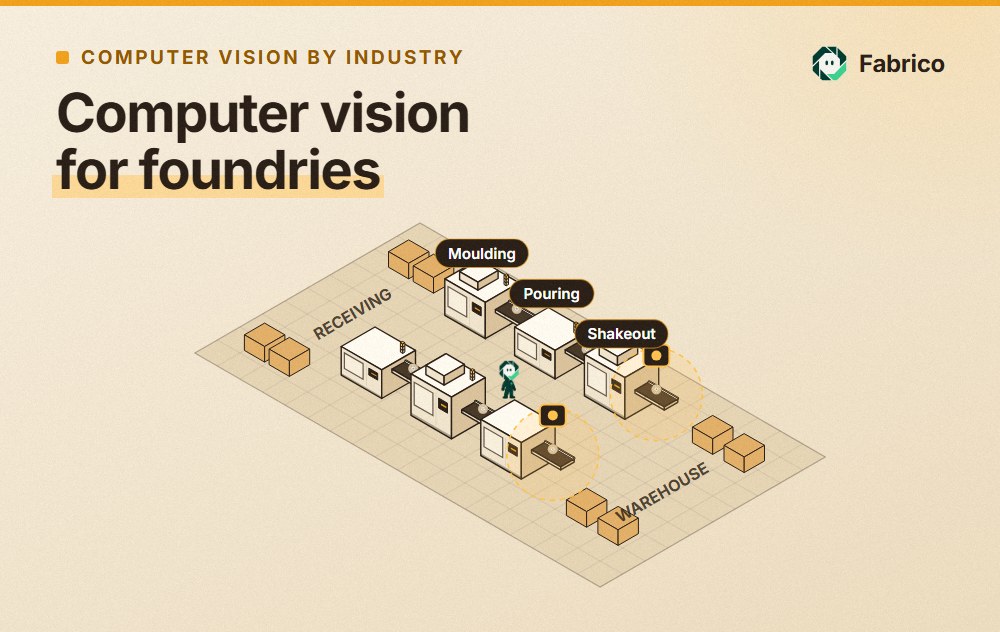
Computer Vision for Foundries: Cameras in Fettling, Cores and Packing

In short: computer vision in a foundry is worth its housing where nothing counts castings: the fettling shop, manual core setting, investment casting cut-off, packing and pre-PLC machines. There a camera counts castings or baskets, and you can replay the minutes a booth stood idle.
- Moulding lines and die casting machines already have PLCs or controllers. Read their signal first: moulds made, shots, run state.
- Casting defect inspection (X-ray, CT, dye penetrant, magnetic particle) is a different job and a different system. An OEE camera does not judge a casting.
- Foundry losses hide in pattern and die changes, waiting for metal, ladle and pouring delays, scrap and rework, and the fettling bottleneck.
- Heat and dust decide where a camera can go: in a housing, well back from the pour, looking at castings, not people.
Your moulding line knows how many moulds it made. Your die casting machines count every shot. The fettling shop, where castings are blasted, cut and ground, often reports nothing until the packing list.
It walks the casting from the melt to the packing bench: where a camera count helps, where the moulding line PLC or the die casting controller already has the number, and what to ask a supplier.
Computer vision for foundries: judging castings or counting them
Foundries hear "vision" from two directions. X-ray, CT and surface systems judge whether a casting is sound. An OEE camera never judges a casting; it counts castings and baskets and lets you look back at a stalled booth.
Different suppliers, different budgets, different questions: write two specs, not one.
| Job in the foundry | Inspection | OEE camera |
|---|---|---|
| Porosity, shrinkage | X-ray or CT | No |
| Surface cracks | Dye penetrant, magnetic particle, visual | No |
| Dimensions | CMM, gauges, 3D scan | No |
| Count castings | Rarely | Yes, at fettling, cut-off and packing |
| Why core setting held the line | No | Video of the station for those minutes |
| What it gives OEE | Scrap and rework by pattern | Castings out per hour |
Keep both. Scrap and rework found at inspection, booked by the inspector or read from the X-ray reject log, set the quality figure; the camera's job ends at counting what leaves fettling. For the line between the two losses, see scrap vs rework.
Where the losses hide in a foundry
Castings sit inside most of what industry builds. The American Foundry Society says that about 90 percent of durable goods include castings, and calls metalcasting a $52 billion industry that directly provides more than 160,000 jobs in the US alone.
A foundry is several plants in one: melt shop, core shop, moulding or die casting, then fettling, heat treatment and finishing. A loss in one shows up as waiting in the next. Here is where the hours go.
Pattern and die changes
On a sand moulding line, a pattern change means swapping pattern plates and checking the first moulds. A jobbing foundry with short runs does this many times a shift. In a die casting cell, a die change brings die heating and warm-up shots, which go back to the furnace. Count them as scrap, not output.
Book pattern and die changes as their own codes, by pattern or die. See SMED, single minute exchange of die, and for the cell itself, OEE for high pressure die casting.
Waiting for metal
The moulding line is ready and the melt shop is not. The furnace is still melting, the chemistry sample is still at the spectrometer, or the temperature needs correcting, or the magnesium treatment and inoculation are not done.
Give waiting for metal its own code and its own owner, the melt shop, apart from breakdowns. Also check what your line counts. Some lines keep making moulds while they wait, so moulds made and moulds poured drift apart, and only the poured ones become castings.
Ladle and pouring delays
A ladle has to be preheated, filled, moved by crane, skimmed and poured before the metal cools too far. One that loses its temperature goes back to the furnace, and the line waits.
An automatic pouring unit logs its pours. Where a crew pours by hand, nothing counts, and a camera kept well back from the pour can show on video what held the line up.
Scrap and rework
Foundry scrap is often found late: at shakeout or fettling, at X-ray, inline in a die casting cell or days later in a sand foundry, or when the buyer machines the casting. Scrapped castings go back into the furnace, so the cost hides in metal and energy, not in a bin.
Book scrap by reason and pattern, and rework apart from it. A casting that passes only after weld repair is not first-pass good. See rework and the good count in OEE.
The fettling bottleneck
Fettling covers cutting off risers and gates, shot blasting and grinding parting lines and flash. It is mostly manual, and it costs real money. A 2005 Foundry Management and Technology article estimated that 20 to 35% of the manufacturing cost of an average casting can be put down to cleaning and finishing. A 2014 Casting Source buyer's guide says finishing can be more than 25% of total casting cost for a ferrous part.
Both are dated trade press estimates, so read them as scale only.
Fettling booths have no PLC to read. A camera that counts castings or baskets leaving the shot blast and the grinding booths gives them an hourly count. That is often where the bottleneck shows: the moulding line runs well while castings pile up in front of the grinders.
For welding and machining stations, see computer vision for metal fabrication.
Manual core setting
On many sand lines, cores go into the mould by hand between the moulding machine and mould closing. A complex casting can need several cores, and core setting then sets the pace of the line.
The line PLC sees the line waiting, not why: a broken core, cores late from the core shop, or a hard core to place. A camera at the core setting station lets you open the video for those minutes. The core setters still enter the reason; stop detection by the camera add-on is on the Roadmap, so ask any vendor how stop time is caught at a station with no signal.
Die casting and investment casting cells
A high pressure die casting machine knows its shots and cycle. Its signal does not cover what comes after: manual trimming, deburring, sorting and packing.
Investment casting is more manual still. Wax injection presses have signals, but tree assembly, the shell room, knockout, cut-off and finishing often do not. A camera at assembly or at the cut-off saw counts trees or castings where nothing else counts.
Heat, dust and older machines
A foundry is hard on electronics. OSHA lists foundry work among the uses of industrial sand that expose people to respirable crystalline silica, and the same dust settles on lenses. Add radiant heat near furnaces and the pour, shot blast dust and grinding sparks.
So mount cameras in a housing that suits the spot, with cooling or an air purge near heat. Keep them well back from the pour and out of the spark path, and look at the castings from a distance rather than from close above. Put cleaning the lens window on the fettling shop's weekly list. Mounting and light in general are covered in where to mount a camera and how to light the scene.
Older machines are the other place a camera pays off. A moulding machine or cut-off saw from before the PLC era gives no usable count, and a camera over its output does.
Where a camera goes in a foundry
Machines outside the foundry are sorted the same way in camera or sensor: a machine-by-machine guide.
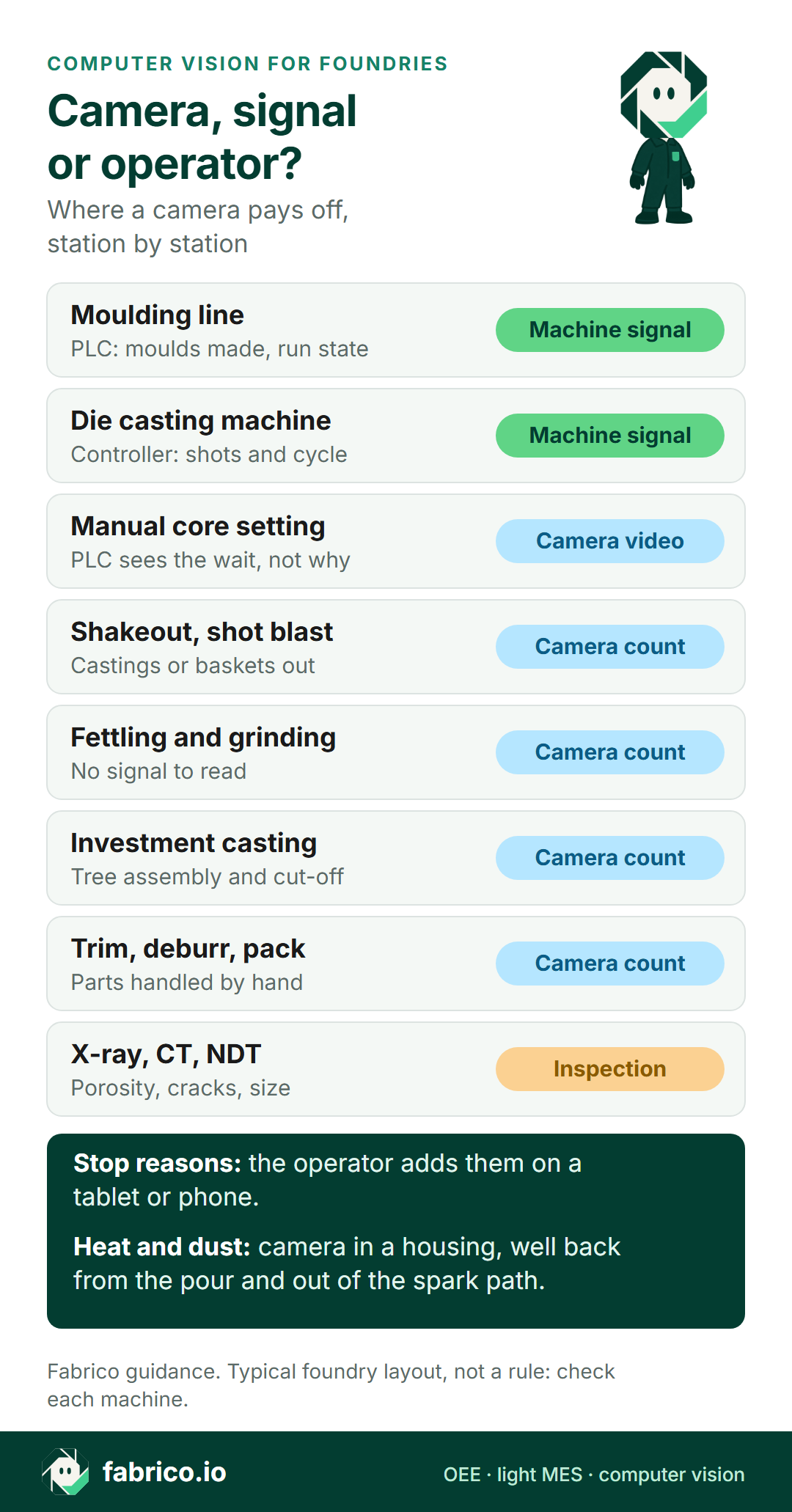
Camera, signal or operator: station by station
Most foundries fit this pattern, but a jobbing shop with a 1980s moulding machine may have no PLC worth reading, so walk the floor first.
| Foundry station | Count and stops come from | Camera add-on's part |
|---|---|---|
| Melt shop, furnaces | Furnace controls and the melt log | Little. Use the log. |
| Moulding line | Line PLC: moulds made, run state | Video of a disputed stop |
| Manual core setting | Line PLC sees the wait, not why | Video of what held the line |
| Pouring | Pouring unit controller, or the crew | Video, from well back |
| Die casting machine | Controller: shots and cycle | Little. Use the signal. |
| Trim, deburr, sort | Trim press PLC, if you can reach it | Count where parts are handled by hand |
| Shakeout and shot blast | A run signal at most | Count of castings or baskets out |
| Fettling: cut-off, grinding | Nothing | Count of castings finished |
| Heat treatment | Furnace controller and batch log | Little. Count baskets only where loading is by hand. |
| Investment casting assembly, cut-off | Nothing | Count of trees or castings |
| X-ray, CT, NDT | Its own reject log | None. Its rejects set quality. |
| Packing | Nothing, or a scale | Count of castings packed |
| Why a line or booth stood | Moulder, core setter or fettler, tablet or phone | Booth video for the minutes in question |
Melt shop, moulding line and die casting machines can stay camera-free; the cameras go where castings are handled by hand. The card below marks those spots.
Before a demo, mark which booths and saws in fettling have no count today; we will start there, not at the moulding line.
Worked example: one moulding shift and its castings
The figures are invented for illustration. A green sand flask moulding line works a 10-hour day shift and stops for a 30-minute meal break, so it has 570 planned minutes. It runs one pattern with 4 castings in each mould, at an ideal rate of 4 moulds a minute.
The moulding line PLC gives the run state and counts moulds, and here every mould made was poured. A camera at the exit of the grinding booths counts castings leaving fettling. Castings scrapped at shakeout and fettling are pulled out before that point, so what the camera counts is the good output.
The line stood for 150 minutes: 50 waiting for metal from the melt shop, 45 on a pattern change, 25 on ladle and pouring delays, 20 in short stops and 10 on one breakdown. It ran 420 of 570 minutes, an availability of 73.7%.
At 4 moulds a minute, 420 running minutes could make 1,680 moulds. The line poured 1,512: performance is 90.0%. The missing 168 moulds are 42 minutes of slow running, much of it waiting on a slow core setter for a complex core.
The 1,512 moulds held 6,048 castings. The camera add-on counted 5,696 leaving the grinding booths after scrap was pulled, so 352 were scrapped and quality is 94.2%. At 16 castings a minute, those 352 are 22 minutes of line time.
OEE: 73.7% x 90.0% x 94.2% = 62.5%. From the fettling count alone: 5,696 good castings out of 9,120 possible in 570 minutes is also 62.5%.
One honest caveat. Castings reach fettling hours after pouring, because they have to cool, and X-ray can scrap more days later. So book quality to the pattern and the job, not only to the shift, and expect the figure to settle once late inspection is in.
With both counts, castings poured sit next to castings fettled, so a growing queue at the grinders shows up the same day.
Eight checks for any foundry camera or OEE vendor
Put them to every supplier, us among them, and test the answers on last week's melt log, scrap tickets and one shift of fettling counts.
| Ask | How to test the answer |
|---|---|
| How do you book pattern and die changes? | Ask for a code per pattern or die, and for warm-up shots counted as scrap. |
| How is waiting for metal booked? | Ask for its own code and owner, apart from breakdowns. |
| What exactly does the camera count? | Castings, baskets, trees or moulds? Castings per mould change by pattern, so ask how that is set, then check it against the fettlers' basket tally for a day. |
| Will it cope with heat and dust? | Ask for the housing rating, cooling or air purge near heat, and how the lens window is kept clean. |
| Where does each camera go near the pour and the grinders? | Ask for each position on a drawing, out of the spark path and the crane's ladle route, with safety sign-off before anyone drills. |
| How does late scrap get in? | Ask how X-ray rejects and returned castings reach the quality figure after the shift has closed. |
| Who can replay grinding booth video? | Ask if any footage is kept, where and for how long, and whether a fettling supervisor can open a single booth's recording. |
| Does it show the fettling queue? | Ask to see castings poured against castings fettled, by pattern and by day. |
Begin with one fettling shop, or one moulding line and its grinders, and follow the computer vision OEE pilot steps.
Cameras, privacy and the works council
Fettlers and core setters work in view of any camera at their booth, often in masks and visors. Explain to both shifts what the camera counts before it is mounted, and where the foundry has a works council, take the plan there first.
Aim at the basket, the casting or the conveyor out of the booth, not at the grinder, and keep reports at booth, line and shift level. Which privacy masking works today in a dusty, spark-lit booth, and which is still planned? Put that question to every supplier.
The add-on counts castings and baskets; whose hands ground them is no concern of it. More on briefing people and setting rules is in production line cameras without surveillance.
Where Fabrico fits
In a foundry, Fabrico's cloud OEE and light MES line up moulds poured on the moulding line with castings out of fettling, shift by shift and pattern by pattern.
- Moulding line and die casting: moulds made, shots, cycles and run state from the line PLC or the die casting controller, or from a sensor or counter on an older machine.
- Why the line or a booth stood: the moulder, core setter or fettler books it on a tablet or phone, for example waiting for metal, pattern change or ladle cold.
- OEE by line and shift: availability, performance and quality, with downtime and scrap shown in money, on the web, iOS and Android.
- Fettling, cut-off and packing (camera add-on, on request): the add-on counts castings, baskets or trees where nothing else counts, and on machines with no usable signal. Pick a moment on the shift timeline and it streams that booth on request, and Fabrico keeps no copy in the standard setup.
- Out to other systems: counts, stops and scrap codes are available through the REST API and webhooks, and as Excel or CSV exports for the foundry's cost reports.
Roadmap, not live today: stops spotted by the camera add-on, jam zones on the video, and a stop reason proposed by the add-on.
What Fabrico does not do: casting inspection, which stays with your X-ray, CT and NDT, whose scrap and rework counts can feed Fabrico's quality figure. Fabrico does not control the furnace, the pour or the melt chemistry.
Product details: Fabrico computer vision for OEE. To compare platforms, see our guides to OEE software and to OEE for high pressure die casting. The eight checks above are fair questions for us as well.
What people ask next
Which foundry station should get the first camera?
The grinding and cut-off booths in fettling, in most foundries, then the shot blast exit, an investment casting cut-off saw or manual packing. Moulding lines and die casting machines with a count you trust come last.
Can a camera find porosity or cracks in castings?
Not an OEE camera. Porosity and shrinkage are found by X-ray or CT, and surface cracks by dye penetrant, magnetic particle testing or a trained inspector. Fabrico does not sell inspection. The scrap and rework those checks find can feed the quality part of OEE.
Will a camera cope with the heat and dust in a foundry?
It can, if the housing suits the spot and the camera sits well back from the pour, the furnaces and the spark path of the grinders. Plan how the lens window gets cleaned, and test the count after a dusty week. See camera placement and lighting.
Does a die casting cell need a camera?
Often not at the machine, because its controller already counts shots and knows the cycle. A camera earns its place after it: at manual trimming, deburring, sorting and packing, where good parts leave the cell and nothing counts them.
Want an OEE figure that includes fettling? Bring one week of melt logs and scrap tickets to a demo, and we will work a shift of them through with you.
Related articles











Real Fabrico tiles, sample data.