


 Login
 Blog
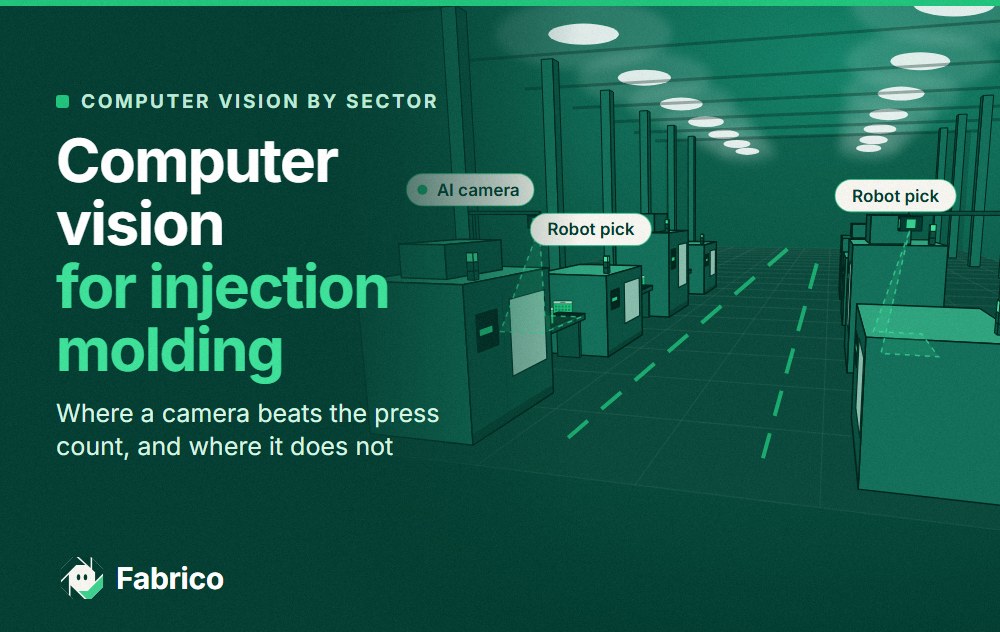
Computer Vision for Injection Molding: After the Mold Opens

In short: computer vision for injection molding pays off away from the press: the press already gives you a cycle signal, so cameras earn their place where people and robots handle parts after the mold opens.
- Use the press counter for the press. Put cameras at manual degating, inserts and secondary assembly, inspect and pack tables, bagging and boxing, robot cells with no usable signal, and the outfeed conveyor.
- Short shots, flash, sink marks and dimensions are inspection. That is a different job, done by inspection vision systems.
- Molding losses hide in mold changes, color and material changes, start-up scrap, micro-stops on robots and conveyors, and waiting for QC release.
- Fabrico's AI camera add-on counts output and lets you open the video for any moment on the shift timeline. The operator adds the stop reason.
Your presses already count. A modern injection molding machine knows every cycle, its cycle time and often its cushion and injection pressure. So why put a camera in a molding shop at all?
Because the press counts shots, not good parts in a box. Between the mold and the pallet there are robots, conveyors, degating tables, insert loading, assembly, inspection and packing. That is where counts go missing and short stops go unrecorded.
This page is for plant managers, operations and CI leads in plastics plants choosing where cameras belong.
Computer vision for injection molding: two different jobs
Two kinds of camera system get sold to molders under one name. Inspection systems check parts for defects. OEE cameras count output and show you what happened at a stop. They come from different vendors, so keep them apart in the spec.
| Job in a molding shop | Inspection system | OEE camera |
|---|---|---|
| Short shots, flash, sink marks | Yes | No |
| Dimensions and color match | Yes | No |
| Count shots at the press | No, use the press | No, use the press |
| Count good parts after degating or packing | Counts what it inspects | Yes, also at manual steps |
| Video of a stop | Reject images, not stop video | Open the video for that minute |
| Feeds OEE through | Its reject count | The output count |
If you searched for machine vision in plastics and found defect inspection, this page is about the other job. The two work side by side: an inspection system's reject count, read from its PLC or a counter signal, can feed the quality part of OEE, so rejects are counted once. For where one ends and the other starts, read label and code vision vs an OEE camera.
Start with the press: it already has a signal
Injection molding is one of the few industries where the machine signal is close to a standard. EUROMAP 77, from the European plastics and rubber machinery makers, describes the interface between injection molding machines and manufacturing execution systems. Older presses without it still give a mold open or cycle contact you can wire to a counter.
So be honest about the press itself. For run state, cycle count and cycle time, the press counter is usually the better source. It is cheaper than a camera, it does not need a clear view, and it knows the difference between a slow cycle and a stop.
The press count has three blind spots, and they are the reason cameras exist in molding at all:
- It counts shots, not parts. Parts per shot equals cavities only while every cavity runs. Block one cavity on an 8-cavity mold and the count is wrong until someone changes the setting.
- It counts before scrap. Color-transition parts, start-up parts and short shots pulled off by hand are all in the shot count.
- It stops at the mold. Degating, inserts, assembly and packing happen after the press, often by hand, often at a different speed.
Our page on OEE for injection moulding covers cycle drift and scrap per cavity at the press. This page is about what happens after the mold opens.
Where the losses hide in a molding shop
The scale is large. Plastics Europe estimates more than 51,700 companies and more than 1.5 million employees in the European plastics industry (EU27+3) in 2023, estimates based on 2020 Eurostat data. Most molders run many presses, many molds and short runs, and the losses below repeat across them.
Mold changes
A mold change is the biggest planned stop on most presses. Crane, clamps, water and hot runner connections, then heating up and dialing in the process before the first good part. The press knows it is stopped, but not why, or which part of the change took longest.
Book it as its own stop code, split into mechanical change and process start-up if you can. A camera adds little at the press itself. The operator's reason code and the press signal tell most of the story.
Color and material changes
Changing color or resin means purging the barrel, then molding parts until the hot runner clears and the color looks right. The press is cycling, so the shot count climbs, but none of those transition parts are good.
That is the trap: a color change can look like production in the press data. Book the purge as a stop with its own code, and count the transition parts as scrap. A camera count at the pack table shows the gap between shots and good parts by product, shift after shift.
Short shots and start-up scrap
After a mold change, a long stop or a material change, the first parts are often short, flashed or the wrong size while the mold and barrel settle. Operators pull them off by hand and drop them in the regrind bin.
Those parts were made, so they count against quality, but they are easy to miss. Spotting the short shot is inspection. Counting what reaches the box is where the OEE camera helps.
Micro-stops on robots and conveyors
Many presses now have a robot or a sprue picker. The IFR World Robotics 2025 summary puts the plastic and chemical products industry at 5% of the 542,076 industrial robots installed worldwide in 2024. That includes chemicals, so read it as scale only.
A robot that misses a pick, a part that hangs in the mold, a conveyor that backs up: each one costs seconds, and the press often just waits. A 30-second wait rarely gets written down. Thirty of them are 15 minutes. Where the robot cell gives no usable signal, a camera count on the take-out or the conveyor shows the gaps in output, and the video shows what happened. See micro-stops.
Waiting for QC release
Many molders hold a new run until quality signs off the first parts. The press is ready, the parts are in a bag on the QC bench, and the clock runs.
That wait belongs to availability with its own code, not hidden inside the mold change. It is one of the easiest losses to cut once it is visible, and only people can tell you it happened. Give the operator a code for it.
Manual degating and secondary ops
Family molds, cold runners and parts with inserts often mean a person at the press: cutting gates, removing sprues and runners, loading inserts, assembling clips or caps, then inspecting and packing.
When that table falls behind, parts pile up, or the press slows to match. There is no PLC count to read at a hand table, which is where a camera pays off. See computer vision OEE for manual assembly.
Where a camera goes in a molding cell
Here is one example: a press with a robot, a conveyor and a secondary operations table.
For a longer list by machine type, see camera or sensor for OEE, machine by machine.
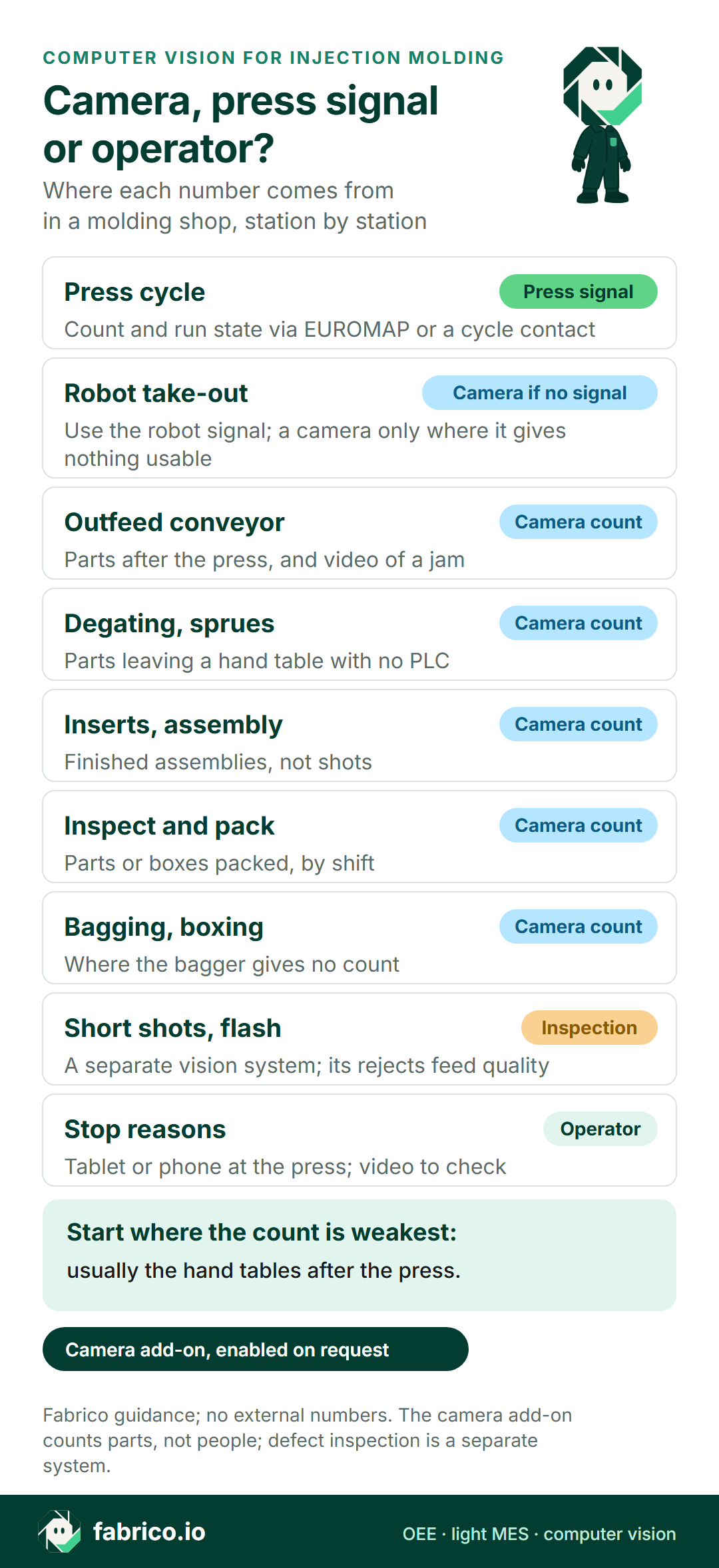
Camera, press signal or operator: station by station
This is typical for a molding shop, not a rule. Check each press and each table.
| Station | Count and stops from | What a camera adds |
|---|---|---|
| Press cycle | Press controller or cycle contact | Little. Use the signal. |
| Robot or sprue picker | Robot controller, if you can reach it | Count and video where it gives nothing usable |
| Outfeed conveyor | Often nothing | Part count after the press |
| Degating, sprue and runner removal | Nothing at a hand table | Count of parts leaving the table |
| Inserts and secondary assembly | Nothing, or a fixture counter | Count of finished assemblies |
| Inspect and pack table | Nothing, or a scale | Count of parts or boxes packed |
| Bagging and boxing | Bagger PLC on newer machines | Count where the bagger gives none |
| Vision inspection | Its own reject count | Nothing. Feed rejects to quality. |
| Stop reasons | The operator, on a tablet or phone | Video to check a disputed reason |
You rarely need a camera at every station. Start where the count is weakest.
Bring your station list and one week of stop sheets to a demo, and go through it station by station.
Worked example: one press, one shift, a color change inside it
These are example numbers, and they describe no real plant. A press runs a 4-cavity mold with an ideal cycle of 20 seconds: 12 shots and 48 parts a minute. One 480-minute shift includes a color change.
The press gives the run state and counts shots. A camera at the pack table counts the good parts that reach the box. Transition parts, start-up parts and short shots make up the difference.
Stops took 80 minutes: the color change 35, waiting for QC release 20, micro-stops at the robot and conveyor 15, and a dryer alarm 10. Run time is 400 of 480 minutes, so availability is 83.3%.
At 48 parts a minute, 400 minutes could make 19,200 parts. The press counted 4,320 shots, which is 17,280 parts, so performance is 90%. The gap is 40 minutes of slow cycles.
The camera counted 16,512 good parts at the pack table. That leaves 768 parts of scrap, so quality is 95.6%. Those 768 parts are 16 minutes of press time.
OEE is 83.3% x 90% x 95.6% = 71.7%. Check it the short way: 16,512 good parts of 23,040 possible is also 71.7%.
Without the pack table count, quality would read 100% and OEE 75%. The 768 parts in the regrind bin would never reach the report. And if the QC wait were booked inside the color change, nobody would see that 20 minutes went to a bag on a bench.
Eight checks for any injection molding camera or OEE vendor
Run these with every vendor, and with us. Bring one real shift from last week as the test case.
| Ask | How to test the answer |
|---|---|
| How do you read the press? | Ask which presses connect through EUROMAP, which need a cycle contact, and what happens on presses with neither. |
| How do cavities work? | Ask how parts per shot change per mold, and what happens when one cavity is blocked. |
| Where do transition and start-up parts go? | Ask how scrap after a color or mold change reaches the quality figure, and who counts it. |
| What exactly does the camera count? | Parts, assemblies, bags or boxes? Run it next to a hand count for a full shift. |
| Can it count parts that touch or tumble? | Test it on your hardest part: small, clear or stacked on a conveyor. |
| How is QC release booked? | Ask for a separate code, so the wait is not hidden inside the mold change. |
| Is video kept, and who can open it? | Ask where it lives, for how long, and who sees it. |
| How do inspection rejects get in? | Ask if the vision system's reject count feeds quality, so rejects count once. |
Before you roll out across the shop, test the count on one cell. See how accurate camera OEE is for what to measure.
Cameras, privacy and the works council
Secondary operations are people's work: degating, assembly and packing are done by hand. A camera on a pack table will see hands and arms. Tell staff before any camera goes up. In many European countries, talk to the works council first.
Frame the camera on the parts, the tray or the box, not the person. Report by station and shift, not by name. Ask each vendor, us included, what privacy masking is live today and what is still roadmap.
For a fuller checklist, read production line cameras without surveillance.
Where Fabrico fits
Fabrico is a cloud OEE and light MES platform. Here is what it does in a molding shop today.
- Stops and counts: from the machine signal: the press PLC, a sensor or a counter.
- Stop reasons: the operator adds them at the press, on a tablet or phone: mold change, color change, QC release, robot fault.
- OEE and losses: OEE, downtime and losses by press and shift, with losses shown in money. On the web, iOS and Android.
- Cameras, an add-on on request: the AI camera add-on counts output, including at degating, assembly and pack tables and on robot cells with no usable signal. With the add-on, you can open the camera video for any moment on the shift timeline. In the standard setup, video is streamed on request, not stored in Fabrico.
- Your data: it leaves through a REST API, webhooks and Excel or CSV export.
Roadmap, not live today: stops detected by the camera add-on, jam zones on the video, and a camera add-on suggesting a stop reason.
What Fabrico does not do: defect inspection, which stays with your inspection systems and feeds Fabrico's quality figure through the reject signal or counter. Fabrico does not control or tune your molding process. For planning and scheduling, ask us in the demo.
For the camera add-on, see Fabrico computer vision for OEE. For the wider shop system, read MES for plastics injection moulding. If you are still comparing platforms, read five molding OEE tools compared or our guide to OEE software. All eight checks above apply to us too.
Bring one shift's press data and stop sheet to a demo, and ask us to show which numbers we can fill and which we cannot.
What people ask next
Do I need a camera on the injection molding press itself?
Usually not. The press controller already knows its cycles, and you can read them through a EUROMAP interface, a cycle contact or a mold open signal. Use that for the press. Put cameras where the press count stops being the truth: degating, assembly, packing and the outfeed.
Can a camera find short shots, flash and sink marks?
Yes, but that is an inspection camera, not an OEE camera. Defect checks on molded parts are done by inspection systems. Fabrico does not sell inspection. The inspection system's reject count can feed the quality part of OEE.
Can the camera add-on count parts that a robot drops onto a conveyor?
Yes, if the parts cross a clear counting zone. Parts that pile up, tumble or overlap are harder, so run the count next to a hand count for a full shift before you trust it. See how accurate camera OEE is.
How should color and material changes show up in OEE?
Book the purge and the restart as a stop with its own code, so changeover time stays visible. Count the parts molded before the color is right as scrap, so they reach the quality figure instead of disappearing into the regrind bin.
Is the camera video stored?
Not in Fabrico. In the standard setup, video from the camera add-on is streamed on request, and you can open it for any moment on the shift timeline. Ask every vendor the same question, and where their video lives.
What drives the cost of computer vision in a molding shop?
Pricing is set per quote. The drivers are the number of presses, secondary stations and cameras, mounting, the network to the shop floor, and training. Give each vendor the same station list so the quotes compare.
Want to see it on a line like yours? Book a demo and bring one shift from a molding cell.
Related articles










Real Fabrico tiles, sample data.