


 Login
 Blog
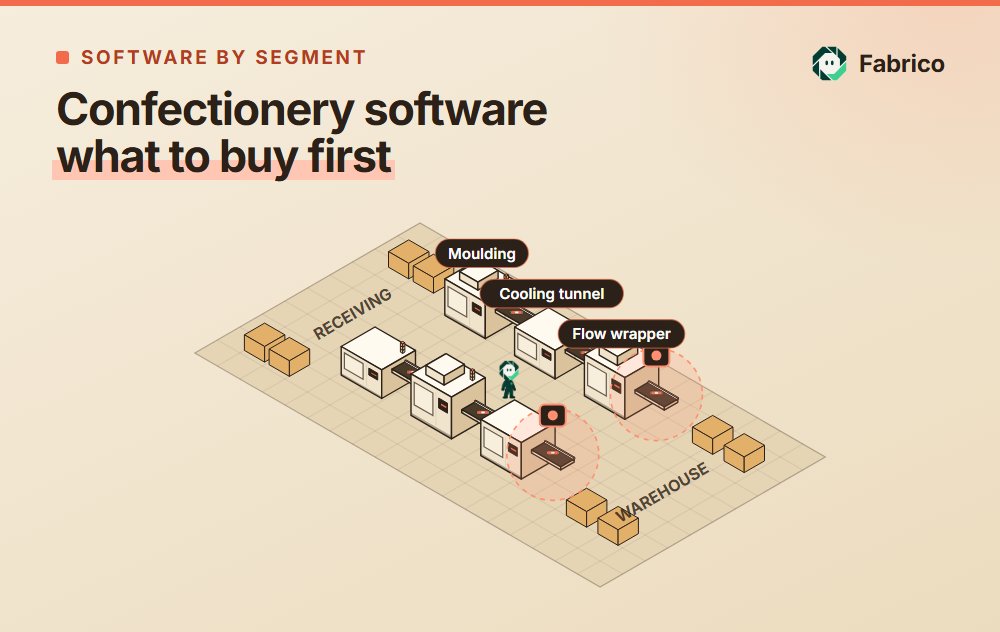
Confectionery Manufacturing Software: What a Chocolate Plant Buys First

In short: confectionery manufacturing software is a set of separate systems, not one product. A chocolate or sweets plant runs an ERP for orders, lots and costing, a recipe or batching system at the kettles, a quality system for allergen and CCP records, checkweigher software for giveaway, a warehouse system for seasonal stock, and an OEE or light MES layer for the lines. Most plants already own the records systems. The gap they still have is on the floor: why the moulding line and the wrappers lost hours last week.
- Buy for the loss you can already name. Lost hours at the depositor, tunnel and wrapper point to OEE and light MES first.
- Recipe errors, lot traces and allergen paperwork point to recipe, ERP and quality systems, which Fabrico does not replace.
- Seasonal runs for Easter and Christmas load every system at once: new SKUs in the ERP, new moulds on the line, new stock in the warehouse.
- Giveaway on weight never shows in OEE. It lives in checkweigher data.
A chocolate plant has a strange year. Bars and pralines run all year, then the moulding hall fills with hollow figures, advent calendar pieces and selection boxes for a few short seasons, and every line changes shape, foil and pack.
That rhythm decides which software pays back first. Chocolate, sugar confectionery and gum plants choosing chocolate manufacturing software, or a wider confectionery stack, face the same order-of-purchase question.
Fabrico makes one layer of that stack, OEE and light MES, and says so where it matters. The rest of the map names product types, not vendors.
The confectionery manufacturing software map, system by system
Each system below answers a different question, and each has a different owner in the plant. Read the third column first: if nobody in that role is asking for it, it is not your first purchase.
| System | What it does in a confectionery plant | Owner | Fabrico? |
|---|---|---|---|
| ERP | Orders, seasonal forecasts, cocoa and sugar stock, lots, costing | Finance, supply chain | No |
| Recipe or batching | Weighs sugar, cocoa mass, milk powder and fats at the kettle, conche or cooker | Process, QA | No |
| Quality system (QMS) | Allergen controls, CCP checks, metal detector tests, audit files | QA, food safety | No |
| Checkweigher software | Pack weights, rejects and giveaway against the declared weight | QA, line engineers | Feeds the reject count |
| Warehouse system (WMS) | Seasonal stock built months ahead, pallets, dates, picking | Logistics | No |
| Full MES or batch records | Enforced recipes, batch genealogy, electronic records | IT, QA | Not this part |
| OEE and light MES | Stops, counts and losses at the depositor, tunnel, wrapper and packing | Operations, CI | Yes, this is Fabrico |
Maintenance software is a separate buy in most plants. In Fabrico it is built into the same platform, but it is not why a confectionery plant starts.
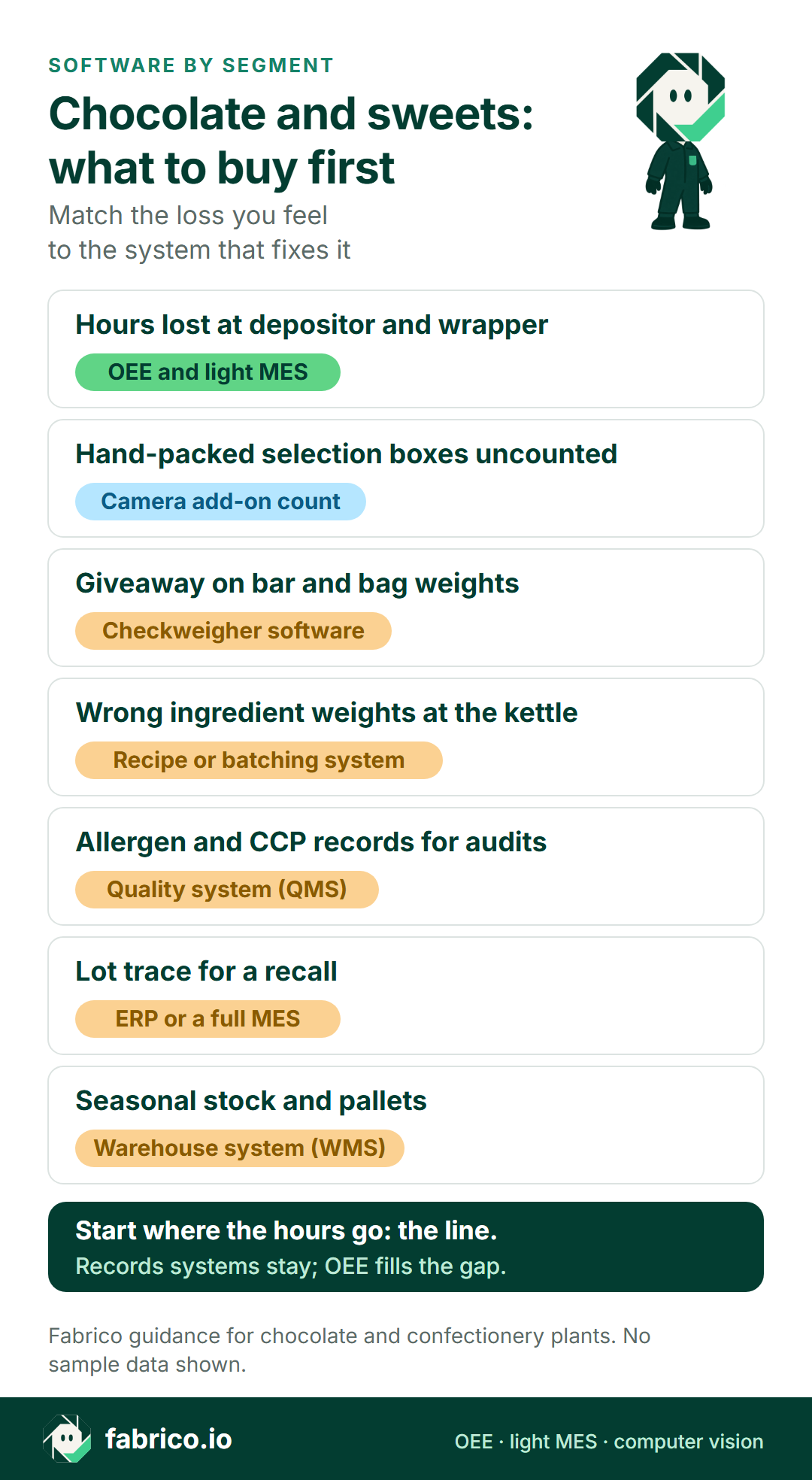
Text version of this infographic
- Chocolate and sweets software card: if hours are lost at the depositor and wrapper, buy OEE and light MES first; giveaway goes to checkweigher software, recipe errors to a batching system, allergen and CCP records to a quality system, lot traces to ERP, seasonal stock to a WMS.
The ERP: seasons are planned here
Christmas and Easter stock is planned and often built months ahead, so the ERP carries the forecast, the cocoa and packaging buys, and dozens of short-life SKUs. A chocolate ERP needs lot control on cocoa mass, nuts and milk powder, and best-before dates that match the season. It does not know why a line ran slow.
Recipe and batching: the kettle, the conche, the cooker
A batching system weighs ingredients against the recipe and logs each batch. On sugar lines it also holds cooking temperatures for hard-boiled mass and gum. Tempering curves usually live in the tempering machine's own controller. A full MES can enforce all of this in one system, which suits plants with strict customer batch record demands. Many mid-size plants keep a batching system and the ERP instead.
The quality system: allergens and audit files
Chocolate plants share lines between milk, dark and nut recipes. In the US, the FDA lists the major food allergens as milk, eggs, fish, crustacean shellfish, tree nuts, peanuts, wheat, soybeans and sesame. Under the preventive controls rule, 21 CFR 117.135 says food allergen controls include procedures, practices and processes to control food allergens, including protecting food from allergen cross-contact. The written controls, clean verification and audit evidence belong in the quality system. The OEE layer only times the clean and shows what it costs. See the allergen changeover matrix.
Checkweigher software: the giveaway number
Bars and bags carry a declared weight. For packers on the average system, UK government guidance for Great Britain sets three packers' rules, including that contents must not be less on average than the nominal quantity, and that no package should be short by twice the tolerable negative error. So depositors run a touch heavy. Those grams pass every check, so they never show as an OEE quality loss. Price them from checkweigher data, as our page on giveaway as a quality loss shows.
OEE and light MES: the hours on the floor
This is the layer that reads the depositor, mogul and wrapper, and asks the operator why a line stood. The map below shows which system records each number on one example line.
How the systems pass data
The useful links are few. The ERP sends products, seasonal SKUs and orders to the OEE layer. The OEE layer sends back actual run hours, changeover minutes and good output. The checkweigher sends its reject count, so OEE quality matches what QA rejected. Ask each vendor who builds and maintains each link, and what happens when a Christmas SKU is added in the ERP the week before the run.
The wider food version of this map is on our food manufacturing software page.
Where the hours go, in brief
Each line type hides its losses in a different machine: temper and moulds on moulding lines, belt gaps on enrobers, film and foil stops on wrappers, and seasonal mould sets on top. The station-by-station method is in OEE for confectionery and chocolate, and wrapper stops in flow wrapper OEE.
Which confectionery software to buy first
Start from the loss you can already name, not the longest feature list. One row in the table usually stands out.
| The loss you can name | Start with | Why |
|---|---|---|
| Nobody can say why the moulding line missed plan last week | OEE and light MES on that line | Stops, counts and reasons come from the line, so the hours get names |
| Wrappers stop all shift and nobody logs it | OEE and light MES reading the wrapper PLC | Short stops only show when the signal is read |
| Giveaway on bars and bags feels high | Checkweigher software | The weight data lives there |
| Wrong ingredient weights at the kettle | A recipe or batching system | It weighs each ingredient against the recipe |
| A retailer asks for a full lot trace | ERP lot functions or a full MES | A trace needs consumption records |
| Allergen and CCP records are on paper | A quality system | Audit records need their own owner |
| Seasonal stock fills every warehouse corner | A WMS | Locations, dates and picking are its job |
| A customer demands electronic batch records | A full MES, in stages | Ask for a staged plan with the first line live before the next season |
Three rules help when two rows tie. Buy the system with an owner ready to run it. Buy before the seasonal build, not during it, because nobody has time to learn a system in October. And buy what pays back on one line first, then roll out.
Many chocolate plants end up with the records systems they already own plus OEE on every line. If you are weighing a full MES against that, read light MES vs full MES. Bring a moulding line's stop sheet and the wrapper speeds to a demo, and we will show which rows Fabrico fills and which stay with your other systems.
What the OEE layer shows on a moulding line
A light MES reads the run state and counts from the tempering machine, depositor, mogul and wrapper PLCs, and the operator tags the reason on a tablet or phone: temper out of spec, mould change, foil jam, allergen clean. Set the ideal rate at the machine that paces each product, often the wrapper on a bar line. The camera add-on fits hand packing tables for selection boxes, where no machine count exists; the confectionery camera guide and the FMCG camera guide cover those stations.
Worked example: one praline lot traced back to its nuts
An invented case, from no real plant. A retailer reports a nut reaction from a milk chocolate selection box sold as nut free in one lot. The plant must show which nut lot ran on the line that week, whether the clean before the milk run was verified, and where each case went.
| System | What it holds for this lot | Where the hand-off can break |
|---|---|---|
| ERP | Hazelnut and milk powder lots, finished lot, retailer orders | Nut lot booked per week, not per run |
| Recipe or batching | Batch log at the kettle and conche | Batch number not carried to the moulding run |
| Quality system | Allergen clean verification before the milk run | Swab result on paper, not tied to the lot |
| WMS | Pallets of the seasonal lot, dates, dispatch | Pallets mixed across two lots |
| OEE and light MES | Stops, the clean's start and end, counts for the run | Holds no lot or allergen record, only run data |
The trace breaks where a batch, lot or clean is recorded against a different run. Fabrico plays no part in the trace; it supplies only when the line stopped and how much it counted. The OEE maths for a moulding line shift is in OEE for confectionery and chocolate.
Eight things to ask a confectionery software vendor before the seasonal build
Put these to every vendor on the shortlist, with one week of moulding line stop sheets on the table.
| Ask | How to test the answer |
|---|---|
| Can it hold a different ideal rate for each mould set and wrapper format? | Ask for two products on one line with two rates, set at the pacing machine, not one nameplate speed. |
| How does it split an allergen clean from a mould change and a foil change? | Ask for three separate reason codes, each with its own minutes in the weekly report. |
| How fast can we add Christmas SKUs from the ERP, and retire them in January? | Ask who adds a product with its rate, and how long 40 seasonal items take. |
| Which system is the source of good output for costing? | Ask whether ERP, checkweigher or line counts win when they differ. |
| What happens to our data if we leave? | Ask for the export format in writing. |
| Does it touch recipes, tempering settings or batch records? | If it is an OEE tool, the answer should be no. If it is a full MES, ask who validates the recipe control. |
| How do hand-packed selection boxes get a count? | Ask whether a camera add-on, a case count or a tablet entry is used, and how accurate it is. |
| Can it sit beside our allergen records without copying them? | Ask for clean times by type in OEE, with the verification records left in the quality system. |
What Fabrico covers in a chocolate plant, and what it leaves alone
Fabrico is a cloud OEE and light MES platform. For a confectionery buyer, three things matter most:
- Seasonal weeks by type: the operator tags allergen cleans, mould set changes and foil changes at the line on a tablet or phone, so a pre-Easter week reads as minutes and money by changeover type.
- The pacing machine per product: stops and counts come from the depositor, mogul and wrapper PLCs, or from a Fabrico IoT device on older machines, with an ideal rate per product.
- Hand packing tables: the camera add-on counts packed selection boxes and gift packs where no machine count exists. Its video is streamed on request, not stored in Fabrico.
The rest of the platform, from losses in money to the apps and data export, is on our MES and OEE software page and the computer vision add-on page.
What Fabrico does not do: recipes and tempering curves, batch records and lot genealogy, allergen clean validation, CCP records, checkweigher control and giveaway, and quality inspection such as bloom or foil checks. Those stay in your recipe system, ERP, quality system and inspection equipment. Sequencing the Easter and Christmas builds stays with your planners and their tool.
What confectionery buyers ask next
Does a chocolate plant need a full MES?
Only if it needs enforced recipes and batch genealogy in one system. Many plants keep recipes in a batching system and lots in the ERP, and add OEE and a light MES for the lines.
Is chocolate manufacturing software different from general food software?
The system types are the same. What differs is the detail: lot control on cocoa, nuts and milk, seasonal SKUs, tempering and mould changes, and allergen sequences between milk and dark.
Can OEE software track tempering?
It can time the stops when temper drifts and give them their own reason code. The temperatures and the temper curve stay in the tempering machine's controller.
Which system should hold seasonal SKUs?
The ERP. Add Easter and Christmas SKUs there first, with their pack sizes and dates, and let the line layer pick them up from the ERP link. Ask each vendor how a product added the week before the run reaches the line.
Does Fabrico check bloom or broken bars?
No. Bloom, foil and weight checks belong to quality staff and inspection systems. Their reject counts can feed the quality part of OEE.
Which software should a small confectionery plant buy first?
The one for the loss it can name. If the hours vanish at the depositor and wrapper, start with OEE on one line. If audits are the pain, start with the quality system.
Want to see where a moulding line's hours went? Book a demo with one moulding line shift report and the wrapper's rated speeds.
Related articles






Real Fabrico tiles, sample data.