


 Login
 Blog
Frozen Food Processing Software: Which System to Buy First

In short: frozen food processing software is not one product. A frozen plant runs an ERP for orders, lots and stock, a quality system for food safety records, temperature recorders for the cold chain, a warehouse system for the cold store, and on the line a light MES with OEE that shows where the freezer's hours go. If those lost hours are your biggest cost, buy the OEE layer first.
- Frozen food ERP software runs orders, recipes, coating specs, lots and costing. It cannot tell you why the spiral lost 40 minutes to an unplanned defrost.
- Freezer, cold store and transport temperature records are a legal duty with their own instruments. Fabrico does not hold them.
- Line losses hide in extra defrosts, die and coating changes, belt gaps, cold packing hall stops and pallets waiting for the cold store.
- Set the ideal rate in kilograms a minute at the freezer, per product, and keep glaze and giveaway out of OEE quality.
A frozen line has a delay built into it. Product enters an IQF tunnel or a spiral freezer and leaves much later, so a jam at the former turns into an empty bagger long after the former is running again. Software that only counts packs at the end of the line blames the wrong machine.
Frozen vegetable, fruit, potato, poultry, seafood, pizza and ready-meal plants all hit this delay. Below is which system does which job in a frozen plant, and which one to buy first.
Fabrico makes the OEE and light MES layer only. The other rows below are other products, and we name categories, not vendors.
The software map of a frozen food plant
Many frozen plants already own several of these systems. The question is which row has no owner today.
| System | What it does in a frozen plant | Usually owned by | Fabrico? |
|---|---|---|---|
| ERP | Orders, recipes and coating specs, lots, stock, costing, retailer orders | Finance, planning | No |
| Quality and food safety | HACCP plan, CCP checks, metal detector tests, audits | QA | No |
| Temperature recording | Air temperature in freezers, cold stores and trucks, kept as records | QA, engineering | No |
| Warehouse system (WMS) | Pallet locations in the cold store, picking, stock rotation | Logistics | No |
| Freezer and refrigeration controls | Belt speed, air temperature, defrost sequence, compressor plant | Engineering, OEM | Reads run and stop signals |
| Light MES with OEE | Stops, counts, stop reasons, OEE and losses by line and shift | Operations, CI | Yes |
| Maintenance (CMMS) | Work orders, spares, refrigeration service plans | Maintenance | Work orders from a stop |
The food-wide version of this map, with the symptoms behind each row, is in our guide to food manufacturing software.
Frozen food ERP software is a different system
An ERP is the plant's book of record. It holds what was ordered, which recipe and coating spec to use, which raw material lots went into which finished lots, what sits in the cold store and what each case cost.
It records what was made, after the fact. It does not see the line minute by minute. When the spiral slows to protect core temperature, or the bagger stops for a cold film splice, the ERP only learns that fewer cases arrived.
A full MES sits between the two and can enforce recipes and keep batch records. A light MES with OEE does a narrower job: it reads the machines, times the stops, lets the operator give the reason, and shows OEE and what the lost time costs, per line and shift. Many frozen plants need the ERP and the OEE layer, and only some need a full MES. Our page on light MES vs full MES shows where the line falls.
Cold chain records belong to their own instruments
Temperature is the frozen plant's legal backbone. Under the quick-frozen foods Directive 89/108/EEC, as published on legislation.gov.uk, the temperature of quick-frozen foodstuffs "must be stable and maintained, at all points in the product, at -18 °C or lower", with brief upward moves allowed in transport.
The monitoring rule, Regulation (EC) No 37/2005 on legislation.gov.uk, says the means of transport, warehousing and storage must be fitted with suitable recording instruments, and that temperature recordings must be dated and kept by the food operator for at least one year.
Those records come from calibrated recorders and the QA system. Fabrico does not monitor product or air temperature and keeps no cold chain records. If a vendor offers both in one box, ask who signs the records off in an audit.
Glaze and giveaway sit with the weighing systems
Fish, shellfish and some IQF products get an ice glaze. Regulation (EU) No 1169/2011, Annex IX point 5, as published on legislation.gov.uk, says: "Where the food has been glazed, the declared net weight of the food shall be exclusive of the glaze." For packers on the average system, UK government guidance for Great Britain says the contents "must not be less on average than the nominal quantity", so bagging lines aim a little high. Glaze rate and giveaway are controlled in the glazing station, weigher and checkweigher software, with QA. They never show in OEE quality, because the pack passes. Our page on giveaway as a quality loss shows how to price them.
How the systems pass data in a frozen plant
Choosing one system is easier once you know what it must send and receive. In a typical frozen plant the flows look like this.
- ERP to the line: the product, its coating spec and pack size, and the order quantity for the run.
- Line to the ERP: kilograms frozen and packs made, so stock and costing match what really left the spiral.
- Line to planning: real changeover, defrost and sanitation times by product, which the planner needs to sequence allergens and coatings.
- Weighers to QA: average pack weights, glaze checks and rejects, which stay with the quality records.
- Temperature recorders to QA: freezer, cold store and truck air temperatures, kept as dated records.
- Cold store WMS to the palletiser: whether the store can take pallets, which explains the stops logged as waiting for the cold store.
Ask each vendor which of these flows it owns, which it only reads, and which it leaves to another system. If one vendor claims all of them, ask for the go-live date and the owner of each flow.
Where a frozen line loses its hours
On the line, the hours go in five places: die and coating changes at the former, extra defrosts and slow or gappy belts in the IQF tunnel or spiral, the long thaw, wash, dry and pull-down of sanitation, weigher clumps and cold film seal faults in the packing hall, and pallets waiting for the cold store. How to set the freezer's ideal rate, split planned from extra defrosts and charge starved time is in OEE for frozen food production.
Where a hand pack table has no machine signal, a camera add-on can count output. Mounting cameras against fog, frost and washdown is covered in cameras in a frozen food packing hall.
Which frozen food processing software to buy first
Rank your problems by what they cost per week, then buy for the top one.
| What hurts most | Start with | Why |
|---|---|---|
| Hours vanish between the former and the pallet, and nobody agrees why | A light MES with OEE, on one line | It times stops from the machine signal and gets the reason at the line |
| A retailer asks for a lot trace from field or catch to pallet | ERP lot functions or a full MES | A trace needs consumption records, which OEE software does not keep |
| An auditor asks for a year of cold store temperatures | Temperature recorders and the QA system | The law asks for dated recordings kept at least a year |
| Pallets get lost or picked out of date order | A warehouse system | Locations and rotation are its job |
| Bags run heavy and the glaze rate drifts | Weigher, checkweigher and glazing data with QA | The weight data lives there |
| The plan is rebuilt by hand around defrosts and allergens | A planning tool or ERP planning | Scheduling is its own job. Feed it real changeover and defrost times. |
If the first row is the one that hurts, see a demo built around a spiral freezer line, with a week of defrost logs as the test case.
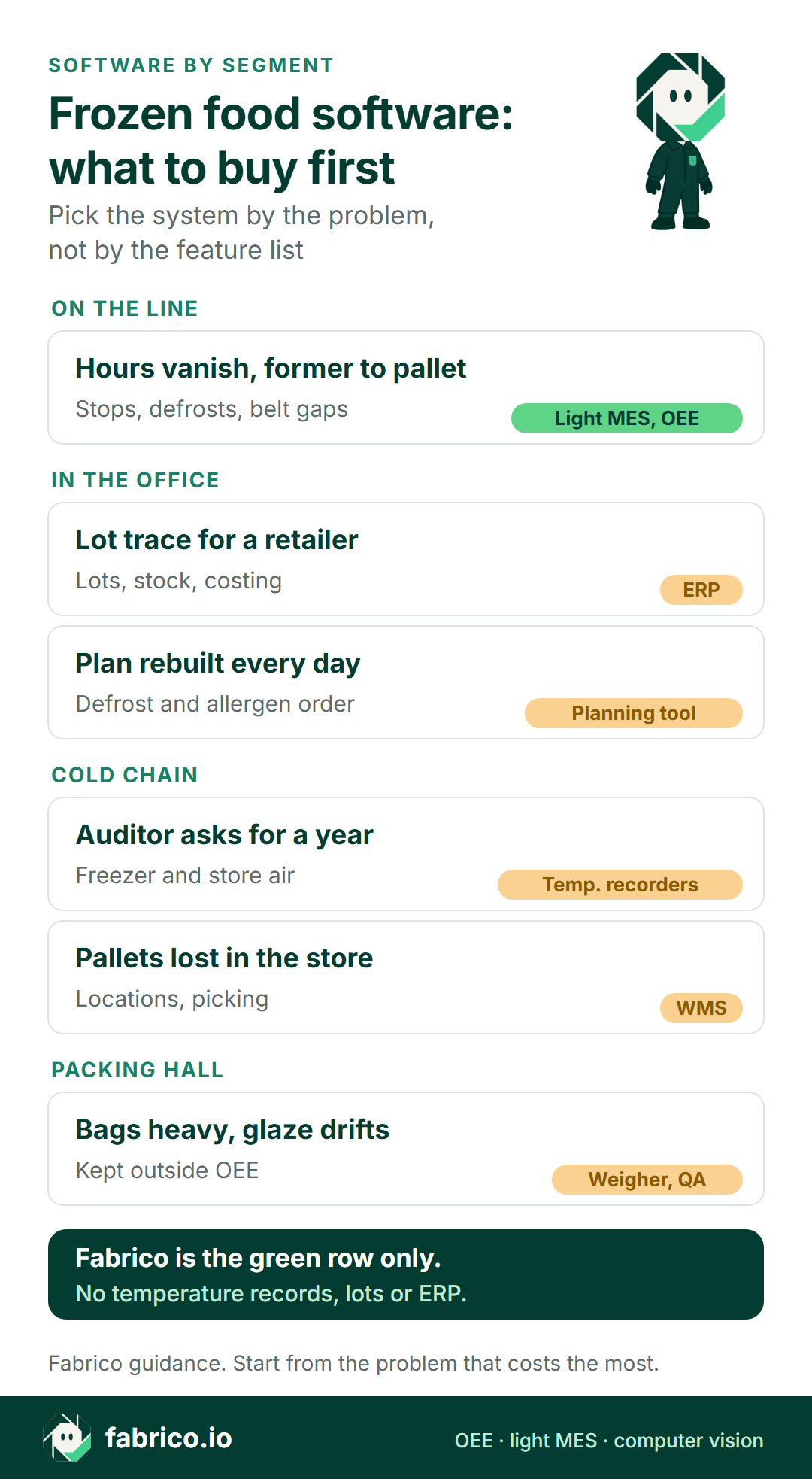
Text version of this infographic
- Frozen food software card: what to buy first. Lost line hours go to a light MES with OEE, lot traces to the ERP, plan rebuilds to a planning tool, a year of store temperatures to recorders, lost pallets to a WMS, heavy bags and glaze drift to weigher and QA data.
Worked example: one coated chicken lot traced to the retailer
An invented case, from no real plant. A retailer reports a foreign body in one lot of coated chicken. The plant must show the raw material lots, the CCP checks, the cold chain and each pallet shipped, and each of those lives in a different system.
| System | What it holds for this lot | Where the hand-off can break |
|---|---|---|
| ERP | Raw meat and breading lots, finished lot, retailer orders | Breading lot booked per day, not per run |
| Quality and food safety | Metal detector tests and CCP checks for the run | Checks on paper sheets, not tied to the lot |
| Temperature recorders | Freezer and cold store air temperatures | Recorder clock not matched to the run times |
| WMS | Pallets of the lot, locations, dispatch | Pallet relabelled without a scan |
| Line OEE layer | Stops and pack counts for the run, by shift | Holds no lot record, only run data |
The trace breaks where one system's lot or time does not match the next one's. Fabrico is not part of the trace; it supplies only when the line stopped and how much it counted. The OEE maths for a frozen line shift is in OEE for frozen food production.
Eight questions for frozen food software vendors
Bring a week of defrost logs and stop sheets, and the answers are easy to test.
- How do you tell a planned defrost from an extra one? Ask to see both as separate reasons, with their minutes and cost by line.
- Can the ideal rate be set in kilograms a minute at the freezer, per product? One nameplate speed for every SKU hides the slow belt.
- Can your lot trace run from field or catch to pallet without the OEE layer? Ask which system holds the consumption records.
- Which sensors do you trust in the cold packing hall? Ask how counts are checked against the checkweigher when frost forms.
- Who owns the interface to the temperature recorders? Ask whether you read their data, store it, or leave it with QA.
- Where do glaze rate and giveaway live? They should stay out of OEE quality and sit with the weigher and QA data.
- Which ERP fields feed the line, and which numbers flow back? Products, coating specs and orders should come in, actual kilograms and packs go out. Find out who keeps that interface working.
- Will you put the out-of-scope list on paper? Temperature records, lot trace and HACCP should each be marked yours or another system's.
What Fabrico covers in a frozen plant, and what it leaves alone
Fabrico is the light MES row on the map. In a frozen plant it earns its keep in three places.
- The cost of ice, made visible: planned and extra defrosts get their own reason codes, tagged by the operator at the line on a tablet or phone, so the minutes and the money show by line and shift.
- Former, freezer and bagger on one shift timeline: their signals sit side by side, so an empty bagger can be traced back to the former stop that caused it.
- Hand pack tables with no machine signal: the camera add-on counts output there. Its video is streamed on request, not stored in Fabrico.
The rest of the platform, OEE and downtime by cause, losses in money, web and mobile apps and the ERP link, is on our MES and OEE software page, and the cameras are on the computer vision add-on page. For how camera counting fits across FMCG lines, see computer vision for FMCG manufacturing.
What Fabrico does not do: ERP, temperature monitoring or cold chain records, lot traceability, HACCP and quality records, batch records, recipe and coating spec management, and inspection such as metal detection, checkweighing or seal checks. The daily freezer, defrost and allergen run order stays with your planners and their tool.
What people ask next
What is frozen food processing software?
It is a set of systems, not one product. A frozen plant usually runs an ERP, a quality system, temperature recorders, a warehouse system and, on the line, a light MES with OEE. None of them replaces another.
Is frozen food ERP software the same as an MES?
No. The ERP holds orders, recipes, lots, stock and costs. An MES works on the shop floor: a full MES can enforce recipes and keep batch records, and a light MES times stops and shows OEE by line and shift.
Does Fabrico record freezer or cold store temperatures?
No. Cold chain temperature records come from recording instruments and your quality system, which the law asks you to keep for at least a year. Fabrico reads run and stop signals from the freezer, not product temperatures.
Which frozen line should get OEE first?
The one where the most hours go missing and the product sells out. That is often a coated or formed line with a spiral, because former stops, defrosts and belt gaps add up there.
Does the line software need a link to the cold store WMS?
It helps. When the WMS shows the cold store cannot take pallets, a palletiser stop can be booked as waiting for the cold store, not as a palletiser fault. Ask each vendor whether it reads that status or leaves the operator to pick the reason.
Is glaze part of OEE quality?
No. A glazed pack still passes, so glaze rate and giveaway stay outside OEE. Measure them in kilograms per shift from the glazing station, weigher and checkweigher data.
Want to see what an extra defrost costs? Send last month's freezer defrost log ahead of a demo.
Related articles


Real Fabrico tiles, sample data.