


 Login
 Blog

Oden Technologies Alternatives: Process AI, Analytics or OEE

In short: Oden Technologies alternatives split on whether your first problem is the settings of a running line or the time the line is not running. Oden describes AI for manufacturing optimization: process setting recommendations to operators, predictive quality, analytics and AI agents on a cleaned data foundation. The options here are Braincube and Seeq on the process side, Sight Machine on plant data, and Fabrico for OEE and light MES.
- Oden's product suite has four parts: Data Engine, Process AI, Factory Analytics and Forge AI agents.
- Process AI sends setting recommendations to operators to raise speed, cut cost or hold quality on a run.
- OEE software answers a different question: where time and output went, and why. The two can sit side by side.
- Vendor statements quote the vendor's own pages as read on 13.11.2026, with the link beside each one.
Think of a plastics pipe plant with six extrusion lines, a process engineer per two shifts, and a scrap pile that grows after every product change. The engineers believe the lines could run faster with the right temperatures and puller settings. The plant manager believes the bigger loss is the hours the lines spend stopped or changing over. Both may be right, and that is the decision behind an Oden shortlist.
Oden describes process AI; Fabrico, which we make, is OEE software and a light MES. The two can run on the same line, so the useful question is which job comes first. Oden's own description comes first, then Braincube, Seeq, Sight Machine and Fabrico by the job each one names.
What Oden Technologies is (as of 13.11.2026, per oden.io)
The Oden Technologies home page describes AI for manufacturing optimization and lists offices in New York and in Altrincham, UK. Its about page says the company started in 2014 and that its products now span the manufacturing analytics journey, from guided analytics to AI. As of 13.11.2026, its pages say:
- Process AI. The Process AI page says it delivers process setting recommendations directly to operators, whether the goal is speed, cost, quality or a mix, and includes predictive quality modelling to keep product within spec.
- Factory Analytics. The Factory Analytics page describes real-time line monitoring with configurable alerts, investigative visualizations for lost performance, cost, utilisation and quality, and comparisons across shifts, lines and factories.
- Data Engine. The Data Engine page combines streaming process data with contextual production data, and cleans it with outlier identification, automated labelling, shared taxonomy, standard units and timing alignment.
- Forge. The Forge page describes AI agents that automate data management and analytics tasks such as tag paths, alert settings and process targets, and run trend and root-cause investigations.
- Downtime. The reduce downtime page says its products capture the reasons behind downtime periods and help categorize downtime events and slow changeovers.
Worth asking Oden: which process signals each line needs for a first model, and how downtime reasons are captured on the floor alongside the setting recommendations.
When process AI is the right first step
- The line runs most of the shift, and the loss is in speed, scrap or material use while it runs.
- Quality depends on settings such as temperatures, pressures and speeds, and experienced operators set them better than new ones.
- Process data already exists in PLCs or a historian, and engineers want it cleaned and modelled.
- Material and energy per unit matter as much as output.
If the bigger loss is stopped time, changeovers and unexplained minutes, compare how each option measures where the time goes, Oden's Factory Analytics included. Our OEE software guide covers that category.
Two questions on the same line
Process AI and OEE software read the same machine data but ask different questions: are the settings right while the line runs, and where did the shift's time and output go? Our guide to MES vs machine monitoring explains how monitoring, OEE and MES layer up.
Oden Technologies and four alternatives at a glance
Cells summarise each vendor's site on 13.11.2026, with sources in the vendor sections. Oden is listed first because the page is about it, Fabrico second because we publish it; nothing else is implied by the order.
| Vendor | Lead job on its site | Other parts of its site | Ask them |
|---|---|---|---|
| Oden (reference) | Process setting recommendations for operators | Predictive quality, analytics, AI agents | Which signals does a first model need? |
| Fabrico | OEE and stop causes per extrusion line | Light MES, losses in money, repair work orders | How are changeovers coded? |
| Braincube | Real-time process optimization | Targets that adapt to production conditions | How do operators see the targets? |
| Seeq | Industrial AI and analytics on operational data | Connects data across existing systems | Which data sources come first? |
| Sight Machine | A manufacturing context layer across OT and IT | Agents that propose improvements | Which systems connect first? |
Stopped hours or slow metres: which is bigger on your lines? See a sample line in a demo.
Fabrico: where the line's time goes, and what it costs
We wrote this part about our own product; every feature in it is stated on our MES and OEE overview or our light MES guide. Fabrico does not tune process settings. It measures availability, performance and quality per line and shift, names the causes of lost time, and puts a money value on the losses, which is the plant manager's half of the pipe plant debate.
Six lines, one count. Where an extruder's PLC is usable, Fabrico takes run state, stops and output from it, over a protocol on our machine connectivity page. An older line whose controller cannot be read gets a Fabrico IoT device with external sensors. If pipes are bundled or packed by hand at the end of the line, the camera add-on can count that output; opening the video for a moment of the shift streams it, and in the standard setup it is not stored in Fabrico (camera add-on page).
Changeovers and alarms, named. Fabrico logs when a connected line stopped and for how long. Puller slips and other short stops are picked up from the signal and reported apart from long stops such as a product change, and running below the ideal speed counts as performance loss. Operators choose the cause on a tablet or phone from the plant's own reason codes, and start-up scrap can be keyed in where no sensor counts it.
When a stop is a repair. If the melt pressure alarm turns out to be a failing sensor or heater band, a technician opens a work order from that stop on the line's record, and the repair counts toward MTTR and MTBF. Notification rules decide who hears about what.
Scope, and room for process AI. Fabrico is a light MES: it collects machine data, monitors production and analyses OEE and downtime. Dispatching, BOMs, routings and genealogy remain in the ERP, and production planning and scheduling are on our roadmap. SAP or another ERP can be connected through REST APIs, scoped per customer, and webhooks and Excel or CSV export pass data to other tools, a process analytics system included. In ISA-95's five-level model this is operations management, which IEC 62264-1 defines as Level 3, between the control systems and the ERP. EU customers are hosted on AWS in Frankfurt.
Worked example: one extrusion shift, both questions
Sample data for a pipe extrusion line: the shift is 480 minutes, the break 30, so 450 minutes are planned. For this pipe size the ideal line speed is 20 metres a minute.
Availability. The line stopped for 80 minutes: a 50 minute product changeover, an 18 minute melt pressure alarm, and five short stops from puller slip adding up to 12 minutes. Run time is 450 minus 80, or 370 minutes, so availability is 370 / 450 = 82.2%.
Performance. At 20 metres a minute, 370 minutes allow 7,400 metres. The line made 6,660, so performance is 6,660 / 7,400 = 90.0%; it ran at about 18 metres a minute.
Quality. 222 metres were scrapped, most of it start-up pipe after the changeover, leaving 6,438 good metres. Quality is 6,438 / 6,660 = 96.7%.
OEE. 82.2% x 90.0% x 96.7% = 71.5%. As a check, 6,438 good metres at 20 a minute need 321.9 minutes, and 321.9 / 450 = 71.5%. The three factors follow the ISO 22400-2 OEE index; our OEE calculation guide shows the steps.
Reading it. In this sample, 80 stopped minutes cost more good pipe than the slower speed did. The changeover and the alarm are availability losses with named causes. The speed gap and the start-up scrap are where process settings matter, and that is the ground process AI covers.
Braincube: real-time process optimization
Braincube describes industrial AI for real-time process optimization. The Braincube home page says, as of 13.11.2026:
- It continuously adapts operations to changing production conditions to reduce variability and protect margin across plants, lines and shifts.
- Plants operate at the best conditions available at the time, rather than yesterday's setpoints.
- Its industry pages cover pulp and paper, building materials, tires and elastomers, food and beverage, and mining and metals, with pages by role for leadership, IT, engineering and frontline teams.
Compared with Oden: both aim at the settings of a running process. Braincube frames it as targets that move with conditions; Oden frames it as recommendations to operators backed by predictive quality.
Seeq: industrial analytics for process experts
Seeq describes industrial AI that brings people and systems together. The Seeq home page says, as of 13.11.2026:
- Seeq AI brings together operational data, human expertise and industrial analytics software to improve performance across assets, plants and enterprises.
- It connects and contextualizes data across existing systems, with partner pages for AWS, Microsoft, AVEVA and Databricks.
- Its industry pages cover oil and gas, chemicals and petrochemicals, pharma and life sciences, mining, metals and materials, power and utilities, food and beverage, and semiconductors.
Compared with Oden: both work on process data from existing systems. Seeq centres on the subject matter expert doing the analysis; Oden centres on recommendations that reach the operator.
Sight Machine: a context layer with agents
Sight Machine describes an agentic manufacturing platform. The Sight Machine home page says, as of 13.11.2026:
- It connects OT and IT systems such as controls, historians, MES and ERP, maps the plant into one structured model, and turns raw signals into production events and KPIs.
- Agents investigate production, and validated findings become live recommendations for operations teams.
- It publishes manufacturing intelligence as an MCP server so other enterprise agents can use it.
Compared with Oden: both clean and model plant data before acting on it. Sight Machine leads with the data model and enterprise agents; Oden leads with operator-facing setting recommendations.
Which Oden Technologies alternative fits which job
- Setting recommendations and predictive quality for operators on a running line: Oden Technologies.
- Operating targets that adapt as production conditions change: Braincube.
- Analytics on process and historian data, led by your own experts: Seeq.
- One plant data model across OT and IT, with agents on top: Sight Machine.
- Stopped time and changeovers per extrusion line, coded by cause and priced in money: Fabrico.
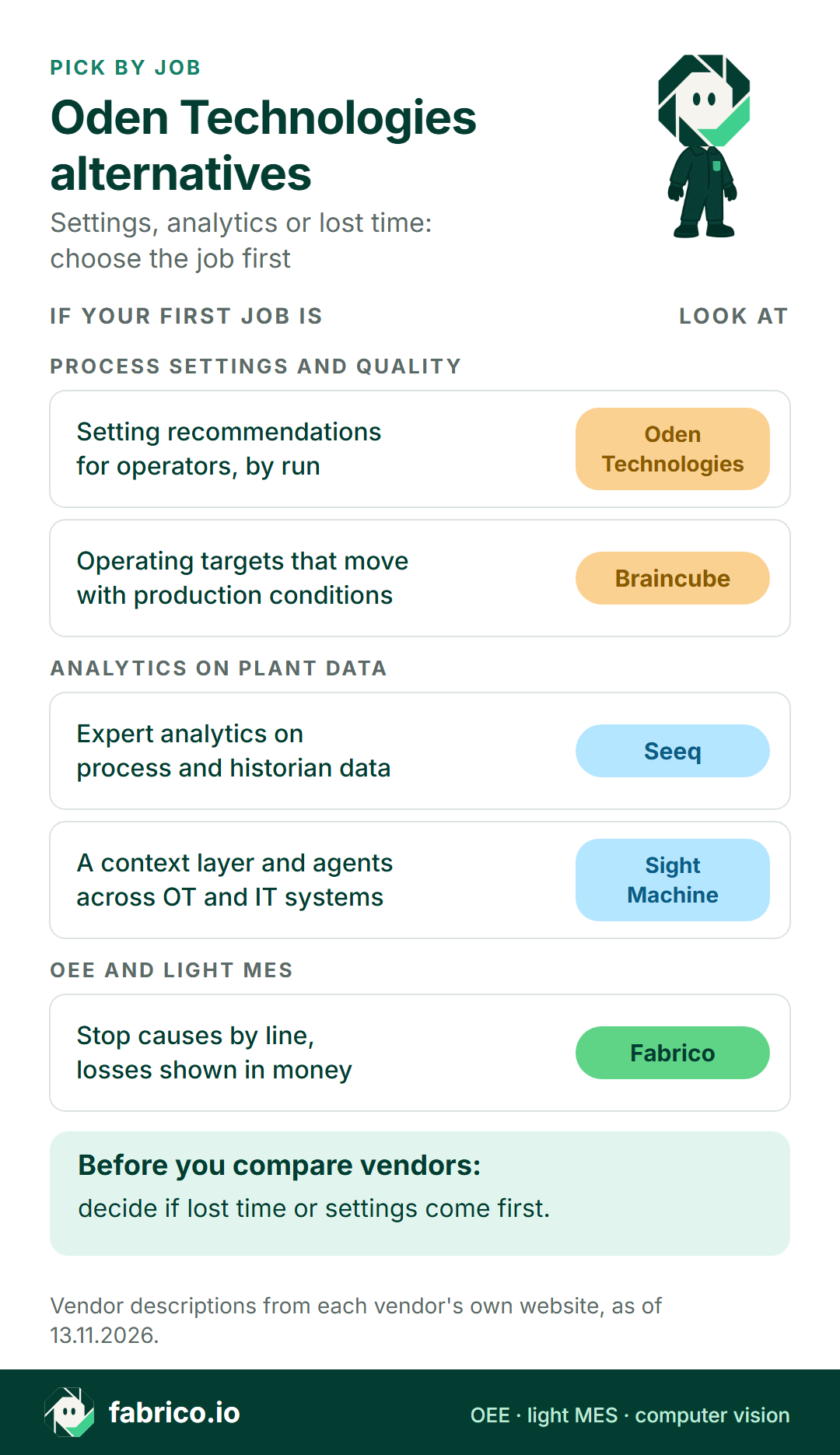
Text version of this infographic
- Pick by job: Oden Technologies alternatives. Settings, analytics or lost time: choose the job first.
- Process settings and quality: setting recommendations for operators, by run (Oden Technologies); operating targets that move with production conditions (Braincube).
- Analytics on plant data: expert analytics on process and historian data (Seeq); a context layer and agents across OT and IT systems (Sight Machine).
- OEE and light MES: stop causes by line, losses shown in money (Fabrico).
- Before you compare vendors: decide if lost time or settings come first.
- Vendor descriptions from each vendor's own website, as of 13.11.2026.
Questions to settle before you choose
Ask every option the same, us included.
- Where is the bigger loss? Stopped time and changeovers, or speed and scrap while running?
- Which signals are needed, and does a historian already hold them?
- Who acts on the output? The operator at the line, the process engineer, or the plant manager.
- How are stop reasons captured, and how is OEE defined for changeovers?
- How does data leave to the ERP or to another analytics tool?
If the plan is to add MES functions later, read light MES vs full MES; plastics plants can also see MES for plastics injection moulding.
What people ask next
What does Oden Technologies do?
Oden describes AI for manufacturing optimization. Its suite has a Data Engine that cleans and contextualizes plant data, Process AI that sends setting recommendations and quality predictions to operators, Factory Analytics for monitoring and reports, and Forge AI agents.
Is Oden Technologies OEE software?
Oden's pages cover both sides. Its Process AI page is about process settings and quality on a running line, while its downtime page describes capturing downtime reasons to improve OEE, and Factory Analytics compares shifts, lines and factories.
Can process AI and OEE software run on the same line?
Yes. They read the same machine data and answer different questions: where the time and output went, and whether the running line is at its best settings. Data can move between them through APIs or exports.
How is Fabrico different from Oden Technologies?
Oden's Process AI recommends process settings to operators. Fabrico is a cloud OEE and light MES platform that measures where an extrusion line's time and output went: stops and output come from the PLC, a Fabrico IoT device or the camera add-on, operators name the cause on a tablet or phone, and the losses are priced in money. Fabrico does not tune process settings.
Why can an extrusion line lose output while it is running?
Because OEE counts speed and scrap as well as stops. In the sample shift on this page, the line ran at about 18 of an ideal 20 metres a minute, which cost 740 metres, and scrapped 222 metres after the changeover; the 80 stopped minutes cost another 1,600 metres of potential pipe. Together they leave an OEE of 71.5%.
A Fabrico demo walks through the stopped and running time of a sample extrusion line, which helps settle the pipe plant debate with numbers; for anything else, contact us.
Related articles











Real Fabrico tiles, sample data.