


 Login
 Blog
Redzone vs L2L: Operator Maintenance, TPM and OEE Compared

In short: Redzone and L2L both route a problem seen at the line to maintenance, from different starting points. Redzone calls itself AI manufacturing software for frontline teams, and its Reliability module lets operators submit a maintenance request from the line and run TPM operator care, CILs included. L2L calls its platform a Connected Manufacturing Operations platform, and its CMMS pages describe Operator Care for autonomous maintenance, with a Dispatch sent to maintenance when an operator check turns up a problem for a technician. Both also report OEE; the real choice is which routine goes on a tablet first.
- Operator requests: Redzone, a request from the line in seconds; L2L, a Dispatch from the AM check.
- TPM: Redzone builds on TPM principles with CILs and personal observations; L2L names Autonomous Maintenance as a TPM pillar.
- OEE: Redzone, live OEE by line, cell and shift; L2L, the Six Big Losses in real time.
- Sources: rzsoftware.com (Redzone's own site) and l2l.com, as of 14.11.2026.
This search tends to start after a bad night. An operator heard a bearing growl at 2 a.m., told the shift lead, and the note never reached maintenance. Redzone and L2L both pitch a tablet at the line as the cure, in different words that show where each product began.
Key takeaways
- Both products route an operator's observation to maintenance: Redzone as a request from the line, L2L as a Dispatch from an autonomous maintenance check.
- L2L's notification page publishes a timed escalation ladder; Redzone's Reliability page describes immediate alerts to the right technicians and CIL checks triggered by shop-floor events.
- Both report OEE, so the deciding test is the maintenance route and the shift routine around it, run on one machine.
- Write one planned-downtime rule for operator care time before any pilot; in the sample bakery shift below it moves availability from 88.0% to 90.9%.
- Price lost minutes with the plant's own margin: in the sample shift, the OEE gap is worth EUR 222.80 at a made-up margin of EUR 0.04 a piece.
Fabrico, which builds cloud OEE and light MES software, is covered separately toward the end.
Redzone vs L2L at a glance
Cells paraphrase each vendor's own pages as of 14.11.2026, linked further down.
| Job | Redzone | L2L |
|---|---|---|
| How each describes itself | AI manufacturing software for frontline teams | A Connected Manufacturing Operations platform |
| Operator raises a maintenance issue | Operators submit a request from the line in seconds | A Dispatch goes to maintenance when an AM check finds a problem |
| TPM and operator care | Builds on TPM principles: operator care, CILs, personal observations | Operator Care for basic autonomous maintenance tasks, a TPM pillar |
| Breakdowns | Immediate alerts to the right maintenance technicians | Alert at once, then timed escalation up to the plant manager |
| PMs and work orders | Mobile alerts, guided digital checklists, PM compliance tracked | PMs by time, cycle or condition; work orders with routing and cost accounting |
| OEE and losses | Live OEE by line, cell and shift; Pareto charts of top losses | OEE calculated in seconds; the Six Big Losses in real time |
| Guiding the shift | Digital huddles, handover notes, SOPs at the point of use | Visual work instructions, digital checklists, a skills matrix |
| Connections | QAD, SAP, Oracle, Infor M3 and other ERPs; open REST API; CSV import | ERP, MES, spare parts and scheduling tools; SCADA/OPC and IIoT data |
What Redzone offers for frontline teams and reliability
As of 14.11.2026, the Redzone homepage headlines AI manufacturing software for frontline teams, with Productivity, Compliance, Reliability, Learning, Scheduling and Analytics modules plus an assistant called ChampionAI. The product pages describe:
- Reliability. The Reliability page, titled "CMMS That Connects Maintenance to the Production Floor", lets operators submit a request from the line in seconds. It builds on TPM principles, guiding operator care including CILs and personal observations, with CIL checks triggered from real shop-floor events. Breakdowns that need repair alert the right technicians at once; they get guided digital checklists, PM compliance is tracked automatically, and work orders are prioritised by urgency.
- Productivity and OEE. The Productivity page promises live OEE tracking for every line, cell and shift. Downtime and throughput are collected automatically and timestamped, operators add context from the line, and Pareto charts rank losses by frequency and duration. Digital huddles and handover notes carry issues across shifts.
- Compliance. The Compliance page offers digital inspections tied to live production and digital HACCP checks.
- Integrations. The integrations page names QAD, SAP, Oracle, Infor M3 and other major ERPs, an open REST API and CSV import, and also lists MaintainX for parts inventory. Devices: web, iOS and Android.
Ask Redzone: how a line request becomes a work order, and how the operator hears it was closed.
What L2L offers for dispatch, maintenance and production
The L2L homepage, as of 14.11.2026, presents a Connected Manufacturing Operations platform with five pillars: Execution AI, Shop Floor Execution, Maintenance, Production and Skills. Its product pages describe:
- CMMS and TPM. The CMMS page calls Autonomous Maintenance a pillar of TPM and offers Operator Care (OC) for basic AM tasks, guided step by step on mobile devices. When an AM check turns up an issue that needs a technician, a Dispatch can go to the maintenance team. PMs run on time intervals or usage cycles, and spare parts carry low inventory notifications.
- Maintenance management. On the maintenance management page, a downed machine raises an alert to the assigned responder, and long changeovers escalate. PMs trigger by time, cycle or condition, and work orders carry routing and cost accounting.
- Notifications. On the factory notification page, an issue is logged once and the right person hears. Its sample ladder reaches the line lead at once, the supervisor at 30 minutes, the area manager at one hour and the plant manager at four hours, by email, text, Microsoft Teams, WhatsApp or browser.
- Production and guidance. The production management page calculates OEE in seconds and tracks the Six Big Losses live, from PLCs and SCADA or operator entry. The connected workforce page adds visual work instructions, digital checklists and a skills matrix on browser, Windows, Mac, Android and iOS, and the integrations page names ERP, MES and scheduling tools plus SCADA/OPC and IIoT data.
Ask L2L: which escalation ladder ships by default, and who edits it later.
Operator-triggered maintenance and TPM, job by job
This buyer usually runs TPM on paper and wants the operator's observation to reach a technician without a phone call.
Daily operator care. Redzone speaks of CILs and personal observations; L2L of Operator Care, guided on a mobile device. Ask each to build a CIL route for one machine and show what happens when a step is skipped.
From the line to maintenance. Redzone puts the operator request up front. L2L ties it to the AM check, which sends a Dispatch when a technician is needed. Count the taps in both.
Response and escalation. Redzone alerts the right technicians when a breakdown needs repair. L2L publishes a timed ladder and names its channels. Ask both to replay a night-shift breakdown nobody acknowledges for 40 minutes.
Planned work and OEE. Redzone tracks PM compliance; L2L adds cost accounting and spare parts alerts. Both report OEE. If a separate CMMS already holds the asset register, settle which system owns the work order, or technicians get two queues.
What a slow route from line to technician costs
Maintenance is a large line in any plant budget, and the route from operator to technician decides how much of it goes on breakdowns. A NIST report on the economics of manufacturing machinery maintenance (accessed 14.11.2026) states that in 2016, US manufacturers spent $50 billion on reported maintenance and repair, a Census-based figure that excludes internal spending on labour and materials. The same report puts maintenance at between 15% and 70% of the cost of goods sold, a range wide enough that every plant has to measure its own.
NIST also cites survey data from Sweden estimating that downtime takes 13.3% of planned production time. That is one country's survey, quoted second hand, so read it as a sense of scale and not as a benchmark for a bakery or a bottling hall.
Safety regulators stress the same reporting route. The UK Health and Safety Executive's guidance on maintenance of work equipment (accessed 14.11.2026) suggests a planned maintenance programme "as well as having a reporting procedure for workers who may notice problems while working on machinery". It adds that under PUWER, where any machinery has a maintenance log, the log is kept up to date. Ask both vendors how a closed work order becomes that machine's maintenance record.
Lean practice built this route long before tablets. The Lean Enterprise Institute's andon entry (accessed 14.11.2026) describes a light tripped when a machine sensor detects a problem or an operator pulls a cord or pushes a button, and says the lit number calls for a quick response from the team leader. Redzone's request from the line and L2L's escalation ladder are digital versions of that cord. The pilot question is whether the response is as quick as the cord was.
Match the first job to Redzone, L2L or both
If operators see problems and maintenance hears late, both fit; time the same request scenario in each.
If the first job is the team routine around the shift, with huddles, handover notes, coaching and learning beside maintenance requests, Redzone's pages are written around that.
If the first job is dispatch with a timed escalation ladder and PMs by cycle or condition, L2L's pages spell that out in detail.
If both end up in one plant, pick one home for the asset register, the work order and the stop reason list before go-live. The wider choice is covered in light MES vs connected worker platform.
Decision matrix: Redzone or L2L for your plant
Each row starts from a situation a maintenance or CI manager will recognise. "Look first at" names the product whose own page spells that job out in detail; the other may handle it too, so the last column is the test that settles it. Vendor pages were read on 14.11.2026 for every row.
| If this is you | Look first at | Why (vendor page) | Prove it in the pilot by |
|---|---|---|---|
| Operators notice faults, but maintenance hears about them hours later | Both, side by side | Requests from the line in seconds (Redzone Reliability); a Dispatch from an AM check (L2L CMMS) | Timing one staged request from the first tap to a technician's acknowledgement |
| Night-shift breakdowns sit unanswered | L2L | A published ladder from line lead to plant manager at four hours (L2L notifications) | Leaving a test alert unacknowledged and logging who is told at each step |
| CIL checks should follow what the machine actually did | Redzone | CIL checks triggered from real shop-floor events (Redzone Reliability) | Linking one machine event to a CIL and watching the check reach the tablet |
| PMs should run on cycles or condition, with cost per work order | L2L | PMs by time, cycle or condition; work orders with cost accounting (L2L maintenance) | Running a cycle-count PM on one asset and reading the cost on the closed order |
| Huddles and shift handovers are the weak link | Redzone | Structured digital huddles and handover notes for the incoming shift (Redzone Productivity) | Running two real huddles in the tool and checking what the next shift sees |
| Only qualified operators may do certain AM tasks | L2L | L2L's dynamic skills matrix checks that people hold the skills for a machine or process (L2L connected workforce) | Showing where the skills check sits before an AM route is assigned |
| The ERP is QAD, SAP, Oracle or Infor M3 | Redzone | Those ERPs are named, plus an open REST API (Redzone integrations) | Showing the named ERP connection live with the plant's own codes |
| Machine data already flows through SCADA, OPC or IIoT | L2L | SCADA/OPC and IIoT data that can trigger condition-based workflows (L2L integrations) | Reading one live tag into a downtime event on the pilot machine |
| A separate CMMS keeps the asset register | Both, side by side | MaintainX listed for parts inventory (Redzone); spare parts tools named (L2L) | Agreeing which system owns the work order before the trial starts |
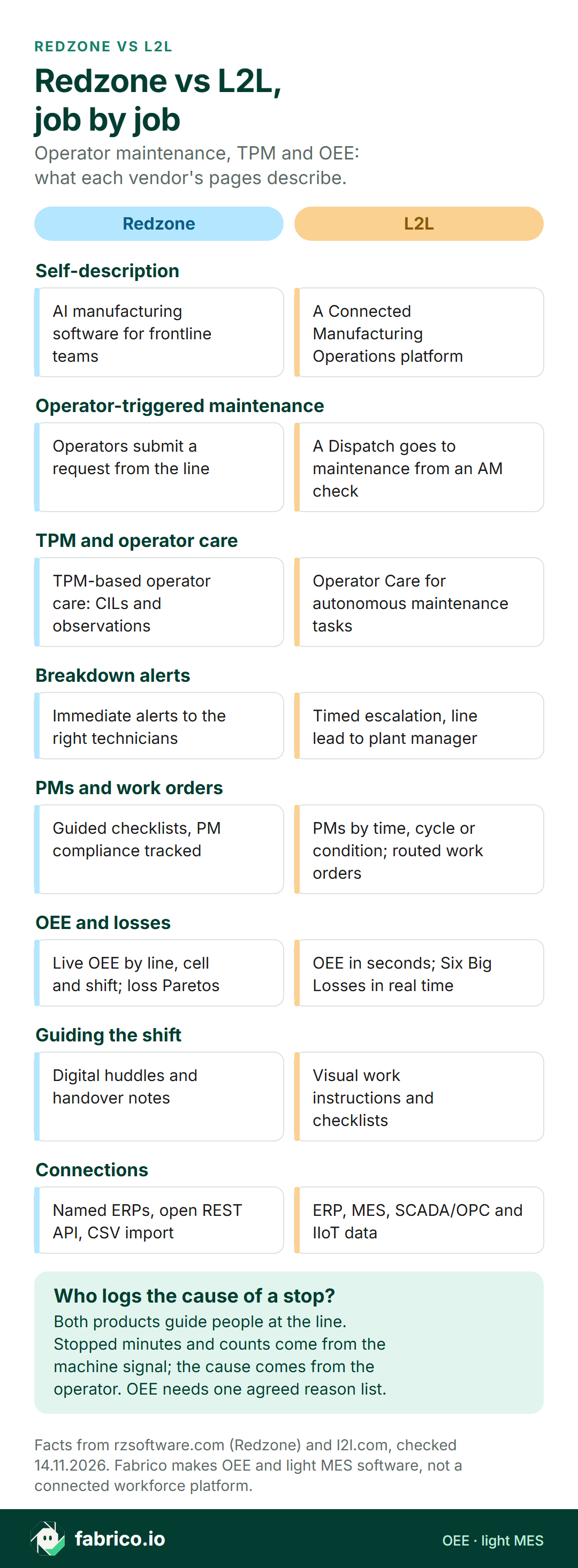
Text version of this infographic
- Self-description. Redzone: AI manufacturing software for frontline teams. L2L: A Connected Manufacturing Operations platform.
- Operator-triggered maintenance. Redzone: Operators submit a request from the line. L2L: A Dispatch goes to maintenance from an AM check.
- TPM and operator care. Redzone: TPM-based operator care: CILs and observations. L2L: Operator Care for autonomous maintenance tasks.
- Breakdown alerts. Redzone: Immediate alerts to the right technicians. L2L: Timed escalation, line lead to plant manager.
- PMs and work orders. Redzone: Guided checklists, PM compliance tracked. L2L: PMs by time, cycle or condition; routed work orders.
- OEE and losses. Redzone: Live OEE by line, cell and shift; loss Paretos. L2L: OEE in seconds; Six Big Losses in real time.
- Guiding the shift. Redzone: Digital huddles and handover notes. L2L: Visual work instructions and checklists.
- Connections. Redzone: Named ERPs, open REST API, CSV import. L2L: ERP, MES, SCADA/OPC and IIoT data.
- Who logs the cause of a stop? Both products guide people at the line. Stopped minutes and counts come from the machine signal; the cause comes from the operator, and OEE needs one agreed reason list.
Where OEE fits beside Redzone or L2L
TPM and OEE share a root. The Lean Enterprise Institute lexicon (accessed 14.11.2026) says TPM involves operators in routine maintenance, improvement projects and simple repairs, such as lubricating, cleaning, tightening and inspecting. Its OEE entry (accessed 14.11.2026) calls OEE a TPM measure of how effectively equipment is being used: Availability Rate x Performance Rate x Quality Rate = OEE. Operator care is the input; OEE shows whether it paid off.
ISA-95 (also IEC 62264; accessed 14.11.2026) is, per ISA, aimed at integrating logistics systems with manufacturing control systems; maintenance requests, dispatch and OEE sit in its operations layer between PLC and ERP. See the ISA-95 guide and the autonomous maintenance page.
| Signal | Feeds | Context added by |
|---|---|---|
| Run and stop from the PLC or sensor | Availability minutes | The operator, who picks the cause |
| Count from the machine or a counter | Performance against ideal rate | Whoever owns the ideal rate per product |
| Reject signal from a checkweigher or inspection unit | Quality | Quality staff, who sort rejects by type |
Where Fabrico fits beside Redzone or L2L
Fabrico is a cloud OEE product with light MES functions. It does not offer a connected workforce suite, SCADA, connectivity software or inspection vision. Beside Redzone or L2L, its job is the stop clock, the cause and the OEE figure. Per the MES and OEE overview:
- Machine state and counts arrive from a PLC, sensor or counter.
- The cause of a logged halt is picked by the operator beside the machine, on a phone or tablet.
- Lost time and OEE per line and shift, each loss valued in money, on web, iOS and Android.
- Maintenance from the stop: a work order opens from a logged stop in one tap, and you can set chosen stop reasons to create that work order automatically as soon as the reason is logged.
- The camera add-on counts output where a manual step or older machine has no usable signal. When a stop falls inside a camera's view, its minute of video opens from the shift timeline, streamed on request and not stored, while stop reason suggestions from the camera add-on are on the Roadmap (computer vision add-on).
- Figures go out by REST API, by webhooks, or as an Excel or CSV file.
Fabrico claims no ready-made connector to Redzone or L2L; if one of them keeps the frontline routines while Fabrico holds OEE, prove that hand-off in a pilot. Direct pairings: Fabrico vs L2L, Redzone alternatives and L2L alternatives. Packaged OEE tools are compared in the OEE software guide.
To see a logged stop turn into a work order on a real OEE screen, book a demo.
Worked example: a roll divider on a bakery bun line
Sample data invented for this page: it shows the method, not a real bakery or a product screen. A divider-rounder cuts dough into pieces for burger buns and feeds a proofer, with a checkweigher after it. The shift runs 525 minutes; 40 minutes of breaks leave 485 planned minutes. At an ideal 50 pieces a minute, the divider could make 24,250.
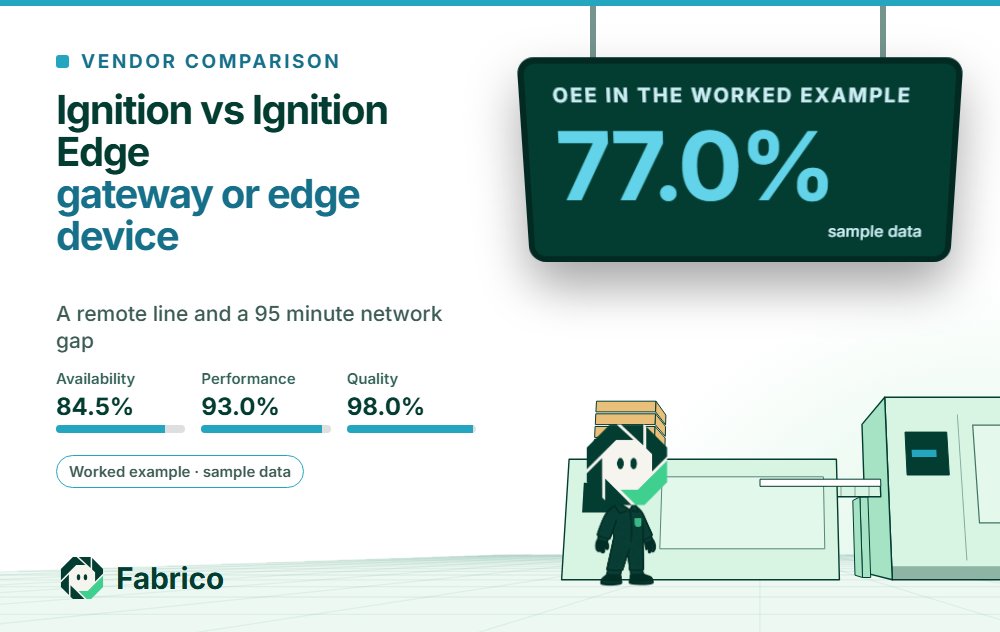
The divider's PLC records 58 stopped minutes, so run time is 427 minutes and availability is 427 / 485 = 88.0%. In 427 minutes the ideal is 21,350 pieces; the divider made 19,100, so performance is 19,100 / 21,350 = 89.5%. The checkweigher rejected 420 off-weight pieces, leaving 18,680 good, so quality is 18,680 / 19,100 = 97.8%. OEE is 88.0% x 89.5% x 97.8% = 77.0%, and 18,680 / 24,250 also gives 77.0% (OEE calculation).
The PLC records that the divider stood for 58 minutes; people add the split: 17 minutes waiting for dough from the mixer, 15 on the CIL clean and oil, 14 clearing knife jams, 8 waiting for a technician after an operator heard a noisy bearing, 4 not coded. That 8 minute stop is the operator-triggered case. In a Redzone setup it starts as a request from the line; in L2L, as a Dispatch to maintenance.
One rule changes the figure. The CIL work is planned operator care done inside the shift. Count it as planned downtime and planned time drops to 470 minutes, stops to 43, and availability rises to 427 / 470 = 90.9%. Either rule works if it is written down once. Bakery lines with hand stations are covered in computer vision for bakeries.
The same shift in euros. Assume a sample contribution margin of EUR 0.04 per bun piece, made up for this page; use the plant's own figure. The divider could have made 24,250 pieces and made 18,680 good ones, so the shift lost 5,570 good pieces: 2,900 to the 58 stopped minutes (58 x 50), 2,250 to slow running (21,350 minus 19,100) and 420 to rejects. Rejected dough also costs ingredients, which a margin figure leaves out.
The 8 minute wait for a technician is 400 pieces at the ideal rate; at this shift's 89.5% performance and 97.8% quality, that is about 350 good pieces. The 17 minute wait for dough works out the same way at about 744. The table assumes two shifts a day, 21 production days a month and 250 a year, so 42 shifts a month and 500 a year.
| Sample data, EUR 0.04 a piece | Per shift | Per month | Per year |
|---|---|---|---|
| Whole OEE gap, 5,570 pieces | EUR 222.80 | EUR 9,357.60 | EUR 111,400 |
| Waiting for dough, about 744 pieces | EUR 29.76 | EUR 1,249.92 | EUR 14,880 |
| Waiting for a technician, about 350 pieces | EUR 14.00 | EUR 588 | EUR 7,000 |
The technician wait is the smallest row, yet it is the one a request from the line or a Dispatch exists to shorten, and a bearing nobody looks at can turn into a far longer breakdown. Put the plant's real margin into this table before the pilot, so the result of the trial reads in euros and not just in OEE points.
What to do this week
- Count last month's maintenance calls from the line. For each, note how it travelled (radio, paper, a word at shift change) and the minutes from report to technician on site. That number is the baseline both vendors have to beat.
- Pick one pilot machine and write its CIL route on one page, with the escalation wanted when a breakdown goes unanswered: who hears at once, who after 30 minutes, who after an hour.
- Send Redzone and L2L the same night-shift scenario: a bearing noise reported at 02:00 that nobody acknowledges for 40 minutes. Ask both to run it live on a tablet, not on slides.
- Write the two rules the OEE figure depends on: whether CIL time counts as planned downtime, and the stop reason list operators pick from. Give both vendors the same rules.
- Put a euro value on one lost minute of the pilot machine with the plant's real margin, as in the table above, so the pilot ends with a cost and not an impression.
Questions to ask Redzone and L2L
- How does a request raised at the line reach a technician, and how many taps does the operator need?
- Can a CIL or operator care check be triggered by a machine event, and what happens when a step is skipped?
- Who is alerted when a breakdown goes unacknowledged, and after how many minutes?
- Where does the stop reason list live, and who edits it in year two?
- Which signals feed the downtime timestamp, and what is needed on a machine without a PLC network?
- If the current CMMS stays, which system owns the work order and the asset register?
Packing consumer goods? The FMCG computer vision hub shows where a counting camera add-on helps at hand stations.
What people ask next
Do Redzone and L2L support operator-triggered maintenance?
Both describe it. Redzone's Reliability page says operators submit a request from the line in seconds. L2L's CMMS page says that when an AM check turns up an issue that needs a technician, the operator can send a Dispatch to the maintenance team.
How do Redzone and L2L handle TPM?
Redzone says its Reliability module builds on TPM principles, guiding operator care activities including CILs and personal observations. L2L calls Autonomous Maintenance a pillar of TPM and offers Operator Care, with step-by-step guides on mobile devices.
How do Redzone and L2L escalate a breakdown?
Redzone says breakdowns that need repair trigger immediate alerts to the right maintenance technicians. L2L describes a timed ladder, for example the line lead at once and the plant manager at four hours, with alerts by email, text, Teams, WhatsApp or browser.
Do Redzone and L2L calculate OEE?
Yes, per their pages. Redzone describes live OEE tracking for every line, cell and shift, with Pareto charts of top losses. L2L describes OEE calculated in seconds and a real-time view of the Six Big Losses; its data can come from PLCs and SCADA or from operator entry.
Can OEE run in a separate tool next to Redzone or L2L?
Yes. Fabrico, for example, reads machine state and counts from a PLC, sensor or counter, and the operator records why the machine stopped from a phone or tablet at the line. Results can be pulled through the REST API, pushed by webhook or exported to a spreadsheet; prove any hand-off to Redzone or L2L in a pilot.
Want stop reasons, OEE and a one-tap work order on one screen before choosing between Redzone and L2L? Book a demo.
Related articles











Real Fabrico tiles, sample data.