


 Login
 Blog
Computer Vision for Tire and Rubber Manufacturing: Green Tires to Final Finish

In short: computer vision in tire manufacturing earns its place as a counter where no machine counts: cameras count green tires in the buffer and tires leaving final finish where no barcode scan does, and moulded rubber parts at deflashing and packing, while mixers, extruders, building machines and curing presses already give a signal.
- Defect checks, X-ray, uniformity and balance are inspection. That is a different system, and it keeps its own reject count.
- Tire losses hide in curing presses waiting for green tires, mould changes, material waits and micro-stops at the building machine.
- In rubber goods, the press counts shots, not good parts. The good count is made at the trimming table and the packing bench.
- Fabrico's camera add-on counts output and lets you open the video for any moment on the shift timeline. The operator adds the stop reason.
Your mixers, calenders and curing presses all have controls. Your trimming tables, inspection spreaders and packing benches have people.
This page is for plant managers, operations leads and CI engineers in tire plants and rubber goods plants who are choosing where to put cameras to count output and get OEE.
It shows where a camera earns its place, where the machine signal is enough, and what to ask each vendor.
Computer vision in tire manufacturing: two different jobs
Two kinds of camera system get sold to tire and rubber plants under one name. Inspection systems look for defects. OEE cameras count output and show you what happened at a stop.
Tire plants already run a lot of inspection: X-ray on truck tires, uniformity and balance machines, and trained people checking each tire by eye. Keep those apart from the OEE spec.
| Job in the plant | Inspection system | OEE camera |
|---|---|---|
| Bead, belt and ply defects | Yes, X-ray or vision | No |
| Uniformity and balance | Yes, test machines | No |
| Surface flaws on moulded parts | Yes, or a person at a lamp | No |
| Count tires or parts that move on | Counts what it tests | Yes, also at manual steps |
| Video of a stop or a wait | Reject images only | Open the video for that minute |
| Feeds OEE through | Its reject count | The output count |
The two work side by side. A uniformity or X-ray machine's reject count, read from its PLC or a counter signal, can feed the quality part of OEE, so a held tire is counted once.
Where the losses hide in tire and rubber plants
Tire making is usually split into three steps, as a 2020 arXiv preprint on tire curing scheduling from the University of the Republic in Uruguay puts it: material mixing, tire building, and curing or vulcanization. Rubber goods plants share the first step and then mould, trim and pack.
In the United States alone, the U.S. Tire Manufacturers Association says its members operate 55 facilities in 16 states.
Mixing, extrusion and calendering
Internal mixers such as Banbury machines run in batches, and the mixer control knows each batch start, drop and weight. Extruders make treads, sidewalls and apex. Calenders coat textile and steel cord. These lines run continuously, with line speed and metres in the control system.
Losses here are compound changes, start-up scrap, material waits and quality holds on a batch. A camera adds little. Read the signal, and give the operator a short list of reasons for waits.
Tire building machines
Building machines put inner liner, plies, beads and sidewalls together on the first-stage drum, then belts and tread on the second stage. Many are tended by an operator, and they lose time in short bursts: a splice that does not close, a bead that does not seat, the end of a component roll, a servicer waiting for material.
These stops are short and rarely written down. The machine PLC usually gives the cycle count and the run state, so use it for the count.
A camera helps here as a witness. When short stops jump on one shift, someone can open the video for those minutes and see whether it was the splice, the bead loader or the operator waiting for a cart. See micro-stops for how to group them.
Green tire handling
Between building and curing, green tires are moved on carts, racks or conveyors, often sprayed, and staged in front of the presses. Many plants label and scan each green tire, so check that first. Where the buffer has no scan, or the scan data never reaches OEE, this is where counts get lost: tires are made, but nothing counts them until a press loads them.
A camera at the green tire buffer counts tires going in and out. That tells you whether a press waited because the buffer was empty or because nobody loaded it.
Curing presses
The curing press is where tires get their shape, tread pattern and properties, using heat, pressure and a mould. The same arXiv paper notes that curing "has a large impact in the manufacturing efficiency", since it uses expensive equipment and a lot of energy.
Cure cycles are long. A 1988 Uniroyal Goodrich patent on curing press blowdown put a typical passenger tire cycle at about 15 minutes, and said 30 seconds saved per cycle could add up to a several million dollar advantage. That figure is old and from a patent, so read it as scale only.
Press controls know when a cure starts and ends, so use that signal. The losses to watch are the press waiting open for a green tire, mould changes with heat-up, bladder changes, mould cleaning, and cycles running longer than the recipe. Book each one with its own code.
Trimming, final finish and inspection
After curing, vents and spew are trimmed, and each tire is checked: by trained inspectors on spreaders and tables, and by uniformity, balance or X-ray machines. Some of those machines count, and many plants scan each tire's barcode at final inspection. Where the manual tables have no scan, nothing counts there.
A camera at the exit of final finish counts tires that move on to the warehouse. The gap between press count and that count is tires held, reworked or scrapped. Inspection stays with the inspection systems and the people doing it.
Rubber goods: moulding, deflashing and packing
Seals, gaskets, hoses, mounts and other moulded parts come off compression, transfer and injection moulding presses. The press counts shots. Good parts depend on how many cavities ran and how many parts survive trimming.
Deflashing is done by hand with knives at trimming tables, or in a cryogenic deflashing machine that runs in batches. Then parts are checked under a lamp and bagged or boxed by count, often by weight on a counting scale. The hand trimming and inspection steps have no machine signal.
The hand steps are where a camera pays off. It counts parts or trays leaving the trimming table and bags or boxes at packing, so output by hour stops being a guess. For more on cameras at manual steps, read computer vision for OEE at manual assembly.
Where a camera goes in a tire plant
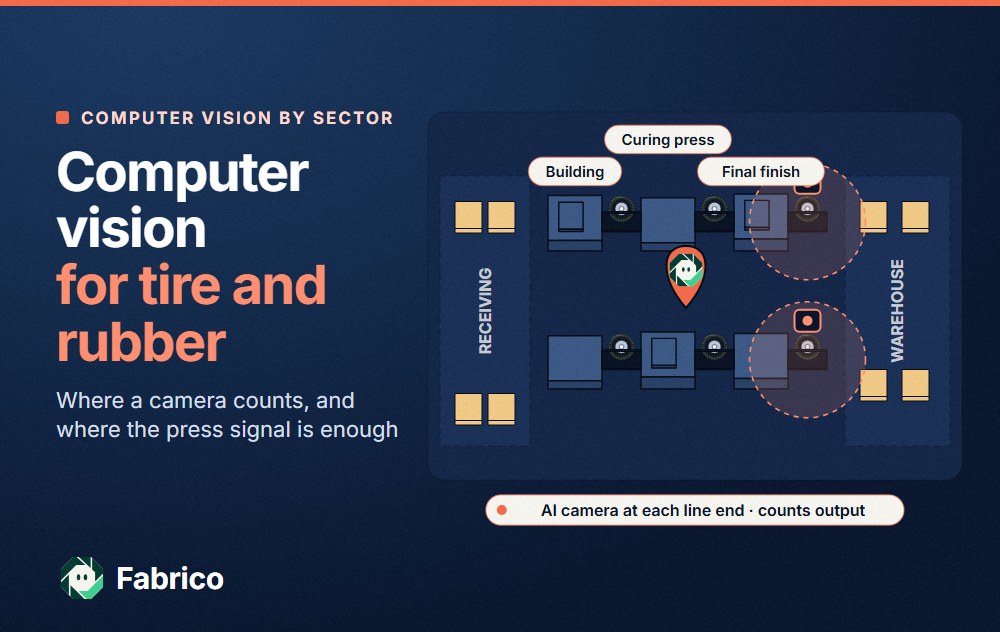
Here is one example: a passenger tire line and a moulded rubber goods cell.
For a longer list by machine type, see camera or sensor for OEE, machine by machine.
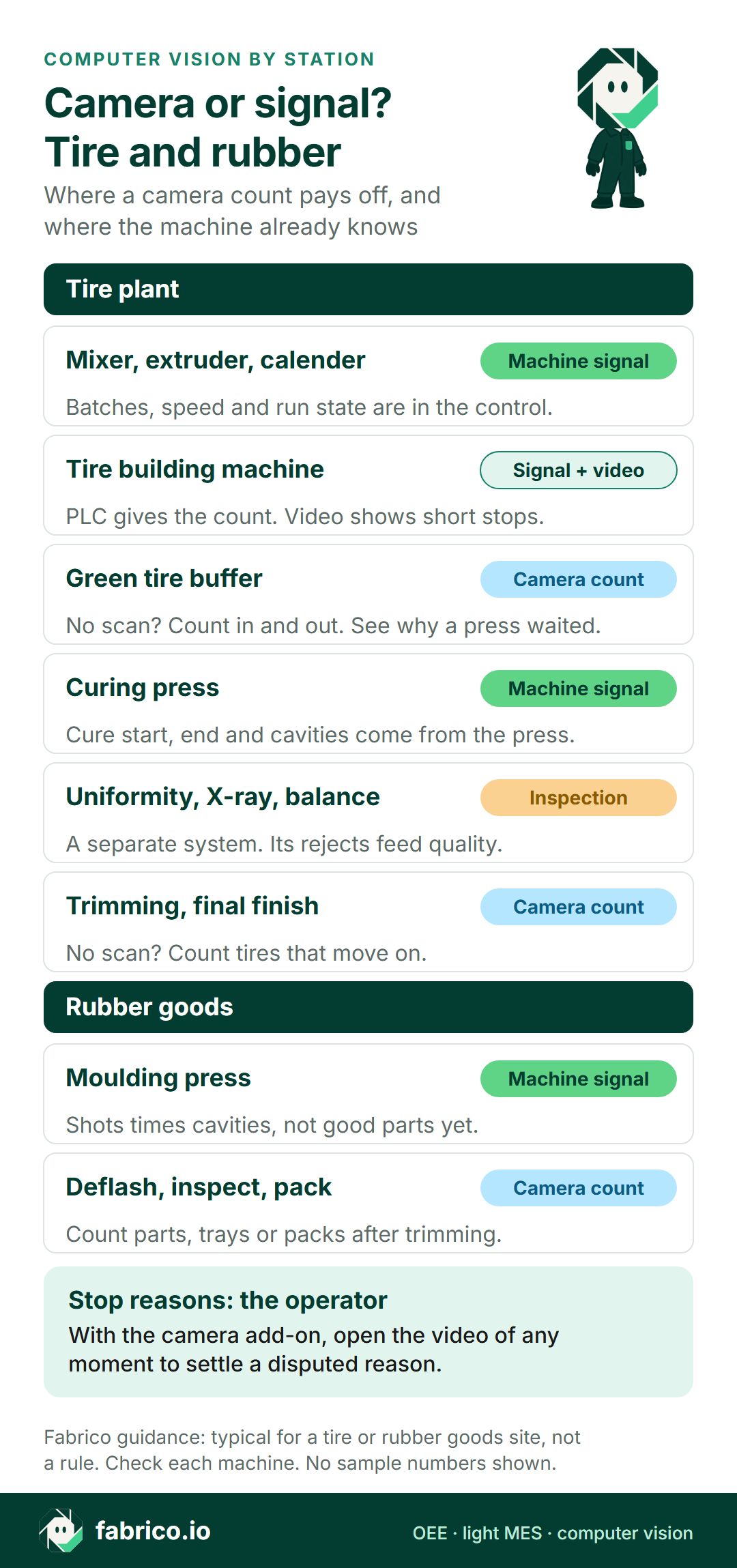
Camera, sensor or operator: station by station
This is typical for a tire or rubber goods site, not a rule. Check each machine.
| Station | Count and stops from | What a camera adds |
|---|---|---|
| Mixer, extruder, calender | Machine control: batches, speed, run state | Little. Use the signal. |
| Tire building machine | Machine PLC | Video of short stops, such as splices and bead loading |
| Green tire buffer | Barcode scan, if the plant has one | Count in and out, and video of press waits |
| Curing press | Press control: cure start, end, cavities | Little. Use the signal. |
| Uniformity, balance, X-ray | Its own pass and reject count | Nothing. Feed rejects to quality. |
| Trimming and final finish | People; a barcode scan in many plants | Count of tires that move on |
| Rubber moulding press | Press shot count | Little, unless cavities vary |
| Deflashing, inspection, packing | People, by hand | Count of parts, trays or packs |
| Stop reasons, all areas | The operator, on a tablet or phone | Video to check a disputed reason |
You rarely need a camera at every station. The card below shows where one pays off.
Bring your station list and one week of press and building machine stop sheets to a demo, and we will go through it station by station.
Worked example: one curing press shift
These are example numbers, and they describe no real plant. A two-cavity curing press with a 15-minute ideal cycle runs one 480-minute shift. At full speed it makes two tires every 15 minutes.
The press control gives the run state and the cure count. Final inspection, keyed to each tire's barcode, tells you how many of this press's tires were held or scrapped.
Stops took 120 minutes: one mould change 60, waiting for green tires 45 and a press fault 15. Run time is 360 of 480 minutes, so availability is 75%.
In 360 minutes the press could finish 24 cures, or 48 tires. It finished 22 cures, or 44 tires, so performance is 91.7%. The gap is 30 minutes of cycles running long.
Final inspection passed 43 of the press's tires and held one, so quality is 97.7%. That tire is 7.5 minutes of press time.
OEE is 75% x 91.7% x 97.7% = 67.2%. Check it the short way: 43 good tires of 64 possible in 480 minutes is also 67.2%.
Look at the 45 minutes of waiting. The press signal shows the press was open and idle. Only the green tire buffer count says why: the buffer was empty for most of that time, so the fix is upstream at the building machine, not at the press.
For rubber goods, the same logic applies. The press gives shots times cavities, the camera at the packing bench counts parts after trimming and inspection, and the gap is trim scrap and rejects.
Eight checks for any tire or rubber camera vendor
Run these with every vendor, and with us. Bring one real shift from last week as the test case.
| Ask | How to test the answer |
|---|---|
| How do you book press waits? | Ask to see a press waiting for a green tire as its own loss, split from a press fault. |
| How do mould changes show? | Ask for mould change and heat-up time by press, with minutes over standard. |
| What exactly does the camera count? | Tires, trays, bags or boxes? Ask how packs convert to parts per item. Run it next to a hand count or your counting scale. |
| Does it cope with heat, dust and black parts? | Ask what happens near presses and in carbon black dust, and how it counts black parts on a dark belt. |
| Where does each camera mount? | Ask for each position on a drawing, clear of press doors, loaders and forklift lanes. |
| Is video kept, and who can open it? | Ask where it lives, for how long, and who sees it. |
| How do inspection rejects get in? | Ask if the uniformity, X-ray or hand inspection count feeds quality, so a held tire counts once. |
| How do cavities and cycle times change by item? | Ask to see the ideal rate change with mould, size and cavity count on the shift timeline. |
Before you roll out across the site, test on one area first. See our guide to a computer vision OEE pilot, and our list of computer vision software for manufacturing OEE if you are still comparing.
Cameras, privacy and the works council
Trimming tables, inspection spreaders and packing benches are places where people work all shift, so a camera there will see them. Tell staff before any camera goes up. In many European countries, talk to the works council first.
Frame the camera on the product, the tires or the trays, not the crew. Report by area and shift, not by person. Ask each vendor, us included, what privacy masking is live today and what is still roadmap.
Fabrico's camera add-on counts product, not people. For a fuller checklist, read production line cameras without surveillance.
Where Fabrico fits
Fabrico is a cloud OEE and light MES platform. Here is what it does in a tire or rubber plant today.
- Stops and counts: from the machine signal, through the press or building machine PLC, a sensor or a counter.
- Stop reasons: the operator adds them at the machine, on a tablet or phone.
- OEE and losses: OEE, downtime and losses by line, press and shift, with losses shown in money. On the web, iOS and Android.
- Cameras, an add-on on request: the AI camera add-on counts output, including at green tire buffers, trimming tables and packing benches where no scan or machine signal counts. With the add-on, you can open the camera video for any moment on the shift timeline. In the standard setup, video is streamed on request, not stored in Fabrico.
- Your data: it leaves through a REST API, webhooks and Excel or CSV export.
Roadmap, not live today: stops detected by the camera, jam zones on the video, and a camera suggesting a stop reason.
What Fabrico does not do: inspection, which stays with your X-ray, uniformity and vision systems and feeds Fabrico's quality figure through a reject signal or counter. Fabrico does not control your presses or recipes. For planning and scheduling, ask us in the demo.
For the full product, see Fabrico computer vision for OEE. If you are still comparing platforms, read our guide to OEE software and our review of OEE software for rubber and tire manufacturing. All eight checks above apply to us too.
Bring one shift of press data and a stop sheet from a building machine to a demo, and ask us to show which numbers we can fill and which we cannot.
What people ask next
Which station in a tire plant should get the first camera?
Usually the one with the weakest count: a manual trimming or final finish area, or a green tire buffer, where no barcode scan counts the tires. Curing presses and building machines with a PLC count you trust come last.
Can a camera find defects on tires or moulded rubber parts?
That is an inspection system, not an OEE camera. X-ray, uniformity, balance and surface defect checks are inspection jobs. Fabrico does not sell inspection. An inspection system's reject count can feed the quality part of OEE.
Does the curing press not already give the count?
Usually it does. The press control knows when a cure starts and ends, and how many cavities ran. Use that signal. A camera earns its place before and after the press, where tires are moved and checked by hand.
Can a camera count small moulded parts after deflashing?
Often, yes, if the parts leave the trimming table in a way a camera can see, such as in trays, on a belt or into a bag at the packing station. Test it next to a hand count for each part family before you trust it.
Is the camera video stored?
Not in Fabrico. With the camera add-on, video is streamed on request in the standard setup, and you can open it for any moment on the shift timeline. Ask every vendor where their video lives.
What drives the cost of computer vision in a tire or rubber plant?
Pricing is set per quote. The drivers are the number of lines, presses and cameras, mounting in hot and dusty areas, the network to the hall, and training. Give each vendor the same station list so the quotes compare.
Want to see it on a line like yours? Book a demo and bring one shift from a curing press or a trimming table.
Related articles










Real Fabrico tiles, sample data.