


 Login
 Blog
Flour Mill Software: ERP, Mill Control and OEE, Sorted

In short: flour mill software is a set of separate systems. A wheat mill runs mill control or SCADA for the rolls, sifters and bins, lab records for ash, moisture and protein, blend and treatment control, a flour mill ERP for wheat, lots, orders and invoices, a warehouse and dispatch system for bags and tankers, and an OEE and light MES layer on the packers. The right first purchase depends on whether you are missing records or missing hours.
- The ERP is the business record: contracts, lots, stock and costs. It is not a floor system, and it does not see the packer stop.
- Most of the mill, from cleaning to the plansifters, already runs under its own control system.
- Extraction rate and ash are lab and QA figures. Line software should not pose as their source.
- Bagging lines for 1 to 50 kg sacks are where Fabrico measures OEE, plus run and stop time on machines with a signal.
A flour mill is a long chain of machines with very few people. Wheat arrives by truck or rail, is cleaned and tempered, then passes through break and reduction roller mills, plansifters and purifiers, often for hours with nobody touching it. The flour streams are blended, treated, and then packed into bags or blown into bulk tankers.
Searches for flour mill software or flour mill ERP software turn up suites that promise all of it. A mill buys several products instead, and the real choice is the order in which to fix them.
Fabrico covers one of them: measuring OEE, with a light MES, on the packing and bagging lines, and run and stop time on any machine with a signal. Mill control, lab records and the ERP are other products, and this page says which.
Flour mill software, system by system
Each system in a flour mill answers one question. The control system asks whether the flow is right. The lab asks whether the flour is right. Finance reads the ERP for money and stock. Operations needs the line layer to see why the packer was idle.
| System | Its job in a flour mill | Owner | Fabrico? |
|---|---|---|---|
| Mill control or SCADA | Runs intake, cleaning, tempering, roller mills, sifters, conveyors and bins, with alarms and interlocks | Head miller, automation | No |
| Intake and weighbridge | Truck weights, wheat samples, bin allocation | Intake, QA | No |
| Mill lab records | Ash, moisture, protein and other flour tests, extraction rate per run | QA lab | No |
| Blend and treatment control | Flour stream blending, enrichment and improver feeder rates | Head miller, QA | No |
| Flour mill ERP | Wheat contracts, lots, stock, orders, invoices, costing | Finance, sales | No |
| WMS and dispatch | Bag stock, bulk bins, tanker loading, delivery notes | Logistics | No |
| OEE and light MES | Run time, stops and counts at the packers, palletiser and machines with a signal | Operations, CI | Yes, this is where Fabrico works |
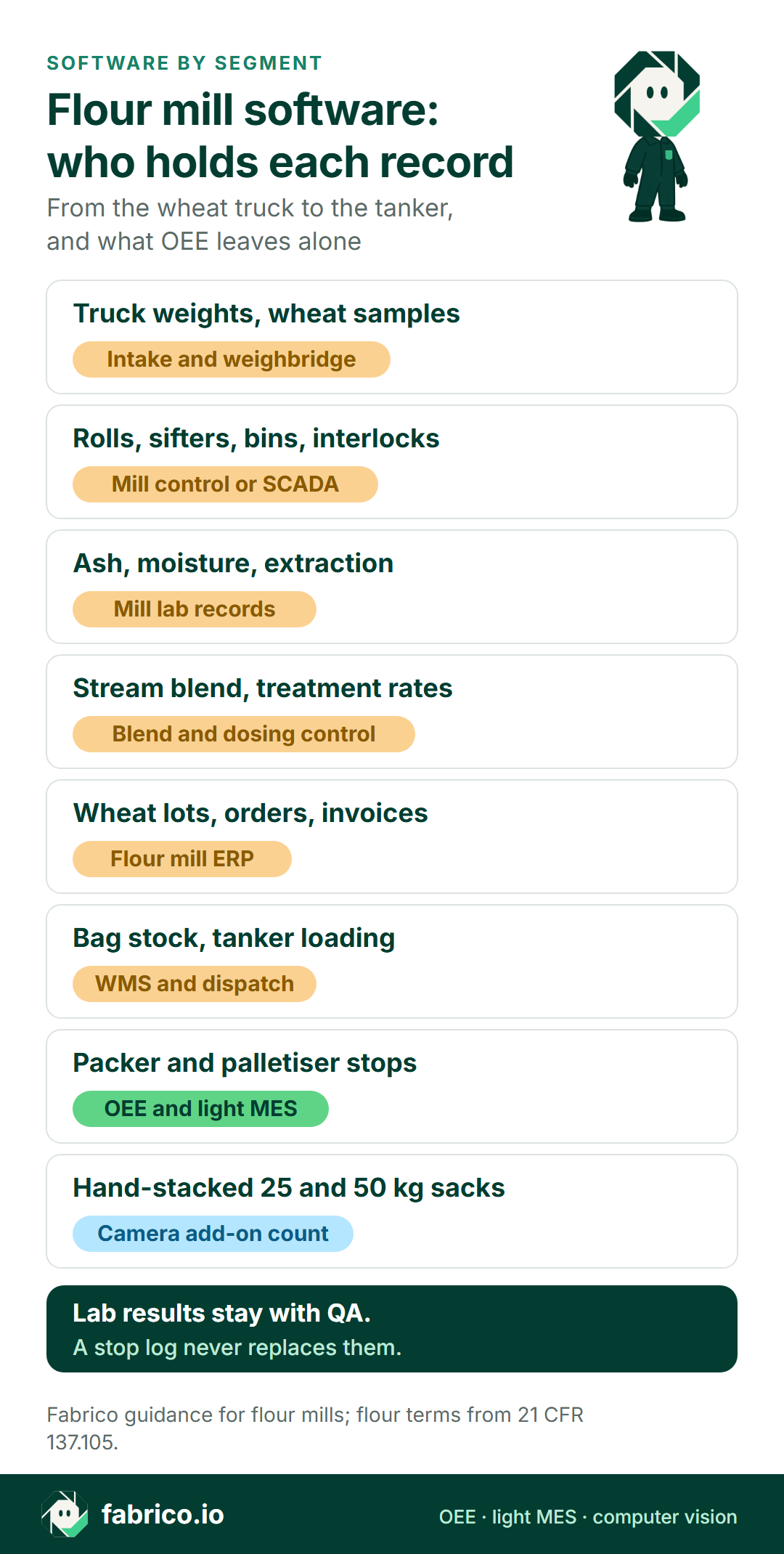
Text version of this infographic
- Truck weights and wheat samples: intake and weighbridge software.
- Rolls, sifters, bins and interlocks: mill control or SCADA.
- Ash, moisture, protein, extraction: mill lab records.
- Stream blend and treatment rates: blend and dosing control.
- Wheat lots, orders, invoices: flour mill ERP.
- Bag stock and tanker loading: WMS and dispatch.
- Packer and palletiser stops: OEE and light MES (where Fabrico works).
- Hand-stacked 25 and 50 kg sacks: camera add-on count.
- Lab results stay with QA; a stop log never replaces them.
Mill control and SCADA
The mill control system is the mill's nervous system. It starts and stops the cleaning section, sets tempering water, runs the roller mills, plansifters and purifiers in sequence, moves stock between bins and trips the line when a choke or a high level is seen. It usually comes with the mill equipment or from an automation integrator. A floor layer should read from it, never run it.
Lab records: extraction rate and ash
Whether the flour is right is a lab question. The lab tests moisture, ash and protein on wheat and on flour, and the extraction rate comes from wheat in against flour out over a run. These are QA records, owned by the lab, with their own methods and sign-offs. Fabrico does not measure yield or extraction, and no line monitoring tool should claim to.
Blending and treatment
Bakery, biscuit and household flours are blends of streams and sometimes of wheats, and many are treated: enrichment, improvers, ascorbic acid, or bleaching where it is allowed. Feeder rates and blend ratios sit in the mill control or a dedicated dosing system, and the proof that the dose was right sits with QA.
Flour mill ERP software: what it does, and what it does not
Flour mill ERP software is the business record of the mill. It holds wheat purchase contracts and intake tickets, flour products and specs, customer orders, lots, stock in bins and bags, invoices and costs. Some ERPs for milling add a grist calculator or a link to the lab. It is the right home for anything finance or sales must sign.
What an ERP does not do is watch the floor during the shift. It counts the bags packed per product once the run is booked. It rarely shows that the 25 kg packer stood for 40 minutes because the flour bin ran empty, or that a sewing head jammed nine times. That is the job of an MES or OEE layer, which reads machine signals during the run. Our page on ERP vs MES covers the general split.
| Question | Flour mill ERP | OEE and light MES |
|---|---|---|
| How much wheat did we buy and grind? | Yes, from contracts and intake | No |
| What did this lot cost? | Yes, from stock and costing | No |
| How many bags did we pack? | After the run, per product | During the run, per packer |
| Why did the packer stop at 03:10? | No | Yes, signal plus operator reason |
| What was the extraction rate? | From lab and stock figures | No, a lab record |
So the ERP and the floor layer do not compete. The ERP sends products, bag sizes and orders to the line, and gets run hours, stop minutes and bag counts back.
What the flour rules ask for, and which system keeps the proof
US and UK rules show why lab and dosing records are their own category. Other countries have their own flour rules, so QA should name the ones that apply.
- Ash and moisture. Under 21 CFR 137.105, flour is freed from bran coat, or bran coat and germ, until its ash, on a moisture-free basis, is not more than 1/20 of the percent of protein plus 0.35. The same section says its moisture content is not more than 15 percent. Both are lab results.
- Bleaching on the label. 137.105 also says that when any optional bleaching ingredient is used, the label shall bear the word "Bleached". That decision links the dosing record, the product spec in the ERP and the bag artwork.
- Enrichment. 21 CFR 137.165 says enriched flour contains in each pound 2.9 milligrams of thiamin, 1.8 milligrams of riboflavin, 24 milligrams of niacin, 0.7 milligrams of folic acid and 20 milligrams of iron.
- UK fortification. The Bread and Flour Regulations 1998, as made, list the essential ingredients of flour in Schedule 1, for example calcium carbonate at not less than 235 and not more than 390 milligrams per hundred grams. Later amendments apply, so check the current text.
The lab and the dosing control prove these, not a stop log. The line layer adds only time: a lab hold that stops the packer gets its own reason, while the record stays with QA.
Packing line losses in a flour mill, briefly
The mill itself is a continuous process, so its losses show as low throughput and unplanned shutdowns, chokes in spouts or sifters and stops for roll changes. Most of the stop time a buyer can see sits in the packhouse. Valve bag packers and open-mouth baggers jam, sewing and sealing heads fault, check weighers reject, and palletisers block the line. Packers also stand starved when the flour bin above them runs low, which is a mill problem showing up at the packer. Product changes between flours, and bag size changes from 1 kg packs to 25 kg sacks, take time too. For how OEE treats continuous and batch steps, see OEE for batch processes.
Which flour mill software to buy first
Start with the pain that costs the most today. An open audit finding on treatment or labelling comes before anything else. Beyond that, a mill weighs better lab and dosing records against a floor layer on the packers.
The sales mix changes the order. A mill selling mostly bulk flour by tanker puts the lab, dosing and dispatch first. A mill with retail packs and many sack sizes loses more hours in the packhouse, so the floor layer pays sooner.
A week of packing shift reports is enough for a demo: we show what Fabrico would record and what stays with the mill control, the lab and the ERP.
Worked example: one complaint about a weak bakery flour
An invented case, from no real mill. A bakery reports that two pallets of 25 kg bread flour made weak dough. QA has to show which wheat went into the grist, the blend and treatment rates, the lab results for that lot, which pallets went where, and when the packer ran. The answers sit in five places.
| Record | Held in | Where the hand-off breaks |
|---|---|---|
| Wheat bins and grist | Intake records, mill control | Bin switched mid-run, not logged |
| Blend and improver rate | Blend and dosing control | Feeder refilled by hand, rate not checked |
| Protein, ash and moisture | Mill lab records | Sample time not matched to the lot |
| Lot, pallets and customer | ERP and WMS | One lot code spread over two shifts |
| Packer run times and stops | OEE and light MES | Times and bag counts, nothing on quality |
This kind of trace breaks where the bins, the lab samples and the lot code run on different clocks. Fabrico plays no part in the trace; it supplies only when the packer ran, stopped and how many bags it counted. The OEE arithmetic for mixed batch and continuous steps is in the batch OEE guide linked above.
Who hands what between flour mill systems
Name an owner for each link before the first shift goes live. The most useful link for the packhouse is a single signal from the mill control: the bin level or run state that lets a packer stop be booked as starved, not as a packer fault.
Eight questions for flour mill software vendors
Put them to the shortlist with a month of packing shift reports, lab sheets and tanker tickets on the table.
| Question | What a good answer shows |
|---|---|
| Does it run the mill, or read from the mill control? | A floor layer should only read. Ask which signals it takes from the SCADA and who agreed them with the head miller. |
| Where do ash, moisture and extraction live? | The answer should be the lab records. Be wary of line software that offers to calculate extraction. |
| How are treatment feeder rates recorded? | Ask to see one enriched flour run with its feeder rate and the lab check that proves it. |
| What does the ERP send to the packing line, and get back? | Products, bag sizes and orders in; bags packed and stop minutes out. Ask who repairs the feed when a product code changes. |
| Can a packer stop be booked as starved by the mill? | Ask for a bin level or run state input, and a reason group for mill-side causes. |
| Can one line hold 1 kg packs and 50 kg sacks? | Ask for a separate ideal rate per bag size, set at the packer. |
| How is bulk tanker loadout recorded? | Ask which system books a tanker to a bin and a lot. It should be dispatch, not the line layer. |
| Who owns the flour lot code? | One owner, usually the ERP. Watch one lot code travel from the lab sheet to the bag and the ticket. |
Where Fabrico fits in a flour mill
Fabrico runs in the cloud as an OEE and light MES platform. In a flour mill it covers the packhouse, and run and stop time on mill machines that already give a signal:
- Bagging line OEE: valve and open-mouth packers, sewing or sealing heads, check weigher and palletiser are each logged with stops and bag counts, with a separate ideal rate per bag size.
- Stop reasons from the crew: the crew picks why the packer stopped, on a tablet or phone, from a short list that splits bag jams, bin empty, product change and lab hold.
- Run and stop time in the mill: where a roller mill, sifter or conveyor already gives a run signal, its running and stopped minutes are recorded per shift, with lost time shown in money. Fabrico does not control these machines, and it does not measure yield.
Where 25 or 50 kg sacks are stacked by hand, there is no machine count. The camera add-on fills that gap by counting the sacks. Its video for that moment opens from the shift timeline; it is streamed on request and not kept in Fabrico. The FMCG camera guide and the computer vision add-on page explain how the count works.
The ERP can take bag counts and stop minutes from Fabrico by REST API or webhooks, or as an Excel or CSV export. For the platform itself, read OEE software; for where a full MES would take over, read light MES vs full MES.
Planned work on rolls, sifter sieves and filters is a separate buy; our flour and grain milling maintenance software guide covers it.
Outside Fabrico's scope: mill control or SCADA, tempering and roll settings, extraction rate, ash, moisture and other lab records, blend and treatment dosing, lot genealogy, ERP, invoicing, dispatch and tanker loading, and inspection. Each keeps its own home, and QA owns the records. The milling and packing plan stays with your planners and the ERP.
What flour mill teams ask next
What is flour mill software?
Several products, not one: mill control or SCADA, intake and lab records, blend and treatment control, an ERP, a warehouse and dispatch system, and OEE on the packing lines. Each answers a different question.
What does flour mill ERP software do?
It runs the business side: wheat contracts and intake tickets, flour products and customers, lots, stock, invoices and costing. It counts packed bags once the run is booked, not the minutes the packer stood still or why.
Is the mill SCADA the same as an MES?
No. The mill control system runs the rolls, sifters, conveyors and bins, and holds the flow settings. A light MES sits beside it and records run time, stops and output per machine and shift, with the reason the operator picks.
Can Fabrico measure extraction rate or flour yield?
No. Extraction rate, ash and moisture are lab and QA records, worked out from wheat in and flour out. Fabrico records run time, stop time and counts on machines that give a signal.
Where should treatment and enrichment records live?
With the dosing control and the lab. US enrichment levels per pound are set in 21 CFR 137.165. The record that the feeder ran at the right rate belongs to the mill's own control system and lab.
Which system owns a flour lot code?
Usually the ERP, with the WMS for bags and tankers. Agree one owner before go-live, so the lab result, the lot printed at the packer and the delivery ticket all carry the same code.
Want to see where packhouse hours go? Book a demo with a week of packer shift reports and the bag size plan that goes with them.
Related articles
Latest from our blog



Real Fabrico tiles, sample data.