


 Login
 Blog
Manufacturo Alternatives: ION, Solumina, Tulip or OEE First

In short: the right Manufacturo alternative depends on whether you want one platform to hold the plan, the build record and quality, or want to keep your ERP and add a layer beside it. For an all-in-one platform for complex hardware, compare Manufacturo with First Resonance ION. If an ERP already runs orders, an MES such as Solumina or station apps such as Tulip sit next to it. When the real puzzle is where the machine hours go, Fabrico, a light MES built on OEE, is made for that.
- Manufacturo calls itself integrated manufacturing management software: production, MRP, inventory and quality apps on one data model.
- Its homepage names space, defense, aviation, new energy, additive, drone, SMR and robotics makers.
- Manufacturo vs ION: both court high-mix hardware makers; compare planning, as-built records and AI agents side by side.
- All vendor facts trace to the vendors' public websites, checked on 13.11.2026; links sit next to the facts.
A satellite component maker has outgrown spreadsheets and a starter accounting system. The program lead wants one place for the plan, the work steps and every nonconformance. The plant manager has a different question: why did the two five-axis mills cut metal for barely half of last week?
Both questions are fair, and they point at different software. This guide covers Manufacturo in its own words, sets it against ION, then sorts four other options by the first job they take on. Fabrico wrote the guide and sits among those four, which is why no option gets a rank.
What Manufacturo is (as of 13.11.2026, from manufacturo.com)
The Manufacturo homepage describes integrated manufacturing management software with a unified data model, an end-to-end digital thread and a single source of truth. Its apps are grouped into production, supply chain, quality and supporting apps. Highlights from those pages on 13.11.2026:
- Shop floor. Technicians follow defined steps, scan barcodes, log work in real time and report nonconformances, with version-controlled procedures (shopfloor operations).
- Planning. The MRP app compares demand from the master schedule with available supply, generates planned work orders and purchase orders, and shows clear-to-build indicators for multilevel assemblies (MRP).
- Quality. Nonconformance, CAPA, document management and action boards. Nonconformances link to CAPAs, and disposition types such as repair, rework, scrap and return to vendor carry their own rules (nonconformance).
- Equipment. A registry with real-time status, location, ownership and availability, plus calibration dates with automatic reminders (equipment management).
- Integration. API-first, with more than 80 public APIs that connect ERP, PLM, supplier portals and accounting systems; a machine status update can trigger a material issue (integration).
- Hosting. Regional cloud, private cloud and on-premise options. European customer data sits on Microsoft Azure in the Netherlands and Germany (EU data sovereignty).
- AI agents. They draft structured process plans and walk technicians through nonconformance intake (AI agents).
Vendor-reported timelines and results are left out.
Worth checking with Manufacturo: which machine events the platform takes in, and whether a stopped machine shows up as a status, a duration or a reason.
Two reference points keep the comparison fair. OEE here is the availability, performance and quality KPI defined in the OEE KPI as written in ISO 22400-2, and "MES" means the manufacturing operations layer of the ISA-95 levels for MES scope, published internationally as IEC 62264-1.
When Manufacturo fits
Keep Manufacturo in the running when most of the following describe you:
- The hardware is complex and high-stakes, and each step, inspection and nonconformance has to be on record.
- You would rather not stitch together a separate ERP, MES and quality system; one data model is the goal.
- Planning belongs with the build: MRP, inventory and kanban should share data with the shop floor.
- You are moving from prototype to production and want one system to scale with you. Manufacturo has a page for startups and emerging businesses.
If most are true, an integrated platform deserves a close look. If the plan already lives in an ERP that works, the next sections matter more. For the split itself, see ERP vs MES.
Manufacturo vs First Resonance ION
Buyers who look at Manufacturo often look at ION as well. Both court makers of complex, high-mix hardware, and both put the build record, quality and AI in one product. The rows paraphrase both websites as read on 13.11.2026:
| Question | Manufacturo | ION (First Resonance) |
|---|---|---|
| Calls itself | Integrated manufacturing management | Factory operating system |
| Makers it names | Space, defense, aviation, SMR, robotics | Aerospace, space, medical, robotics, energy |
| Planning | MRP, planned work and purchase orders | Constraint-based scheduling, Autoplan |
| Build record | Steps, scans, inspections, NCs | As-built BOM from receipt to delivery |
| AI | Agents for process plans and NC intake | ION Intelligence agents |
| Connections | 80+ public APIs | Native integrations, open APIs |
Who owns the plan: three ways to set up the stack
The real choice with Manufacturo is less about features and more about ownership. Which system holds the production plan, which holds the record of how each part was built, and which measures what the machines actually did? Answer that, and the shortlist shrinks.
A plant can combine two of these. An integrated platform or ERP keeps orders and the build record; a light MES keeps machine time. Where a lighter layer ends and a full system begins is the subject of light MES vs full MES.
Comparison table: Manufacturo and four alternatives
Each cell condenses a vendor website checked on 13.11.2026, and the per-vendor sections hold the links. Read it as a map, not a league table, and confirm details with each vendor. Fabrico, the author, follows the Manufacturo reference row.
| Tool | Built around, per its site | Makers it names | Question to put to the vendor |
|---|---|---|---|
| Manufacturo (for reference) | Plan, build and quality on one data model | Space, defense, aviation, robotics | Which machine events come in? |
| Fabrico | Machine clock, operator-named causes | FMCG, food, metal, more | What feeds a mill that has no PLC? |
| First Resonance ION | Factory OS for high-mix hardware | Aerospace, medical, robotics, energy | How is the as-built record exported? |
| Solumina | MES for complex discrete products | A&D, space, nuclear, shipbuilding | Cloud, on-premises or hybrid? |
| Tulip | Composable frontline operations apps | Pharma, A&D, industrial, medical | Who builds and maintains the apps? |
Curious how measured machine hours would sit next to a planning platform? Book a demo, and have last month's late work orders to hand.
Fabrico: machine time and OEE, beside the plan you keep
Fabrico is our product: cloud OEE software that also serves as a light MES. It takes the plant manager's question from the opening, why two five-axis mills cut metal for barely half of last week, and leaves the program lead's plan and build record to the platform or ERP that holds them. Manufacturo begins with the plan; Fabrico begins with the machine clock. From our MES and OEE overview:
Mills, test stands and benches. A CNC with a usable PLC reports run, stops and part counts through it. An older machine gets a Fabrico IoT device wired to external sensors (machine connectivity). At a hand assembly bench with no signal, AI cameras sold as an add-on can count output; a supervisor can open the video for a given minute of the shift, and by default it is streamed on request, not stored in Fabrico (camera add-on page).
Causes and cost. Halts are timestamped with their length, brief ones listed apart from long ones, and the operator picks the cause from the plant's own list on a tablet or phone. Availability, performance and quality update live per line and shift, with lost minutes priced in money. When a halt needs a repair, the technician raises the work order from it, against the same machine.
A week on one mill, illustrated. Invented numbers: over a week of two shifts, mill 1 cuts for 53% of planned time. The largest block in the cause list is not breakdowns but 7 hours of waiting for fixtures, which operators log under one code. That is a staging problem the planning system cannot see, and the money figure tells the program lead what it costs.
The plan stays where it is. Dispatching jobs, bills of materials, routings and product genealogy stay in the ERP or in a platform such as Manufacturo; data goes out through a REST API, webhooks or Excel and CSV export, and links to SAP or another ERP are scoped per customer. Roadmap, not live: scheduling and production planning, and halt detection through the camera add-on that would also propose a cause. EU customers are hosted on AWS in Frankfurt. For aerospace specifics, see OEE for aerospace manufacturing and our OEE software guide.
First Resonance ION: a factory operating system for high-mix hardware
The First Resonance homepage presents the ION Factory Operating System as a flexible alternative to traditional MES, for makers from spacecraft and nuclear to robotics. Its ION page calls it the first modern operating system purpose-built for agile, high-mix, complex manufacturing. As of 13.11.2026:
- ION's aBOM captures each component, inspection and technician action from receipt to delivery.
- Parts are tracked through work in progress, scrap, installation and beyond.
- ION Autoplan automates production scheduling and resource allocation, and the homepage describes constraint-based scheduling with predictive data.
- ION Intelligence puts AI agents to work alongside the team.
- It connects to ERP, PLM and productivity tools through native integrations or open APIs.
Compared with Manufacturo: both record how hardware was built and both add AI agents. ION's pages lead with the as-built BOM and scheduling; Manufacturo's group MRP, inventory and kanban with the shop floor apps. Ask both how far planning goes in your setup.
Fits plants that build high-mix hardware and want the as-built record and production scheduling in one system.
Solumina: MES for complex discrete products
iBase-t sells Solumina. Its homepage positions the company around complex discrete production and brands Solumina as an industry cloud for A&D. From the Solumina MES page, read on 13.11.2026:
- The target buyer makes complex products built up from several layers of sub-assemblies.
- As-built data is recorded through the whole production tree, nonconformance and deviation handling are part of the MES, and serial numbers are tracked at suppliers as well as in the factory.
- Deployment choices: cloud, on-premises, or a hybrid of the two.
- A quality module, Solumina EQMS, runs through the platform, from MES to supplier compliance and sustainment.
Compared with Manufacturo: both name space and defense makers and both keep a deep build record. Ask each which records it expects to own and which it expects the ERP to keep. Our Solumina alternatives page covers Solumina itself in more depth.
Fits plants that want an MES with an as-built record for multi-level assemblies, with a choice of cloud, on-premises or hybrid.
Tulip: composable apps at the station
On its homepage, Tulip pitches a platform for frontline operations that joins people, machines and agents, and it lists pharma, A&D, industrial manufacturing and medical devices as sectors. Its work instructions page, read on 13.11.2026, adds:
- Instructions are laid out step by step in the App Editor, with no code to write.
- Readings from torque tools, scanners and calipers go into the record on their own, so nobody retypes them.
- Machines link over OPC UA and MQTT without middleware.
Compared with Manufacturo: Manufacturo ships a set of apps on one data model. Tulip gives plant engineers a kit to assemble their own, use case by use case. More options in our Tulip alternatives.
Fits plants that have engineers keen to design their own station screens and want them to run beside an ERP they keep.
Which Manufacturo alternative fits your plant
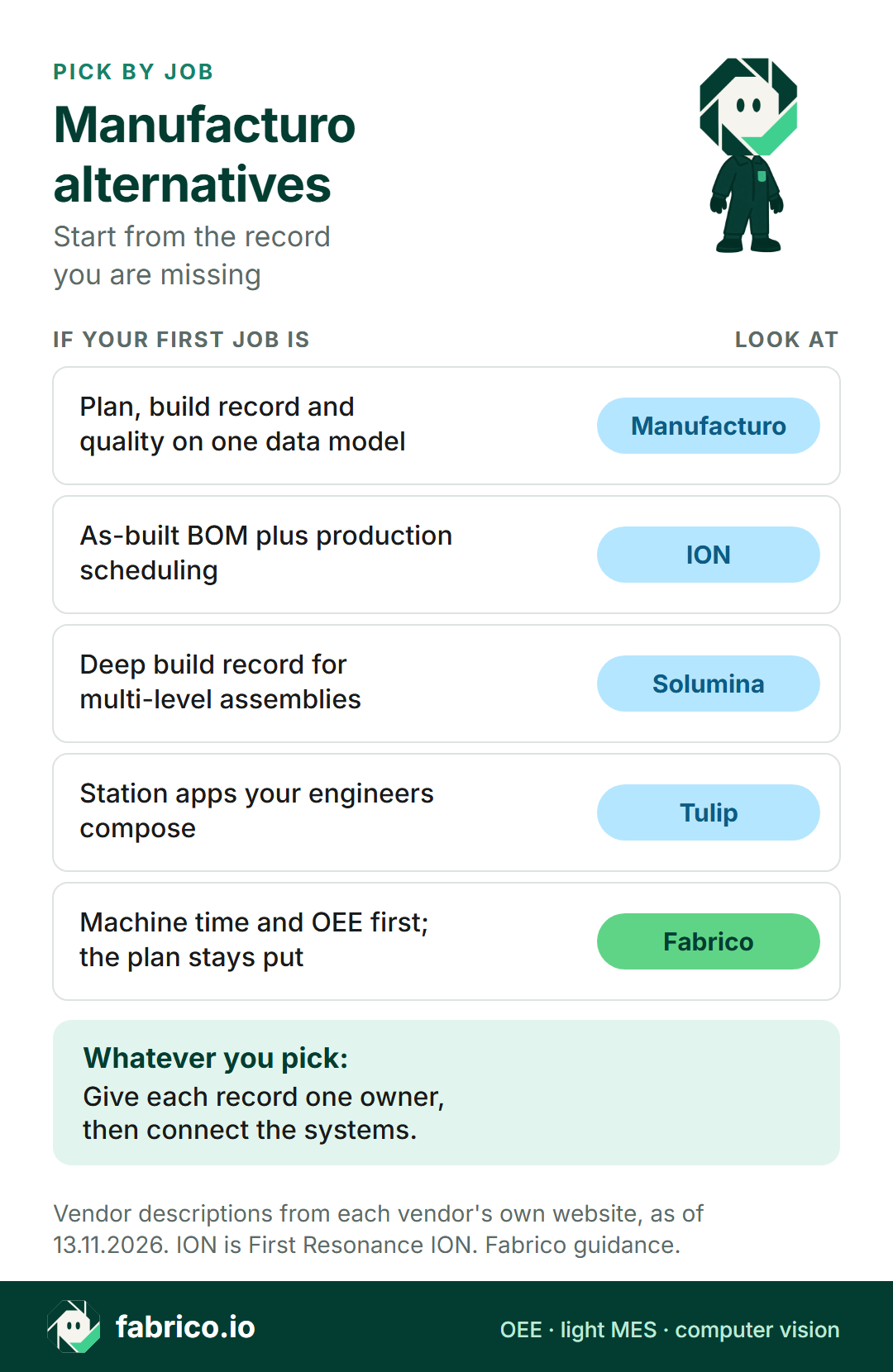
- Plan, build record and quality on one data model, from prototype to production: Manufacturo.
- An as-built BOM and production scheduling in a factory operating system: First Resonance ION.
- An MES with a deep build record for multi-level assemblies, cloud or on-premises: Solumina.
- Station apps your engineers compose themselves: Tulip.
- Measured machine time, downtime by cause and OEE first, with the plan left where it is: Fabrico.
Text version of this infographic
Pick-by-job card for Manufacturo alternatives: plan, build and quality on one platform (Manufacturo, First Resonance ION), a build record beside the ERP (Solumina), station apps your engineers build (Tulip), or measured machine time and OEE first (Fabrico).
Worked example: what the plan assumed, what the mill delivered
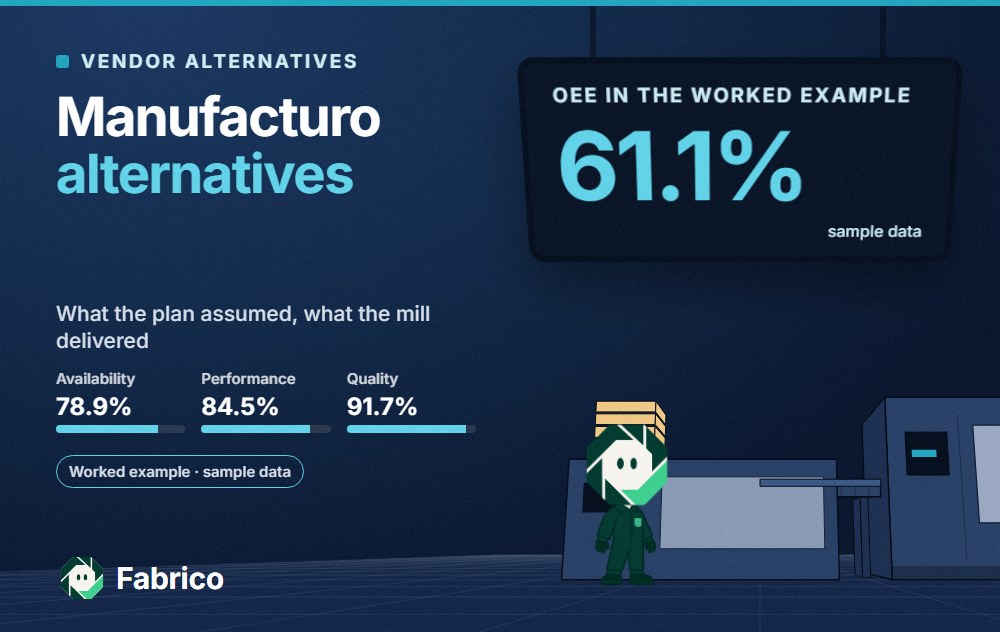
The figures are invented for illustration: one shift on a five-axis mill in a space hardware cell, with no real plant or Fabrico screen behind them. The shift is 480 minutes; take off a 30 minute break and 450 planned minutes remain. One part ideally takes 25 minutes, so the MRP run counted on 18 parts per shift.
Stops took 95 minutes, so the mill ran for 355 minutes: availability is 78.9%. At 25 minutes a part, 355 minutes allow 14.2 parts. The mill made 12, so performance is 84.5%.
One part failed inspection, leaving 11 good: quality is 91.7%. OEE is 78.9% x 84.5% x 91.7% = 61.1%, the same as 11 good parts x 25 minutes over 450 minutes.
The planning platform still believes in 18 parts a shift. The cell delivers 11, so promised dates slip and nobody can say why until someone counts the minutes. The biggest single loss here is the 40 minute wait for first article inspection, which is a scheduling and staffing fix, not a machine fix. Measured machine time keeps the plan's capacity figures honest, whichever system holds the plan. The arithmetic is laid out step by step in OEE calculation, and downtime reason code design helps build a cause list that operators keep using.
Six questions for a Manufacturo shortlist
Run them past each vendor here, Fabrico too, with a single typical cell as the test case.
- Which records does it own? The plan, the build record, quality, machine time, or several.
- What happens to the ERP? Replaced, connected, or left to run beside it.
- How does a machine report? PLC, sensor, barcode scan or operator entry, including machines with no signal.
- Where do stop reasons come from, and how is OEE or utilization calculated, if the product shows it?
- Who changes a process once it is live? Plant engineers, the vendor's team, or a partner.
- Where is data hosted, and in which formats can you take it out?
What people ask next
What is Manufacturo?
Going by manufacturo.com on 13.11.2026, it is integrated manufacturing management software with production, supply chain and quality apps on one data model. It names space, defense, aviation, new energy, additive, drone, SMR and robotics makers.
How does First Resonance ION compare with Manufacturo?
Both are pitched at complex, high-mix hardware makers. ION calls itself a factory operating system, with an as-built BOM, Autoplan scheduling and ION Intelligence agents. Manufacturo describes MRP, inventory, shopfloor and quality apps on one data model, with AI agents for process plans and nonconformance intake. Ask both to run the same work order.
Does Manufacturo replace an ERP?
Its pages describe MRP, inventory and kanban apps, and its integration page connects ERP, PLM, supplier portals and accounting systems. Ask Manufacturo which records it would own in your setup and which would stay in the ERP.
Does Manufacturo track machine downtime or OEE?
Its equipment app tracks status, availability, maintenance and calibration dates, and its integration page describes machine status updates that can trigger a material issue. Ask Manufacturo how run time, stop time, stop reasons and OEE would be reported for a machine like yours.
How is Fabrico different from Manufacturo?
Manufacturo holds the plan, the build record and quality on one data model, per its site. Fabrico measures machine time: the machine signal supplies halts and part counts, operators name the cause, and OEE is reported per line and shift, losses expressed as money. Bills of materials, routings and genealogy remain wherever you keep them today.
Can Fabrico and Manufacturo be used together?
They can, if each record has one owner. Manufacturo describes more than 80 public APIs, and Fabrico has a REST API and webhooks. Agree which system owns machine time and the OEE figure, then scope the connection with both vendors.
A Fabrico demo shows where the missing minutes get counted when the plan promises 18 parts and the cell makes 11. Questions about running it beside Manufacturo or your ERP go through the contact page.
Related articles




Real Fabrico tiles, sample data.