


 Login
 Blog
Manual, Semi-Automatic or Automatic Packing: Measure, Then Automate

In short: Automate a manual packing station only after four weeks of measured data show that the gap is pace and labour, not waiting, staffing gaps or changeovers. Otherwise fix the flow first, then size the machine on measured output.
- Manual fits low volume and daily format changes. Semi-automatic fits several formats with one repeat task. Automatic fits stable formats and volume.
- Measure output per person-hour, short stops, waiting for material, rework, staffing gaps and changeovers.
- A hand-pack station has no machine signal, so count with operator entry on a tablet or a camera that counts output.
- Build the payback on recovered output and labour hours from your own data, not on a brochure rate.
- A machine does not fix a starved station. If waiting is the biggest loss, automation is the wrong first move.
A hand-pack station is slow, hiring is hard, and a supplier is ready to quote a case erector or a robot cell. Before the capex meeting, know what the station really loses. This guide helps you choose between manual, semi-automatic and automatic packing on measured data.
It is not a guide to counting at a packing station. For that, read OEE for a manual packing station and computer vision OEE for manual assembly. For the wider methods on hand lines, see measuring OEE on manual and hybrid lines. For a whole new line rather than one station, see a new line vs recovering capacity.
Manual vs semi-automatic vs automated packing: what each one changes
The three options differ in who sets the pace and who handles a format change.
| Option | Who does what | Fits when | Watch out for |
|---|---|---|---|
| Manual | People erect, fill, close and stack cases | Low volume, many formats, frequent changes | Pace varies by person and shift |
| Semi-automatic | A machine does one repeat task, such as erecting or taping; people load and check | Mid volume, several formats, one task sets the pace | People still set the pace of the rest |
| Automatic | Machines feed, pack, close and stack; people supervise | High volume, few stable formats | Changeovers, jams and a starved infeed move to the machine |
Labour is the reason most plants look at this. In a December 2025 report, PMMI, the packaging and processing machinery trade association, said 95% of the consumer packaged goods companies it surveyed are struggling to hire skilled operators and technicians. The same report names the barriers to automation: "return on investment (ROI), small plant footprints, and potential downtime due to installation and training".
End of line is where much of the spend goes. A 2021 PMMI white paper summary put end-of-line machinery at nearly 47 percent of the US packaging machinery market. The figure is US only and dated. Each barrier is easier to judge with measured data: the return depends on what the station makes today.
Pick manual, semi-automatic or automatic: a decision framework
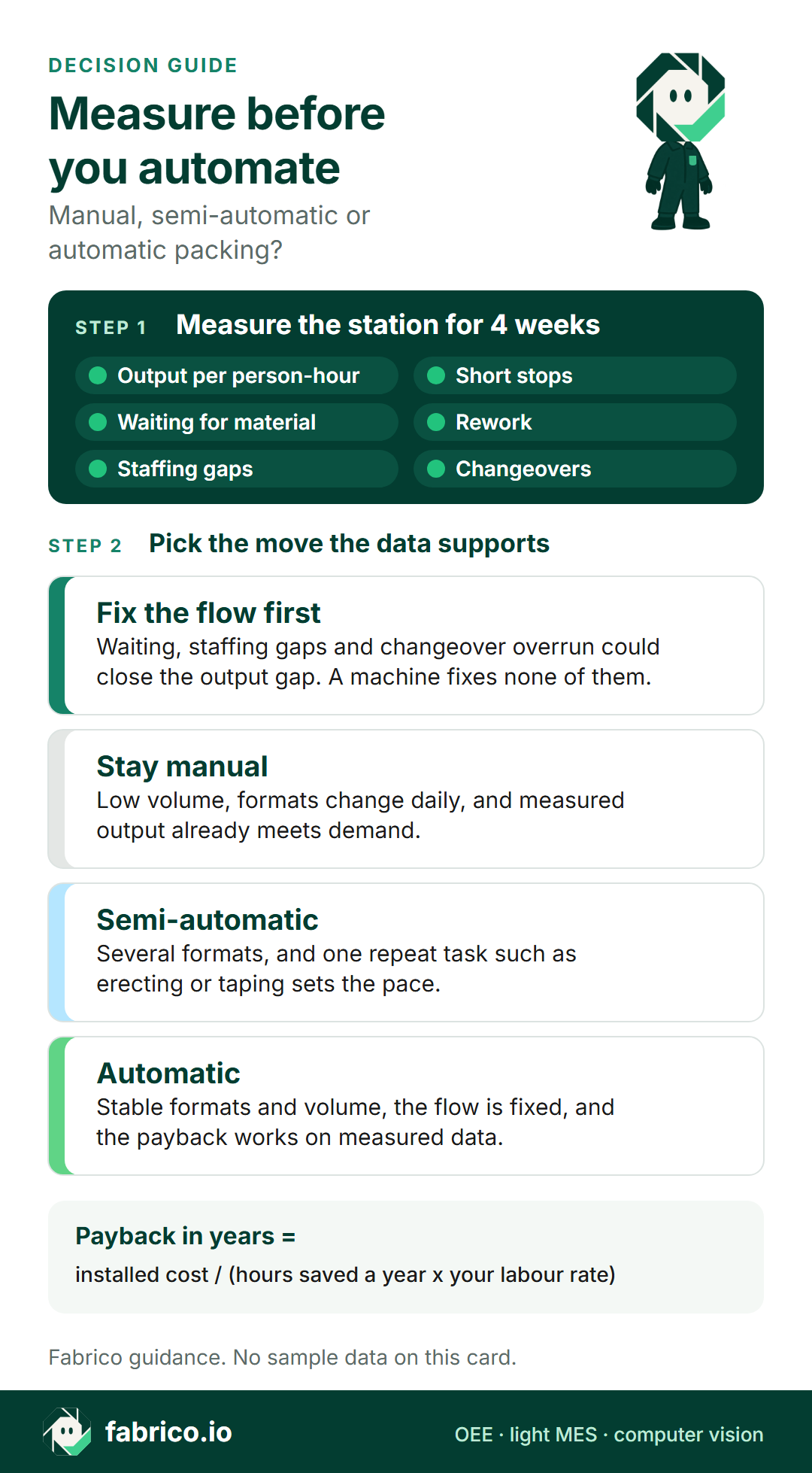
Stay manual if volume is low, formats change daily, and measured output meets demand.
Fix the flow first if waiting for material, staffing gaps and changeover overrun add up to more than the output you are short. A machine fixes none of them.
Pick semi-automatic if the data shows one repeat task sets the pace, such as erecting or taping cases, and the station packs several formats. The machine takes that task; people handle the variety.
Pick automatic if formats and volume are stable, the flow is fixed, and the payback still works on measured output and labour hours.
Do both if demand is growing: fix the flow now, then automate on the cleaned-up numbers. The worked example below shows why the order matters.
Want to see how a hand-pack station is measured before a capex decision? Book a demo and bring your station list.
What to measure first at a manual packing station
Measure for at least four weeks, across all shifts and the main formats. One good week hides the gaps. These six numbers decide the case.
| Measure | How | What it tells you |
|---|---|---|
| Output per person-hour | Good cases divided by person-hours booked to the station | The labour baseline your payback depends on |
| Short stops | Stops under a set threshold, such as 5 minutes | Jams and fumbles a machine may cut, or make worse |
| Waiting for material | Minutes with no product, cartons or labels, with a reason | Upstream or supply loss that no packing machine fixes |
| Rework | Cases repacked or relabelled, and why | Quality loss, and whether a machine would repeat it |
| Staffing gaps | Hours run short of crew or stood idle | Whether the real problem is people, not pace |
| Changeovers | Minutes per format change, against a standard | Whether a machine would change faster or slower |
Book losses the OEE way, so nothing counts twice. Waiting, staffing gaps and changeovers are availability losses. Short stops and slow pace are performance losses. Rework is a quality loss. The OEE calculation guide covers the formula, and micro-stops covers the short ones.
Set the ideal rate first: a pace the crew can hold with full material, agreed with the team, not the best hour on record. Keep it fixed for the four weeks.
How to measure a station with no machine signal
A hand-pack table has no PLC to read. You have three ways to count.
| Method | What it gives | Limits |
|---|---|---|
| Hand tally on paper | A count at the end of the shift | No timing; gaps and slow hours vanish |
| Operator entry on a tablet | Counts, scrap and stop reasons entered at the station | Depends on discipline; counts arrive late in busy hours |
| Camera that counts output | A count over time, with no typing | Placement, light and privacy need agreement; reasons still come from people |
Operator entry is the cheapest start, where the crew is stable and the shift lead checks entries. A camera that counts output needs no typing, so operators can focus on stop reasons. Point it at the work surface, not at faces, and agree that with the team first. See line cameras without surveillance and AI visual counting. If some stations have a usable signal and others do not, camera or sensor for each machine sorts them.
Check any count against a hand tally in the first days, and keep the same method after the change so before and after compare.
Worked example: payback on recovered output and labour hours
Illustrative, sample data, not a customer. A hand-pack station packs retail trays into shipper cases. Three packers per shift, two shifts of 7.5 hours, five days: 75 planned hours a week. The agreed ideal rate is 600 cases an hour for the crew of three. Demand is 32,000 good cases a week. The plant measured the station for four weeks. Weekly averages:
- Stops: waiting for material 8 hours, changeovers 6 hours (4 at standard, 2 overrun), station idle for lack of crew 6 hours. 20 hours in all.
- Run and output: run time 75 minus 20 = 55 hours. Output 28,050 cases, of which 561 were repacked.
- Labour: 3 x 75 = 225 person-hours booked to the station.
Today. Availability = 55 / 75 = 73.3%. Performance = 28,050 / (55 x 600 = 33,000) = 85.0%. Good cases = 28,050 minus 561 = 27,489, so quality = 98.0%. OEE = 73.3% x 85.0% x 98.0% = 61.1%. Check: 27,489 / (75 x 600 = 45,000) = 61.1%. Good output per person-hour = 27,489 / 225 = 122.2 cases. The station is 4,511 cases a week short of demand.
Option A: automate first. Sample assumption: a semi-automatic case erector and taper lets two people hold the same ideal rate of 600 cases an hour. Waiting, idle hours and changeovers stay. Output stays at 27,489 good cases with 150 person-hours, so 75 person-hours a week are saved. The gap of 4,511 cases stays. At today's 499.8 good cases per run hour (600 x 85.0% x 98.0%), closing it takes about 9.0 extra run hours a week (4,511 / 499.8).
Option B: fix the flow first. A carton kanban and a feed schedule cut waiting from 8 to 3 hours. A standard changeover routine removes the 2-hour overrun. Cross-trained cover cuts idle hours from 6 to 2. Run time rises by 11 hours to 66. Output = 66 x 600 x 85.0% = 33,660 cases; good = 33,660 x 98.0% = 32,987. OEE = 32,987 / 45,000 = 73.3% (up from 61.1%; availability is now 66 / 75 = 88.0%). That is 5,498 more good cases a week from the same 225 person-hours, and demand is met.
Option C: fix the flow, then automate. The same 32,987 good cases with 150 person-hours: 219.9 good cases per person-hour, against 122.2 today.
Payback. The machine saves 75 person-hours a week in A and in C. Over 48 working weeks that is 3,600 person-hours a year. As a reference, Eurostat puts 2025 hourly labour costs in industry in the euro area at €40.3. At that rate the saving is 3,600 x €40.3 = €145,080 a year. Use your plant's loaded rate instead. Payback in years = the installed cost from your quote divided by the yearly saving. The saving is only real if the freed packer moves to an open role.
The order makes the difference. A still needs about 9 extra run hours a week. C gets the same saving and meets demand. B closes the gap with no capex. Across EU countries, Eurostat's 2025 whole-economy hourly labour costs run from €12.0 in Bulgaria to €56.8 in Luxembourg, so payback speed differs a lot by country.
When automation is the wrong first move
- The station waits more than it runs slow. If waiting for material is the biggest loss, the problem is upstream. A faster packer just waits faster.
- Staffing gaps are the real gap. Fix cover and training first. A machine still needs someone to run and clear it.
- Formats change daily. A machine change needs parts and settings. Find out how long it takes on the machine.
- Rework starts upstream. If cases are repacked because of poor labels or product, a machine packs the same faults.
- The station is not the constraint. If the filler before it sets the pace, more packing speed adds nothing. Value losses at the constraint; see how to quantify hidden capacity.
- There is no baseline. Without a measured before, nobody can prove the after.
If the data says automate, the robot choice is next: see cobot vs traditional robot.
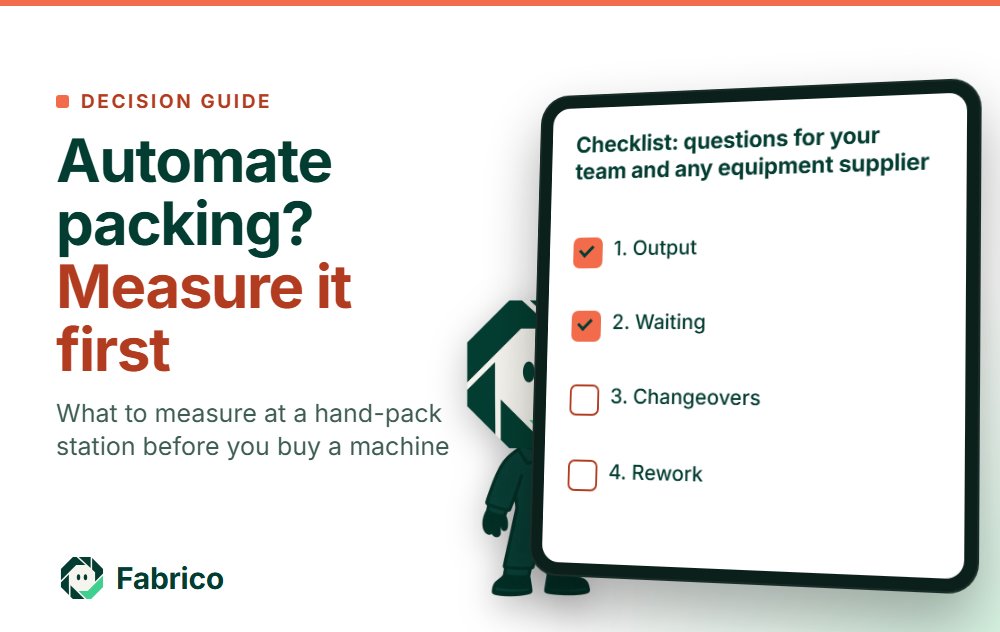
Checklist: questions for your team and any equipment supplier
Put these to your own team before the quote, and to each supplier with the same station data.
| Topic | Question to answer in writing |
|---|---|
| 1. Output | What is good output per person-hour over four weeks, by shift? |
| 2. Waiting | How many hours a week does the station wait, and for what? |
| 3. Changeovers | How many formats, how long per change by hand, and how long on the machine? |
| 4. Rework | What share of cases is repacked, and where does the fault start? |
| 5. Staffing | How many hours a week does the station run short or stand idle? |
| 6. Rate | What rate will the machine hold on our formats, and how is it tested at handover? |
| 7. Labour | Where do the freed hours go, and is that written into the case? |
| 8. Counting | How is output counted after the change, so before and after compare? |
If you are still choosing how to measure, our guides to OEE software, the best OEE software and MES for mid-size FMCG plants list what to compare. For sector detail, see computer vision for FMCG manufacturing, computer vision for co-packers and computer vision for food manufacturing.
Where Fabrico fits
Fabrico is a cloud OEE and light MES platform. It measures the station before and after a change.
- Before you price a machine: at a hand-pack table or bagging station with no usable signal, the camera add-on counts output, so the manual station gets an OEE before anyone writes a business case.
- Where the hours go today: good parts and scrap can be entered on a tablet, and operators tag the cause of a stop from your reason codes. You see whether waiting for material or format changes cost more than packing speed.
- After the change: a new semi-automatic or automatic machine is read through its PLC (cycles, stops and output), or through an IoT device with external sensors on an older machine, so before and after use one OEE method.
- Stop review at the station: with the camera add-on, the video for a stop is streamed when someone opens it and, in the standard setup, is not stored in Fabrico.
- Numbers for the payback sheet: OEE split into availability, performance and quality, with losses shown in money. Lists export to Excel or CSV, and a REST API and webhooks feed other systems.
Roadmap, not live today: the camera add-on proposing a likely stop cause, such as a jam or no material, for the operator to confirm.
Fabrico does not do quality inspection; rework and scrap reach OEE as counts. Ask in the demo: how to set up a before and after comparison for one station, and whether labour hours can sit next to output in the reports.
See light MES and OEE in Fabrico and Fabrico computer vision for OEE.
What people ask next
When should you automate a manual packing station?
When four weeks of measured data show that the gap is pace and labour, the flow is already fixed, formats are stable enough, and the payback works on measured output and person-hours. If waiting for material or staffing gaps are the biggest losses, fix those first.
What is the difference between semi-automatic and automatic packing?
In semi-automatic packing a machine does one repeat task, such as erecting or taping cases, and people load, check and handle format changes. In automatic packing, machines feed, pack and close the cases, and people supervise and clear faults.
How long should you measure a packing station before deciding?
At least four weeks, across all shifts and the main formats. A shorter run can miss a bad supply week or a holiday staffing gap.
How do you measure output at a hand-pack station with no machine signal?
Use operator entry on a tablet, or a camera that counts output at the work surface. Check either one against a hand tally in the first days, and keep the same method after any change so that before and after compare.
How do you work out payback on packing automation?
Take the person-hours a week the machine saves on measured data, multiply by working weeks and your loaded hourly labour cost, then divide the installed cost from your quote by that yearly saving. Add recovered output only if demand needs it.
When is automation the wrong first move?
When the station mostly waits for material, stands idle for lack of crew, changes format daily, repacks faults made upstream, or is not the line's constraint. A packing machine fixes none of those.
Want to measure a hand-pack station before the capex meeting? Book a demo and bring your station list.
Related articles




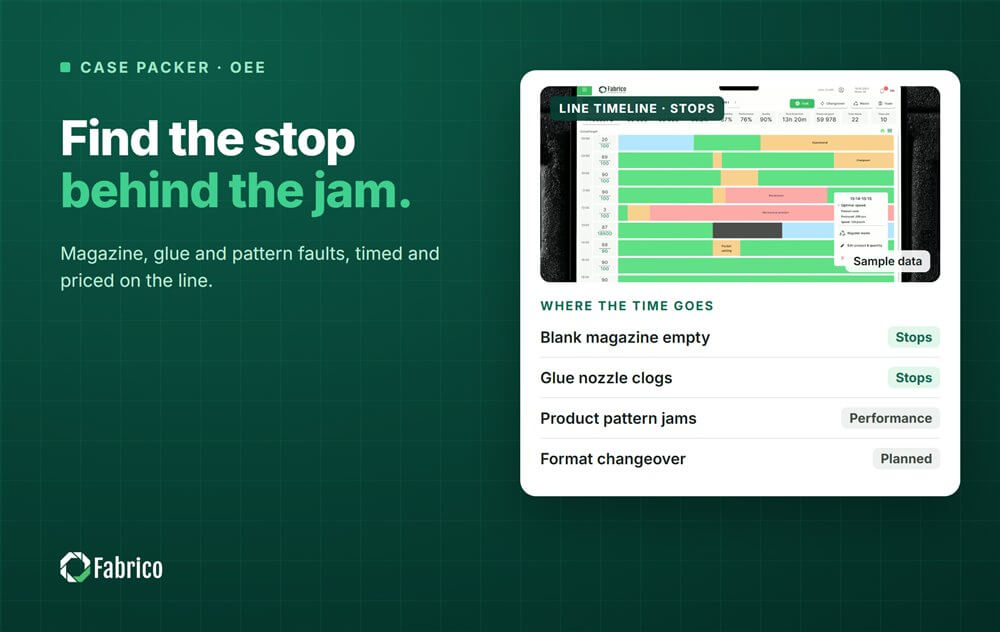








Real Fabrico tiles, sample data.