


 Login
 Blog

Computer Vision for Pipe Manufacturing: Find the Tubes Your Count Gets Wrong

In short: in pipe manufacturing, computer vision earns its place counting strapped bundles, bench pieces and loaded racks, where no PLC counts and tallies drift.
- The mill PLC counts metres and saw cuts; bundles, bench pieces and loaded racks are counted by hand, or not at all.
- Seven miscounts recur: mixed units, crop ends, test rejects, cut-back tubes, second straightener passes, held bundles and seamless mother tubes.
- Give each count one owner station. Test systems own their rejects; the camera add-on owns strapped bundles and bench pieces.
- In the audited example shift, the shift sheet says 64.8% OEE and the audited count says 61.6%.
Inspection cameras and test gates decide whether a tube is sound; a counting camera only tells OEE how many good tubes left each station.
A tube plant rarely lacks numbers. It has too many: the saw count, the bench sheet, the bundle tags and the loading list disagree, and the shift report picks the most flattering one. This page audits those gaps for welded and seamless tube. Sheet metal cells are covered in computer vision for metal fabrication.
The pipe mill miscount table: seven errors and who owns each count
Each row is a way the output number goes wrong, with the one station whose count the shift report should use.
| # | Miscount | What the shift report shows | The fix | Station that owns the count |
|---|---|---|---|---|
| 1 | Metres, pieces and tonnes mixed | Mill metres divided by a nominal length, tonnes in the monthly report | One unit per station, joined by length and pieces per bundle | Flying saw, from its PLC cut count |
| 2 | Crop ends booked as output | Every saw cut counted, including crops at coil welds and size changes | Crops and setup tubes go to quality as scrap, with a reason | Flying saw, with the operator's scrap entry |
| 3 | Test rejects missing | Saw count treated as good tubes | Reject counts from the test gates reach quality | Eddy current or UT gate and hydrotester |
| 4 | Cut-back tubes counted twice | A rejected tube cut back at the bench appears again as a new piece | Counted once, after rework and re-test, outside first-pass good | Cut-back bench, camera add-on at the outfeed |
| 5 | Re-straightened tubes counted twice | The straightener's counter adds the second pass | Second passes flagged as rework, not output | Straightener, first-pass count only |
| 6 | Held bundles counted as shipped | Strapped and tagged means shipped on the sheet | Held bundles stay in stock until released | Loading rack, camera add-on over the rack |
| 7 | Seamless mother tubes counted as pipes | Hollows from the piercer read as finished pipes | Pipes counted after the cut-to-length saw | Cut-to-length saw after the cooling bed |
Rows 1, 2, 5 and 7 need reason codes and one unit per station; rows 3 and 4 need the test systems and the bench in one record. Row 6 and the bundle side of row 1 need a count where tubes leave by crane, the gap a camera add-on closes.
Explainer presented by Iris, Fabrico's AI-generated presenter: how an add-on camera counts output where a machine has no signal. Book a demo.
Plays from YouTube. Google may set cookies when you press play. Privacy policy.
Metres, pieces, bundles and tonnes: one unit per station
A welded tube mill is a continuous machine. The World Steel Association's AHSS Insights describes precision welded tube as made by "continuous roll forming followed by a longitudinal weld", usually by high frequency induction welding. The strip never stops, so the mill counts metres; the flying saw turns them into pieces, bundling into bundles, and the market into tonnes: worldsteel's World Steel in Figures 2026 puts world exports of steel tubes and fittings at 39.9 million tonnes in 2025, up from 35.5 million tonnes in 2021. That is a trade figure for the sales team, not a shift measure.
The miscount starts when one unit is converted into another with a nominal factor. Dividing mill metres by 6 m to get pieces ignores crops and short lengths. Tonnes make a heavy wall size look busy while the mill crawls. The fix is one unit per station: metres at the mill against a design speed per size, pieces at the saw, bundles at the strapping table. The forming side works like any roll former; OEE for roll forming sets out the speed logic.
Pieces per bundle joins the last two units. A hexagonal bundle holds 1, 7, 19, 37, 61 or 91 tubes as rings are added around the centre tube. When the tag says 91 and 30 bundles leave the strapping table, 2,730 tubes are in bundles. Any good tubes the saw counted beyond that are in the cradle, on the bench or lost.
Crop ends: the miscount that looks like output
On an ERW mill the strip tail of one coil is welded to the head of the next. The tube made across that strip weld is cut out and scrapped, and the saw counts those cuts like any other. Tubes made while the rolls are set for a new size are off size, and the saw counts them too. Take the saw count as output and every crop and setup tube is a good piece on paper.
The fix sits at the saw: the mill operator books crops and setup tubes as scrap with a reason in the same shift. Setup tubes are start-up loss, which start-up loss versus reduced yield separates from scrap in a steady run. Three reasons, "coil weld crop", "size change setup" and "short length", cover most of it; a scrap reason code taxonomy shows how to keep the list small.
Bench cuts repeat it: a 12 m mill length cut into two 5.9 m pieces leaves a 0.2 m remnant, which a sheet counting cuts adds as a third piece. A camera add-on at the bench outfeed counts finished pieces leaving, not cuts made.
Eddy current and hydrotest rejects: inspection owns the verdict
Between the saw and the bundle, tubes pass test gates. The scope of ISO 10893-2 for automated eddy current testing of steel tubes covers seamless and welded tubes, except submerged arc-welded ones, with an outside diameter of 4 mm or more, against acceptance levels set out in the standard. Line pipe also goes through a hydrostatic tester, which fills each pipe with water and holds test pressure; the method itself is covered in hydrostatic pressure testing.
The miscount here is quiet: rejects that never leave the good count. The gate marks a tube, a crane driver lifts it off, and the saw count still says it was made. Take the reject count from the test system's own reject signal into quality, never from a camera or memory. A tube that fails, is re-tested and passes counts once. Fabrico does no inspection: test results stay in the test systems and go on the mill test certificate, and weld test methods are covered in welding inspection.
Mounting a bracket near the test bay falls under the site's pressure test rules. In the UK, HSE guidance GS4 on safety requirements for pressure testing is aimed at all employers, supervisors and managers responsible for pressure testing. Keep cameras outside the hydrotest enclosure.
Cut-back and re-straightened tubes: count once, after rework
Many test rejects are not lost. A tube with an indication close to one end can be cut back on a bench, faced, re-tested and sold as a shorter length. Good practice, bad counting, when the bench sheet adds it as a new piece: the saw counted it, the gate rejected it, the bench counts it again.
Straighteners repeat the error. A tube that leaves the rotary straightener still bent goes round again, and a counter on tubes through adds it twice. One rule fixes both: rework is counted once, after rework and re-test, and never as first-pass good. OEE quality uses first-pass good tubes; reworked ones show up as rework output with their own crew time.
The cut-back bench has no PLC. A camera add-on at its outfeed counts pieces leaving, and because the bench is booked as a rework station, its count cannot slip into first-pass output.
Held bundles: strapped and tagged is not shipped
A strapped, tagged bundle often appears on the shift sheet as shipped. Tube is delivered with inspection documents, and EN 10204 "specifies the different types of inspection documents supplied to the purchaser for the delivery of all metallic products". A bundle can sit on the rack waiting for its document, a re-test result or a quality release, and while it waits it is stock, not a shipment.
The fix is to separate made from loaded. Bundles strapped is a production count, owned by the strapping table; bundles loaded is a shipping count, owned by the loading rack. A held bundle sits between them. Quality hold process design covers how the hold is raised and released. A camera add-on over the rack counts bundles loaded onto trucks or rail cars, so the gap between made and shipped is a number, not a guess.
Seamless tube: where the count changes from hollows to pipes
Seamless tube has its own miscount, and it starts at the piercer. In the mandrel mill route described by the Wermac piping reference on how seamless pipe is made, "The pierced billet or hollow shell is rolled by a mandrel mill to reduce the outside diameter and wall thickness which forms a multiple length mother pipe." The mother pipe is then stretch reduced, cooled, cut and straightened: one hollow, several pipes.
Count hollows at the piercer as pipes and output is undercounted; count saw cuts and forget the crops and it is overcounted. The Tube & Pipe Journal's account of a floating mandrel mill shows where the clean count sits: "As the tube exits the last stand of the mill, its length is measured by laser." The tube then cools on a 150-foot walking beam cooling bed, and "The tubes then are conveyed to the cutoff mechanism, where they are cut to the prescribed length." The same account names yield and "minimal crop losses" as a design goal of the stretch mill.
So the seamless count has two owners. The hot mill counts hollows against an ideal rate per size. Finished pipes are counted after the cut-to-length saw, where crops from both ends of the mother tube go to scrap. Pipes per mother tube is a recipe value per size and order length, not a constant.
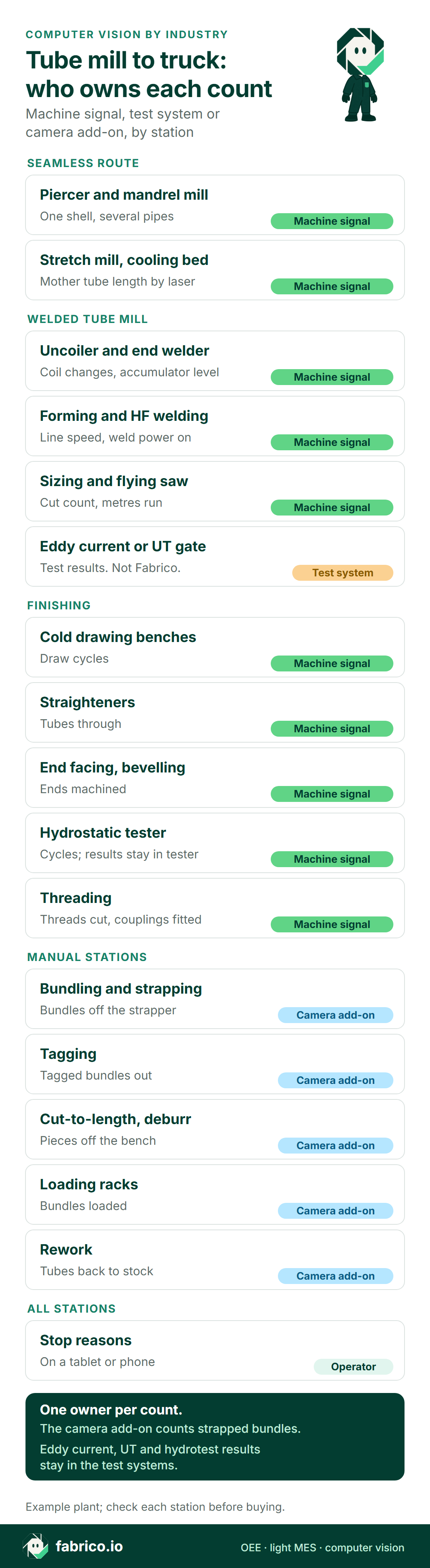
Text version of this infographic
- Seamless route: piercer and mandrel mill: machine signal, one shell, several pipes
- Seamless route: stretch mill and cooling bed: machine signal, mother tube length by laser
- Welded tube mill: uncoiler and end welder: machine signal, coil changes and accumulator level
- Welded tube mill: forming and HF welding: machine signal, line speed and weld power on
- Welded tube mill: sizing and flying saw: machine signal, cut count and metres run
- Welded tube mill: eddy current or UT gate: test system, test results, not Fabrico
- Finishing: cold drawing benches: machine signal, draw cycles
- Finishing: straighteners: machine signal, tubes through
- Finishing: end facing and bevelling: machine signal, ends machined
- Finishing: hydrostatic tester: machine signal, cycles; results stay in the tester
- Finishing: threading: machine signal, threads cut and couplings fitted
- Manual stations: bundling and strapping: camera add-on, bundles off the strapper
- Manual stations: tagging: camera add-on, tagged bundles out
- Manual stations: cut-to-length and deburr benches: camera add-on, pieces off the bench
- Manual stations: loading racks: camera add-on, bundles loaded
- Manual stations: rework: camera add-on, tubes back to stock
- All stations: stop reasons, entered by the operator on a tablet or phone
- One owner per count. The camera add-on counts strapped bundles.
- Eddy current, UT and hydrotest results stay in the test systems
- Example plant; check each station before buying.
The audited shift: what one ERW mill made in 450 minutes
Example numbers, no real plant. The day shift on an ERW mill is 06:00 to 14:00; take out a 30-minute break and 450 minutes remain planned. It runs 48.3 mm tube in 6 m lengths at a design speed of 60 m per minute, which is 10 tubes a minute. The PLC gives run state and the saw cut count, the eddy current gate its reject signal, a camera add-on counts bundles at the strapping table and the rack, and the operator enters stop reasons. The shift is counted twice: by the shift sheet, and by the owners in the miscount table.
| Line on the report | Shift sheet | Audited count | Why they differ |
|---|---|---|---|
| Tubes counted | 2,914 | 2,890 | 24 cut-back tubes counted a second time at the bench |
| Good tubes, first pass | 2,914 | 2,770 | 40 setup tubes and 80 eddy current rejects were booked as output |
| Rework output | Not shown | 24 tubes of 5.5 m | Counted once, after re-test, outside first-pass good |
| Bundles shipped | 30 | 28 loaded, 2 held | Two bundles wait on the rack for release |
| OEE | 64.8% | 61.6% | The sheet treats every counted tube as good |
| Lost tubes to price | 1,586 | 1,730 | The sheet hides 144 tubes of loss |
Availability. The shift opened with a roll change from the previous size: 70 minutes. Weld trouble stopped the mill for 25 minutes. Then the run-out table filled and the mill stood 15 minutes waiting for bundling. Stops total 110 minutes, so the mill ran 340 of 450 minutes: 75.6%.
Performance. The saw cut 2,890 tubes, or 17,340 m. At 60 m per minute that is 289 minutes of output from 340 minutes of running: 85.0%. The 51 minutes in between is slow running after the roll change.
Quality. 40 tubes were setup scrap after the roll change and 80 were rejected at the eddy current gate: 120 in all. Good tubes are 2,770 of 2,890, or 95.8%. Those 120 tubes are 12 minutes of mill time.
OEE. 75.6% x 85.0% x 95.8% = 61.6%. The quick check: 2,770 good tubes at 10 a minute is 277 minutes, and 277 of 450 planned minutes is 61.6%. The shift sheet added 24 cut-back tubes to the saw count and called all 2,914 good: 291.4 minutes of good output, or 64.8%. The 3.2 extra points are miscounts 2, 3 and 4.
Rework. Of the 80 eddy current rejects, 24 had their indication within 0.5 m of one end. The bench cut them back to 5.5 m and all 24 passed re-test. They count once, as rework output, priced at crew time, not lost margin: 1.5 crew minutes a tube is 36 minutes, at an example EUR 40 an hour EUR 24.
In money. No margin for this size is published, so the margin is an example input each plant replaces with its own. For a public band, NYU Stern's January 2026 margin data (accessed 16.11.2026) lists 19 US steel firms at a gross margin of 12.25% and a pre-tax operating margin of 4.10%; at those margins, EUR 4 is the margin on a 6 m length selling for about EUR 33 to EUR 98. At design speed the shift could have made 4,500 tubes; it made 2,770 good ones. If orders for this size are waiting, the 1,730 missing tubes are lost contribution: at an example EUR 4 per 6 m length, EUR 6,920 for the shift. The shift sheet's 1,586 missing tubes would price the loss at EUR 6,344, hiding EUR 576 of it. The 15 minutes waiting on bundling alone is 150 tubes, or EUR 600. Fabrico prices losses the same way, from the plant's own SKU price or margin. The general method for metal plants is in OEE for metal fabrication.
Bundles. The strapping table sent out 30 bundles of 91, which is 2,730 tubes, so 40 good tubes were still in the cradle at 14:00. Two bundles were held on the rack for release, so the rack camera add-on counted 28 loaded. No bundle left the strapping table from 11:05 to 11:25, which filled the run-out table. The team lead opened the video for the minute of the strapping table stop at 11:10 from the shift timeline, streamed on request and not stored in Fabrico, saw what held up the strapping table, and booked the stop under its real cause. The fix belongs at bundling, not on the mill.
Book a demo to see strapped bundles, bench pieces and loaded racks counted next to the mill's saw count, station by station.
What a counting camera can and cannot see on a tube floor
Counting tubes from their ends looks easy and is not. A peer-reviewed study on counting bundled bar ends, Li and co-authors in PLOS ONE (2023), states the problem: "Counting problems with densely stacked rebars: overlapping and unclear borders make accurate recognition very difficult." It adds that "several challenges are faced in obtaining clear and usable images for accurate counting under different lighting conditions, such as dawn, day, and night." Their F1 above 0.99 came from still images, not a moving cradle with hands, chains and crane hooks in view.
So on a tube floor the camera add-on counts the large, separate object: a strapped bundle leaving the table, a piece leaving a bench, a bundle landing on a truck. Tubes inside a bundle are counted by the saw and the tag. Glare from bright tube, scale dust and outdoor racks at night are the conditions to test in a pilot. Where tubes pass one at a time on a conveyor, a photo eye may be enough; photo eye output counting covers when.
Six questions for a counting vendor
| Ask the vendor | A sound answer on a tube floor |
|---|---|
| Which unit does each station count in? | Mill in metres, saw in pieces, bundling in bundles, joined by length and pieces per bundle. |
| How are crop ends removed from good output? | A scrap entry with a reason at the saw, not a separate paper sheet. |
| How does a cut-back tube enter the count? | Once, as rework output after re-test, never as a second first-pass tube. |
| What does the camera count at the strapping table? | A strapped bundle leaving, not tubes rolling across the cradle. |
| How is a held bundle shown? | In stock, not shipped, until quality releases it. |
| Can a camera survive a finishing floor? | A housing and mount for mist, scale dust, saw vibration and crane clearance. |
A camera over a strapping table will see people. Tell the crew what the count is for first; in Germany and several other European countries the works council has a say. Aim at the bundle exit or the bench outfeed and report per station and shift, never per person. In the EU, the European Data Protection Board's Guidelines 3/2019 on processing of personal data through video devices are the reference most data protection officers will ask about.
Where Fabrico fits on a tube mill
Fabrico is a cloud OEE platform with light MES on top. Today, on a tube and pipe site, it covers four things:
- On the mill it reads run state, line speed and the saw cut count from the mill PLC, so roll changes, weld trouble and accumulator run-outs show as stop time with a reason.
- On the finishing floor it takes cycle signals from draw benches, straighteners, end facers, hydrotesters and threaders.
- At strapping tables, saw benches, loading racks and rework the camera add-on counts bundles and pieces. Where a camera add-on covers the station, the video for the minute of a stop can be opened from the shift timeline, streamed on request and not stored in Fabrico.
- Per tube size each size gets an ideal cycle time worked out from its design speed, so performance reads against the size actually running.
Mill operators and finishing crews enter stop reasons on a phone or tablet. The mill manager reads OEE, downtime and losses in money per station and per shift on a web page or in the iOS or Android app. To move shift data into an ERP, use the REST API, webhooks or an Excel or CSV export.
Roadmap: a camera add-on that notices an idle strapping table without being told and proposes a likely cause; this is not live today.
Outside Fabrico: eddy current, ultrasonic and hydrotest results, laser gauging, weld parameter records, heat traceability and the mill test certificate. Those records stay in the test systems and with quality.
To go deeper: the computer vision feature page, how vision counts become OEE for the arithmetic behind camera add-on figures, and how to evaluate OEE software. Put the six questions above to Fabrico as well.
Tube and pipe miscount questions
Should a tube mill count output in metres, pieces or tonnes?
The mill in metres against the design speed for each size, the saw in pieces, bundling in bundles. Tonnes suit the monthly report, not the shift.
Is a crop end scrap or output?
Scrap. Coil weld crops and size change setup tubes go to quality with a reason, never into the good count.
How do you count a tube that is cut back after an eddy current reject?
Once, as rework output after it passes its re-test. The saw already counted it, so it is never new first-pass output.
Can a camera count the tubes inside a strapped bundle?
Overlapping ends and poor light make that hard even for research models. The camera add-on counts strapped bundles leaving; the tag gives pieces per bundle.
Does a held bundle count as good output?
It counts as made, not as shipped. It stays in stock until quality releases it and reaches the loading count only when loaded.
Want to see a mill's saw count, strapped bundles and loaded racks on one shift timeline? Book a demo.
Related articles













Real Fabrico tiles, sample data.