


 Login
 Blog
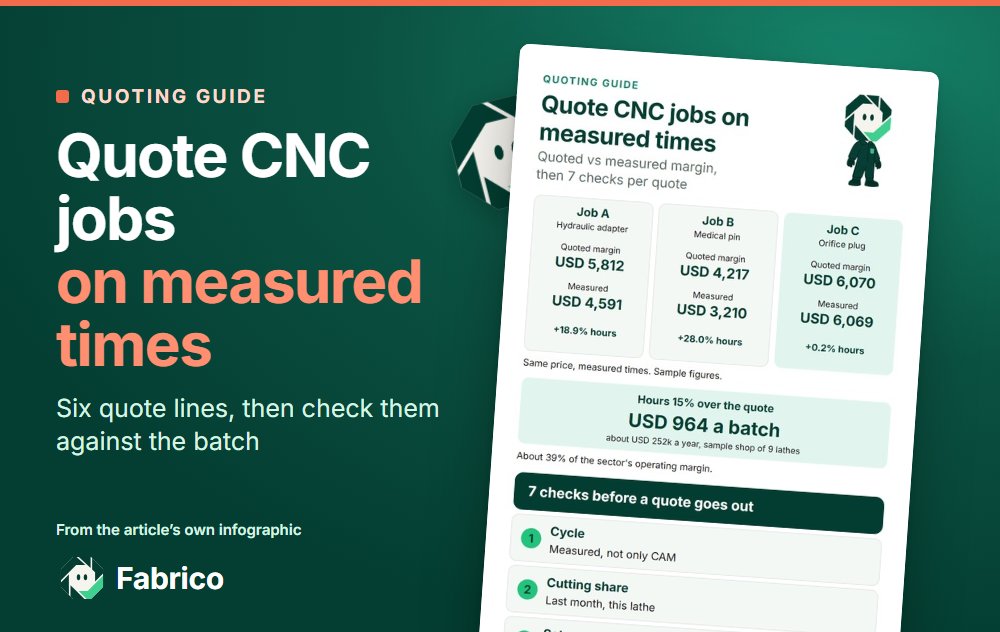
How to Quote CNC Machining Jobs: Calibrate With Measured Cycle Times

In short: to quote a CNC machining job, add material for the parts you will start, machine time at your machine hour rate, setup and first-off, programming, finishing and margin. Then check the quote against measured cycle and setup times after each batch, and correct the next quote for that part family.
- Machine time is the biggest cost line in two of the three sample jobs, and it is the line quotes get wrong.
- CAM cycle estimates missed real machining time by about 30% in published cutting tests.
- In the worked example, two of three Swiss-type jobs lost 21.00% and 23.89% of their gross margin to time overruns.
- A 15% time underquote costs USD 964.19 per batch and about USD 252k a year in the sample shop.
A machining quote is a forecast. It forecasts how long a part will take on a machine, how long the setup will take, how much bar it will eat and how many parts will be scrapped. The estimator signs a price on that forecast, and the shop finds out whether it was right only when the batch runs.
This guide is for the owner, estimator or production manager of a job shop or subcontract machining business. It walks through the six lines of a quote, then runs three jobs on Swiss-type lathes, quoted and then measured, with the margin per batch carried through. The last part shows how to feed measured times back into the next quote, and which tools can hold the numbers.
What goes into a CNC machining quote: the six lines
Every machining quote, from a spreadsheet to a full estimating system, comes down to the same six lines. The table shows what drives each one and where the error hides.
| Quote line | How it is worked out | Where it goes wrong |
|---|---|---|
| Material | Parts started x bar length per part (part, cut-off, facing) x price per foot or kilo | Scrap and bar remnants left out; price from last quarter |
| Machine time | Parts started x cycle time / cutting share x machine hour rate | CAM cycle taken as real; cutting share assumed at 100% |
| Setup and first-off | Setup hours x (machine rate + setter cost), once per batch | Planned setup, not measured; first-off inspection forgotten |
| Programming | Programming hours x programmer cost, once per part number | Charged on every repeat, or never charged |
| Finishing | Deburr, plating, passivation, heat treat; outside quotes plus freight | Minimum lot charges missed on small batches |
| Margin | Price = cost / (1 - target margin) | Markup on cost confused with margin on price |
Two of these lines are fixed per batch (setup and, for a new part, programming) and four scale with quantity. That is why the price per part falls steeply as the batch grows, and why a small batch with a long setup is where a time error costs most per part. The job shop vs flow shop comparison explains why high-mix work carries so many of these fixed costs.
Research on make-to-order quoting confirms the problem is not the formula. A 2022 paper in the proceedings of the Conference on Production Systems and Logistics (Berwing, Schuh and Stich, case studies of contract and make-to-order manufacturers) says quotation costing in these mostly small and medium-sized firms is mainly done on experience, that its quality varies strongly because data is poor when the quote is made, and that the gap between the quoted cost and the actual cost is crucial to their existence.
Machine time: from cutting time to the hours you will actually bill
Machine time has three parts, and each needs its own number.
- Cycle time: the time from one part to the next while the machine runs the job, including tool changes, bar pull and part ejection inside the program.
- Parts started: the order quantity divided by (1 minus the scrap allowance), rounded up. You pay machine time for scrapped parts too.
- Cutting share: the share of booked hours the machine is actually running the job. Bar reloads, chip clearing, tool offsets, gauging and short stops all sit outside the cycle. A quote that assumes 100% is wrong before the batch starts.
Machine hours = parts started x cycle time / 3,600 / cutting share. Multiply by the machine hour rate and you have the machine line. This page takes the rate as given. How to build it, which costs go in and which hour base to divide by, is set out in the machine hour rate guide; use the same rate in every quote for that machine so the comparisons below mean something.
Why the CAM estimate is not the cycle time
Most estimators take the cycle time from CAM or from a calculation of feeds and lengths. Both describe the commanded tool path, not what the machine does. In cutting tests published in the Journal of Advanced Mechanical Design, Systems, and Manufacturing (Yamamoto, Aoyama and Sano, Keio University, 2017), the conventional CAM estimate missed the real machining time by about 30%. The authors explain why: CAM does not model the control and functional characteristics of the machine tool, such as how it accelerates and smooths the path for accuracy. Their own model, which did, got within about 5%.
A sliding-head lathe adds its own gaps: synchronised sub-spindle work, guide bushing settings and the parts catcher all change the real cycle. The safest base is a measured cycle from a similar part on the same machine. The ideal cycle time guide covers how to set the best-case time, and theoretical vs actual cycle time covers why the two drift apart.
Setup, first-off and programming: the fixed costs of every batch
Setup on a Swiss-type lathe means loading the tools, setting the guide bushing, loading the bar, proving the program and running parts until the first one passes inspection. The machine earns nothing during that time, and a skilled setter is tied to it. Price it at the machine rate plus the setter's cost per hour.
The setter's wage is a sourced floor. O*NET OnLine, the US Department of Labor occupation database, using Bureau of Labor Statistics wage data, puts the median wage of machinists at USD 28.24 an hour in 2025. That is the wage before benefits and payroll taxes, so the cost to the shop is higher; the example below uses the wage alone to stay on the safe side, and your payroll cost belongs in its place.
Setup time is also the line most worth measuring, because it can move a lot. In a case study on a turning line at a bearing maker (Sahin and Kologlu, Gazi University Journal of Science, 2022), applying SMED cut machine setup times by more than 45%. Every quote built on last year's setup standard after a change like that is overpriced; every quote built on a planned setup that the floor never achieves is underpriced. The internal vs external setup time guide shows how to split the work so less of it stops the machine.
First-off inspection belongs inside setup. On a medical part the first piece may need a full dimensional check before the batch can run; the first article inspection guide covers when a formal FAI is needed. If the lathe waits for the inspector, that wait is setup time.
Programming is charged once per part number, not per batch. O*NET OnLine data for CNC tool programmers gives a median wage of USD 32.75 an hour in 2025, again before benefits. Charge it on the first order, and leave it out of repeats unless the drawing changes.
Material, tooling and finishing: the lines that move with prices
Material. On a bar-fed lathe, the bar length per part is the part length plus the cut-off width plus a facing allowance, and each bar leaves a remnant the feeder cannot use. Price the parts started, not the parts shipped. Get a current bar price for each quote on stainless, titanium or brass, and state how long the quote is valid.
Tooling. In this page's example, tooling is carried inside the machine hour rate, so it is only as current as the rate. Its price is moving fast. The Cutting Tool Market Report for September 2026 from AMT, The Association For Manufacturing Technology, and the US Cutting Tool Institute puts US cutting tool shipments at USD 287.6 million that month, up 29.6% from September 2025, while unit shipments stayed steady. Value up by almost 30% on steady units points to higher prices per tool, and the report cites elevated carbide raw material prices. A tooling allowance per part copied from a 2025 quote is likely low.
Finishing. Plating, passivation, heat treatment and outside deburring come with a price per part and may carry a minimum lot charge. On a small medical batch the minimum charge can be more than the per-part price times the quantity. Ask the finisher for both, and add freight and the days the parts are away.
Margin: what the price has to carry
Margin is the line where quotes go wrong on paper, before any part is cut. A 37.47% markup on cost is not a 37.47% margin: on a cost of USD 100, a 37.47% markup gives USD 137.47, and the margin on that price is only 27.26%. To earn a margin m on the price, divide: price = cost / (1 - m).
Which m? Anchor it to a sourced range. The NYU Stern margins by sector dataset (Aswath Damodaran, January 2026 data, 105 US machinery firms) shows a gross margin of 37.47%, selling, general and administrative costs of 19.65% of sales and a pre-tax operating margin of 15.86%. The cost lines of a machining quote, with the machine hour rate holding the factory overheads, are close to cost of goods sold, so the gross margin is the right comparison. The price then has to carry the shop's sales, office and management costs, and what is left is profit.
That 15.86% is the number to keep in mind for the rest of this page. Every dollar of time overrun comes straight out of it, because sales and office costs do not fall when a job runs long. Your own margin targets may differ; the sector figure is a sense check, not a price list. For pricing by line hour rather than by cost, see contribution margin per line hour.
Worked example: three Swiss-type jobs, quoted vs measured
Sample figures for illustration only. A subcontract turning shop runs nine sliding-head lathes on two shifts, making hydraulic fittings and medical pins. Its comprehensive machine hour rate for a lathe is USD 67.40 an hour, built the way the machine hour rate guide shows. Setup is priced at that rate plus the machinist median wage of USD 28.24; programming at the CNC programmer median of USD 32.75. Every quote assumes the lathe cuts the job 85% of the booked hours. Prices are set at the 37.47% machinery gross margin.
| Quoted | Job A | Job B | Job C |
|---|---|---|---|
| Part | Hydraulic adapter, 12L14 steel | Medical pin, 316LVM stainless | Orifice plug, free-cutting brass |
| Order quantity | 6,000 | 1,500 | 10,000 |
| Cycle, setup | 46 s, 3.0 h | 88 s, 4.5 h | 27 s, 2.5 h |
| Scrap allowance | 1.0%, 6,061 started | 1.5%, 1,523 started | 1.0%, 10,102 started |
| Machine hours | 91.11 h | 43.80 h | 89.14 h |
| Machine time | USD 6,141.02 | USD 2,952.03 | USD 6,007.72 |
| Setup | USD 286.92 | USD 430.38 | USD 239.10 |
| Programming | 2.0 h, USD 65.50 | 4.0 h, USD 131.00 | 1.5 h, USD 49.12 |
| Material | USD 0.41 a part, USD 2,485.01 | USD 1.94 a part, USD 2,954.62 | USD 0.33 a part, USD 3,333.66 |
| Finishing | USD 0.12 a part, USD 720.00 | USD 0.38 a part, USD 570.00 | USD 0.05 a part, USD 500.00 |
| Cost | USD 9,698.45 | USD 7,038.03 | USD 10,129.60 |
| Price | USD 15,510.08, USD 2.59 a part | USD 11,255.45, USD 7.50 a part | USD 16,199.59, USD 1.62 a part |
Job A, the arithmetic. 6,000 / (1 - 0.010) = 6,060.6, so 6,061 parts started. 6,061 x 46 s / 3,600 / 0.85 = 91.11 machine hours, x USD 67.40 = USD 6,141.02. Setup 3.0 h x (USD 67.40 + USD 28.24) = USD 286.92. Programming 2.0 h x USD 32.75 = USD 65.50. Material 6,061 x USD 0.41 = USD 2,485.01. Plating 6,000 x USD 0.12 = USD 720.00. Cost USD 9,698.45; price USD 9,698.45 / (1 - 0.3747) = USD 15,510.08.
Then the batches run. The lathes' signals give run time, stop time and part counts; the operators give a reason for the longer stops, so setup and first-off show up as their own rows. The shop reads the measured figures per job:
| Measured | Job A | Job B | Job C |
|---|---|---|---|
| Cycle | 52 s (quoted 46) | 101 s (quoted 88) | 27.5 s (quoted 27) |
| Cutting share | 81% (quoted 85%) | 78% (quoted 85%) | 86% (quoted 85%) |
| Setup and first-off | 3.6 h (quoted 3.0) | 6.2 h (quoted 4.5) | 2.3 h (quoted 2.5) |
| Scrap | 1.2%, 6,073 started | 3.0%, 1,547 started | 0.8%, 10,081 started |
| Machine and setup hours | 111.90 vs 94.11 quoted | 61.84 vs 48.30 quoted | 91.84 vs 91.64 quoted |
| Actual cost | USD 10,919.00 | USD 8,045.52 | USD 10,131.08 |
| Gross margin | USD 4,591.08, 29.60% (quoted 5,811.63) | USD 3,209.93, 28.52% (quoted 4,217.42) | USD 6,068.51, 37.46% (quoted 6,069.99) |
Reading it. Job A ran a 52-second cycle against 46 quoted, and the lathe cut only 81% of its booked hours because of extra bar reloads. Its machine and setup hours came out 18.9% over the quote, and the batch lost USD 1,220.55 of gross margin: 7.87% of the price, about half of the sector's 15.86% operating margin gone on one job.
Job B, the medical pin, is worse in proportion. The cycle ran 101 seconds against 88, setup with first-off inspection took 6.2 hours against 4.5, and scrap doubled to 3.0% on a USD 1.94 blank. Hours ran 28.0% over and the batch lost USD 1,007.49, 8.95% of its price. Job C, the brass plug, came in within USD 1.47 of its quote: a simple part, run often, with a cycle the shop had measured before.
The lesson is not that Jobs A and B were quoted carelessly. Both used a plausible CAM cycle and the shop's standard 85% cutting share. They were quoted without measured times for those part families. Job C had them.
What a 15% underquote costs per job and per year
Take the simplest version of the problem: the machine and setup hours run 15% over what the quote assumed, and everything else is right. On Job A, machine and setup cost were quoted at USD 6,141.02 + USD 286.92 = USD 6,427.94. Fifteen percent of that is USD 964.19 per batch, 6.22% of the USD 15,510.08 price. Against the machinery sector's pre-tax operating margin of 15.86%, that is about 39% of the operating profit the order would carry at that margin.
Per year. The shop has 9 lathes open 16 hours a day for 244 days: 35,136 lathe hours. If it sells 70% of them, that is 24,595 quoted machine and setup hours, or 261.3 batches the size of Job A (94.11 hours each). Over 261 such batches the 15% gap costs USD 251,653.89 a year, on revenue of USD 4,048,130.88. At the sector's 15.86% operating margin, that revenue carries USD 642,033.56 of pre-tax operating profit, so the underquote takes 39% of it.
Two things make this worse in practice. First, the overrun is not spread evenly: it lands on new part numbers, tight-tolerance work and small batches, where the shop has the least data. Job B's hours ran 28% over, not 15%. Second, the hours are not free even when a lathe would otherwise stand idle: the overrun pushes the next job back, and late jobs bring overtime and expedited freight.
The reverse error costs money too. A shop that pads every quote by 15% to be safe prices itself out of the repeat work it runs best, the Job C kind, and keeps the work it runs worst.
Closing the loop: feed measured times into the next quote
The fix is a feedback table per part family, updated after every batch. A part family is a group of parts that run alike on the same machine type: hydraulic adapters in 12L14, 316LVM pins under 3 mm, brass plugs. For each family keep four standards and the date they were last measured:
| Family | Hours ratio, measured / quoted | Standards for the next quote |
|---|---|---|
| Hydraulic adapters | 111.90 / 94.11 = 1.19 | Cycle 52 s, cutting share 81%, setup 3.6 h, scrap 1.2% |
| Medical pins | 61.84 / 48.30 = 1.28 | Cycle 101 s, cutting share 78%, setup 6.2 h, scrap 3.0% |
| Orifice plugs | 91.84 / 91.64 = 1.00 | Cycle 27.5 s, cutting share 86%, setup 2.3 h, scrap 0.8% |
On the next order for the medical pin, the quote uses 101 seconds, 78%, 6.2 hours and 3.0% scrap, with no new programming. The same 1,500 pins now quote at USD 12,657.16 instead of USD 11,255.45. The customer may push back, and that is the point: the shop now knows its real cost and can choose between a higher price, a setup improvement or walking away, instead of finding out after the batch.
A few rules keep the table honest:
- Update after every batch, but use a rolling figure of the last few batches so one bad bar does not swing the standard.
- Keep the machine hour rate fixed between budget updates. If the rate and the times both move, nobody can tell why a quote changed.
- Split setup from first-off waiting. If the lathe waits for the inspector, the fix is in the inspection room, not in the setup standard.
- Ask why before you raise a price. A cycle 13 seconds over the quote may be a program that can be shortened.
Where the measured times come from
The raw data may already exist, scattered: cycle times on the control screen, setup on a job card, scrap in a spreadsheet. The work is getting them per machine and shift without asking the operators to write them down. CNC machine monitoring reads run, stop and part count from the control or a sensor on the machine, and the comparison with the quote is then a report rather than a project. The quote vs actual comparison for electronics assembly shows the same loop on SMT lines.
With OEE software, run time, stop time and counts come from the machine's PLC or an IoT device with sensors, and the operator gives the stop reason on a tablet or phone at the machine, so setup and first-off waiting appear as their own rows by machine and shift. The cutting share in this page's example is the availability side of OEE, and the cycle gap is the performance side. The walkthrough below shows the line screen and how a stop waits for its reason.
Demo data is synthetic. Book a demo.
Plays from YouTube. Google may set cookies when you press play. Privacy policy.
Seven questions before a quote goes out
Ask these per quote, and answer them from the feedback table where you can. A quote that fails two or more needs a second look or a measured trial batch.
- Cycle: Is the cycle time from a measured run of this part family, or only from CAM?
- Cutting share: What share of booked hours did this lathe actually cut last month?
- Setup: Is the setup and first-off time the measured one for this family?
- Scrap: Does the allowance match measured scrap on this material, start-up parts included?
- Tooling: Is tool cost per part at this year's prices?
- Finishing: Is the outside processing quote in hand, with its minimum lot charge?
- Margin: Does the price still clear the operating margin if the hours run 15% over?
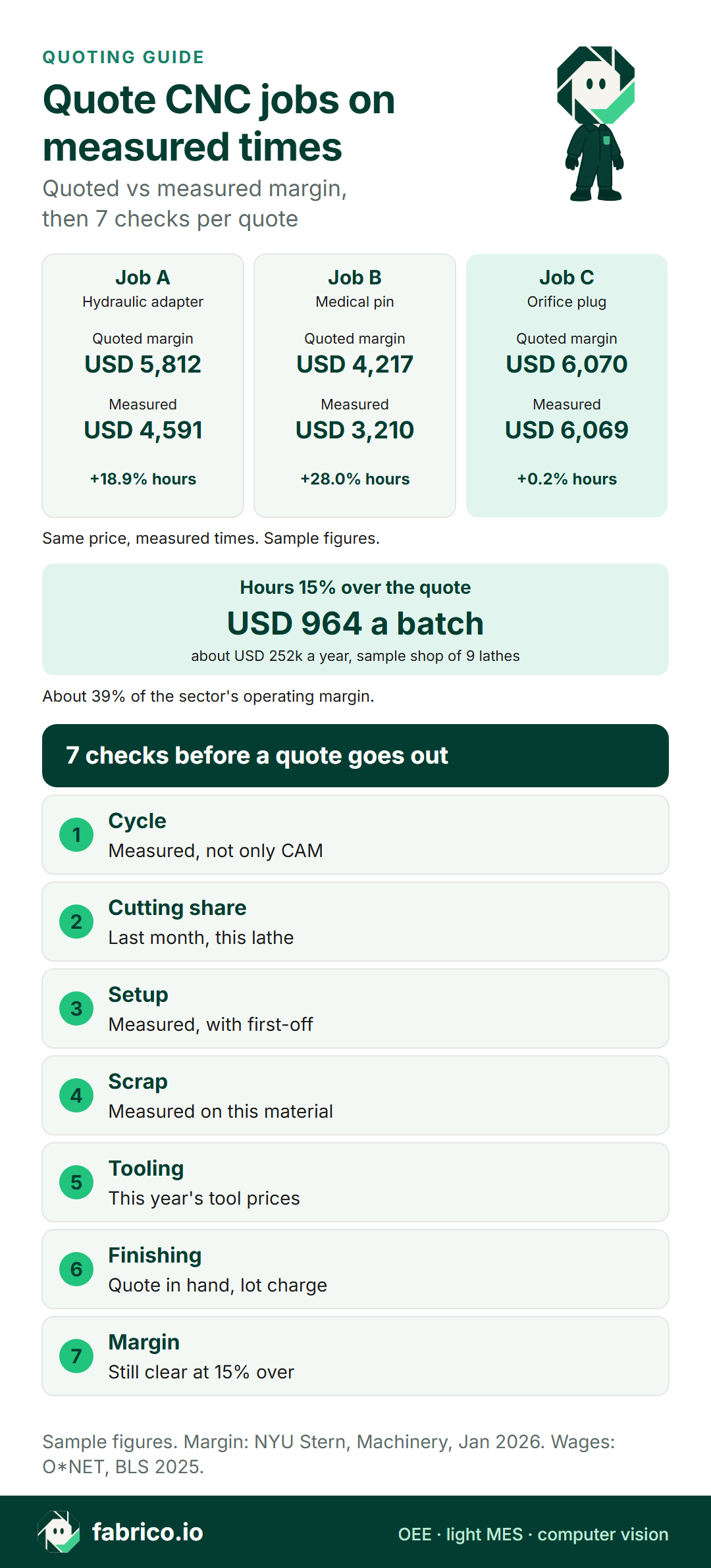
Text version of this infographic
- Job A, hydraulic adapter: gross margin USD 5,812 quoted, USD 4,591 on measured times.
- Job B, medical pin: gross margin USD 4,217 quoted, USD 3,210 on measured times.
- Job C, orifice plug: gross margin USD 6,070 quoted, USD 6,069 on measured times.
- A 15% time underquote: USD 964.19 per batch, about USD 252k a year in the sample shop.
- Check 1, Cycle: Is the cycle time from a measured run of this part family, or only from CAM?
- Check 2, Cutting share: What share of booked hours did this lathe actually cut last month?
- Check 3, Setup: Is the setup and first-off time the measured one for this family?
- Check 4, Scrap: Does the allowance match measured scrap on this material, start-up parts included?
- Check 5, Tooling: Is tool cost per part at this year's prices?
- Check 6, Finishing: Is the outside processing quote in hand, with its minimum lot charge?
- Check 7, Margin: Does the price still clear the operating margin if the hours run 15% over?
- Sample figures. Margin: NYU Stern, Machinery, January 2026. Wages: O*NET OnLine, BLS 2025 data.
Spreadsheet, ERP module, quoting software or calibration: which to pick
There are four ways to hold a quoting process, and the last one works with any of the first three. Cost ranges are given as categories; ask each vendor for the same scope in writing.
| Option | Cost range (category) | Choose it if |
|---|---|---|
| Spreadsheet quoting | No licence; estimator hours to build and keep the sheet, plus the risk of broken formulas and copies | Few machines, one estimator, mostly repeat work |
| Estimating module in the ERP | A licence add-on or included module, plus setup effort to load routings, rates and materials | The ERP already holds routings and costs, and orders flow from the quote into the job |
| Dedicated quoting software | A subscription per seat, plus effort to load machines, rates and materials and to connect it to the ERP | High quote volume, many new part numbers, CAD-based estimating, several estimators |
| Calibrate any of them with measured times | Machine connection per machine plus a monitoring or OEE software subscription, plus about an hour a week of estimator time to update the table | Quotes miss on new or difficult parts, margins vary job to job, no one knows real cycle and setup times |
Who picks which. A small shop with steady repeat customers can stay on a spreadsheet for years if the standards in it are measured. A shop whose ERP already drives routings gains most from its own estimating module. A shop answering many requests for new parts a week, often from drawings, is where dedicated quoting software saves estimator time. In all three cases the price is only as good as the times put in, which is why calibration is the option that pays across the board.
Questions to put to your team, or to any vendor of quoting, ERP or monitoring software:
- Where do the cycle and setup times in our quotes come from today, and when were they last checked against a real batch?
- Can the tool hold a cutting share or efficiency factor per machine, separate from the machine hour rate?
- Can it store standards per part family and update them from measured data, by import or API?
- How are scrap allowance, programming once per part number and finishing minimum charges handled?
- Can we see quoted and actual hours side by side per job after the batch, without retyping?
- What does it take to connect our oldest lathes, which may have no network port?
Measured times on the machines are the starting point for any of these options. Book a demo to see run time, stops and counts by machine and shift.
Where Fabrico fits in a quoting process
Fabrico is light MES and OEE software. In a quoting process its role is to supply the measured side of the comparison; the quote itself is made in the spreadsheet, the ERP or the quoting tool the shop already uses.
- Run time, stop time and part counts come from the machine's PLC or an IoT device with sensors on the machines you connect. The operator picks the stop reason from a grouped list on a tablet or phone, so setup and first-off waiting are recorded with their length. The OEE and light MES solution page shows the screens.
- OEE, downtime and losses by machine, line and shift, with availability and performance shown apart, which are the cutting share and the cycle gap in this page's example. With the selling price and margin of each SKU entered, losses are priced in money.
- On machines or manual steps with no usable signal, such as a hand deburring bench, the camera add-on counts output; see MES and OEE with computer vision.
- Measured times export to Excel for the quoting spreadsheet, and Fabrico also has a REST API and webhooks.
For shops comparing systems, the OEE software for CNC machine shops guide sets out what to look for.
Sources, accessed 17.11.2026: Berwing, Schuh and Stich, CPSL 2022; Yamamoto, Aoyama and Sano, JAMDSM 2017; O*NET OnLine, Machinists; Sahin and Kologlu, GUJS 2022; O*NET OnLine, CNC Tool Programmers; AMT and USCTI, Cutting Tool Market Report, September 2026; NYU Stern margins by sector.
Questions estimators ask
How do you calculate the cost of a CNC machining job?
Add six lines: material for the parts you will start, not only the good ones; machine time at your machine hour rate; setup and first-off time; programming; finishing and outside processing; and the margin the price has to carry. Machine time is the parts started times the cycle time, divided by the share of booked hours the machine actually cuts.
What machine hour rate should I use in a quote?
Use a rate built from the machine's own costs and a realistic hour base, as the machine hour rate guide on this site shows, and keep it the same for every quote on that machine. Do not add idle time into the rate; put it in the efficiency factor of the quote, where you can check it against measured data.
How accurate are CAM cycle time estimates?
Less accurate than a quote needs. In cutting tests published by Keio University researchers in 2017, the conventional CAM estimate missed the real machining time by about 30%, because CAM does not model how the machine's control accelerates and smooths the tool path. A measured run of a similar part is the better base.
How do I compare quoted and actual times?
For each batch, put the quoted cycle, setup, cutting share and scrap next to the measured ones, from the machine signal and the operator's stop reasons. Work out the ratio of measured to quoted hours for each part family and use it on the next quote for that family.
What does a 15% underquote cost?
In the sample hydraulic adapter job on this page, machine and setup time run 15% over the quote and cost USD 964.19 on a USD 15,510.08 order, 6.22% of the price. That is about 39% of the operating margin of the machinery sector in the NYU Stern dataset.
Should a job shop buy quoting software?
Only once it knows its real cycle and setup times. Any quoting tool, spreadsheet or ERP module multiplies the times it is given. A shop that feeds it measured times per part family gets better quotes from all three; one that feeds it guesses gets faster guesses.
Want to see measured run time, stops and counts by machine and shift? Book a demo.
Related articles




Latest from our blog







Real Fabrico tiles, sample data.