


 Login
 Blog
Listeria Recalls Tracker: How the Clean Break Sets the Scope

In short: A Listeria recall pulls ready-to-eat food that may carry Listeria monocytogenes, a bacterium that can live on in a plant's equipment and drains and grow slowly in the fridge. This tracker reads each FDA, CFIA and FSANZ notice for how the problem was found and what set its edge. With Listeria, the edge is set by sanitation: the last clean the plant can date and verify, and the swab results on both sides of it.
- FDA Enforcement Report data hold 9 Listeria recall events, 29 product records, with report dates from 5 August to 21 October 2026: 7 Class I, 5 of them cheese. Three were found by state sampling of product, two by an environmental finding, two through a supplier, one by illnesses and one by a product test.
- Scope ran from one 10 lb lot of pecorino to "all lot codes" of a frozen pasta, and to 68 deli salads and cream cheeses over 16 expiration dates after environmental sampling found Listeria in a New York plant.
- Example plant: a zone 1 positive on a fresh-cut salad line puts one day, 33,300 bags, in scope when the plant can show dated, verified cleans and daily swabs, and five days, 166,500 bags, when it cannot. The difference is $75,204.72 to $348,651.00 per event.
Tracker, updated 16 November 2026. Next update: December 2026. Sources are listed at the end.
This page reads each US, Canadian and Australian Listeria notice for how the problem was found and what set the edge of the recall. That edge rests on a time record, the same kind of line record that OEE for food and beverage is built on: when the line ran, when it stopped for a clean, and how much it made in between.
Listeria is not a foreign body that one worn part drops into one run. Foreign body recalls, bounded by the interval between detector checks, are read in the foreign material recalls tracker. The FDA's draft guidance on ready-to-eat foods says foods that have caused outbreaks are typically contaminated from the environment during processing or packing, and that the organism persists in equipment and harborage sites and can multiply slowly at refrigeration temperatures. That changes how far a recall reaches. A plant that can show when a line was last fully cleaned and sanitised, and what its swabs showed on both sides of that clean, can bound the product between two clean breaks. A plant that cannot show it recalls back to the last negative result it has on file, and sometimes everything it made.
New notices join the tables each month, and older ones stay, so the page builds into a record of which sanitation evidence held a recall to a day and which did not.
Nine US Listeria recalls, read for how they were found
The US rows come from the FDA's Enforcement Report data for food, searched for "Listeria" in the reason_for_recall field with a report_date from 1 August to 16 November 2026. The data were last updated on 4 November, so the newest report_date is 21 October and the oldest is 5 August. The search returns 29 product records. Grouped by event_id, that is 9 recall events from 8 firms; one importer has two events.
The counts below use three rules, and the same rules will apply to each month's update.
- Classification: the classification field of each record. Seven events are Class I and two are Class II; by record, 27 are Class I and 2 are Class II.
- Product type: the main product named in the product_description field. Five events are cheese, two are a frozen pasta meal, one is deli salads and one is a soup kit. Five of the nine are product types that the FDA's draft guidance lists among ready-to-eat foods that support the growth of L. monocytogenes: soft unripened cheese such as ricotta, fresh soft cheese, soft-ripened cheese such as Brie, and deli-type salads.
- How it was found: the first trigger named in the record's reason_for_recall text, or, where that is silent, in the company announcement or outbreak page the FDA posted for the same event. State sampling of finished product: 3 events. A finding passed on by a supplier: 2. An environmental finding, by sampling or a plant condition: 2. An illness investigation: 1. A product test whose tester the record does not name: 1.
| report_date | Firm and product | Class | How it was found | Scope stated |
|---|---|---|---|---|
| 21 Oct 2026 | Made Fresh Salads, Bay Shore, New York: deli salads and cream cheese (one product record so far, black bean and corn salad, 5 lb tub) | Class I | Environmental sampling by the FDA and the company (company announcement) | Expiration dates 3 to 18 Sep 2026; 68 products in the announcement. See the case below. |
| 14 Oct 2026 | Gias Foods, New York: bettergoods Lemon Alfredo Fettuccine, 22 oz, frozen, made in Italy (second event) | Class I | Routine sampling of finished product by the Washington State and Florida agriculture departments | Record: 1,174 cases, code L6081A, best by 21 Sep 2027. Announcement of 1 Oct: all lot codes |
| 30 Sep 2026 | Gias Foods: the same fettuccine (first event) | Class I | The same state sampling program | 16,002 bags (2,286 cases), lots L6079C and L6080C, best by 19 and 20 Sep 2027 |
| 30 Sep 2026 | Elegant Foods, Madison, Wisconsin: Pecorino Toscano D.O.P. stagionato wheels, made in Italy | Class II | A plant condition: "dripping condensation in cooler" | 10 lb, one lot (093DPD), Wisconsin |
| 23 Sep 2026 | Optimus Inc. (Markys Caviar), Miami Gardens, Florida: Mon Sire Brie, 1 kg | Class I | The Brie supplier's sample results | 22 cases (44 units), 2 lots, expiry 15 and 18 Aug 2026 |
| 2 Sep 2026 | Kettle Cuisine, Savage, Maryland: Marketside Tomato Bisque Soup Kit with cheese croutons and white cheddar, 14 oz | Class II | A "presumptive positive test result" on product; the tester is not named | 540 cases, one best by or use by date, 22 Aug 2026, 12 states |
| 12 Aug 2026 | La Colonia Foods, Rockville, Maryland: requeson and Mexican cottage cheese, 14 and 16 oz, and bulk requeson | Class I | A supplier: the record names bulk product from Clover Hill Dairy | 670, 205 and 169 retail units and 19 bulk buckets, 4 codes, Maryland and Virginia |
| 12 Aug 2026 | Clover Hill Dairy, Mechanicsville, Maryland: 18 product records of requeson, cuajada, cheddar, colby and jack | Class I | An illness investigation, with state product and environmental samples (FDA outbreak page) | One code in the record; expanded on 18 June to all cheese products on the market made at the facility |
| 5 Aug 2026 | Nelson & Isa Lacteos, Bay Shore, New York: requeson, 1 lb clamshells with no lot code or UPC | Class I | State sampling by New York's Department of Agriculture and Markets, matched to the outbreak strain | 480 clamshells, no code; sold 15 to 28 May 2026 (FDA outbreak page) |
Pages read for the table besides the data: the FDA's posting of the Gias Foods announcement of 1 October 2026, which follows the first one of 15 September, and the FDA's outbreak investigation of soft cheese, June 2026, content current as of 26 August 2026. The Enforcement Report rows are not the start of a recall. From each event's recall_initiation_date to its report_date took 20 to 72 days in this set, with a median of 47 days, so a plant that waits for the report to learn about a supplier's recall is weeks late.
Five lessons sit in these rows, and each depends on a fact from its own record.
- Two lots, then all lot codes. Gias Foods recalled lots L6079C and L6080C, best by 19 and 20 September 2027, on 15 September, after a routine state sampling program. Sixteen days later it recalled all lot codes; the second Enforcement Report record adds L6081A, best by 21 September 2027. Neither announcement says why the scope grew. An importer or a brand owner can only bound a recall with the maker's records, so ask for the maker's clean and swab history per production day before you need it.
- A cooler, not a line. The one record in this set that names a plant condition names "dripping condensation in cooler", and Elegant Foods' recall stayed at one lot of 10 lb. As the FDA's draft guidance points out, Part 117 requires a plant to be designed and built so that drip or condensate from fixtures, ducts and pipes does not contaminate food, food-contact surfaces or food packaging, and the guidance recommends that condensate from refrigeration coils be led to a sanitary drain. Cold rooms, coils and drip pans belong on the swab list as much as the line does.
- A supplier's result arrives as your recall. Markys Caviar recalled two lots of Brie after its supplier's sample results, and La Colonia's record names bulk requeson from Clover Hill Dairy. Two of the nine events reached the recalling firm from upstream. A distributor's scope is the maker's lot list, so keep each supplier lot against what you shipped and when.
- A presumptive result, one date. Kettle Cuisine recalled 540 cases of a soup kit on a presumptive positive, all with one date, 22 August 2026. A kit joins components that can come from different lines or suppliers; this one holds soup, cheese croutons and white cheddar. The record does not say which component tested positive. A kit maker needs to know which line, and which interval between cleans, each component came from.
- Three years of onsets. The FDA's outbreak page lists 15 illnesses in 4 states with onsets from 6 March 2023 to 8 July 2026, an environmental sample from Clover Hill that matched the outbreak strain and a second one that tested positive, and an expansion on 18 June 2026 to all cheese products on the market made at the facility. Our reading: when the same strain lives in a plant for years, no clean break can be argued, and the scope becomes everything the plant made.
Why Listeria scope follows the clean, not the code
For a foreign body or a label error, the plant looks for the moment a part broke or a label changed. For Listeria the question is different: was the organism living somewhere in the line or the room, and from when? The FDA's Control of Listeria monocytogenes in Ready-To-Eat Foods: Guidance for Industry, a draft issued in January 2017 and still marked as a draft, gives the clean its role in plain words. For its hold and test examples it assumes that a lot is "one day's production on a processing line, with cleaning and sanitizing between production lots". The clean is the lot boundary. A clean the plant cannot date or verify is not a boundary at all.
The rule behind it is in the US preventive controls regulation. 21 CFR 117.165(a)(3) requires environmental monitoring for an environmental pathogen or an appropriate indicator organism, if contamination of a ready-to-eat food with an environmental pathogen is a hazard requiring a preventive control, as appropriate to the facility, the food, and the nature of the preventive control and its role in the facility's food safety system. The written procedures must, among other things, identify where samples are taken, how many sites, and the timing and frequency, all adequate to determine whether the preventive controls are effective, and they must include the corrective action procedures required by 21 CFR 117.150. Those procedures must address, as appropriate, an environmental pathogen found through that monitoring, and describe the steps to ensure that all affected food is evaluated for safety and kept out of commerce if the plant cannot ensure it is not adulterated, or misbranded under section 403(w). All corrective actions must be documented in records.
"All affected food" is where the clean break earns its keep. In this tracker's sense, a clean break has three parts, and each one is a record:
- The clean happened on this line, at this time. A start and an end, a line name and a person, not a room ticked off on a weekly sheet.
- It was verified before production restarted. A signed pre-operation inspection, and where the plant uses one, a cleaning check such as ATP swab testing. A cleaning check shows residue; it is not a Listeria test.
- Swab results sit on both sides of it. The FDA's draft guidance says the most important time to swab is several hours into production, such as 3 to 4 hours, or preferably just before cleanup, because by then the organism, if present, has had time to work its way out of a harborage site.
Meat and poultry plants under USDA rules meet the same idea as a legal requirement. Under 9 CFR 430.4, an establishment that controls Listeria by sanitation measures only, Alternative 3, and that produces a deli product or a hotdog product, must verify its corrective actions after a first positive on a food-contact surface by follow-up testing of that site and the surrounding surfaces. If that follow-up testing gives a second positive for an indicator organism, it must hold the lots that may have become contaminated by contact with that surface until it corrects the problem, and it may release them only after testing that gives statistical confidence, or after reworking them with a process that kills the organism. Which lots "may have become contaminated" is a question about cleans and contact, and the answer comes from the sanitation record.
Zones 1 to 4: what a positive in each says about product
The FDA's draft guidance sorts a plant into four zones for sampling and sets out example corrective actions for each. It also recommends testing for Listeria species rather than only L. monocytogenes, because the wider test also finds the more common Listeria species and lets the plant correct conditions that could lead to L. monocytogenes; a positive for Listeria species on a surface does not by itself establish that L. monocytogenes is there. The frequencies and actions below are the guidance's examples for a plant making a ready-to-eat food that supports growth.
| Zone | FDA's description and examples | Example frequency | Example actions after a positive | What it says about product (our reading) |
|---|---|---|---|---|
| 1 | Food-contact surfaces: utensils, table surfaces, slicers, pipe and tank interiors, filler bowls, packaging and conveyors, hoppers | Specific food-contact surfaces at least weekly; each one at least monthly | First positive: clean and sanitise, retest at least 3 hours into the next run, investigate. Second: intensified cleaning with disassembly, hold and test the day's lot and hold the next two production days. Third: assume a harborage; for growth foods, stop production | Speaks directly to the product made on that surface since the last clean break |
| 2 | Non-food-contact surfaces close to food and food-contact surfaces: equipment housing or framework, some walls, floors or drains nearby | At least weekly | Clean and sanitise, retest at least 3 hours into the next run; a second positive brings intensified cleaning and sampling, and a root cause analysis if results are not all negative | A warning that a zone 1 positive may follow; no product hold in the FDA's example |
| 3 | More remote non-food-contact surfaces in or near processing: forklifts, hand trucks, carts, some walls, floors or drains | Every two weeks | Corrective actions that may be less rigorous than for zone 2 | Shows how the organism could travel towards the line |
| 4 | Remote areas outside processing: locker rooms, cafeterias, hallways | Monthly | As for zone 3 | Shows where it could come in from |
The steps in the zone 1 row are for a positive for Listeria species. When the organism found on a food-contact surface is L. monocytogenes itself, the guidance's example is firmer: reprocess the lot made on it with a validated listericidal step, divert it from human food or destroy it, and consider whether product in commerce should be recalled. Which lot "that lot" is depends on where the plant can show its last clean break.
Two more of the guidance's examples set the size of a swab plan. It recommends that even the smallest processors collect samples from at least 5 food-contact sites and 5 non-food-contact sites on each ready-to-eat production line, and that all non-food-contact sites on the plan be tested at least once each quarter. It also warns against a clean record that looks too good: a plant should expect to find Listeria species occasionally, and if its results are consistently negative, it should add or swap sampling sites to make sure it is not missing a source. A swab history only bounds a recall if the swabs were taken where the organism would be.
Case: Made Fresh Salads, New York, September 2026
On 6 September 2026 the FDA posted a company announcement from Made Fresh Salads, Inc. of Bay Shore, New York, recalling its ready-to-eat deli style salads and cream cheese. The announcement says the recall followed "environmental sampling by the FDA and the company", which found that some areas of the facility tested positive for Listeria monocytogenes. The products carry expiration dates from 3 September through 18 September 2026 and were sold in 30 lb and 5 lb tubs and half-size aluminium pans, by direct delivery to stores and distributors in Brooklyn, Queens, the Bronx and New York City. The list runs to 68 products: 43 salads, puddings, croquettes and crabcakes, and 25 cream cheeses and spreads. No illnesses had been reported at the time of the announcement, and the company stopped production and distribution while it and the FDA investigate.
It was the firm's second Listeria recall of 2026 in the Enforcement Report data. On 20 February 2026 the FDA posted an earlier announcement: the company's routine sampling program had found that a part of the mixer used for finished products was contaminated. Fourteen products, 13 cream cheeses and a tofu spread, with expiration dates through 27 February 2026 were recalled, 557 tubs of 5 lb in all according to the Enforcement Report data, and the company removed the mixer from service. That event is Class I, with a recall_initiation_date of 19 February and a termination_date of 18 August 2026. The September event's recall_initiation_date is 4 September, 17 days after that termination. The Class I record for September has a center_classification_date of 14 October and a report_date of 21 October.
Neither notice says what caused the contamination or whether the two findings are linked, and we make no claim about either. What the two notices show, line by line:
- "Through 27 February" against "3 September through 18 September". The February scope had an end and no start. The September scope had both, 16 expiration dates. Our reading: the start is the edge that needs the most evidence, and it can only come from a dated, verified clean with a negative swab behind it.
- A part of a mixer against "some areas of the facility". A positive on one machine part put 14 cream cheese and spread products in scope and no salads. Positives in areas of the facility put all 68 products in scope, salads and cream cheese alike. The more exactly a positive can be placed, the shorter the product list, so keep a map from every zone 1 and zone 2 site to the lines and products it touches.
- Removed from service, then 17 days from termination to the next recall. After a positive, the FDA's draft guidance asks for follow-up samples at the positive site and at least 3 surrounding sites, and a root cause analysis when Listeria species turn up in the same general area more than once. Keep those results with the dates of each clean, so that a later finding can be compared with the earlier one in hours, not argued from memory.
- "Repacked by retail locations". The September announcement warns that stores may have repacked the products in deli-style or other packaging, where the plant's expiration date may no longer show. A forward trace by customer and delivery date is the only part of the scope that survives a repack.
- Production stopped. Restarting is a clean-break proof as well. For a food that supports growth, the guidance's example after a third positive on a food-contact surface is to stop production, and after the corrective actions to hold and test product with intensified sampling until three consecutive dates of negative results for food-contact surfaces and product.
The next case will be added under this one, with its date in the heading.
Four notices from Canada and Australia, and where each edge sits
When read on 16 November, the Government of Canada's recall site listed one Listeria notice published from October to mid-November 2026, and Food Standards Australia New Zealand none that names Listeria in that time. The table adds the September notices, with each publication date shown, because their code fields show the three kinds of edge side by side.
| Published | Notice | Product | Trigger stated | Codes recalled |
|---|---|---|---|---|
| 14 Oct 2026 | Canada, RA-82779, Class 1 | Fromagerie L'Ancêtre: 12 organic cheeses under three brands, blocks and shredded, national | CFIA test results; no illnesses reported | Blocks: best before 2027 JL 30, and 2027 MR 30 for one mozzarella. Shredded: five production codes, best before 2026 DE 04 to 2027 JA 24 |
| 17 Sep 2026 | Canada, RA-78484, Class 1 | Fresh Bites Inc.: 28 sandwiches, subs, croissants and a naan under three labels and unbranded, Alberta | The company; no illnesses reported | "All best before dates up to and including" 26 SE 17, 26 SE 19 or 26 SE 20, by label |
| 11 Sep 2026 | Canada, RA-82622, Class 1 | Olymel: Chicken Breast Strips, 2 x 175 g, Quebec | The company; no illnesses reported | Best before 2026 OC 10 only |
| 4 Sep 2026 | FSANZ, Bottega 1995 | Brie Mon Sire, 1 kg, one store in South Australia | Not stated | Best before 13/10/2026 |
- No start date. Fresh Bites' three code groups each read "all best before dates up to and including" a date in mid-September. The recall has an end and no beginning. Our reading: that is the shape of a scope set back to the last result the firm can show, or further, and here it covers all 28 products listed.
- One date. Olymel's notice lists a single best before date, 2026 OC 10, for one product. The notice does not say how the date was chosen; in our reading, one date is the shape a recall takes when one production day can be shown to stand alone.
- Two forms, two spans. L'Ancêtre's block cheeses carry two best before dates, 2027 JL 30 and, for one mozzarella, 2027 MR 30, while its five shredded products run from 2026 DE 04 to 2027 JA 24, 51 days apart (our count). The notice gives no cause. Our reading: where blocks and shreds come off different steps, each step's codes can only be argued with that step's own cleans.
- One brand, two markets. The Brie Mon Sire recalled at one store in South Australia carries a best before date of 13 October 2026; the Mon Sire Brie that Markys Caviar recalled in Florida after its supplier's results carried expiry dates of 15 and 18 August 2026. The notices do not say whether the lots are linked. For an importer, the maker's sanitation record is the only record that can set the edge.
Pricing one positive swab on a fresh-cut salad line
Example plant. Every operating figure in this worked example is Example data; only the two unit values are sourced. The plant is not any company named above, and the sums are not an estimate of any recall in this tracker. Fresh-cut vegetables are among the FDA draft guidance's examples of ready-to-eat foods that support growth, so its growth-food examples apply.
- The line: washes, cuts, dries and bags chopped romaine in 12 oz bags at 37 bags a minute, 37 x 60 = 2,220 bags an hour. It runs 15 hours a day, 06:00 to 21:00, so a production day is 2,220 x 15 = 33,300 bags. It runs Monday to Saturday, with a full clean and sanitise every night. Product ships the morning after it is packed.
- Plant A's records: each nightly clean is logged with its start, end and line, and a signed pre-operation inspection releases the line at 05:30. Zone 1 swabs are taken every production day at 20:30, just before cleanup, at the chopper's discharge belt and four other food-contact sites.
- Plant B's records: the same nightly cleans, but the sanitation sheet records the room and the date and is signed at the end of the week. Zone 1 swabs are taken on Mondays and Fridays at 20:30, which already meets the guidance's example of at least weekly sampling of specific food-contact surfaces. This is a realistic baseline, not a strawman.
Step 1: the event, in time order. On Friday at 20:30 both plants swab the chopper's discharge belt. On Saturday at 18:00, during the run, the lab reports L. monocytogenes on that belt. Friday's bags shipped on Saturday morning; Saturday's bags are still in the plant. Both plants hold Saturday's product and take a follow-up set at 18:30, 12.5 hours into the run: the positive site and four surrounding sites, one more than the guidance's minimum of three. After the run, both clean that site with particular attention. On Sunday at 17:00 the follow-up set comes back negative for Listeria species. Under the guidance's example for L. monocytogenes on a food-contact surface, the lot made on that belt is to be reprocessed, diverted or destroyed, and product in commerce considered for recall. The question each plant now has to answer is which bags make up that lot.
Step 2: what each plant can prove.
- Plant A: Thursday's 20:30 swab at the same belt was negative, and Thursday night's clean is dated and was verified before Friday's start. Friday night's clean is dated and verified too, and Saturday's follow-up set is negative. Friday's production sits between two clean breaks with negative results on both sides, so the scope is Friday: 33,300 bags. Saturday's lot is released.
- Plant B: its last negative result at that belt is Monday's 20:30 swab. It cannot show when any clean between Monday night and Saturday morning started or ended, or that any was checked, so it cannot argue a break. Saturday's negative follow-up does not help on its own, because B cannot show the clean that opened Saturday's run. Its scope runs from Tuesday's start to the Saturday stop: 5 x 33,300 = 166,500 bags. Four days have shipped and Saturday's lot is held.
Step 3: two unit values, low and high.
- Low, a trade value of the leaf. UN Comtrade records US imports under HS 070519 in 2025 at $357,764,258 FOB for 215,584,449 kg, a weight Comtrade does not mark as estimated. That is $1.6595 a kg (our arithmetic). The US tariff schedule files 0705.19 as lettuce other than head lettuce, fresh or chilled, and splits it into romaine, butterhead, red and green leaf, and other. A 12 oz bag holds 0.75 x 0.45359237 = 0.3402 kg, so 1.6595 x 0.3402 = $0.5646 a bag.
- High, a shelf price of the leaf. The BLS average price for lettuce, romaine, per lb, US city average was $3.490 in October 2026. For a 12 oz bag: 3.490 x 0.75 = $2.6175 a bag.
Both are values of the leaf, not of a branded bag, and neither is margin or any named company's price, so the sums below are value floors.
| Scope | Bags | At $0.5646 | At $2.6175 |
|---|---|---|---|
| A: between two verified clean breaks, Friday | 33,300 | $18,801.18 | $87,162.75 |
| B: back to Monday's negative swab, Tuesday to Saturday | 166,500 | $94,005.90 | $435,813.75 |
| B minus A: kept out by Plant A's records | 133,200 | $75,204.72 | $348,651.00 |
The sums: 33,300 x 0.5646 = 18,801.18 and 33,300 x 2.6175 = 87,162.75; 166,500 x 0.5646 = 94,005.90 and 166,500 x 2.6175 = 435,813.75; 166,500 minus 33,300 = 133,200, and 133,200 x 0.5646 = 75,204.72 and 133,200 x 2.6175 = 348,651.00.
Step 4: the second cost, if the follow-up had been positive. Suppose Sunday's result had come back positive instead: a second positive on a food-contact surface. The guidance's example then moves to hold and test. Saturday's lot, the day of the second positive, stays on hold and is tested; the next two production days, Monday and Tuesday, are held as well, with intensified cleaning that includes taking the equipment apart. Held lots are released once the tested lot is negative and food-contact samples taken over three sequential production days are negative. For a food that supports growth and is sold to the general population, the guidance's sampling table gives 20 samples per lot with none allowed to be positive (case 12; our reading of which case applies).
- Product on hold: 3 x 33,300 = 99,900 bags, 99,900 x 0.5646 = $56,403.54 to 99,900 x 2.6175 = $261,488.25. This is value at stake, not lost unless a test is positive; a short shelf life product loses selling days while it waits.
- Line time: if each of the two intensified cleans pushes the next start from 06:00 to 07:30 (Example data), Tuesday and Wednesday each lose 90 minutes: 2 x 1.5 x 2,220 = 6,660 bags not made, 6,660 x 0.5646 = $3,760.24 to 6,660 x 2.6175 = $17,432.55. On each of those days, 90 of the 900 planned minutes, 10%, comes off availability if the plant books the overrun as unplanned stop time. How to book sanitation time is covered in sanitation shift OEE and TEEP.
Lab fees, the recall's own costs, freight, retailer charges and destruction are not priced here, so every figure is a floor. Against the realistic baseline, Plant B, Plant A's dated and verified cleans and daily zone 1 swabs keep 133,200 bags out of a recall: $75,204.72 to $348,651.00 for one event on one line. Whether a regulator accepts the narrower scope is a food safety and regulatory call; the records only make the argument possible.
Book a demo and see downtime and losses per line and shift.
Clean records, more swabs or separate lines: what to fund first
The rules read for this page leave the swab frequency to the plant's written procedures: 21 CFR 117.165 asks that timing and frequency be adequate to determine whether the controls are effective, and the FDA's frequencies are examples. The table uses this page's Example plant as the cost anchor, because this tracker read no independent price source for lab tests or sanitation software.
| Option | What it bounds | Cost anchor on this page | Choose it if | Watch for |
|---|---|---|---|---|
| Dated, line-level clean records with a signed pre-operation release | Makes each production day a lot that can stand alone | Minutes of sanitation and supervisor time per night; not priced | Your cleans happen but are logged by room or by week | A clean with a time but no verification is still only a claim |
| Zone 1 swabs every production day, just before cleanup | Gives each clean break a negative result on both sides | The gap between A and B: 133,200 bags, $75,204.72 to $348,651.00 per event | Product ships before results return, as in this page's Example plant | Results that are consistently negative: the guidance asks for added or substituted sites then |
| Hold product until the day's zone 1 results are back | Keeps the suspect day in the plant, so a positive becomes a hold, not a recall | One day of output in the cold store: 33,300 bags, $18,801.18 to $87,162.75 at stake each day | Shelf life can carry one or two days in storage | Cold store space and lost selling days |
| A site map from each swab point to lines and products | Turns "some areas of the facility" into one line's products | Desk time; not priced | One room or one mixer feeds many products, as at Made Fresh | Shared tools, carts and drains that cross between lines |
| Separate rooms or lines for high-risk products | Stops one positive spreading the scope to the whole plant | Capital; not priced | A growth-supporting product shares a room with lower-risk ones | Zone 3 traffic: forklifts, hand trucks and carts |
Fund dated, verified clean records first if your sanitation sheet cannot say which line was cleaned when: without them, no swab result can be placed against a day. Fund daily zone 1 swabs next if product leaves before results come back, because the gap between Plant A and Plant B is mostly the four days with no swab. Choose test-and-hold where shelf life allows it, and a site map before separate rooms: the map costs desk time and shows whether the rooms are needed. For holds, the record of what is held, where and on whose release is covered in quality hold process design.
Questions to settle with your lab and with any vendor of sanitation or line data software:
- How many hours from swab to result, at night and at weekends, and is a presumptive result reported before the confirmation?
- Can each swab result be stored with its site, zone, line and the time it was taken, and searched by date range?
- Can a clean be recorded with its start, end, line and the person who released the line, and can that record be edited after the shift without a trace?
- Can the plant export, for any date, which order ran on which line, when the line stopped for a clean, and how many units it made between cleans?
- Who is told, and how fast, when a swab result is positive while product from that line is still in the plant?
This month and this quarter, by role
Food safety or quality manager
- Pick last week's production on one ready-to-eat line. For each day, find the clean before it and after it, and the zone 1 results on both sides. Count the days you could argue as a lot of their own.
- Draw the site map: each zone 1 and zone 2 site against the lines and products it touches. Made Fresh's two notices show what one machine part and "some areas of the facility" each put in scope.
- Add cold rooms, evaporator coils and drip pans to the zone 2 and zone 3 lists, as Elegant Foods' "dripping condensation in cooler" shows.
Sanitation lead
- Log every clean with its start, end, line and the name of whoever releases the line, on the night, not at the end of the week. The master plan for what gets cleaned and how often belongs in a master sanitation schedule.
- Take zone 1 swabs late in the run or just before cleanup, as the guidance advises, and not straight after sanitising, when residual sanitiser can interfere with the test.
Production manager
- Log sanitation as a stop with its own reason, so the start and end of the night's clean sit in the same record as the run it closed. How food safety stops show up in the numbers is set out in food safety stops in OEE.
- For each product with a short shelf life, write down whether a day's output could wait in the cold store for its swab results, and how much space that takes.
Plant manager, this quarter
- Run a trace drill that starts from a positive swab, not a complaint: pick a date and a site, and time how long it takes to name the lots, the days and the customers in scope. A worked format is in the mock recall trace drill, and the general method for cutting scope to a proven window in how to keep a food recall narrow.
- Price your own Plant A and Plant B with your line's output and your product's value, using the arithmetic in the worked example, and fund the option that closes the larger gap.
- Check that every lot record joins to a production day and a line, so a recall can be cut by day; a structure for that is in the lot traceability data model.
Dating a clean break from the line record
Every case in this tracker turns on a record that existed or did not: a swab plan that found a mixer part, a code with a start date, a cooler named as the source, a recall that had only an end. The same holds when the record is an ingredient lot, as in the Salmonella recalls tracker, or a label version, as in the undeclared allergen recalls tracker. The sanitation and swab records belong to the food safety plan and the lab. What the line record adds is the time stamp around them: when the line stopped for a clean, when it started again, which product ran in between and how many units it made.
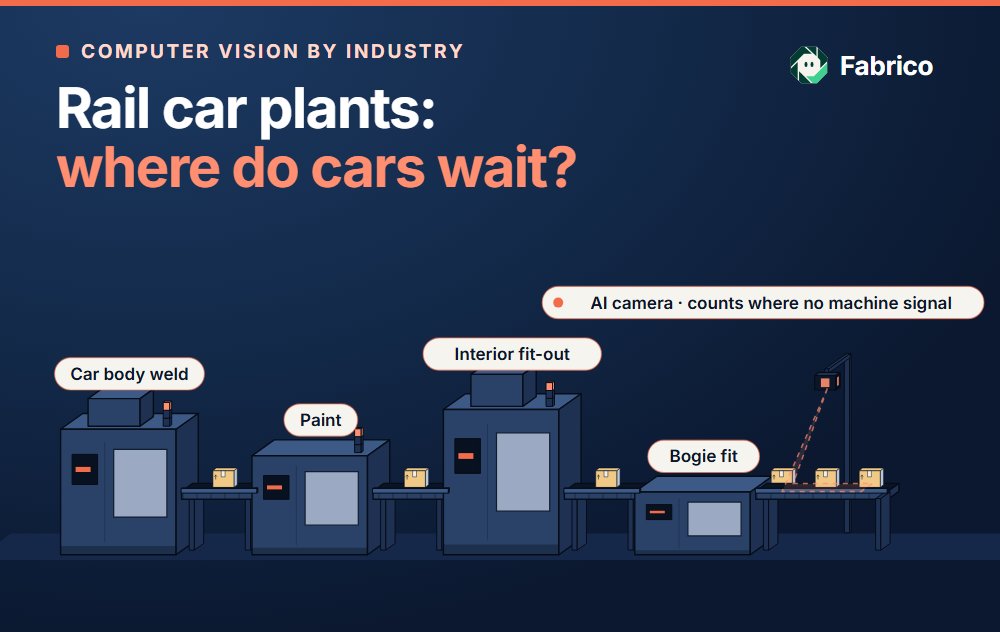
Fabrico is a cloud OEE and light MES platform. It shows OEE and losses by machine, line and shift, with data from the machine's PLC or an IoT device with sensors on the machines you connect, and operators give the reason for a stop at the machine. A sanitation stop logged with its start, end and reason is a time-stamped record of when the line stopped for a clean, which helps date a clean break. With the selling price and margin of each SKU entered, losses are priced in money. Environmental monitoring, swab results, lab testing and sanitation verification stay in the food safety program. On manual stations, AI cameras (an add-on) count output; they do not see contamination or check cleaning. The building blocks are OEE software for the run and stop record and a light MES for the production record.
Book a demo and see OEE and downtime per line and shift.
What people ask next
What should a plant do after a Listeria positive on a food contact surface?
The FDA's draft guidance on Listeria in ready-to-eat foods (January 2017, still a draft) gives an example for a food that supports growth. After a first positive for Listeria species on a food-contact surface: clean and sanitise the site, retest it and the surrounding area at least 3 hours into the next production run, and investigate. After a second positive: intensified cleaning with disassembly, intensified sampling, and hold and test of that day's lot, with product from the next two production days held as well. After a third: assume a harborage and stop production. If the organism is L. monocytogenes itself, reprocess, divert or destroy the lot made on that surface and consider whether product in commerce should be recalled. US rules, 21 CFR 117.150, require written corrective action procedures and records of every corrective action taken.
How often should a ready-to-eat food plant swab for Listeria?
No rule read for this tracker fixes a frequency: 21 CFR 117.165 asks for timing and frequency adequate to determine whether the preventive controls are effective. The FDA's draft guidance gives examples for a food that supports growth: specific food-contact surfaces at least weekly and each one at least monthly, zone 2 sites weekly, zone 3 every two weeks, zone 4 monthly, and every non-food-contact site on the plan at least once a quarter, with at least 5 food-contact and 5 non-food-contact sites on each line even for the smallest processors. It advises swabbing 3 to 4 hours into production or, preferably, just before cleanup.
Which products are in scope after a Listeria positive?
The product made on the positive surface since the last clean break the plant can prove, up to the next one. For its hold and test examples, the FDA's draft guidance assumes that a lot is one day's production on a processing line, with cleaning and sanitising between lots. A plant that can date and verify each clean and show negative swabs on both sides can argue for that day. A plant that cannot goes back to its last negative result, or further: in this tracker, one Canadian notice covers all best before dates up to and including a date, and one US importer recalled all lot codes.
What is the difference between a Listeria species and a Listeria monocytogenes result?
Listeria species covers several kinds of Listeria; L. monocytogenes is the one behind listeriosis. The FDA's draft guidance recommends testing environmental samples for Listeria species, because the wider test also finds the more common species and lets the plant correct conditions that could lead to L. monocytogenes. A positive for Listeria species does not by itself establish that L. monocytogenes is present, and the guidance's firmest product action, to reprocess, divert or destroy the lot, is for L. monocytogenes found on a food-contact surface.
How long does product stay on hold after a second Listeria positive?
In the FDA's draft example for a food that supports growth, the lot from the day of the second food-contact positive is held and tested, and product from the next two production days is held as well. The tested lot is released when it is negative and retests of the food-contact surface are negative for three sequential days; the rest is released once food-contact samples from 3 sequential production days are negative. For the product test, the guidance's sampling table gives 20 samples with none allowed to be positive for a food that supports growth sold to the general population (case 12, our reading). Under 9 CFR 430.4, a meat or poultry plant on Alternative 3 that makes a deli or hotdog product must hold the lots that may have been contaminated until it corrects the problem.
Can OEE software record a clean break?
It can record part of one. A sanitation stop logged at the machine with its start, end and reason is a time-stamped record of when the line stopped for a clean and when it ran again, with the orders and units made in between, and that dates the break. It does not verify the clean or test for Listeria: environmental monitoring, swab results, lab tests and the pre-operation release stay with the food safety plan and the lab. In this tracker's worked example, dated and verified cleans plus daily zone 1 swabs held one positive to 33,300 bags, against 166,500 bags without them.
Sources
Sources accessed on 16 November 2026 unless marked as accessed on another date. Dates are publication dates where a page gives one; other dates are labelled as what they are.
- U.S. Food and Drug Administration, Enforcement Report data for food (openFDA), recall reason containing Listeria, report dates 1 August to 16 November 2026, data last updated 4 November 2026, accessed 16 November 2026
- U.S. Food and Drug Administration, Made Fresh Salads, Inc. Recalls Ready to Eat Deli Style Salads and Cream Cheese Because of Possible Health Risk, company announcement and FDA publish date 6 September 2026, accessed 16 November 2026
- U.S. Food and Drug Administration, Made Fresh Salads, Inc. Recalls Assorted Flavors of Cream Cheese Because of Possible Health Risk, company announcement and FDA publish date 20 February 2026, accessed 16 November 2026
- U.S. Food and Drug Administration, Gias Foods, Inc. Recalls Bettergoods Authentic Italian Lemon Alfredo Fettuccine Because of Possible Health Risk (all lot codes), company announcement and FDA publish date 1 October 2026, accessed 16 November 2026
- U.S. Food and Drug Administration, Gias Foods, Inc. Recalls Bettergoods Authentic Italian Lemon Alfredo Fettuccine Because of Possible Health Risk (two lots), company announcement and FDA publish date 15 September 2026, accessed 16 November 2026
- U.S. Food and Drug Administration, Outbreak Investigation of Listeria monocytogenes: Soft Cheese (June 2026), content current as of 26 August 2026, accessed 16 November 2026
- U.S. Food and Drug Administration, Control of Listeria monocytogenes in Ready-To-Eat Foods: Guidance for Industry, draft guidance, draft issued January 2017, page content current as of 17 January 2017, accessed 16 November 2026
- Legal Information Institute, Cornell Law School, 21 CFR 117.165, Verification of implementation and effectiveness, page undated, accessed 16 November 2026
- Legal Information Institute, Cornell Law School, 21 CFR 117.150, Corrective actions and corrections, page undated, accessed 16 November 2026
- Legal Information Institute, Cornell Law School, 9 CFR 430.4, Control of Listeria monocytogenes in post-lethality exposed ready-to-eat products, 68 FR 34224, 6 June 2003, as amended at 80 FR 35188, 19 June 2015, accessed 16 November 2026
- Government of Canada, Recalls and safety alerts: Various brands of organic cheeses recalled due to Listeria monocytogenes (RA-82779), published 14 October 2026, accessed 16 November 2026
- Government of Canada, Recalls and safety alerts: Various brands of sandwiches recalled due to Listeria monocytogenes (RA-78484), published 17 September 2026, accessed 16 November 2026
- Government of Canada, Recalls and safety alerts: Olymel brand Chicken Breast Strips recalled due to Listeria monocytogenes (RA-82622), published 11 September 2026, accessed 16 November 2026
- Food Standards Australia New Zealand, Bottega 1995 Brie Mon Sire 1Kg recall, recall published 4 September 2026, accessed 16 November 2026
- U.S. Bureau of Labor Statistics, Average price data, series APU0000FL2101, Lettuce, romaine, per lb. (453.6 gm), U.S. city average, October 2026 data, accessed 16 November 2026
- UN Comtrade, United States trade in HS 070519 (lettuce other than head lettuce, fresh or chilled), 2025, data year 2025 (no publication date in the API response), accessed 16 November 2026
- U.S. International Trade Commission, Harmonized Tariff Schedule, heading 0705 and subheading 0705.19, current schedule (no date in the API response), accessed 16 November 2026
Latest from our blog



Real Fabrico tiles, sample data.