







 Login
 Blog

OEE vs Schedule Attainment: Volume, Mix and Unused Capacity

Key takeaways
- Units made / units planned is schedule attainment. It is about volume.
- Production adherence caps each product at its plan. It checks that you made the right mix.
- OEE = good output / what the planned time could give at the ideal speed. It checks capacity.
- In the worked example, a line reaches 101.8% attainment at 62.2% OEE, with adherence of 81.8%.
Fabrico, OEE and light MES (manufacturing execution system) software with AI cameras, logs stops automatically and prices each loss. Your plan stays with your planners and your ERP (enterprise resource planning) system.
Below are the three formulas, a worked day where they part ways, and what to put on the daily board.
What is schedule attainment?
Schedule attainment compares the units made with the units planned, for a day, a week or an order. Some plants cap it at the plan, so making more than planned does not look like a win.
- Schedule attainment = units made / units planned.
- Production adherence = sum of the smaller of made and planned for each product / units planned.
- Neither one says how many hours it took.
Our article on schedule attainment vs production adherence covers the planning side in more detail.
How is OEE different?
OEE compares good output with the planned time at the ideal speed: good count x ideal cycle time / planned production time. It does not care what the plan asked for.
A line that made exactly the plan in twice the time it needed has a low OEE, even if the planner is happy.
| Measure | What it compares, and what hurts it |
|---|---|
| Schedule attainment | Units made against planned volume. A slow line hurts it only if the plan assumed more. |
| Production adherence | Each product against its plan. Making the wrong product hurts it. |
| OEE | Good output against the ideal speed over planned time. Stops, slow cycles and rejects all hurt it. |
How can a line hit plan with low OEE? A worked example
Sample line (illustrative numbers, not a customer): a filler rated at 200 bottles a minute, planned for 2 shifts, 900 minutes in total. At the ideal speed that is 900 x 200 = 180,000 bottles.
The plan asks for 110,000, in three flavours of the same bottle, all rated at 200 a minute: A 50,000, B 40,000 and C 20,000. All bottles made are good. A long run on A goes well, and the crew keeps it going. C never starts.
| Product | Planned | Made | Counted for adherence |
|---|---|---|---|
| A | 50,000 | 72,000 | 50,000 |
| B | 40,000 | 40,000 | 40,000 |
| C | 20,000 | 0 | 0 |
| Total | 110,000 | 112,000 | 90,000 |
- Schedule attainment = 112,000 / 110,000 = 101.8%.
- Production adherence = 90,000 / 110,000 = 81.8%.
- OEE = 112,000 / 180,000 = 62.2%.
- The plan itself asked for 110,000 / 180,000 = 61.1% of the possible output.
Volume looks better than planned. The customer who ordered C gets nothing. And the plan asked for only 61.1% of the possible output. So 68,000 bottles of capacity, 180,000 minus the 112,000 made, never appear in any plan report.
Each number catches a different problem. That is why one of them alone cannot run a plant.
Which number should go on the daily board?
- Attainment and adherence together, because the customer feels both volume and mix.
- OEE next to them, because it shows how much more the line could make.
- The reason for each missed product: a stop, material, a late changeover, or a product never started.
When OEE rises and the plan rate stays the same, the gain turns into idle time. Our note on OEE vs output target covers how to move the target as the line improves.
Why can a line meet the plan and still waste capacity?
Because planners plan on what the line usually does. If the line has run at about 60% for years, the plan assumes about 60%. Hitting that plan proves the line is steady, not that it is good.
OEE shows the gap between the usual and the possible. Our guide to capacity vs throughput explains how that gap becomes real output.
How do you report attainment when the plan changes mid-week?
Plans change: a rush order arrives, a product is pulled, material runs late. Measure attainment and adherence against the plan that was frozen at the start of the day, not the plan as it ended. Keep the changes on a separate line with their reason. Otherwise every late change looks like a miss by the line, or hides one.
What mistakes do plants make with these numbers?
- Celebrating a plan met while one product was never made.
- Letting a good run carry on and skipping the next product.
- Leaving the plan rate unchanged for years while OEE improves.
- Reporting OEE without the plan, so nobody knows if the order shipped.
Where Fabrico fits
Fabrico is a computer vision enabled Manufacturing Performance Platform. OEE and light MES come first. Automatic downtime logging and OEE live by line and shift put the minutes behind a missed product on record.
- Automatic downtime logging, so a product missed because of a stop has the stop, its length and its reason on record.
- Every loss priced in money and ranked, so the costliest stops come first.
- OEE live by line and shift, for the daily meeting next to the plan figures.
The plan itself stays with your planners. Read what a light MES covers in our light MES guide. You start on one line, with a baseline and a decision date agreed in advance. There is no free plan and there are no tiers: each plant gets a quote.
Frequently asked questions
What is the difference between OEE and schedule attainment?
Schedule attainment measures the units made against the units planned. OEE measures good output against what the planned time could give at the ideal speed. Attainment looks at the plan, OEE looks at capacity. A steady line can meet a modest plan every week and still have a low OEE.
What is the difference between schedule attainment and production adherence?
Attainment checks volume: did the line make as many units as planned? Adherence checks the mix: did it make each product as planned? Adherence caps each product at its plan, so extra units of one product cannot hide a shortfall on another. Track both on the board.
Can a line meet its plan with low OEE?
Yes. If the plan was built on a low rate, the line can meet it while using only part of its capacity. In the worked example the line reaches 101.8% attainment at 62.2% OEE. The unused capacity never shows up in a plan report, only in the OEE.
How do you calculate schedule attainment?
Divide the units made by the units planned for the day, the week or the order. Count only good units that can ship. Some plants cap the result at the plan, so overproduction does not look like success. For the product mix, use production adherence alongside it.
Which one should a plant manager watch?
All three, side by side. Attainment and adherence tell you whether customers got what they ordered. OEE tells you how much capacity is still on the table. Each one catches a problem the others miss, so none of them should sit alone on the daily board.
See plan and OEE side by side in a demo
Bring one line, a week of plans and the shift reports. We will show where the lost minutes were and which products they cost.
Related articles











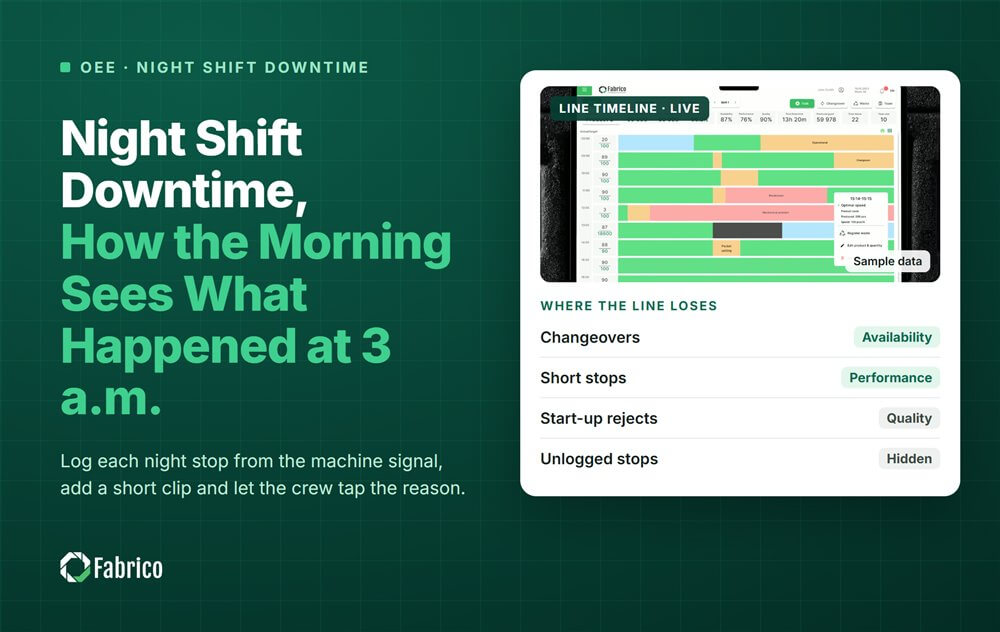


Real Fabrico tiles, sample data.