


 Login
 Blog

Computer Vision for Confectionery Lines: Moulding, Wrapping, Packing

In short: computer vision for confectionery lines, when the goal is OEE, means AI cameras that count output where the line has no usable signal, mostly hand assortment packing, gift boxing and rework tables, so those stations finally show up in the line's OEE.
- Inspection is a separate job, done by systems from vendors such as Cognex, Keyence or Mettler-Toledo. Most plants need both.
- On moulding, enrobing and flow wrapping, the machine signal usually counts well. Put cameras where people pack.
- Seasonal packs and allergen clean-downs eat a lot of line time. Time them from the signal and let the operator add the reason.
- Bring every vendor the same line list and the eight questions below, and ask us too.
- Fabrico counts with AI cameras as an add-on and lets you open the video for any minute. Camera-suggested stop reasons are roadmap.
A chocolate line is fast and well wired from the temper unit to the wrapper. Then the product reaches a packing hall where people fill gift boxes, assortment trays and seasonal displays by hand, and the data stops.
That is where a camera does its most useful work.
This page is for the person choosing camera and OEE software for chocolate and sweets lines.
We sell Fabrico, so test what we say like any other vendor's claims.
What computer vision does on a confectionery line, and what it doesn't
Two different products hide behind "machine vision for chocolate". One inspects the product. The other counts it and shows you what happened. They answer different questions, and you usually buy them from different vendors.
| Job | Inspection system | OEE camera |
|---|---|---|
| Spot broken, misshapen or bloomed pieces | Yes, its core job | No |
| Check codes, labels and wrapper seals | Yes | No |
| Push a bad bar or box off the line | Yes, with a reject arm | No |
| Count output at a hand-packing table | Not its job | Yes, its core job |
| Replay video of any minute | No | Yes, from the shift timeline |
| Mark a stop on its own | No | Roadmap |
| Say why the line stopped | No | No, the operator adds it |
So if you already run vision inspection after the wrapper or at the checkweigher, keep it. Its reject count is useful to OEE: fed in as a signal, it gives the quality part of the number.
The longer comparison is on our page about label and code vision versus an OEE camera. For how a camera counts in general, see AI visual counting.
Confectionery losses a camera helps you see
The machines on a chocolate line are quick and mostly connected. Much of the lost time sits in the gaps between them and in everything around the product mix.
- Hand stations nobody counts. Assortment boxes, gift packs and displays are often packed by hand, so their output and their waits never reach the OEE figure.
- Seasonal SKUs and gift packs. More formats mean more changeovers and more hand packing.
- Allergen clean-downs. Moving from milk to dark chocolate, or from a nut product to a nut-free one, means a validated allergen clean before the next run. On chocolate that is usually a dry clean plus a flush with the next mass, and the flushed chocolate is a quality loss to count.
- Short stops at the flow wrapper. A misfed bar or a film splice costs seconds, many times a shift. See flow wrapper OEE, or VFFS bagger stops for bagged sweets.
- Temper and tunnel stops. They show on the machine signal, but a long tunnel can hide an upstream stop from the wrapper for minutes.
- Breakage and rework. Broken pieces sent back to the melter are a quality loss, and a camera can count what reaches the rework table.
The seasonal point is not small. In the US, sales in the four big seasonal periods made 63.2% of 2025 chocolate and candy dollar sales in the stores Circana tracks, according to the National Confectioners Association's State of Treating 2026. In the same report, 82% of US consumers surveyed want holiday items with special packaging, shapes and flavors. Many of those need their own box, tray or sleeve, and often more hand packing.
The allergen point is about the equipment itself. The US FDA notes that most dark chocolate is made on equipment also used for milk chocolate. In its survey of dark chocolate sold as dairy free, four of 52 products had potentially hazardous levels of milk allergen, and all four were recalled.
So the milk to dark clean-down is a food safety step, not a quick wipe. Give it its own category in your downtime data, not a place in the general stop pile. Many plants also plan the run order, light to dark and nut-free first, to limit the switches. Our pages on allergen changeover validation and changeover standards for FMCG show how to shorten changeovers without cutting corners.
Across FMCG as a whole, Siemens' True Cost of Downtime 2024 found that, of the four sectors it surveyed, FMCG was the only one where hours lost to unplanned downtime rose since 2019, while Automotive and Heavy Industry halved theirs. It also found total downtime costs per large FMCG plant doubled over the same period, to just over $10 million a year.
For temper, tunnel and rework losses and a worked moulding shift, read OEE for confectionery and chocolate. This page stays on the cameras.
Where a camera goes on a chocolate line
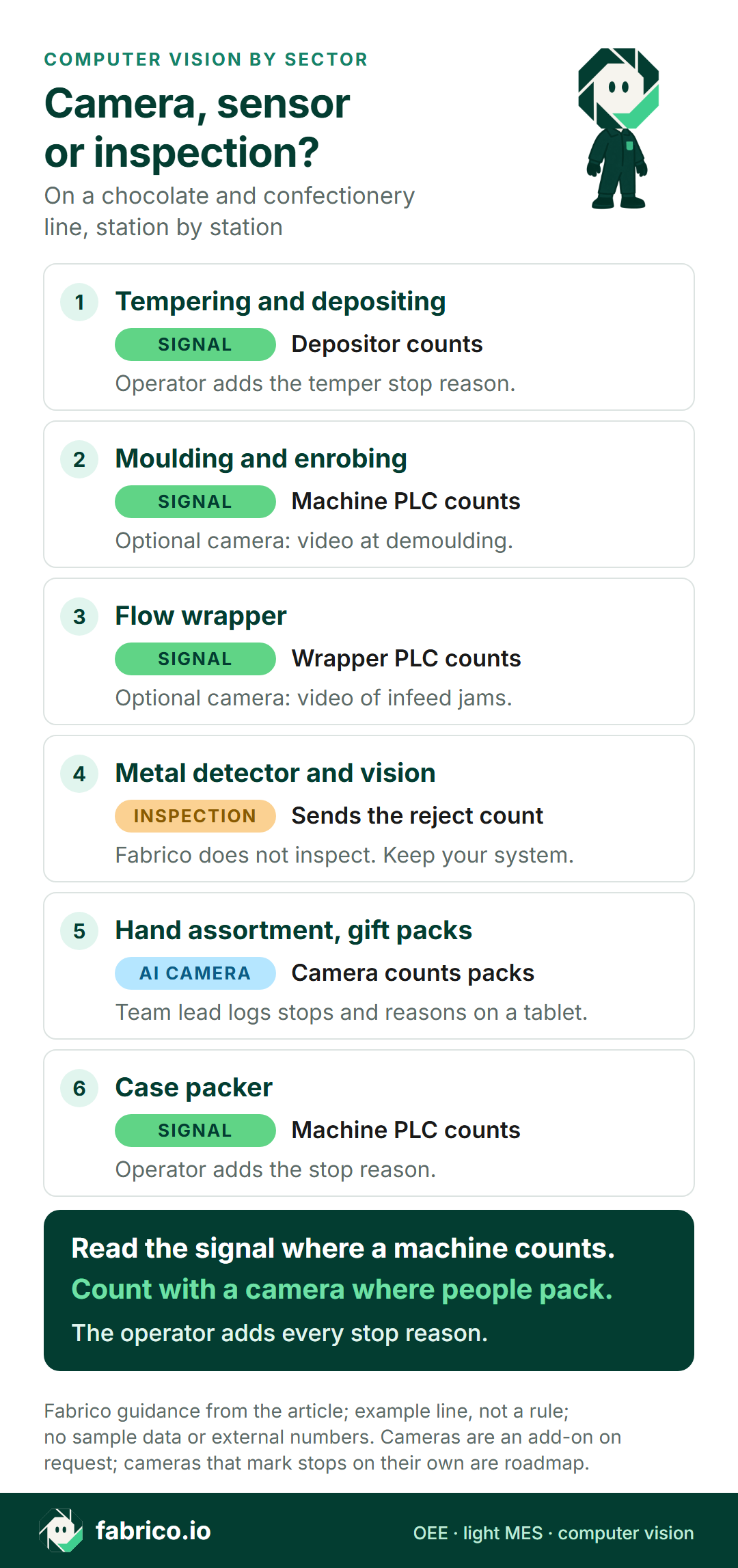
Here is a typical bar and assortment line, with the best source of count at each station. It is an example, not a rule.
Where a machine already counts, read its signal. Where people pack, count with a camera.
On a confectionery site the camera stations are easy to spot. Easter and Christmas hollow figures foiled by hand, advent calendar filling, shelf-ready display building and hand decoration of pralines all make output that no PLC counts.
Shiny foil, dark product on a dark belt and small, fast pieces make counting harder, so test the count before you trust it. The vendor table below shows how.
Camera, sensor or operator: station by station
This is the decision that sets how many cameras you buy. A camera is not better than a signal. It is the answer where no signal exists.
| Station | Count from | Camera's job | Person's job |
|---|---|---|---|
| Tempering, depositing | Depositor signal | Optional: video | Temper stop reason |
| Moulding, enrobing | Machine PLC | Optional: video at demoulding | Mould change reason |
| Cooling tunnel | Next machine's count | Optional: video at the exit | Reason, e.g. too warm |
| Flow wrapper | Wrapper PLC | Optional: video of infeed jams | Film change reason |
| Hand assortment | Camera | Counts boxes or trays | Reason for waits |
| Gift and seasonal packs | Camera | Counts packs | Reason, format change |
| Rework table | Camera or manual entry | Counts reworked packs | Says why |
| Case packer | Machine PLC | Rarely needed | Reason for stops |
So don't pay for a camera where a clean signal exists, unless you want the video. And every station still needs a person to say why it stopped.
For the machine by machine logic, read camera or sensor for OEE, by machine. Hand stations are covered step by step in OEE for a manual packing station.
Map your own line: bring the station list to a demo, and we will mark where a camera helps and where a signal is enough.
Worked example: one gift box station, one shift
These are illustrative numbers for a seasonal gift box station, not a customer. Four people pack 24-piece assortment boxes by hand. The plant agrees an ideal rate of 4 boxes a minute for the team.
The shift has 450 planned minutes. During a camera trial the team kept its paper sheet too. Filled in at the end of the shift, it said 1,300 boxes and 30 minutes of stops.
The camera counted 1,224 boxes. The team lead logged three stops on a tablet as they happened, each with its reason: 40 minutes waiting for pralines from the tunnel, 20 minutes out of box inserts, and 30 minutes for a sleeve change. The camera count shows no boxes packed in those three gaps, and the video for any of those minutes opens from the shift timeline. Today a person logs a stop at a hand station. Cameras that mark stops on their own are on our roadmap.
The arithmetic, step by step:
- Availability: 450 planned minutes minus 90 minutes of stops leaves 360. 360 / 450 = 80.0%.
- Performance: at 4 boxes a minute, 360 minutes could make 1,440 boxes. The camera counted 1,224. 1,224 / 1,440 = 85.0%.
- Quality: 36 boxes went to rework for a wrong piece or a crushed corner, leaving 1,188 good. 1,188 / 1,224 = 97.1%.
- OEE: 80.0% x 85.0% x 97.1% = 66.0%, the same as 1,188 good boxes of an ideal 1,800.
The sheet was not wrong on purpose. Waiting for material is easy to leave off a paper sheet, because nothing broke, and an end-of-shift box count is often an estimate. Our page on when the camera and the operator log disagree covers how to settle gaps like this.
Money makes the case for fixing it. At an example contribution of €1.50 a box, the 612 good boxes the station fell short of its ideal 1,800 are worth €918 on one shift.
The biggest single stop, 40 minutes waiting for pralines, is 160 boxes or €240. It is an upstream problem at the tunnel or the moulding line, not at the packing table.
That is the real value of a camera at a hand station. It puts the packing hall on the same timeline as the line that feeds it, so whoever reads the timeline can trace a wait at the gift box table back to the tunnel or moulding stop that caused it.
Eight questions for any computer vision vendor on a confectionery line
Ask every vendor the same questions, with the same line list. A short trial on one hand station answers most of them.
| Ask | How to test the answer |
|---|---|
| What exactly does the camera count at a hand-packing table? | Pieces, boxes or cases? Count one real gift box run by hand for ten minutes and compare. Then test your shiniest foil and your darkest product on the darkest belt, at full speed. |
| What does a new seasonal box need before it counts? | Bring two real formats. Ask who sets up a new tray or sleeve, and how long it takes. |
| Do camera counts and PLC counts sit on one timeline? | Ask to see a hand station and the wrapper that feeds it in the same view. |
| Who adds the stop reason today? | Ask the vendor to split what works now from what is roadmap, in writing. |
| Is video kept, and who can open it? | Ask where it lives, for how long, and who sees it. Defaults differ by vendor. |
| How are people kept out of the picture? | Ask to see the camera angle on a packing table, and what the works council will see. |
| How do allergen clean-downs show up? | Run a milk to dark switch through the demo. Is it planned time, a stop or its own category? |
| How do rejects from our inspection system reach the quality figure? | Ask which signal carries the reject count, and test it with one known reject. |
Cost is the ninth question. Prices are rarely public, ours included. A quote depends on the number of lines and cameras, mounting, the network at each station, and training. Give every vendor the same line list so the quotes compare.
Privacy, hygiene and the works council
A camera over a hand-packing table sees hands. That is fine for counting boxes, but it is still a camera in a workplace. In Germany, a works council, where there is one, has a say in any technical device that can monitor staff, under the German Works Constitution Act, section 87. Several other European countries have similar rules, so agree it before the camera goes up.
- Aim at the product. Point the camera at the outfeed or the finished box stack, not at faces.
- Report by station, not by person. OEE for a gift box table is a station number. Say so in writing.
- Agree who opens the video, and when. For example, a shift leader looking at one stop, not a manager scrolling through the day.
- Treat the camera like any item near open product. Your QA team will likely want the housing, lens and fixings on the glass and hard plastics register, and mounted where they can be cleaned.
Our page on production line cameras without surveillance covers how plants set this up with the works council.
How Fabrico does it
Fabrico is a cloud OEE software and light MES platform.
- Stops and counts: they come from the machine signal, a PLC, sensor or counter, on machines such as the depositor, the wrapper and the case packer.
- Stop reasons: the operator adds them at the line, on a tablet or phone.
- OEE and losses: OEE, downtime and losses by line and shift, with losses shown in money. On the web, iOS and Android.
- Your data: it leaves through the REST API, webhooks, or Excel and CSV export.
- Computer vision add-on, on request: AI cameras count output, including at hand-packing and gift box stations with no usable signal. You can open the camera video for any moment on the shift timeline. In the standard setup, video is streamed on request, not kept in Fabrico. See computer vision for OEE.
- Roadmap, not live today: cameras that mark stops and jam zones on their own, and a camera that offers a likely stop reason for the operator to confirm.
- Not Fabrico's job: quality inspection of bloom, broken pieces, codes or seals. Keep your inspection system. Its reject count can feed the quality part of OEE through a signal.
- Planning and scheduling: ask us in the demo.
The eight questions above apply to us too. Bring a recent seasonal run, and ask which stations we would not put a camera on.
Comparing software more widely? See our MES and OEE software comparison.
What people ask next
Can a camera check chocolate quality, like bloom or broken bars?
That is a job for an inspection system, from vendors such as Cognex, Keyence or Mettler-Toledo. Fabrico's cameras count output and do not inspect the product. The inspection system's reject count can still feed the quality part of OEE.
Do we need a camera on the flow wrapper?
Usually not for counting, because the wrapper's PLC already counts. A camera at the infeed helps if you want to see what happened in a jam minute. For bagged sweets, see VFFS bagger stops.
How many cameras does a confectionery line need?
Start with one per hand station that has no usable count, such as assortment or gift box tables. Add one where you need to see what happened, like the tunnel exit. Our guide to how many cameras a line needs covers the rest.
What happens when we launch a new seasonal box?
Ask each vendor what a new box, tray or sleeve needs before the camera counts it, and who does that work. Test it with two real formats in a short trial.
Is the camera video kept?
In Fabrico's standard setup, video is streamed on request and not kept in Fabrico. You open it from the moment on the shift timeline. Ask every vendor the same question, because defaults differ.
Will cameras on packing tables upset the team?
They can, if nobody explains them. Aim the camera at the boxes, report by station rather than by person, and agree the rules with the works council before anything goes up.
What drives the cost of computer vision on a confectionery line?
Mostly how many stations need a camera, the mounting and network at each one, and training. Prices are not public, ours included, so ask each vendor to price the same stations.
Want to see it on your line? Book a demo.
Related articles










Real Fabrico tiles, sample data.