


 Login
 Blog
Computer Vision for Glass Manufacturing: Cold End to IGU Lines

In short: computer vision for glass manufacturing pays off as an output counter and a witness at the stations your machines do not count well: cold end palletizing, manual resorting, processed glass stations such as edging, IGU assembly and racking, and older machines.
- Cold end defect inspection (checks, stones, dimensions) is a dedicated inspection system. Fabrico does not do it.
- The furnace runs without stopping, and IS machines, lehrs, cutting tables and tempering furnaces have their own control systems. Read their signals first.
- Glass losses hide in job changes on IS sections, in pack-to-melt, in tempering furnace loading gaps and in rack waits.
- Fabrico's camera add-on counts output and lets you open the video for any moment on the shift timeline. The operator adds the stop reason.
Your furnace has not stopped in years. Your IS machines and inspection machines come with their own control systems. Yet the pallets, the resorting area and the IGU racks are still counted by hand.
This page is for plant managers, operations and CI leads in container glass and in flat glass processing who are choosing how to put cameras on lines to count output and get OEE.
Float lines and glass fibre plants have their own control systems end to end; this page covers container glass and flat glass processing.
It shows where a camera earns its place, where the machine signal is enough, and what to ask each vendor.
Computer vision for glass manufacturing: two different jobs
Two kinds of camera system get sold to glass plants under one name. Inspection systems check the glass itself. OEE cameras count output and show you what happened at a stop.
| Job in a glass plant | Inspection system | OEE camera |
|---|---|---|
| Checks, stones, blisters | Yes, at the cold end | No |
| Dimensions, wall thickness | Yes | No |
| Flat glass defects, distortion | Yes, on scanners | No |
| Count packed ware, pallets or lites | Counts what it inspects | Yes, also at manual steps |
| Video of a stop | Reject images, not stop video | Open the video for that minute |
| Feeds OEE through | Its reject count | The output count |
Cold end inspection machines and flat glass scanners stay in place. The two work side by side. An inspection machine's reject count, read from its control system or a counter signal, can feed the quality part of OEE, so rejects are counted once. For where the line between the two sits, read camera or sensor for OEE, machine by machine.
Where the losses hide in a glass plant
In Europe, FEVE's market report for 2025 puts its members' food and beverage container production at 20.3 million tonnes and 73.3 billion units, with the average container produced weighing 277 grams. At that scale, small losses repeat millions of times.
The furnace never stops
A 2008 guide for ENERGY STAR from Lawrence Berkeley National Laboratory describes it plainly: to keep the glass level constant, batch and cullet are charged into the furnace without a break to replace the glass drawn off. Already in 2008, the same US guide noted campaigns of more than 9 years in some furnaces with better refractories.
So OEE in a container plant lives on the forming side, not the furnace. When an IS machine or a section stops, the furnace keeps pulling, and that glass goes back as cullet. A camera adds nothing there.
Job changes on IS sections
A job change on an IS machine means new moulds, new gob weight and new timing, then sections brought back one by one until the ware passes inspection. The same 2008 LBNL guide says standard forming machines can make more than 200 containers a minute, so one lost hour can mean thousands of containers.
Book job changes inside planned time, with their own code and a standard for each article. Then decide how a stopped section is booked: as lost capacity against the full machine's ideal rate, or as a section-level stop. Pick one rule and keep it, or line comparisons mean nothing.
The IS machine's timing control already knows which sections run. Read it. For the method, see changeover time.
Pack-to-melt
Pack-to-melt is the glass maker's own yield number: how much of the glass you melt leaves the plant packed. Bucher Emhart Glass, a maker of forming and inspection equipment, put it this way in a 2019 report: when quality improves, more of the raw material gets packed, less goes back to melting, and the ratio rises.
Pack-to-melt and OEE overlap but do not match. Pack-to-melt counts glass by weight, from the furnace. OEE counts time and good units on one line. Run both: pack-to-melt for the plant, OEE to show which line, shift and job change lost the glass. For the yield side, see OEE and yield in glass and ceramics.
Cold end packing and resorting
After the lehr and the inspection machines, ware goes to the palletizer, gets tier sheets and a top frame, and then a stretch hood or shrink hood. Stops here back up the whole cold end, and short ones rarely get written down.
Then there is resorting. When QA holds pallets for a defect pattern, people unpack, check and repack them, by hand or over a resort line. That is real labour and real output, and it often has no counter at all.
A camera pays off here. It counts the packs, layers or pallets that leave, and you can open the video when the palletizer stalls. For palletizer stops, see palletizer downtime and cameras. For hand packing, see OEE at a manual packing station.
Tempering furnace loading gaps
In flat glass processing, the tempering furnace is often the bottleneck, and it is loaded in batches from a loading table. Every gap between loads is furnace time lost.
In a 2025 article, tempering furnace maker Glaston writes that industry data shows a typical loading bed utilization of just 37%, meaning how much of the furnace bed each load covers, and that furnace idling and missed loadings waste capacity on top of that. That is a vendor's figure, so check it against your own furnace log: the area per load, and the gaps between loads.
The furnace control records its loads. What it does not show is why the loading table sat empty: no glass from edging, no rack, or no one free to load. Opening the video for those minutes answers that. Camera-detected idle gaps at the loading table are Roadmap, so today the operator still codes the reason.
Rack waits
Processed glass moves between cutting, edging, tempering, laminating and IGU lines on A-frames, L-racks and harp racks. When the right rack is not there, a station waits, or glass waits.
Give "waiting for rack" its own stop code, apart from breakdowns and material shortages.
A camera at the unloading end counts the lites going on racks, and the video shows whether a rack was there.
Edging, IGU and laminating stations
Newer double edgers and CNC centres give a count. Older edgers and hand arrissing often give none. On IGU lines, spacer frame application, gas filling and secondary sealing are often manual or semi-automatic, and the finished unit goes on a rack by hand.
Laminating adds manual layup in a clean room, then batch autoclave cycles. Count the layup station, and read the autoclave's own cycle log.
These manual stations are where a camera earns its place most clearly. See computer vision for OEE in manual assembly.
Heat, dust and breakage
The hot end means heat, swabbing smoke and falling ware. Processing halls mean glass dust, water and breakage.
So keep OEE cameras off the hot end. Mount them at the cold end and in processing halls, outside guarding and out of the breakage zone, in a housing that suits dust and water. Agree each position with safety before anyone drills.
Where a camera goes in a glass plant
For how many cameras a line needs, see how many cameras per line for OEE.
Camera, sensor or operator: station by station
| Station | Count and stops from | What a camera adds |
|---|---|---|
| Furnace, forehearth | Furnace control system | Nothing. Use the signal. |
| IS machine | Timing control for sections and speed, hot end counters | Little. Keep cameras off the hot end. |
| Lehr | Lehr control | Nothing |
| Cold end inspection | Its own reject count | Nothing. Feed rejects to quality. |
| Palletizer, hood | PLC, if you can reach it | Count of layers or pallets, video of stalls |
| Resorting held ware | Usually nothing | Count of repacked ware |
| Cutting table | Cutting control and optimizer | Little |
| Edging | Newer edgers give a count | Count on older edgers and hand arrissing |
| Tempering furnace | Furnace control: loads | Video of the loading table during gaps |
| IGU line, racking | Washer and press PLC | Count of finished units at the rack |
| Stop reasons, all lines | The operator, on a tablet or phone | Video to check a disputed reason |
At the cold end, the inspection machines' good-ware count is often the best count of good containers. You rarely need a camera at more than a few stations. The card below shows where one pays off.
Bring your station list and one week of stop sheets to a demo, and we will go through it station by station.
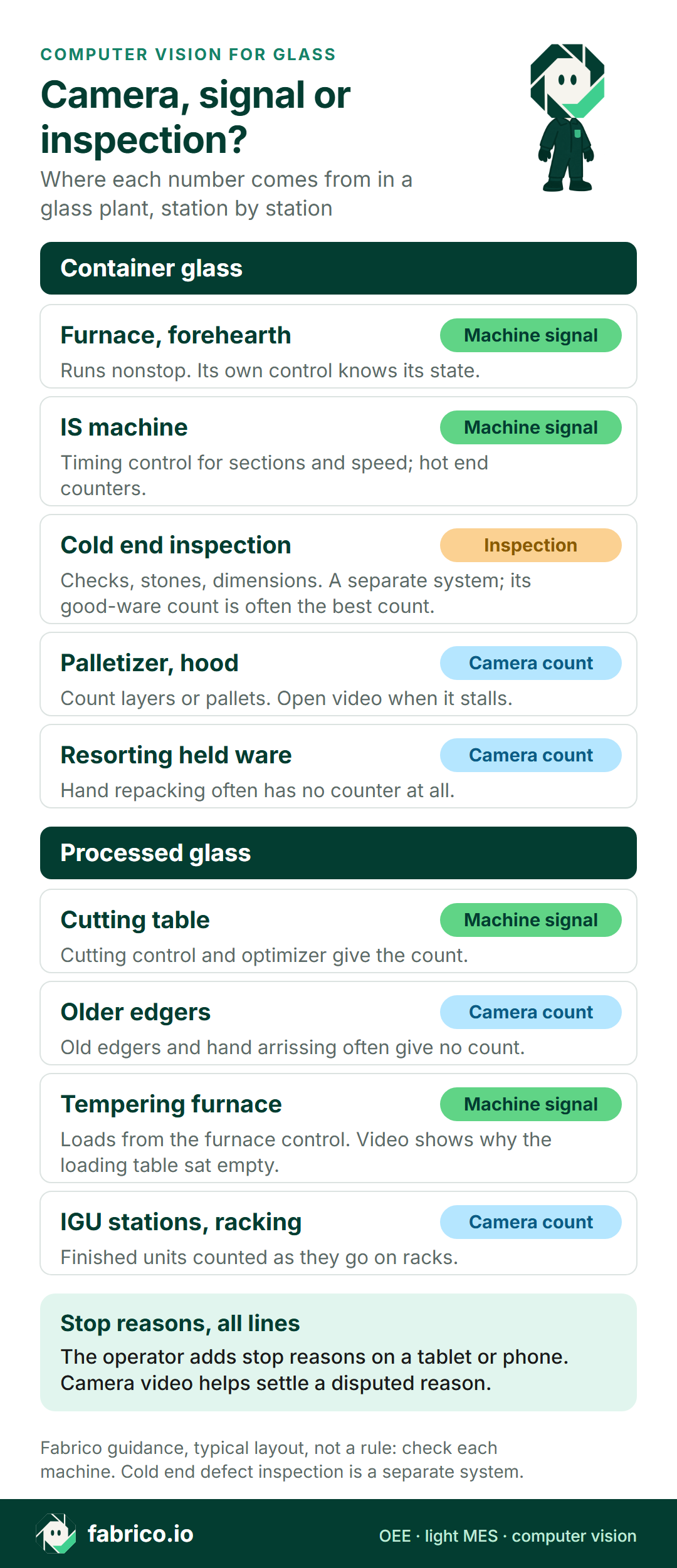
Worked example: one shift on an IGU line
These are example numbers, and they describe no real plant. An insulating glass unit line with an ideal rate of 2 units a minute runs one 480-minute shift.
The washer and press PLC give the run state and count the units made. A camera at the unloading end counts the finished units that go on racks. Units pulled for remake make up the difference.
Stops took 120 minutes: rack waits 45, a spacer width change 30, short stops 25 and one breakdown 20. Run time is 360 of 480 minutes, so availability is 75%.
At 2 units a minute, 360 minutes could make 720 units. The line made 612, so performance is 85%. The gap is 54 minutes of slow running.
The camera counted 600 good units on the racks. That leaves 12 remakes, so quality is 98.0%. Those 12 units are 6 minutes of line time.
OEE is 75% x 85% x 98.0% = 62.5%. Check it the short way: 600 good units of 960 possible is also 62.5%.
Look at the biggest stop. Rack waits are more than double the breakdown, and without their own code they would hide as "other". The fix sits in internal logistics, not in maintenance.
Eight checks for any glass camera or OEE vendor
Run these with every vendor, and with us. Bring one real shift from last week as the test case.
| Ask | How to test the answer |
|---|---|
| How do you book a job change? | Ask for a job change code inside planned time, and minutes over standard for each article. |
| How is a stopped IS section counted? | Ask to see one section down while the others run, and where the lost ware shows up. |
| How do cold end rejects get in? | Ask if the inspection machine's reject count feeds quality, so rejects count once. |
| What exactly does the camera count? | Containers, layers or pallets? Lites or IGUs? Run it next to a hand count for one shift. |
| Pieces or square metres? | Ask how a cut-to-order piece count turns into square metres, and how the ideal rate changes by size. |
| Where does each camera mount? | Ask for each position on a drawing, out of the breakage zone, with safety sign-off first. |
| How do rack waits show? | Ask for a rack wait code by station and shift, apart from breakdowns. |
| Is video kept, and who can open it? | Ask where it lives, for how long, and who sees it. |
Before you roll out across the site, test on one line first. See the guide to a computer vision OEE pilot. If you are comparing full platforms for the industry, see OEE software for glass and ceramics and MES and OEE systems for glass processing groups.
Cameras, privacy and the works council
Resorting areas, edging lines and IGU stations have people at them, and a camera there will see some of them. Tell staff before any camera goes up. In many European countries, talk to the works council first.
Frame the camera on the glass, the rack or the pallet, not the crew. Report by line and shift, not by person. Ask each vendor, us included, what privacy masking is live today and what is still roadmap.
Fabrico's camera add-on counts product, not people. For a fuller checklist, read production line cameras without surveillance.
Where Fabrico fits
Fabrico is a cloud OEE and light MES platform. Here is what it does in a glass plant today.
- Stops and counts: from the machine signal, through a PLC, a sensor or a counter.
- Stop reasons: the operator adds them at the line, on a tablet or phone.
- OEE and losses: OEE, downtime and losses by line and shift, with losses shown in money. On the web, iOS and Android.
- Cameras, an add-on on request: the camera add-on counts output, including at resorting, manual processing stations and machines with no usable signal. You can open the camera video for any moment on the shift timeline. In the standard setup, video is streamed on request, not stored in Fabrico.
- Your data: it leaves through a REST API, webhooks and Excel or CSV export.
Roadmap, not live today: stops detected by the camera, idle gaps at a loading table, and a camera suggesting a stop reason.
What Fabrico does not do: defect inspection of glass. Checks, stones, dimensions and flat glass defects stay with your inspection systems, and their reject count can feed Fabrico's quality figure. Fabrico does not control the furnace, the IS machine or the tempering furnace. For planning and scheduling, ask us in the demo.
For the full product, see Fabrico computer vision for OEE. If you are still comparing platforms, read the guide to OEE software.
Bring one shift's stop sheet and your station list to a demo, and ask us to show which numbers we can fill and which we cannot.
What people ask next
Can a camera find checks and stones in glass containers?
Yes, but that is a cold end inspection machine, not an OEE camera. Checks, stones, blisters and dimensions are found by dedicated inspection systems. Fabrico does not do defect inspection. The inspection machine's reject count can feed the quality part of OEE.
Which glass station should get the first camera?
Usually the one with the weakest count: resorting of held ware, a palletizer whose count you cannot reach, an older edger, or the racking end of an IGU line. Machines with their own control system and a count you trust come last.
Do IS machines need a camera for OEE?
Rarely. The IS machine's timing control gives section states and speed, and hot end and cold end ware counters give the counts. Those are the better source. Read those first. A camera at the hot end also faces heat, oil smoke and swabbing, which is a hard place for any lens.
How do you measure OEE when the glass is cut to order?
Count pieces at the station, and set the ideal rate by product type, for example by glass size band or IGU build. Ask each vendor how pieces turn into square metres from the order data, and test it on one week of real orders.
Is the camera video stored?
Not in Fabrico. In the standard setup, video is streamed on request, and you can open it for any moment on the shift timeline. Ask every vendor the same question, and where their video lives.
What drives the cost of computer vision in a glass plant?
Pricing is set per quote. The drivers are the number of lines and cameras, mounting and housings for hot, dusty or wet areas, the network to the hall, and training. Give each vendor the same station list so the quotes compare.
Want to see it on a line like yours? Book a demo and bring one shift from a glass line.
Related articles










Real Fabrico tiles, sample data.