


 Login
 Blog
Computer Vision for Medical Device Manufacturing: Benches, Pouching, Packing

In short: computer vision for medical device manufacturing is worth having where output still goes on a traveler by hand: at catheter and IV set benches, hand pouching and packing tables, and older sealers with no usable signal. A camera counts finished units there, and you can replay the minute a sealer stopped.
- Dimensional checks, seal checks, label checks and UDI verification are inspection jobs, done by methods and systems your site has validated. Fabrico does not do them.
- Time goes to line clearance, lot changes, waiting for QC release and short stops at pouch sealers.
- Any camera or software in a regulated area goes through the site's change control and, where the QMS requires it, validation. Fabrico is not a validated QMS, eDHR or UDI system.
- Fabrico's camera add-on counts units, pouches and cases; bench video for a chosen minute on the shift timeline is streamed on request and, in the standard setup, not stored.
Your molding presses and assembly machines have PLCs. Your cleanroom benches have people, fixtures and trays. The pouch sealers and packing tables sit in between.
This page is written by Fabrico, which sells the camera add-on it describes; test our claims against your own lot data. This is not regulatory advice. Your quality and regulatory team owns what goes into the device and batch records.
Computer vision for medical device manufacturing: whose job is which
On a device floor, the vision system at the bonding station and the seal tests in the lab decide whether a unit may ship. An OEE camera does something smaller: it replaces the tally on the traveler and shows why the line stopped.
| Job on a device line | Inspection or label system | OEE camera add-on |
|---|---|---|
| Dimensions, bonds, needle and tip checks | Inspection vision or test station | No |
| Pouch seal check | Seal inspection and lab tests under your validated process | No |
| Label content and UDI grade | Label and UDI verification | No |
| Count finished units at an assembly bench | Not its job | Yes |
| Count sealed pouches at a hand pouching table | Not its job | Yes |
| Video of a stop at a pouch sealer | Not its job | Streamed for that minute, on request |
Labeling is where the two are most often mixed up. In the US, the FDA UDI rule in general requires device labelers to include a unique device identifier on device labels, device packages, and in some instances directly on the device. When the system is fully implemented, the label of most devices will carry the UDI in human- and machine-readable form.
The QMSR ties this to the quality system: under 21 CFR 820.10(b), for ISO 13485 clause 7.5.8 the manufacturer must document a system to assign unique device identification in line with part 830. Printing and checking that identifier is done by label and verification systems your site has validated. Fabrico does none of it.
Fabrico's camera add-on only counts. Where the two systems touch is the reject count: a reject signal or counter from the seal or label check, agreed with QA, sets the quality part of OEE. The difference between code reading and counting is in label and code vision vs an OEE camera.
Where the losses hide on a medical device line
Line clearance and lot changes
At a lot change, the line is cleared of labels, pouches, instructions for use and leftover components, labels are reconciled, and the clearance is signed before the next lot starts. Your procedures say what is checked and by whom.
Then come new component lots, a new label run with lot and expiry, and first-off checks, several times a shift on high-mix lines.
For OEE, give clearance and lot change their own stop reasons, and split the clearing from the waiting for a signature. See line clearance.
Waiting for QC release
A line often stands still until QC signs off the first-off parts, or while a component lot is still in incoming inspection.
That wait hides inside "changeover" or "no reason" unless it has its own code. Book it as waiting for QC, and the release queue becomes a number someone owns. See quality hold process design.
Sterilization usually happens after packing, often off site, so keep it out of line OEE.
Short stops at pouch sealers
Single-use devices leave the line in a sterile barrier pouch or a formed tray. Band sealers, impulse sealers and thermoform fill seal machines stop for small things: a film splice, a pouch that did not open, a misfed part, a tray that did not seat in the die.
Each takes under a minute to clear, and few get written down. A seal parameter alarm is different: it follows your deviation procedure, not the stop sheet. See micro stops.
This is a good spot for the camera add-on. The sealer signal times the stop; the streamed video of that minute shows whether the film, the pouch feed or the loader was to blame.
Molding and automated assembly
Barrels, plungers, hubs and connectors come off injection presses, and are joined on automated assembly machines with bowl feeders, needle bonding and UV curing. Their PLCs give cycles and counts, so use them, and add camera video only where the fault code is vague: a feeder bowl jam, a part that missed a nest. See computer vision for plastics injection molding.
Manual assembly benches
Catheters and IV sets are often built by hand: bonding tubing, fitting connectors and clamps, coiling the set into a tray. Output is tallied on a traveler at the end of the shift.
No PLC counts that. A camera add-on over the bench outfeed counts finished sets at one fixed spot, so the hourly figure no longer depends on the traveler. The assemblers still enter stop reasons. See computer vision OEE for manual assembly.
At the end, pouches go into cartons and cases, often by hand. A camera at the case infeed counts the good units; book QC samples as a known quantity per lot.
Where a camera goes on a disposables line
One example: a syringe line from molding to case, plus a manual catheter and IV set room.
For more stations by machine type, see OEE for medical device manufacturing.
Camera, signal or operator: station by station
Device sites differ by product family and machine age, so read this as a starting map and confirm each machine on the floor.
| Device line station | Count and stop data today | Camera add-on's part |
|---|---|---|
| Injection presses | Press cycle signal | Little. Use the signal. |
| Automated assembly | Machine PLC | Video when the fault code is vague |
| Manual assembly bench | Traveler or tally sheet | Count of finished units |
| Pouch sealer or thermoformer | Sealer PLC, if you can reach it | Video on request; count if no signal |
| Hand pouching table | Tally sheet | Count of sealed pouches |
| Seal, label and UDI checks | Site-validated system and its reject count | None. The validated system stays as it is. |
| Carton and case packing | PLC on newer packers | Good count at the case infeed |
| Why a line stood | Operator or line lead, tablet or phone, including clearance and QC waits | Sealer or bench video for the minute in question |
Most device plants need cameras at a handful of benches and tables, not on every machine. The card below sums it up.
Before a demo, list the benches, sealers and packing tables in one room and what each can signal today; we will mark where a count is missing.
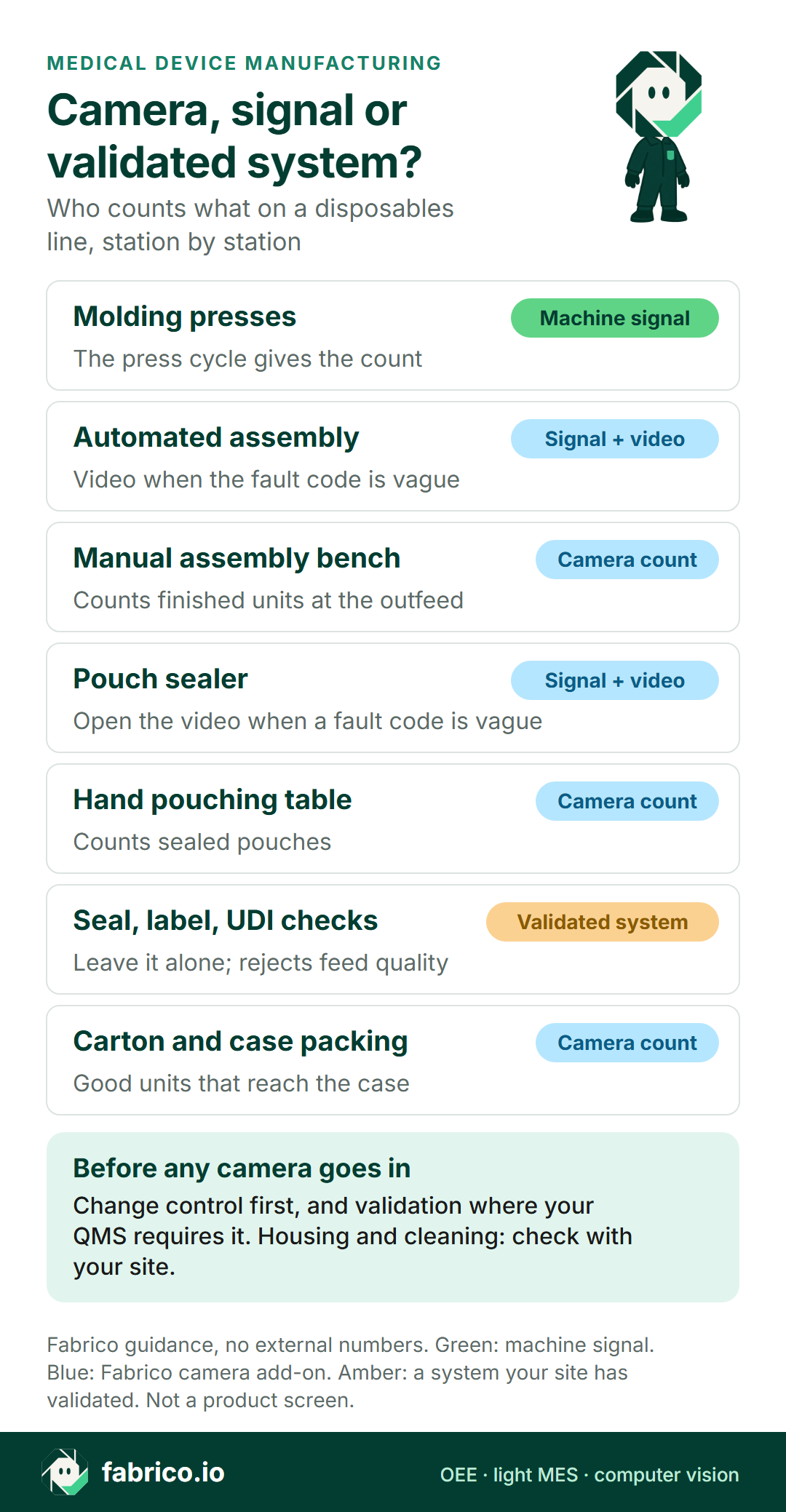
Change control and validation come first
In the US, the FDA's Quality Management System Regulation is effective February 2, 2026. It incorporates ISO 13485:2016 by reference. Under 21 CFR 820.10(a), a manufacturer must "Document a quality management system that complies with the applicable requirements of ISO 13485" and the other applicable requirements of part 820.
For software, the FDA's February 2026 guidance on computer software assurance covers computers and automated data processing systems used as part of medical device production or the quality management system. It describes a risk-based approach and identifies where additional rigor may be appropriate. The guidance contains nonbinding recommendations, not new requirements.
Whether a counting camera falls inside that scope is your quality team's call. Either way, any camera or software in a regulated area goes through the site's change control and, where the QMS requires it, validation (ISO 13485 subclauses 4.1.6 and 7.5.6, which the guidance cites). That applies even to a camera that only counts.
Fabrico is not a validated QMS, not an eDHR and not a UDI system. Its data is for running and improving the line. It does not release lots, does not judge units and is not where your device or batch records live.
Before an OEE camera goes into a cleanroom or a packing area, agree three things with QA in writing:
- Purpose: counting and stop review only, no role in inspection, release or the device and batch records.
- Position: outside the work zone and never above open product. For housing, materials and cleaning, check with the site: contamination control decides, not the vendor.
- Network: the camera kept apart from line control, labeling and UDI systems; any machine or reject signal the OEE system reads is agreed with QA in writing.
For OEE and maintenance in the same rooms, see OEE and CMMS for medical device cleanroom assembly. Pharma packaging has the same split between validated vision and counting; see computer vision for pharmaceutical packaging.
Worked example: one pouching shift with two lot changes
The figures are invented for the example. A syringe line feeds a pouch sealer with an ideal rate of 80 pouches a minute. The crew works an 8-hour shift, but gowning in and out of the cleanroom and two breaks leave 420 planned minutes on the line, with two lot changes inside them.
Run state and pouches made come from the sealer PLC. A camera add-on over the case packing table counts the pouches that reach the case. The gap between the two is seal and label rejects plus the first-off pouches pulled for QC after each lot change.
The line stood for 130 minutes: 50 on clearance and the two lot changes, 30 waiting for QC to release first-off parts, 30 in short stops at the sealer, 10 on one breakdown and 10 waiting for component lots. It ran 290 of 420 minutes, an availability of 69.0%.
At 80 pouches a minute, 290 running minutes could make 23,200 pouches. The sealer counted 22,080: performance is 95.2%. The missing 1,120 pouches are 14 minutes of slow running.
The camera add-on counted 21,680 good pouches into cases. The other 400 were seal and label rejects and first-off pouches, so quality is 98.2%, and those 400 are 5 minutes of sealer time.
OEE: 69.0% x 95.2% x 98.2% = 64.5%. As a cross-check, divide good pouches by what 420 minutes at the ideal rate would give: 21,680 of 33,600, again 64.5%.
Some sites book clearance, lot changes and the QC wait, 80 minutes here, as planned downtime. On 340 planned minutes the same shift reads 79.7%. Not one extra pouch was made, so pick one rule for every line, and report lot change and QC wait minutes as their own figures.
Sealer short stops and the QC wait add up to 60 minutes, six times the breakdown. That is where streamed sealer video and clear reason codes pay off.
Eight checks for any medical device camera or OEE vendor
Pick one recent lot with a lot change in it, and put the same questions to each supplier, and to us, with that lot's sealer counts and clearance records in hand.
| Ask | How to test the answer |
|---|---|
| Does it count units, pouches, cartons or cases? | Run it at case packing for one lot and reconcile it against the sealer count and the lot's label reconciliation. |
| Does it touch any validated system? | Ask for a drawing that shows it writes nothing to labeling, UDI or inspection systems, and reads only the reject count or signal your QA has agreed in writing. |
| Is it a validated QMS or eDHR? | Ask for a plain yes or no, in writing. Fabrico's answer is no. |
| How are lot changes and QC waits booked? | Ask for separate reason codes, with the wait for a signature split from the work. |
| How do rejects get in? | Ask how reject counts from the validated seal and label checks reach quality, read only, and how first-off pulls are kept apart from rejects. |
| Can the camera be housed and cleaned to the site's rules? | Ask for materials and cleaning data, and take them to contamination control before anything is installed. |
| Who can replay cleanroom bench video? | Ask whether footage is saved anywhere, for how long, and whether QA, supervisors or operators can open it, and write the answer into the change control record. |
| How does a short lot look? | Ask to see the ideal rate change with the product, and one lot change on the shift timeline. |
Run it on one line, under one change control, before the site; the computer vision OEE pilot guide lays out the steps.
Cameras, privacy and the works council
A camera over a catheter bench sees gloved hands, and in a gowned room sometimes a face behind a mask. Brief the room's crews before anything is mounted, and where a works council exists, put the plan to it alongside the change control.
Aim it at the outfeed or the tray, not at the assembler, and report by line and shift only. Ask each supplier which privacy masking already works at a bench and which is still planned. For the wider checklist, read production line cameras without surveillance.
Where Fabrico fits
Fabrico runs OEE and light MES from the cloud for the people who run device lines. It sits beside your validated systems, not inside them.
- Presses, assembly machines and sealers: cycles, counts and run state from the press, assembly machine, sealer or packer PLC; a retrofit sensor or counter fills in on an older machine.
- Why the line stood: the operator or line lead picks it on a tablet or phone, with its own codes for clearance, lot change and waiting for QC release.
- By line and shift: OEE, downtime and losses, with lost pouches and sets in money, on the web, iOS and Android.
- Benches, pouching and case packing (camera add-on, on request): the add-on counts sets, pouches and cases where no machine does, and on sealers with no usable signal. Choose a minute on the shift timeline and it streams that station on request, and in the standard setup nothing is kept in Fabrico.
- Data for the CI team: counts, stops and reasons through the REST API or webhooks, or in Excel or CSV files, kept out of the device history record.
Roadmap, not live today: jam zones on the add-on's video, stops detected by the camera add-on, and stop-reason suggestions from it.
What Fabrico does not do: inspection, seal checks, label and UDI verification, device and batch records, lot release or line clearance sign-off. It is not a validated QMS, eDHR or UDI system. Lot scheduling is a separate conversation; a week's lot plan is the best thing to bring.
The product is on Fabrico computer vision for OEE, and a broader comparison in our guide to OEE software. Ask us the eight questions above too.
What people ask next
Can Fabrico's camera add-on verify UDI labels or check pouch seals?
No. Label content, UDI print quality and seal checks run on inspection systems, label verification and lab test methods that your site has validated. Fabrico does not do them. Its camera add-on only counts units, pouches and cases, and streams station video on request.
Which medical device station should get the first camera?
Start where output is still written on a traveler: a manual assembly bench, a hand pouching or packing table, or an older sealer with no usable signal. Presses and assembly machines with a trusted PLC count come last.
Does a camera that only counts need change control?
Yes. Any camera or software in a regulated area goes through the site's change control and, where your quality management system requires it, validation. Your quality team decides how much, from its own risk assessment.
Is Fabrico a validated QMS, eDHR or UDI system?
No. Fabrico is a cloud OEE and light MES platform for running lines. It is not a validated quality management system, an electronic device history record or a UDI system, and it does not release lots.
Can a camera go into an ISO class cleanroom?
Check with your site. Contamination control and QA decide the housing, materials, cleaning agents and position. Get the camera's materials and cleaning data from the vendor and take it to them first.
Want to see one of your lots as OEE? Bring the sealer counts and stop sheets from one recent lot to a demo, kept out of your controlled records, and we will work the shift through with you.












Real Fabrico tiles, sample data.