


 Login
 Blog
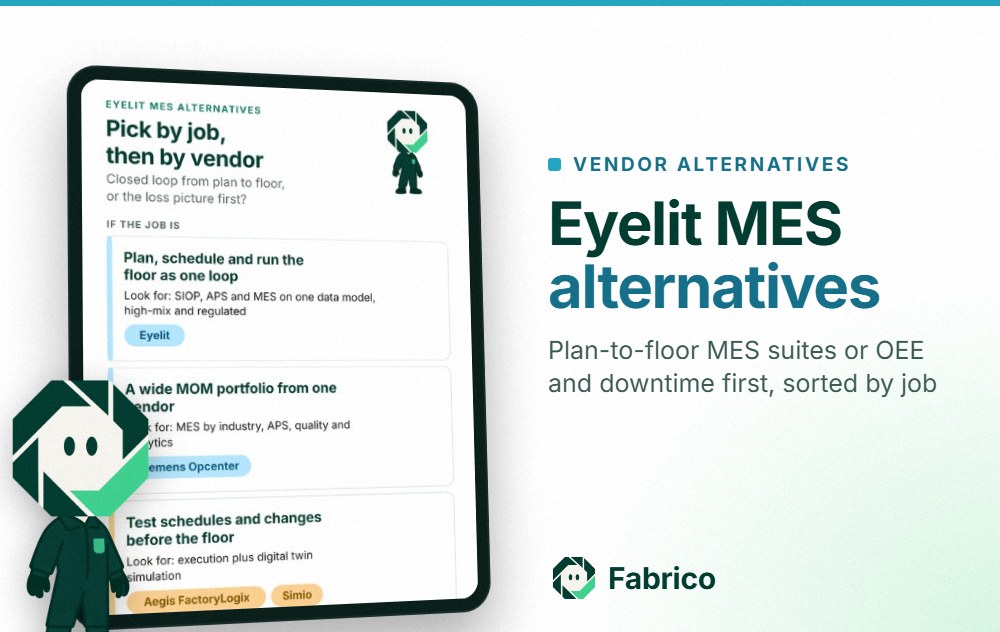
Eyelit MES Alternatives: Plan-to-Floor Suites or OEE First

In short: the right Eyelit MES alternative depends on whether you need planning, scheduling and execution joined in one loop, or first need to know where line time goes. For the loop, compare Eyelit with suites such as Siemens Opcenter, Aegis (FactoryLogix with Simio) and Critical Manufacturing. If you first want OEE and the causes of downtime, a light MES like Fabrico takes the other road.
- Eyelit sells SIOP, APS and MES as one suite, with an AI layer called Agent EyeQ, for high-mix and regulated plants.
- Eyelit acquired the UK cloud MES vendor Mestec in 2022, so Mestec users will find the product under Eyelit today.
- The alternatives differ in how far they reach: from demand plan to shop floor, or from machine signal to loss report.
- All vendor details come from the vendors' own websites, checked on 13.11.2026, with a link beside each. No pricing appears and nothing is ranked.
An electronics contract plant runs forty products across six lines. Every morning a planner rebuilds the schedule in a spreadsheet because yesterday's plan didn't survive the shift. The plant manager has a different worry: the lines never seem to reach the rate the schedule assumes.
Those two problems point at different tools, and sometimes at both. Here you will find Eyelit's offer as its site describes it, the plants it is aimed at, and four other options. One of them is Fabrico, which published this page, so treat our section as sceptically as the others.
What Eyelit sells (as of 13.11.2026, per eyelit.com)
Eyelit's about page lists its headquarters in Holmdel, New Jersey, and names semiconductor, automotive, medical device, electronics and aerospace and defense as its industries. Its homepage describes production orchestration across planning, scheduling and execution. On 13.11.2026 its pages listed:
- Three products, one loop. Eyelit SIOP for sales, inventory and operations planning, Eyelit APS for scheduling, and Eyelit MES, with Agent EyeQ, an agentic AI layer, across all three. Its MES page says the MES runs the schedule built in Eyelit APS and feeds live labor, machine and material data back.
- Equipment performance. The MES page lists real-time OEE tracking, downtime analysis and automatic machine data acquisition, plus tool and maintenance management.
- Labor next to machines. Its industrial page tracks overall labor effectiveness (OLE) and OEE in real time against separate labor and machine standards.
- Quality and records. SPC, non-conformance management, CAPA, document management and track and trace, with electronic controlled history records on a blockchain-supported audit trail.
- Configuration. Processes, including parallel and conditional flows, are modelled in a graphical interface without coding, under validated change control.
- Connectivity. Its modules list names SECS/GEM, OPC UA, JSON, XML, MQTT and other protocols, two-way and one-way.
- Hosting. Its APS page says it runs on AWS, Azure or GCP, or on premises in air-gapped environments.
Eyelit's May 2022 press release announced the acquisition of Mestec, a UK manufacturing SaaS vendor based in Bracknell. If you are searching for Mestec alternatives, this is the same decision.
Ask in the demo: which parts of SIOP, APS and MES phase one needs, and how OEE and OLE standards are set for a line like yours.
When Eyelit fits
Eyelit's pages suggest it fits when most of these are true:
- The schedule is the daily pain. Plans break on the floor, and planners rebuild them by hand.
- Your mix is high and changes often, up to engineered-to-order work where every order is different.
- Regulators want a record per unit. Its medical device page names ISO 13485, EU MDR 2017/745 and FDA 21 CFR Part 820 and Part 11, with eDHR.
- Labor cost matters as much as machine time, so you want OLE next to OEE.
- You run a fab or back end. Its semiconductor page covers reentrant flows, genealogy from ingot to die and SEMI E-10 equipment states.
If your first question is narrower, such as why the lines stop and what that costs, read on before you scope a full suite.
Closed loop from plan to floor, or the loss picture first?
Eyelit's pitch is the loop: one plan, one schedule, one execution layer, with floor data flowing back so the plan stays buildable. A light MES starts at the other end. It measures what the machines actually did, so the losses and real run rates are known before anyone plans with them. The trade-off is laid out in light MES vs full MES.
| Question | Eyelit, per eyelit.com | Fabrico, per fabrico.io |
|---|---|---|
| Starting point | Plan, schedule and execution together | Machine signal and stop reasons |
| Scheduling | Eyelit APS, executed by the MES | On the roadmap; plans stay in your ERP or planning tool |
| OEE | Real-time OEE, downtime analysis | OEE by line and shift, losses in money |
| Labor | OLE against labor standards | Operators tag stop reasons on a tablet or phone |
| Unit records | Genealogy, eDHR, eCHR | Genealogy stays in the ERP |
Comparison table: Eyelit and four alternatives
We paraphrased every row from the vendor's own site on 13.11.2026; the source links sit in each section further down. The order is not a ranking. Fabrico heads the list because the page is ours.
| Tool | Product, as described | Industries it names | Ask in the demo |
|---|---|---|---|
| Eyelit (for reference) | SIOP, APS and MES suite with Agent EyeQ | Semiconductor, automotive, medical, electronics, A&D | Which modules does phase one need? |
| Fabrico | Cloud OEE and light MES | FMCG, electronics, automotive, metal, more | How does a machine with no PLC report? |
| Siemens Opcenter | MOM portfolio: MES, APS, quality, analytics | Discrete, process, electronics, medical, pharma, semiconductor | Which Opcenter products fit our plant? |
| Aegis | FactoryLogix MES plus Simio simulation and scheduling | A&D, electronics, medical, automotive, industrial | What does simulation add before go-live? |
| Critical Manufacturing | MES-powered industrial operations platform | Semiconductor, electronics, medical, industrial equipment | How is master data shared across sites? |
To see where an assembly line like yours loses time, book a demo with one week of production counts in hand.
Fabrico: measure the losses before you plan around them
Our own product, so test it hard. Fabrico is a cloud OEE and light MES platform. It is the monitoring and OEE layer of an MES; dispatching, BOMs, routings and genealogy stay in your ERP. What our MES and OEE overview states:
- Live OEE by line and shift, split into availability, performance and quality, so you see which factor pulls the score down.
- Downtime by cause. Stops on connected machines carry their start and duration; operators add the cause from your own reason codes. Micro-stops and slow cycles show up as performance loss.
- Three ways to connect. PLC data on automated lines, a Fabrico IoT device with external sensors on older machines, and AI cameras, an add-on, counting output at manual steps. Details on machine connectivity.
- Camera add-on video. The camera add-on lets you open video for any moment on the shift timeline; in the standard setup it is streamed on request, not stored in Fabrico. Stop detection and reason suggestions by the camera add-on are roadmap. See computer vision for OEE.
- Maintenance on the same record. A technician opens a work order from a stop that needs a repair, and the repair feeds MTTR and MTBF.
- Data out. REST API, webhooks, Excel and CSV export; an SAP or other ERP connection can be scoped per customer.
- Rollout. Devices connected in about a month; full rollout in 3 to 4 months.
- Roadmap: production planning and scheduling. Not included: job dispatching, BOMs, routings and genealogy.
Fits plants that plan well enough in the ERP but don't know which losses cost most, and want that answer by line and shift before a suite project. For plants with manual packing steps, our computer vision for FMCG guide covers where the camera add-on counts.
Ask in the demo: how measured run rates leave Fabrico through the API or an export, so a planner can use them.
Siemens Opcenter: a wide MOM portfolio
Siemens describes Opcenter as a unified manufacturing operations management portfolio. As of 13.11.2026, its pages list:
- Opcenter APS for production planning and scheduling, Opcenter Quality as a QMS, and Opcenter Intelligence for analytics on production data.
- An Opcenter Execution family with separate MES products for discrete, process, electronics, medical device and diagnostics, pharma and semiconductor.
- Forward and backward traceability of components, and tracking of personnel training and certification for work assignments.
- Opcenter X, a SaaS offer with a modular approach to MOM for the SMB market.
Compared with Eyelit: both pair scheduling with execution and quality. Opcenter splits execution into industry products under one portfolio; Eyelit presents one suite with industry pages. Ask both how the APS and MES share data.
Fits plants that want MES, APS and quality from one large vendor, with separate execution products by industry.
Aegis: FactoryLogix with Simio simulation
Aegis describes a manufacturing operations platform where execution, planning, intelligence and simulation work together. As of 13.11.2026, its homepage says:
- FactoryLogix coordinates production, materials, quality, workforce and equipment, from a single line to multi-site operations.
- Simio adds advanced planning, scheduling and digital twin simulation, so schedules, staffing and layout changes can be tested against real constraints before they reach the floor. It is available with FactoryLogix or on its own.
- Configuration is no-code, and it names aerospace and defense, electronics, medical device, automotive and industrial equipment plants.
Compared with Eyelit: both join planning and execution on shared data. Aegis puts simulation in the middle of that loop. See our FactoryLogix alternatives page for more on this route.
Fits plants that want to test a schedule or a layout change in a model before they change the floor.
Critical Manufacturing: an MES platform for complex discrete plants
For discrete makers of semiconductors, electronics, medical devices and industrial equipment, Critical Manufacturing offers what it calls an MES-powered industrial operations platform. As of 13.11.2026, its homepage says equipment, IoT, ERP, PLM and enterprise systems share a unified data layer, AI agents answer questions and draft dashboards and shift handover summaries, and a Global Data Orchestrator distributes central master data to the sites that need it.
Compared with Eyelit: both name semiconductor, electronics and medical devices. Ask each how its MES and its planning tools exchange data in your setup.
Fits plants that want one MES standard across complex discrete sites.
Which Eyelit alternative fits your plant
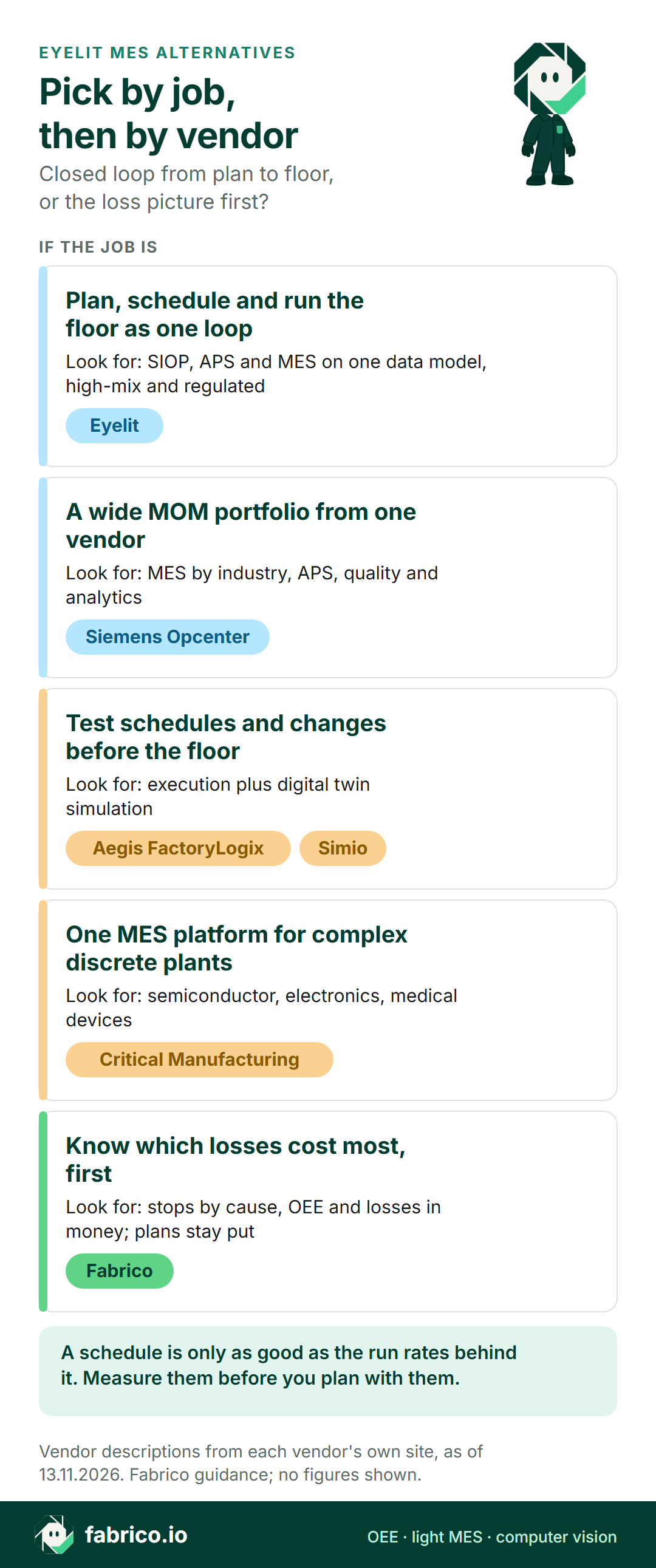
- Planning, scheduling and execution as one loop in high-mix, regulated plants: Eyelit.
- A broad MOM portfolio with industry-specific MES products: Siemens Opcenter.
- Execution with simulation to test changes first: Aegis.
- One MES platform for complex discrete sites: Critical Manufacturing.
- Losses ranked by cause and priced first, while planning stays in its current tool: Fabrico.
Electronics plants can also read our MES for electronics guide. To check whether a light MES covers your needs, see when a light MES is not enough.
Worked example: why the plan missed by 60 units
A schedule is only as good as the rate it assumes. Made-up sample data for one shift on an assembly cell, not taken from any plant or product screen: 450 planned minutes, an ideal cycle of 0.4 minutes a unit, so 1,125 units are possible. The scheduler assumed 80% OEE and planned 900.
The cell stopped for 60 minutes, so it ran for 390. Availability is 390 of 450, or 86.7%.
In 390 minutes the ideal is 975 units. The cell made 858, so performance is 88.0%. Eighteen failed test, leaving 840 good: quality is 97.9%. OEE is 86.7% x 88.0% x 97.9% = 74.7%, the same as 840 good of 1,125 possible.
The plan assumed 80% and got 74.7%, so the order fell 60 units short. Any scheduling engine fed the same 80% assumption would have missed by the same amount; a measured rate, or a fix for the 60 minutes of stops, closes the gap. That is the case for knowing your OEE before you plan with it, whichever route you take. The formula is in OEE calculation; where each tool sits is in OEE vs MES.
Questions to put to every vendor
Run this list against one typical line for each vendor, Fabrico included.
- Which problem does phase one solve: the schedule, the unit record or the line losses?
- Where does the run rate in the schedule come from, and how often is it updated from the floor?
- How is OEE calculated: which ideal cycle, how changeovers count, and who enters stop reasons?
- Which records stay in the ERP and which move to the new system?
- Who configures a new product or route: your engineers, the vendor or a partner?
- What exactly does the quote include, module by module? Hand every vendor the same written brief.
What people ask next
What is Eyelit?
Eyelit Technologies sells a suite of SIOP, APS and MES software with an AI layer called Agent EyeQ, for complex, high-mix manufacturing. Its site names semiconductor, automotive, medical device, electronics and aerospace and defense, and lists its headquarters in Holmdel, New Jersey.
Is Mestec part of Eyelit?
Yes. Eyelit's May 2022 press release announced that it had acquired Mestec, a UK manufacturing SaaS vendor based in Bracknell, and mestec.co.uk now leads to eyelit.com.
Does Eyelit MES track OEE?
Its MES page lists real-time OEE tracking, downtime analysis and automatic machine data acquisition, and its industrial page describes OEE and overall labor effectiveness tracked against separate machine and labor standards.
How does Siemens Opcenter compare with Eyelit?
Both cover scheduling, execution and quality, per their own sites. Opcenter is a portfolio with separate MES products by industry, plus Opcenter APS and Opcenter Quality. Eyelit presents SIOP, APS and MES as one suite. Ask both to run the same scenario.
How is Fabrico different from Eyelit?
Eyelit joins planning, scheduling and execution in one suite. Fabrico starts from the machine: stops and counts from the signal, reasons from operators, and OEE and losses in money by line and shift. Planning and scheduling are on Fabrico's roadmap, and genealogy stays in the ERP.
Can a light MES feed an APS?
Yes, through data exchange. Fabrico exposes OEE and production data through a REST API, webhooks and Excel or CSV export, so measured rates can reach a planning tool. Agree which system owns the run rate before you connect them.
Want to know your real run rates before you plan with them? Book a demo, or put a question to our team.
Related articles

Latest from our blog


Real Fabrico tiles, sample data.