


 Login
 Blog
Ignition vs Node-RED: A Flow or a SCADA Platform for Plant Data?

In short: Choose Node-RED when the job is carrying data from a few machines to a database, broker or web API and your team will own JavaScript flows on small boxes; choose Ignition when a whole hall needs shared screens, alarms and history on one site server; choose neither alone for OEE, which needs the shift plan, the ideal rate and the stop reason. Many plants run both, with flows feeding the platform. Node-RED carries no licence fee under the Apache License 2.0; Inductive Automation's price list puts the Ignition Platform at USD 1,200 (both checked 15.11.2026).
- Ignition logic is Python on a gateway; Node-RED logic is JavaScript in Function nodes on Node.js.
- A flow that keeps its running total in memory loses it on a restart; the worked example shows the cost.
Key takeaways
- Decide by the unit of work: a flow moves one stream of messages, an Ignition project gives many people one view of a hall.
- Licence cost points one way and labour cost the other: Node-RED is free to license, but its flows, Node.js upgrades and boxes are your team's hours.
- In the sample shift below, a restart wiped 4,310 cartons from a flow's running total, so the report showed 44.9% OEE for a line that really ran at 76.8%.
- Let the flow or the tag stay the courier; plan, ideal rate and stop reasons belong to the OEE layer above both.
A packaging engineer wired a Node-RED flow on a Raspberry Pi to count cartons on one dishwasher-tablet cartoner. It works, and now the plant manager is pricing Ignition for the hall. That is a design question, not a contest: which layer does which job, what each costs as published, and how to keep the count honest.
A flow or a platform: the decision in one table
Each cell sums up the project's own pages; the links sit in the sections below.
| Question | Ignition | Node-RED |
|---|---|---|
| Unit of work | A server project that many clients open at once | A flow: a message comes in, nodes act on it, it leaves |
| Logic | Python scripts on tag changes, alarms and startup | JavaScript inside Function nodes |
| PLC access | OPC UA module with core drivers | One node module per protocol, added from the palette |
| Runs on | Servers, laptops, embedded devices; Ignition Edge at the machine | A local PC, Raspberry Pi, Docker, AWS or an Azure VM |
| After a restart | Tag history stays in the historian; store and forward covers a database outage | Context held in memory is cleared unless a file-backed store is set |
| Who keeps it | Inductive Automation ships the platform; your team or an integrator builds the projects | OpenJS Foundation project; your team keeps the flows, node modules and Node.js |
| Price, as published (checked 15.11.2026) | Ignition Platform USD 1,200; Perspective USD 11,225; Vision USD 8,330 (list, estimate) | No licence fee (Apache License 2.0) |
Read the table as a split of jobs. The second flow tutorial polls a CSV feed every five minutes, parses it and sends large values down a separate branch: read, reshape, hand on, the usual shape of plant data glue. An Ignition project is tags, screens, alarm rules, history and reports that a supervisor and the plant manager open at the same moment. A flow carries data somewhere; a project gives a hall one shared picture. So the common answer is both: flows where machines need reshaping, Ignition where people need screens.
Explainer presented by Iris, Fabrico's AI-generated presenter: a neutral concept video, no product shown. Book a demo.
Plays from YouTube. Google may set cookies when you press play. Privacy policy.
What each project says about itself
Ignition. Inductive Automation (IA) calls Ignition, on its Ignition overview (read 13.11.2026), server software and "the hub for everything on your plant floor". Clients open from a server on premise or in the cloud, and projects are made in the Designer. The modules page lists Perspective for mobile-responsive applications, Vision for plant-floor and desktop screens, Alarm Notification, SQL Bridge, Reporting and the Cirrus Link MQTT modules. In the manual, tags are "points of data" fed from an OPC address, an expression or a SQL query, and scripts are Python that can run on a tag change, an alarm or a client or gateway startup.
Node-RED. The about page (read 15.11.2026) calls Node-RED "a flow-based programming tool", first built by IBM's Emerging Technology Services team and open-sourced in September 2013. The OpenJS Foundation's projects page lists it as "a flow-based programming environment built on Node.js" (accessed 14.11.2026). The writing functions guide says the Function node "allows JavaScript code to be run against the messages that are passed through it". Extra node modules install from the Manage Palette option (adding nodes guide), and the home page counts over 5,000 nodes and flows. The project's licence file is the Apache License 2.0, which grants a "no-charge, royalty-free" copyright licence (read 15.11.2026).
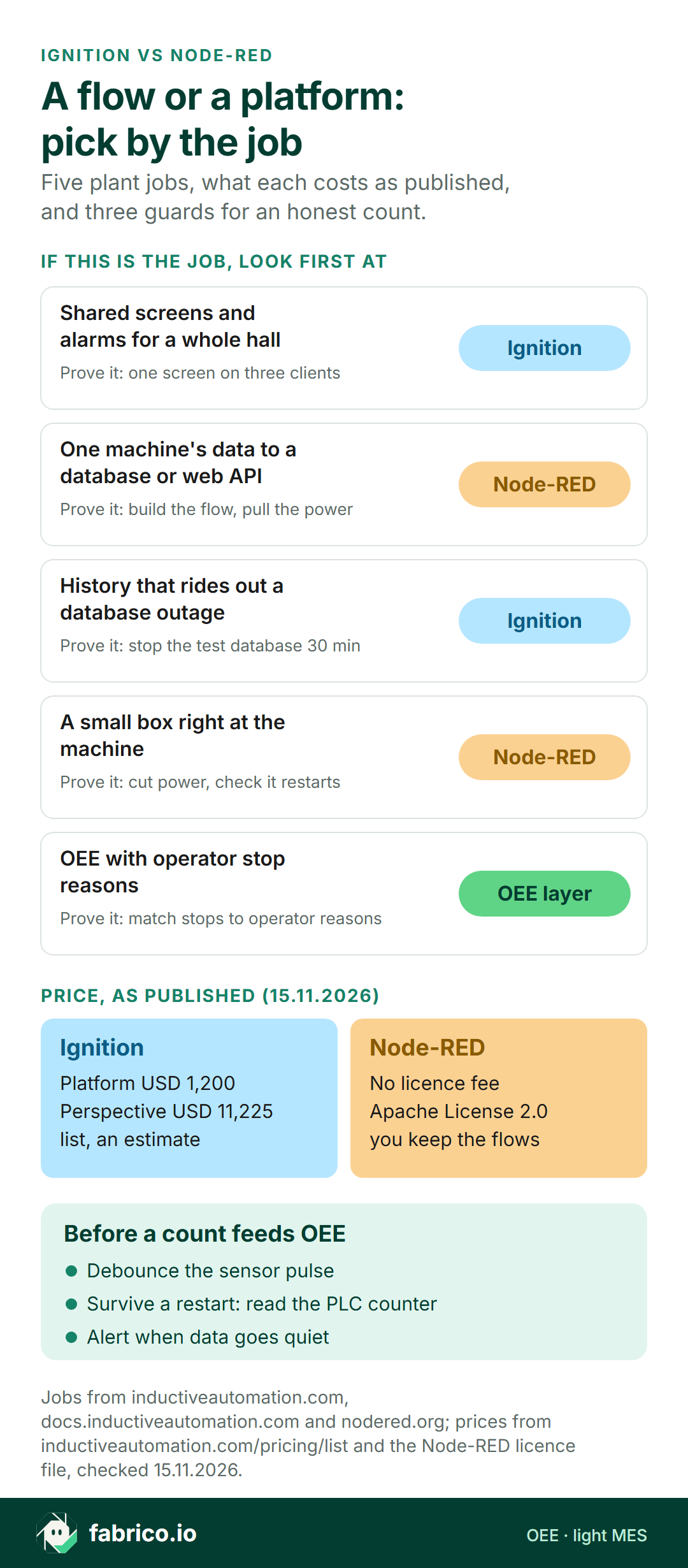
Text version of this infographic
- A flow or a platform: pick Ignition or Node-RED by the job.
- If this is the job: Shared screens and alarms for a whole hall. Look first at: Ignition. Prove it: one screen on three clients.
- If this is the job: One machine's data to a database or web API. Look first at: Node-RED. Prove it: build the flow, pull the power.
- If this is the job: History that rides out a database outage. Look first at: Ignition. Prove it: stop the test database 30 min.
- If this is the job: A small box right at the machine. Look first at: Node-RED. Prove it: cut power, check it restarts.
- If this is the job: OEE with operator stop reasons. Look first at: OEE layer. Prove it: match stops to operator reasons.
- Price, as published (15.11.2026). Ignition: Platform USD 1,200; Perspective USD 11,225; list, an estimate. Node-RED: no licence fee; Apache License 2.0; you keep the flows.
- Before a count feeds OEE: Debounce the sensor pulse; Survive a restart: read the PLC counter; Alert when data goes quiet.
Counting cycles: debounce, restart and the PLC counter
Most Node-RED against Ignition debates end up at the carton count, where a home-built pipeline is tested first. Trigger each fault below on purpose on a test system before a count reaches a shift report.
| Fault | What the shift report shows | Guard, from the project docs |
|---|---|---|
| Sensor contact chatters | Performance above 100% | Drop a second edge that arrives inside a window shorter than the cycle, or read the PLC counter |
| Node-RED restarts mid-shift | The running total starts again at zero, so performance collapses | A localfilesystem store in the context guide; better, the PLC's cumulative counter |
| A node throws an uncaught error | Run state stops arriving and stopped minutes go missing | Catch and Status nodes from the error handling guide, plus an alert when no message has arrived for five minutes |
| History database unreachable | A hole in run and stop history | Ignition store and forward keeps data in a local cache until the database accepts it |
The cheapest guard is to count where the machine already counts. A PLC counter that never resets survives a restart, a dropped link and a swapped Pi; the shift total is the end value minus the start value. An Ignition tag change script that counts edges can fall into the same traps, so the rule applies to both tools. A missed run-state change hides short stops too; the micro-stops guide covers what to log. For the protocol side of reading a counter, see OPC UA vs native PLC protocols.
Worked example: a tablet cartoner that forgot its count
Sample data, invented for this page; the plant and its figures are illustrations, not a customer. A household-products plant packs dishwasher tablets into cartons. The cartoner runs an eight-hour shift; take away a half-hour break and 450 minutes are planned. Its ideal rate is 30 cartons a minute, one every two seconds, so a perfect shift would make 13,500. A Node-RED flow on a Raspberry Pi counts outfeed pulses, writes each run and stop change to a database with a timestamp, and keeps the shift's running total in flow context. A reject counter in the PLC is read once a minute.
What really happened. The line stood for 61 minutes: changeover 24, tablet hopper starved 17, carton magazine jam 11 and short stops 9. Run time is 450 minus 61, or 389 minutes, so availability is 389 / 450 = 86.44%. In 389 minutes at the ideal rate the line could make 389 x 30 = 11,670 cartons. It made 10,580, so performance is 10,580 / 11,670 = 90.66%. Rejects were 212, leaving 10,368 good, so quality is 10,368 / 10,580 = 98.00%. OEE is 86.44% x 90.66% x 98.00% = 76.80%, the same as 10,368 good out of 13,500 possible (the method is in OEE calculation).
What the flow reported. At 10:52 a power dip restarted the Pi. Node-RED came back as a service within a minute, and the run and stop changes were safe in the database. The running total was not: it sat in in-memory context, which the Node-RED context guide says is cleared whenever Node-RED restarts. The 4,310 cartons counted before 10:52 disappeared, and the end-of-shift total read 6,270. Performance became 6,270 / 11,670 = 53.73%, quality (6,270 minus 212) / 6,270 = 96.62%, and OEE 86.44% x 53.73% x 96.62% = 44.87%, the same as 6,058 out of 13,500.
The fix. Set a localfilesystem context store so a running total survives a restart; better still, read the PLC's cumulative counter instead of rebuilding the total from pulses. Then alert on performance above 100% or below half its four-week median, so the next restart shows up within the hour, not at the weekly review. The cartoner OEE guide covers ideal rates and changeover losses on this kind of machine.
The cartoner shift in EUR
Take a sample contribution margin of EUR 0.70 a carton on a sample factory price of EUR 3.10, or 22.6% of the price. The sector's own figures bracket it: NYU Stern's margin table (January 2026 data, accessed 15.11.2026) puts 110 US household products firms at a gross margin of 51.04% and a pre-tax operating margin of 18.62%, and contribution margin sits above the second figure and below the first. Replace the sample with your finance team's figure.
| Line in the shift | Cartons | EUR per shift |
|---|---|---|
| Stopped, 61 minutes at 30 a minute | 1,830 | 1,281.00 |
| Running below the ideal speed | 1,090 | 763.00 |
| Rejected cartons | 212 | 148.40 |
| Real gap to the ideal | 3,132 | 2,192.40 |
| Wiped from the count by the restart (never a real loss) | 4,310 | 3,017.00 |
The three real rows add up to 13,500 minus 10,368, the gap the true OEE describes. On a sample pattern of 40 shifts a month and 470 a year, that is EUR 87,696 a month and EUR 1,030,428 a year, a ceiling, since no line closes its whole gap. The last row is what the restart did to the morning meeting: the speed loss read 5,400 cartons instead of 1,090, so EUR 3,017.00 seemed lost to slow running that never happened. A team chasing it retunes a cartoner already at 90.66% of ideal, while 17 minutes of hopper starvation wait.
Who keeps it running in year three
Inductive Automation ships Ignition and its modules; your team or an integrator builds and maintains the projects. Support is sold as a share of list price: the Ignition pricing page FAQ gives BasicCare at 16%, TotalCare at 20% and PriorityCare at 24%, and a major upgrade bought without support at 65% (checked 15.11.2026).
Node-RED's runtime comes from the OpenJS Foundation project and its contributors. Everything around it is yours: the flows, the node modules, the Node.js version and the box. The Node.js release page says "Production applications should only use Active LTS or Maintenance LTS releases", and that a long-term support line typically gets critical fixes for 30 months (accessed 14.11.2026). A Pi set up three years ago can sit outside that window while it still counts cartons. The Raspberry Pi guide runs Node-RED as a service that starts on boot, which helps after a power dip but not with a total held in memory. On the Ignition side, the store and forward page says records that fail to write too many times are quarantined, so someone watches the quarantine too. Write a named owner next to every flow and project before it feeds a report.
Editor access and security defaults
Node-RED's security guide says that, by default, anyone who can reach the editor's address can open it and deploy changes. The settings file turns on login with adminAuth and HTTPS; set both before a flow counts production. For Ignition, IA's Security Hardening Guide, last updated on 4 September 2026, "provides best practices for securing Ignition installations across industrial environments", covering TLS encryption, user management, database protection, operating system hardening and secrets management (read 15.11.2026).
Licence and price, as published
Node-RED: no licence fee. The licence file grants a no-charge, royalty-free copyright licence under Apache 2.0 (checked 15.11.2026). The cost sits in hardware, hosting and the hours of whoever writes and keeps the flows.
Ignition: a public price list. Inductive Automation's price list (checked 15.11.2026) shows the Ignition Platform at USD 1,200, the Perspective Module at USD 11,225, the Vision Module at USD 8,330, the Alarm Notification Module at USD 2,245 and Ignition Edge IIoT at USD 945. The page says "The price reflected is an estimate and not a final cost." For OEE on Ignition, Sepasoft's pricing page lists its OEE Downtime Module at USD 22,700 as a perpetual site licence (checked 15.11.2026).
| First-year cost line | Ignition route | Node-RED route |
|---|---|---|
| Licence | Platform plus Perspective: USD 12,425 at list | None |
| Support | 16% to 24% of list a year, by plan | Your own team, or a third party you contract |
| Hardware | A site server or virtual machine, plus Edge devices if used | A Pi or industrial PC per machine group |
| People | Project build and changes, by your team or an integrator | Writing flows, choosing node modules, Node.js upgrades, patching |
Put a figure on the people line first: a year of an engineer's hours keeping flows current can outweigh a platform licence on a small site, and a hall of supervisors who need shared screens can make a flow-only route the dearer one.
Decision matrix: Ignition or Node-RED for your plant
Price: Node-RED carries no licence fee, and Ignition's list starts at USD 1,200 for the platform before any module (both checked 15.11.2026). Budget too for the hours each route takes to keep running. Each row sends one job to the tool whose own pages document it.
| If this is you | Look first at | Why (vendor page) | Prove it in the pilot by |
|---|---|---|---|
| Supervisors across the hall need the same screens and alarms | Ignition | Perspective, Vision and Alarm Notification modules | Opening one line screen on three clients during one shift |
| One machine's data must reach a database or web API this month | Node-RED | A flow that polls, parses and branches data | Building that flow, then pulling the box's power |
| The licence budget this year is close to zero | Node-RED | Apache License 2.0, no-charge and royalty-free | Costing a year of a named owner's hours for the flows |
| History must ride out a database outage | Ignition | Store and forward to a local cache | Stopping a test database for 30 minutes and counting rows after |
| A running count must survive a restart | Node-RED, set up for it | A localfilesystem context store | Restarting the box mid-count and comparing with the PLC counter |
| The site server must not be a single point of failure | Ignition | Two-node redundancy, master and backup | Shutting down the master and timing the takeover |
| OEE per line, with stop reasons from operators | An OEE layer, or Ignition with a partner OEE module | Sepasoft OEE Downtime Module on the IA partner page | Matching one shift's stops to the reasons operators gave |
If a connectivity server or an edge data platform is on the shortlist as well, compare Ignition vs Kepware and Litmus Edge vs Ignition; for where a small box at the machine ends and a gateway begins, see IoT gateway vs edge device.
Where the OEE figure lives, and how Fabrico fits
Think of the stack as courier, window and ledger. The flow or the tag is the courier for run state and counts; Ignition screens are the window. The OEE figure needs a ledger that holds the shift plan, the ideal rate per product and the reasons operators gave for stops, and does the sum the same way on all lines. Fabrico is built to be that ledger: cloud OEE software with a light MES, where operators tag a stop with its reason on a phone or tablet and each shift's losses carry a euro figure per line (MES and OEE solution overview). Fabrico reads run, stop and count from the machine's PLC; see the OPC UA and OEE guide. Flows and screens stay; the hand-off is one agreement on whose carton count is official.
At a hand-fed packing step with no usable signal, the camera add-on counts output only; a camera that suggests why the line stopped is on the Roadmap for that add-on. Where a camera covers the line, the video for the minute of a stop can be opened from the shift timeline; it is streamed on request and not stored. See the computer vision page and computer vision for household products manufacturing. Results leave by webhooks, REST API or CSV export; no ready connector to Node-RED or Ignition is claimed, so prove the route on one line. To see a carton count and its stop reasons on one timeline, book a demo.
Questions to put to your integrator
- Which job comes first: moving data from a few machines, or giving a whole hall screens, alarms and history?
- For each PLC on the list, which Ignition driver or Node-RED node module reaches it, and who maintains that module?
- Where does the running count live, and what happens to it when the box or the gateway restarts?
- Who upgrades Node.js on each box, and who hardens the gateway along IA's guide?
- What does year one cost on both routes, licences, support and hours, on a single page?
Five checks before the integrator's first visit
- List what already counts. Every flow and Ignition project that touches a run state or a count, with its box, language and named owner.
- Restart on purpose. On a test copy, restart the Node-RED box mid-count and compare its total with the PLC counter.
- Compare a week of totals. Each shift's flow or tag total next to the PLC counter or pallet tally; flag shifts above 100% or below half the median.
- Check versions and access. Node.js release on every box against the LTS table, and the editor behind a login.
- Cost both routes on one page. Published list figures, support and your team's hours, then one shift priced with finance's margin.
Ignition and Node-RED: questions plant teams ask
Is Node-RED free to use in a factory?
There is no licence fee. Node-RED's licence file is the Apache License 2.0, which grants a no-charge, royalty-free copyright licence. The cost sits in hardware, hosting and the hours of whoever writes and maintains the flows.
How much does Ignition cost?
Inductive Automation's price list, checked 15.11.2026, shows the Ignition Platform at USD 1,200, the Perspective Module at USD 11,225 and the Vision Module at USD 8,330, and calls the figures an estimate, not a final cost. Support plans are priced as a percentage of list.
Can Node-RED and Ignition run in the same plant?
Yes. A common split puts Node-RED flows on small devices that reshape machine data and an Ignition server that holds tags, screens, alarms and history. Agree which system's count is the official one so nothing is counted twice.
Why did our Node-RED count drop to zero mid-shift?
Usually a restart. Node-RED's context guide says context held in memory is cleared when Node-RED restarts. Set a localfilesystem context store, or better, read the PLC's cumulative counter and subtract the value at the start of the shift.
Where should stop reasons live if we use Ignition or Node-RED?
In the system that calculates OEE and lets operators give a reason at the line: an Ignition screen with an OEE module such as Sepasoft's, a screen your team builds, or a separate OEE system such as Fabrico. The signal says the line stopped; a person says why.
Want a carton count your morning meeting can trust? Book a demo.
Related articles


Real Fabrico tiles, sample data.