


 Login
 Blog
MES for Bakeries: Which System Owns Each Job, Mixer to Bagger

In short: an MES for a bakery has to keep up with two clocks: the dough, which cannot wait, and the oven, which sets the pace. A light MES covers the line side first, with stops, counts and OEE by line and shift from the divider to the bagger.
- Recipes, ingredient dosing, batch records and lot tracing are real bakery MES jobs. They usually live in a dosing system, the ERP or a full MES.
- Bakery losses hide in late dough, gaps on the oven band, short stops at the slicer and bagger, and allergen changeovers.
- Set the ideal rate at the oven, in pieces a minute for each product, and price every loss in money.
- Fabrico is a light MES: machine data, live monitoring, OEE and downtime by cause. It does not run recipes, schedules or lot genealogy.
A bakery runs on dough that keeps rising and an oven that keeps baking. When the bagger jams, nothing upstream can wait for it.
This page is for bakery plant managers, operations directors and CI leads choosing MES software for bread, roll, bun and cake lines.
We sell Fabrico, a light MES, so test what we say here like any other vendor's claims.
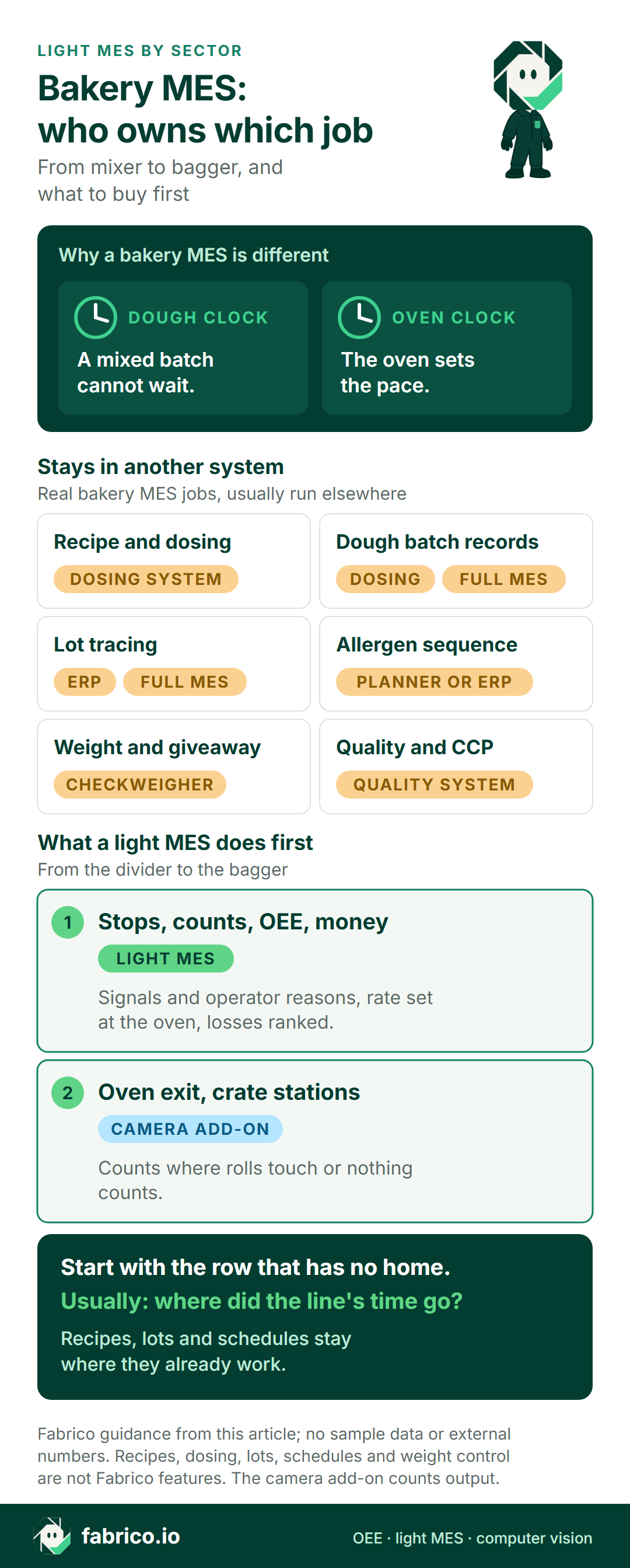
What a bakery MES does, job by job
An MES sits between the ERP, which plans what to bake, and the line, which bakes it. In a bakery its jobs fall into three groups: get the recipe right, prove what was made, and make it at rate.
| Job | In a bakery | Usually runs in |
|---|---|---|
| Recipe and dosing | Flour, water, yeast and improvers weighed to the recipe for each dough batch | A dosing or batching system at the mixer |
| Dough batch records | Which recipe, mix time and dough temperature, batch by batch | The dosing system, a full MES or the ERP |
| Lot tracing | Flour, seed and filling lots linked to finished lots | ERP lot functions or a full MES |
| Allergen sequence and schedule | Which product runs when, and where the clean goes | The ERP, a planning tool or the planner |
| Quality and CCP checks | Metal detector tests, label checks, oven profiles | A quality system, or paper |
| Weight control | Divider weights, checkweigher rejects, giveaway | Divider and checkweigher software |
| Stops, counts and OEE | Line state, pieces and packs, stop reasons, losses in money | A light MES |
| Maintenance | The repair that follows a stop | A CMMS, built into some light MES products |
Many bakeries already have a home for the first rows. Lot tracing, for one, is a legal duty in the EU: the European Commission's General Food Law page says businesses must be able to identify at least the immediate supplier and the immediate subsequent recipient. Many plants keep those records, and the lot links inside the plant behind them, in the ERP or a full MES.
The row with no home is often the one near the bottom: why the line lost two hours last night, and what that cost. That is the job a light MES does first.
For where light ends and full begins, read light MES vs full MES. For the food-wide picture, see MES for food manufacturing.
Two clocks: why bakery MES is different
A bakery line runs on two clocks at once.
The dough clock
Once a batch is mixed, the dough keeps fermenting. If the divider stops for 12 minutes, the next batch may be past its window by the time the line restarts. That dough is scrapped, or reworked into later batches where the recipe allows, before any counter sees it.
So someone has to tie together when each batch was mixed, when the divider took it, and the stops in between. The mix times sit in the dosing system and the stops in the light MES, so ask how the two are joined. Log dough scrap, and dough sent back as rework, in kilograms, with the stop that caused it.
The oven clock
The oven sets the pace. On a tunnel oven, bake time and band speed fix how many pieces leave each minute, and the oven keeps baking whatever is on the band.
So set the ideal rate for OEE at the oven, in pieces a minute for each product. A short divider stop then shows up later as a gap on the band, which is performance loss. A breakdown long enough to log is timed from the divider's own stop signal. Bread lost after baking shows up as quality loss. Our guide to OEE and maintenance software for industrial bakeries sets out the rate and sanitation rules. Biscuit lines are covered in OEE for biscuit production lines.
Where the losses hide from mixer to bagger
Walk the line and the losses sit in five places, each with a different record.
- Mixer to divider: a late batch or dough out of temperature. The line is starved, and the reason sits in the dosing system.
- Divider and prover: weight drift and short divider stops, which turn into gaps at the oven exit once the proofer has emptied.
- Oven band: gaps, a slower band after a change, a burner fault. The running signal times the stops but cannot see the gaps.
- Cooler, slicer and bagger: short stops nobody writes down, and bread sent to a waste crate while the bagger is down. See bakery bagging line stops and micro-stops.
- Product changes: seed, topping and bag changes, a new bake profile, and allergen clean-downs.
Allergen changeovers are a scheduling question
Seeded and plain products often share a line. In the US, sesame is now a major allergen: the FDA says all its requirements for major food allergens, labelling and manufacturing included, apply to sesame as of January 1, 2023.
In a 2021 Q&A on its preventive controls rule, the FDA lists scheduling products with allergens at the end of daily production cycles, where possible, among the ways to control allergen cross-contact. That decision sits in the schedule, not on the line.
A light MES does not build the schedule. It gives the planner the inputs: how long each type of changeover really took, by line, and what those minutes cost. Never win OEE points by shortening a validated clean. See allergen changeover validation and changeover standards for FMCG lines.
Weight and giveaway
Packed bread and cakes carry a declared weight. For packers who use the average system, UK government guidance for Great Britain sets out three packers' rules. Two matter most here: the contents must not be less on average than the nominal quantity, and no package should be short by twice the tolerable negative error. So dividers run a little heavy, and every gram over is product given away.
Giveaway passes every check, so it never shows in OEE quality. It lives in the divider and checkweigher data. Our page on giveaway as a quality loss shows how to price it, and checkweigher rejects and OEE quality shows which rejects count where.
Mixer to bagger: which system records what
Here is one example line, from the dosing system to the crates, with the system that owns each number.
The camera add-on earns its place at two stations: the oven exit, where rolls touch on the band, and hand crate stations with no machine at all. The bakery camera guide covers both stations, and the FMCG camera guide gives the wider picture.
Light MES or full MES for a bakery
Start with the pain that costs the most, not with the longest feature list.
| Your biggest pain | Start with | Why |
|---|---|---|
| Nobody can say where last night's hours went | A light MES on one line | Stops, counts and OEE come straight from the machines, one line at a time |
| Weights drift and giveaway is high | Divider and checkweigher software | The weight data lives there. Feed its rejects to OEE quality. |
| A retailer audit asks for a full lot trace | ERP lot functions or a full MES | A trace needs consumption records, which a light MES does not keep |
| Recipe errors at the mixer | A dosing or recipe system | It weighs each ingredient against the recipe |
| The plan is rebuilt by hand every day | A planning tool or the ERP | Scheduling is its own job. Feed it real changeover times. |
| All of the above, on every line | A full MES, in stages | Expect a longer project before the first result |
Many bakeries end up with two layers: recipe and lot records where an auditor or a customer needs them, and line OEE on every line. Our lot traceability data model walks through a flour lot trace, so you can see what a full trace needs.
Bring a station list, one stop sheet and last week's plan to a demo, and we will show which of these rows Fabrico fills and which it does not.
Worked example: one bun line, one shift
These are example numbers, and they describe no real bakery. A bun line runs one 480-minute shift of planned production time. The scheduled end-of-day sanitation sits outside it.
- Ideal rate: 110 buns a minute, set at the oven for this product.
- Stops: 85 minutes in all. A sesame to plain allergen clean took 50, a white to wholemeal change 15, a divider breakdown 12, and one oven band stop 8.
- Counts: 39,105 buns at the oven exit, and 37,932 good buns packed.
Run time is 480 minus 85, or 395 minutes, so availability is 82.3%. At 110 a minute, 395 minutes could bake 43,450 buns. The oven exit counted 39,105, so performance is 90.0%. That gap is short gaps on the band and the slow restart after each change.
Of the 39,105 baked, 37,932 were packed good, so quality is 97.0%. The other 1,173 were rejects and bread lost while the bagger was down.
OEE is 82.3% x 90.0% x 97.0% = 71.8%. Check it the short way: 37,932 good buns of 52,800 possible in 480 minutes is also 71.8%. The method is in our guide to OEE calculation.
Now rank the losses. The biggest one is not a breakdown. It is the 50-minute allergen clean, worth 5,500 buns.
The fix is not to clean faster. It is a planning question: could the sesame run move to the end of the day, next to the scheduled sanitation? The light MES gives the planner the number. The planner and the food safety team decide.
One loss is missing from the chart. During the divider breakdown, a 150 kg dough batch went past its window: 60 kg went back into later batches as rework and 90 kg was scrapped. None of it reached a counter, so OEE cannot show it. Price a bun lost after baking at its full cost, not its contribution: it has already used dough, gas and labour.
Eight checks for any bakery MES vendor
Put these to every vendor, us included, with last week's stop sheet and dosing log on the table.
| Ask | How to test the answer |
|---|---|
| Can it hold a rate per product on one oven? | Ask for different ideal rates for tin and free-standing bread on the same oven, set at the oven, not one nameplate speed. |
| How is sanitation kept out of planned time? | Ask how end-of-day sanitation and allergen cleans are set, inside or outside planned production time, and check the same rule holds on every line. |
| How are changeovers split? | Ask for allergen cleans, product changes and bag changes as separate types, each with its own minutes. |
| Where does dough scrap go? | Ask who records the kilos of scrap and rework, in which system, and how they link to the stop that caused them. |
| What comes from the ERP, and what goes back? | Orders and products in, actuals out. Ask who maintains the link. |
| How does an operator in gloves log a reason? | Ask to see it done at the line, on a tablet or phone, in seconds. |
| Which jobs stay elsewhere? | Ask the vendor to mark recipes, lots, schedules and weight control as theirs or not, in writing. |
| When is the first line live? | Ask for a date for live data on one line, and what your side must have ready. |
Cameras at the end of the line, and the works council
A light MES on a bakery line mostly reads machine signals. Where the camera add-on does go in, at the oven exit or a crate station, it will see hands as well as bread. Frame the camera on the product, report by line and shift, never by person, and agree who may open video before go-live. In many European plants, talk to the works council first. See production line cameras without surveillance.
Where Fabrico fits
Fabrico is a cloud OEE and light MES platform. In a bakery it covers the line side, from the divider to the bagger.
- Machine data: stops and counts from the divider, oven band, slicer and bagger, through the PLC, or through a Fabrico IoT device with external sensors on older machines.
- Stop reasons: the operator tags them at the line, on a tablet or phone, from your own list of reason codes.
- OEE and losses: OEE, downtime by cause and micro-stops by line and shift, with losses shown in money. Live on the web, iOS and Android.
- Cameras: AI cameras, an add-on on request, count output, for example at the oven exit or a hand crate station. With the camera add-on, you can open the video for any moment on the shift timeline. In the camera add-on's standard setup, video is streamed on request, not stored in Fabrico.
- ERP and data out: a connection to SAP or another ERP can be scoped per customer. Data leaves through a REST API, webhooks and Excel or CSV export.
- Maintenance: a technician opens a work order from the stop, on the same machine record.
Not live today: Production planning is on our roadmap, with no release date. Today Fabrico does not build or schedule your plan: it shows what the lines can do. Stop-reason suggestions from the camera add-on, confirmed by the operator, are also on the roadmap.
What Fabrico does not do: recipes and ingredient dosing, dough batch records, lot genealogy, weight control and CCP records. Those stay in your dosing system, ERP, checkweigher software and quality system. Fabrico makes no HACCP claim.
Devices connected in about a month; full rollout in 3 to 4 months. The full scope is on our MES and OEE software page, and the cameras are on our computer vision add-on page. All eight checks above apply to us too: test our claims like any vendor's in a demo, with one shift's stop sheet as the test case.
What people ask next
Does a bakery need a full MES for traceability?
It needs traceability records. EU food law asks businesses to identify at least the immediate supplier and the immediate recipient. ERP lot functions, a full MES or paper can hold those records. A light MES does not keep lot genealogy.
Can a light MES handle allergen changeovers?
It can time them, give them their own reason codes and show what they cost. It does not decide the sequence or validate the clean. Those stay with your planner and your food safety team.
Can Fabrico read old bakery machines without a PLC?
Yes. Older machines get a Fabrico IoT device with external sensors, and manual stations such as crate loading can use AI cameras, an add-on that counts output.
How long does a light MES take in a bakery?
It depends on the vendor and on how ready your network and machines are. For Fabrico, the timing is this. Devices connected in about a month; full rollout in 3 to 4 months. Start with one representative line and a baseline from today's stop log.
What drives the cost of a bakery MES?
The number of lines and machines, how each one connects, any camera add-on and its mounting, the ERP link and training. Pricing is per quote, so give each vendor the same station list.
Want to see a bakery line's losses in money? Book a demo and bring one shift's stop sheet.
Related articles

Latest from our blog


Real Fabrico tiles, sample data.