


 Login
 Blog
MES for Snack Food Plants: Who Holds Fryer Records, Giveaway and OEE

In short: an MES for a snack food plant has to hold four kinds of record, from fryer settings to pack weights, and tie what the fryer made to what the baggers packed. Start with line data and OEE at the packing stations, and keep fryer records, pack weights and lots in the systems built for them.
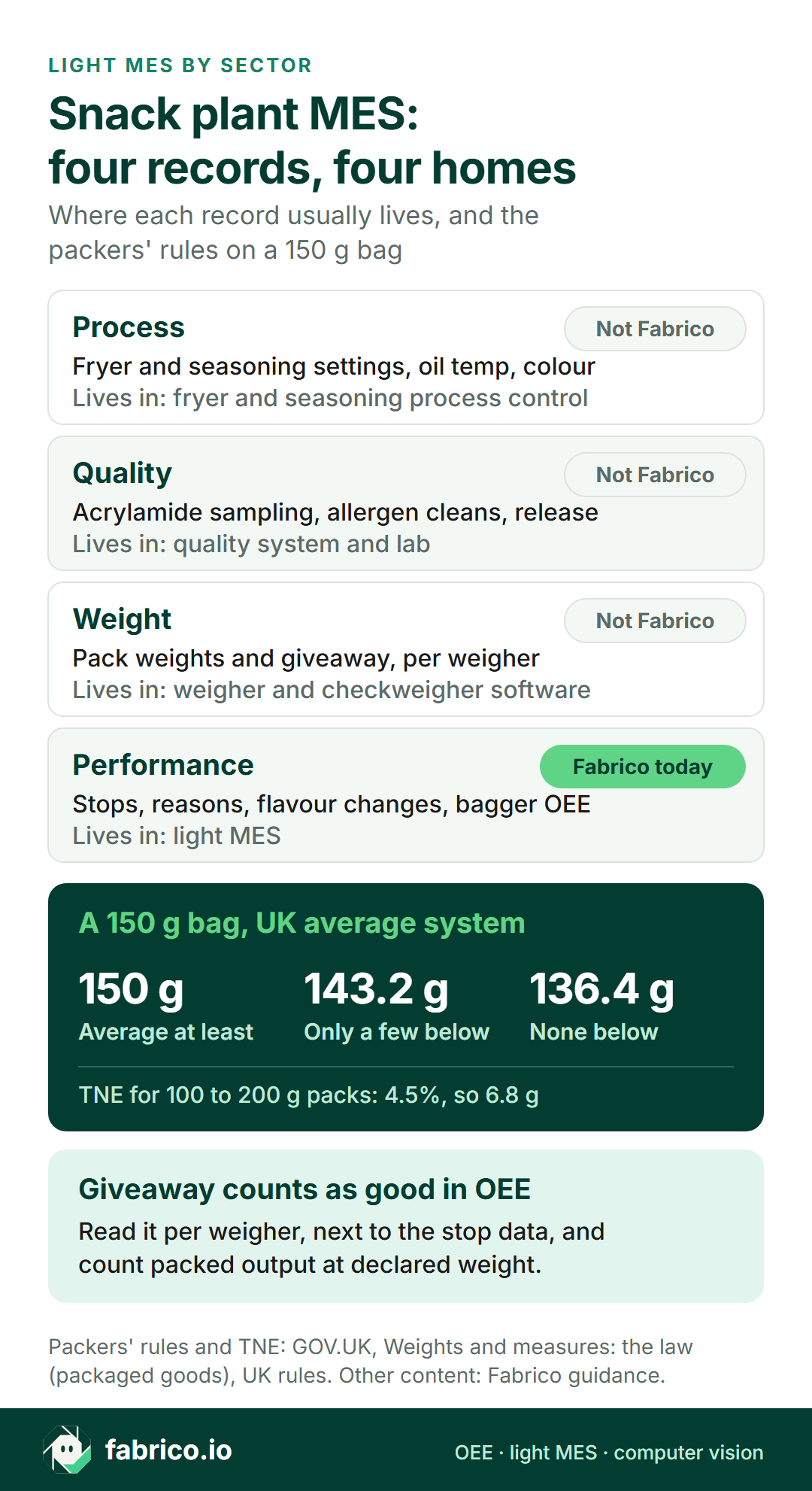
- A snack plant keeps four kinds of record: process, quality, weight and line performance. Each has its own natural home.
- Giveaway lives in the weigher and checkweigher data. The UK packers' rules set the floor; the weigher's spread sets how far above it you run.
- Count packed output at declared weight, or giveaway hides inside good output.
- Flavour changes are where planning, allergens and OEE meet: sequence them, code them, never shorten a validated clean.
- Fabrico is a light MES: stops with reasons, counts, OEE and losses in money by line and shift. It does not run recipes, giveaway statistics or lot genealogy.
Line 2 runs salted crisps until ten, then sour cream and onion, then a milk-free paprika for a private label. The fryer never stops. The three weighers and baggers stop all day. At the afternoon meeting the ERP has the line behind plan, the weigher screen shows bags running heavy, and the shift log says "bagger". Three systems, three stories.
This page is for plant managers and CI leads in potato chip, extruded and baked snack plants who are choosing an MES. For the measuring rules on the line, read OEE for snack food lines. We sell Fabrico, so test what we say like any vendor's claims.
What a snack plant needs from an MES
A snack line joins two kinds of production.
- The process: slicer and washer or extruder, fryer or oven, de-oiling, optical sorter and seasoning drum. It runs in kg an hour, and its world is oil temperature, colour, seasoning rate and lots of potatoes, oil and seasoning.
- The packing: distribution conveyor, multihead weighers, vertical baggers, checkweigher, metal detector, case packer and palletiser. It runs in bags a minute, and its world is stops, film, bag sizes and weights.
The joint between them is where data gets lost. A bagger stop does not stop the fryer: its product is diverted, and the MES has to know where it went. So a snack plant keeps four kinds of record:
- Process: fryer and seasoning settings, oil temperature, colour.
- Quality: acrylamide checks, allergen cleans, sorter and checkweigher rejects.
- Weight: pack weights and giveaway, weigher by weigher.
- Performance: stops, reasons, flavour changes and OEE at each bagger and for the line.
Acrylamide shows why the first two need their own systems. Commission Regulation (EU) 2017/2158, in the version kept in UK law, sets a benchmark level of 750 µg/kg for potato crisps. Its sampling annex asks for sampling and analysis at least annually for products with a known, well-controlled level, and lets product attributes such as colour, or process parameters, replace analysis where a statistical link is shown. Those records belong to the fryer's process control, the quality system and the lab. If you sell in the EU, check the current EU text.
Snack MES functions, and where each one usually lives
The MESA model lists eleven MES functions. On a snack site they turn into the jobs below. Read the right-hand column first: every row needs a home that works today.
| Function | What it does on a snack line | Where it usually lives |
|---|---|---|
| Recipes and seasoning | Fryer settings and seasoning rates per product | Fryer and seasoning process control |
| Process and acrylamide records | Oil temperature, colour, sampling results | Process control, quality system, lab |
| Weights and giveaway | Pack weights against declared weight, per weigher | Weigher and checkweigher software |
| Allergen and flavour changes | Clean, check and release between flavours | Quality system |
| Lot tracking | Potato, oil and seasoning lots into packed lots | ERP lot functions, or a full MES |
| Scheduling | Flavour and bag size order through the week | ERP or a planning tool |
| Line data and OEE | Bagger and weigher stops with reasons, counts, OEE | Light MES |
If each row has a home that works, a light MES fills the last one without moving the others. Our light MES guide shows the full split.
For the camera or sensor choice at each station, see camera or sensor for OEE, machine by machine.
Flavour changes: where planning, allergens and OEE meet
A flavour change means a drum and applicator clean, new seasoning and mixed product to rework, and, from a milk flavour to a milk-free one, a validated allergen clean. The OEE side of it is in OEE for snack food lines.
That clean matters. The FDA lists milk among the nine major food allergens in US law, and says milk is the most common cause of US recalls due to undeclared allergens. Cheese and sour cream seasonings contain it.
Three systems touch one change:
- The plan sets the order. Running milk flavours last before the end-of-day clean, if your QA team agrees, can save a clean in the middle of the day. That is ERP or planning work; our allergen changeover matrix prices run orders.
- The quality system holds the clean, the checks and the release.
- The light MES times the change from the last good bag of one flavour to the first good bag of the next, the operator codes its type, and the report shows minutes over standard. See changeover standards for FMCG lines.
Never shorten a validated clean, and keep its minutes apart from breakdowns.
Giveaway: what the weigher sees and OEE does not
Many snacks are packed to the average system. Under UK packaged goods rules, the average must not be below the label weight, only a small number of packs may fall short by more than the tolerable negative error, and none by more than twice it. For 100 to 200 g packs that error is 4.5%, rounded up to the next 0.1 g.
On a 150 g bag that is 6.8 g. So bags must average at least 150 g, only a few may weigh under 143.2 g, and none under 136.4 g. A weigher with a wide spread has to run its average higher to stay inside those limits. The gap above 150 g is giveaway.
Overfilled bags count as good, so OEE never shows giveaway. The weights live in the multihead weigher and the checkweigher, and their own software usually keeps the average and spread per weigher and product. Our page on giveaway and overfill explains why cutting the spread, not the setpoint, cuts the loss, and checkweigher rejects and OEE quality shows where rejects land.
One trap to check: if the MES counts packed output in weighed kg, giveaway becomes good output. Count good output as bags times declared weight. The gap to the fryer's kg then holds giveaway, sorter rejects and overflow scrap, which the weigher and checkweigher data split.
Bagger and weigher data: what the MES must read
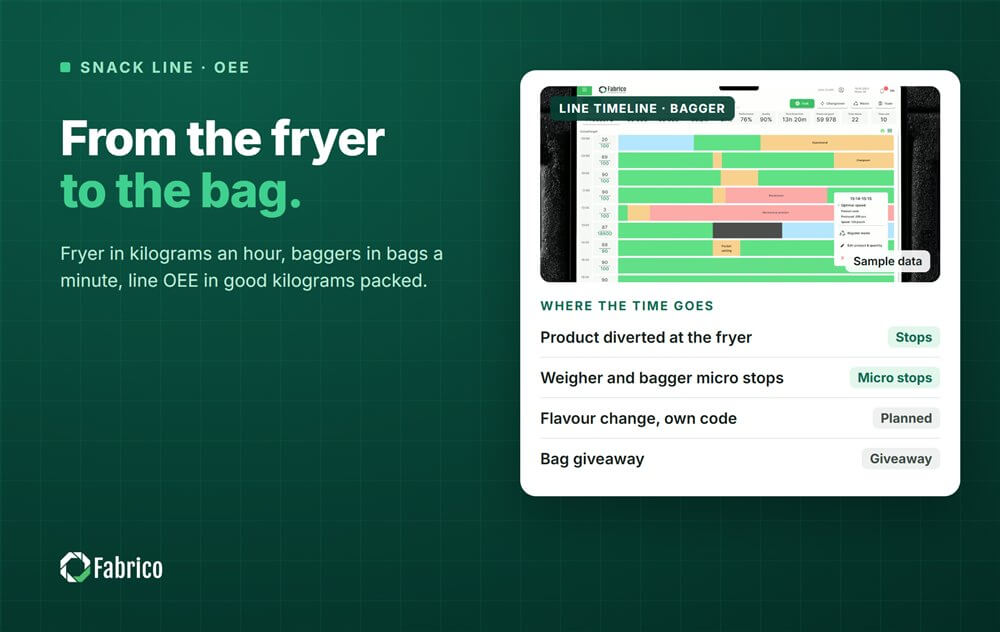
Most bagger stops are short: product in the seal, a film splice, bridging in a weigher bucket. Nobody writes them down, so the MES has to read them from the bagger and weigher signals, and charge product diverted during a stop to the station that stopped, not to the fryer. Where to measure OEE on the line, and at which rates, is in OEE for snack food lines. The stop modes are in VFFS bagger stops, and micro stops shows how to bring them into the open.
From the weigher and checkweigher software, the useful fields are the product, the station, the bag count, and the average and spread per shift. Map each weigher to its bagger once, and name who keeps that map up to date.
Worked example: three weighers, one shift
Example numbers, no real plant. A chip line packs 150 g bags on three weigher and bagger stations over one shift.
| Station | Bags packed | Average bag | Giveaway |
|---|---|---|---|
| Station 1 | 18,000 | 151.2 g | 21.6 kg |
| Station 2 | 18,000 | 151.8 g | 32.4 kg |
| Station 3 | 17,000 | 153.6 g | 61.2 kg |
| Line | 53,000 | 115.2 kg |
Giveaway is grams over 150 times bags. Station 3: 3.6 g x 17,000 = 61,200 g, or 61.2 kg.
OEE sees one thing here and misses another. It sees that station 3 packed 1,000 fewer bags, in this example because it stopped more. It counts all 53,000 bags as good, so it cannot see the 115.2 kg given away.
Price it at a sample cost of €1.90 a kg of finished chips, an assumption for this example, not a market figure: 115.2 kg is €218.88 a shift. If engineers cut station 3's spread to station 1's, so it could run at station 1's 151.2 g average, it would give away 1.2 g a bag instead of 3.6 g. That saves 2.4 g x 17,000 = 40.8 kg, or €77.52 a shift, and, in this sample, €38,760 over 500 shifts a year, without touching its stops.
Station 3 is the worst on both counts. The light MES shows its stops, and the weigher software shows its spread. Read together, per station and shift, they point the engineers at one machine.
Light MES or full MES for a snack plant
A light MES covers line data and OEE and leaves recipes, weights and lots where they are. Pick by the pain you feel every day.
| If the daily pain is | Start with | Fabrico's part |
|---|---|---|
| Baggers lose time and nobody can rank why | A light MES on the baggers, plus the fryer's run state | This is the core |
| Nobody knows the giveaway per weigher | Weigher and checkweigher software | None; rejects can feed quality |
| The flavour order is rebuilt by hand | Your ERP or a planning tool | Roadmap, not live |
| Fryer and acrylamide records are on paper | Process control and a quality system | None |
| A customer asks for lot genealogy | ERP lots, or a full MES | None |
Many plants run both. Our light MES vs full MES guide gives four checks to decide.
Bring one fryer's stops and rates and a week of weigher reports to a demo, and we will show which numbers Fabrico can fill and which it cannot.
Seven questions for any snack MES vendor
Ask every vendor, us included, to answer in writing, and test the answers in a pilot on one line.
| Ask | How to test the answer |
|---|---|
| Which system holds the fryer's kg? | Ask whether it reads a weigh belt or takes the figure from the ERP, and who reconciles it with the bag counts. |
| Where does diverted product go when a bagger stops? | Ask how overflow scrap is charged to the station that stopped. |
| How are flavour changes and allergen cleans coded? | Ask for a code per change type, a standard time each, and minutes over it. |
| Is output counted in declared or weighed kg? | Declared weight keeps giveaway out of good output. |
| Which weigher and checkweigher data comes in? | Ask what is read, what stays in their software, and who maps it. |
| How does it read older baggers? | PLC, add-on sensor or camera? Ask machine by machine. |
| What is live, and what is roadmap? | Get it in writing, with a date for live data on one line. |
Still comparing platforms in general? Our guide to OEE software sets out what to compare.
Cameras, crews and the works council
On a snack line the bagger PLC usually gives the count. The camera add-on earns its place where there is no usable signal, such as hand packing of multipacks and variety boxes, and where opening the video for a stop helps the operator choose the reason. It does not check seals, codes or weights: that is inspection.
Frame cameras on the product, report by line and shift, not by person, and talk to the works council first where that applies. For the wider camera picture, see computer vision for food manufacturing.
Where Fabrico fits
Fabrico is a cloud OEE and light MES platform. On a snack line it does this today:
- Line data: stops and counts from the weigher and bagger PLCs, and run and stop states from the fryer, or from an IoT device with sensors on older machines. Stop reasons come from the operator at the station, on a tablet or phone.
- OEE and losses: OEE, downtime and losses by line and shift, shown in money, with micro-stops detected from the signal. Live output shows how much each line has made so far in the shift. On the web, iOS and Android.
- Cameras: AI cameras, an add-on on request, count output where there is no usable signal, such as hand packing, and you can open the video for any moment on the shift timeline. In the standard setup, video is streamed when someone opens it and is not stored in Fabrico.
- Your ERP and your data: a connection to SAP or another ERP, scoped per customer, plus a REST API, webhooks and Excel or CSV export, so you can put weigher reports and line data side by side in your own reports.
Maintenance is built in, so a technician opens a work order from the stop, on the same machine record. Devices connected in about a month; full rollout in 3 to 4 months.
Roadmap, not live today: Production planning is on our roadmap, with no release date. Today Fabrico does not build or schedule your plan: it shows what the lines can do. Also on the roadmap for the camera add-on: stop-reason suggestions from the camera, confirmed by the operator.
What Fabrico does not do: recipes and seasoning control, fryer process and acrylamide records, giveaway statistics, lots and genealogy, and inspection. Checkweigher and inspection rejects can feed its quality figure through the line's reject signal or counter.
See the full scope on our MES and OEE software page and the camera add-on on Fabrico computer vision for OEE. Related reading: computer vision for FMCG manufacturing and the parent guide, MES for food manufacturing.
What people ask next
What does an MES do in a snack food plant?
It runs and records production between the ERP and the lines: recipes, fryer settings and process records on the process side, and counts, stops, flavour changes and OEE at the packers. Most plants split these across process control, a quality system, weigher software and a light MES.
Does a snack plant need a full MES?
Only where customers or auditors expect electronic batch and lot records that your ERP and quality systems cannot keep. Where lost output and giveaway are the main costs, start with line data and OEE, next to the weigher data you already have.
Does an MES track giveaway?
Some full suites read weigher data. Fabrico does not calculate giveaway: pack weights stay in the weigher and checkweigher software, and rejects can feed Fabrico's quality figure. Look at both per station and shift.
Which system owns a flavour change on a snack line?
Three systems share it. The plan sets the flavour order, the quality system holds the clean, the checks and the release, and the light MES times the change and shows the minutes over standard. Never shorten a validated allergen clean.
Should an MES count snack output in weighed or declared kg?
In declared kg: bags times the declared weight. Counted in weighed kg, giveaway becomes good output. The gap to the fryer's kg then holds giveaway, sorter rejects, rejected bags and overflow scrap.
Can a camera count bags or cases on a snack line?
Yes, with Fabrico's AI camera add-on, where no usable signal counts them. You can open the video for any moment on the shift timeline; in the standard setup it is streamed when someone opens it and is not stored in Fabrico. It does not check seals or weights.
Want to see it on a line like yours? Book a demo and bring one fryer's stops and a week of weigher reports.
Related articles
Latest from our blog





Real Fabrico tiles, sample data.