


 Login
 Blog

Computer Vision for Sawmills: Set a True Rate for Every Log Class, Size and Grade

In short: computer vision in a sawmill counts output at hand stations no PLC covers. Judge each count against its own size and log class rate.
Grading and defect scanning stay with the scanners and graders; an OEE camera counts pieces, packages and pallets and inspects nothing.
- Log class, species, sawing pattern, size and grade each change the rate at a different station.
- One ideal piece rate for a whole planer shift can turn a 68.5% shift into 51.3% or 96.3%.
- Saw line, trimmer, sorter and kilns already give signals; the camera add-on counts trim-back, hand strapping, hand stacking and pallet benches.
- Price a lost minute at the size that was running: on our example, a 2x6 minute is worth 1.6 stud minutes.
A sawmill never runs one product. The log yard sorts stems into sawing classes, each class gets its own sawing pattern, the kilns run schedules by species and thickness, and the planer resets for every size. Lundahl's Luleå University of Technology thesis on sawmill quality defines the yard side plainly: logs are sorted into predefined groups called sawing classes by top diameter and/or quality, normally in steps of 10 to 20 mm. Below, the mix goes through the mill station by station, then one ideal rate bends a shift's OEE, then the camera add-on fills the counts machines leave out. Panel lines downstream are covered in MES for woodworking.
Variant by station: what each log class, species, size and grade changes
Read it across: each row is something that changes from one order or log class to the next, and each cell is what that change does at a station. "No" means the station barely notices. Example mill; check your own stations.
| What changes | Log yard | Saw line | Edger, trimmer | Kilns | Planer | Grading, strapping |
|---|---|---|---|---|---|---|
| Log diameter class | Own box | Pattern, feed speed | Boards per log | No | No | No |
| Species | Own boxes | Feed speed | Grade rules | Schedule | Feed speed | Grade rules |
| Sawing pattern | No | Setting change stop | Side board count | No | No | No |
| Dimension, length | No | Follows pattern | Pieces per lug | Hours by thickness | Head reset, piece rate | Courses per package |
| Grade | Quality sort | No | Wane, trim | No | No | Grade split, trim-back |
| Export pallet stock | No | No | No | Treatment step | No | Pallet type count |
The saw line takes the log class and pattern changes. The kilns take species and thickness, days later. The planer and the grading end take size and grade, and they are where the count you report usually comes from. A rate that ignores those three places is wrong somewhere every shift.
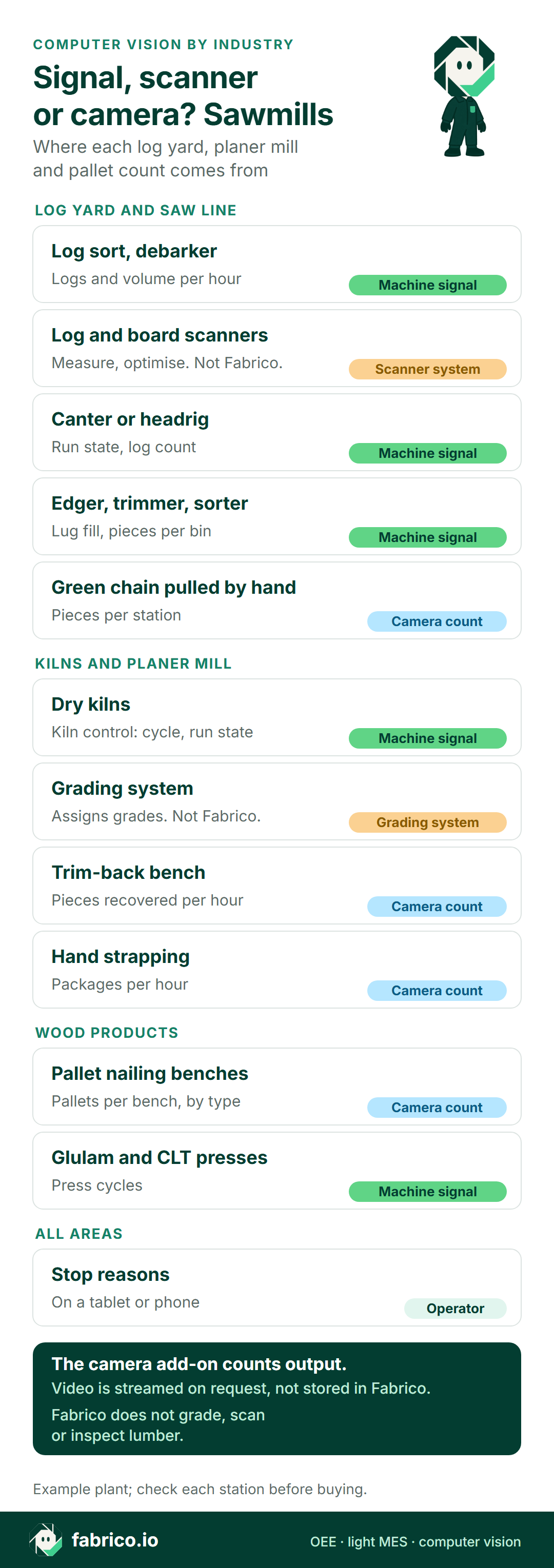
Text version of this infographic
- Log yard and saw line: log sort and debarker: machine signal, logs and volume per hour
- Log yard and saw line: log and board scanners: scanner system, measure and optimise, not Fabrico
- Log yard and saw line: canter or headrig: machine signal, run state and log count
- Log yard and saw line: edger, trimmer, sorter: machine signal, lug fill and pieces per bin
- Log yard and saw line: green chain pulled by hand: camera count, pieces per station
- Kilns and planer mill: dry kilns: machine signal, kiln control cycle and run state
- Kilns and planer mill: grading system: assigns grades, not Fabrico
- Kilns and planer mill: trim-back bench: camera count, pieces recovered per hour
- Kilns and planer mill: hand strapping: camera count, packages per hour
- Wood products: pallet nailing benches: camera count, pallets per bench by type
- Wood products: glulam and CLT presses: machine signal, press cycles
- All areas: stop reasons: operator, on a tablet or phone
- The camera add-on counts output; video is streamed on request, not stored in Fabrico
- Fabrico does not grade, scan or inspect lumber
Explainer presented by Iris, Fabrico's AI-generated presenter: how an add-on camera counts output where a machine has no signal. Book a demo.
Plays from YouTube. Google may set cookies when you press play. Privacy policy.
Why one ideal piece rate lies in a sawmill
A planer that feeds at a steady speed in lineal feet turns out more short pieces than long ones. In our example mill, 8-foot 2x4 studs run at 75 pieces a minute and 16-foot 2x6 boards at 40. Both are about the same feed speed: 600 and 640 lineal feet a minute. A single line rate of 60 pieces a minute is wrong for both: too slow for studs, too fast for 2x6. Set the ideal rate per product, from the best rate the line has shown on that size, so rate loss on a high-speed line shows up as real slow running, not as a change of size.
The saw line has the same problem from the other side. Lundahl notes that "Optimized feed speed is governed by individual log properties, season and machinery", and that some losses show up as a line running faster than nominal, which can be caused by an incorrect calculation of nominal speed. A performance figure above 100% is the classic sign: the ideal rate was set for the wrong log class. A planner who schedules at demonstrated rates per size gets the same benefit on the order book.
The unit matters too. A 2x6 at 16 feet is 16 board feet; an 8-foot stud is about 5.3. Count pieces at the station and convert to board feet or cubic metres for money; which unit to count for OEE covers the choice.
Log yard: the scanner already counts, sawing classes set the pace
A Silva Fennica study of log yard box assignment (Rathke, Huka and Gronalt, 2013) describes a hardwood sawmill of 30,000 cubic metres a year. Its sorting chain conveyor ejects logs into boxes depending on length, diameter and quality; the study grouped diameters in 5 cm steps. The saw line is fed from storage boxes one batch at a time.
The log scanner on the sorting line already gives logs, diameter and volume per hour. What the yard does not see is its cost downstream: a box that runs empty before the next class is ready makes the saw wait. Give that wait its own stop reason on the saw line, "next class not ready", so it is not booked as a saw fault.
Headrig or canter: a pattern change is a stop with a cause
The same study is blunt about what a class change costs at the saw: "an assortment change yields a time range from 5 to 30 minutes. Usually, changing from one dimension to another leads to a stop in production and additional costs for both machines and personnel." Its mill sawed on a frame saw, which "works with a constant feeding speed, within one assortment", so the class, not the log length, sets the pace there.
On a canter line or band headrig the PLC and optimiser report run state and log count, so the stop is captured. What goes missing is the cause. Log a pattern change as a changeover from one class to the next, with a standard time per pair, and the 5 or the 30 minutes become visible per pair. The gap between them is mostly setting work; a changeover checklist and the difference between SMED and a faster changeover apply here as on any line.
Lundahl adds the other saw line loss: "Log gaps and lack of logs are the main causes of equipment idling." A gap between logs is a speed loss, not a stop, so it lands in performance. It also moves with the mix: small top diameter classes put more logs through per minute and make every gap count for more. For the cost of the minutes, a USDA Forest Service study of hardwood sawmill downtime costs (Wiedenbeck and Blackwell, 2003) put operating costs at 4 to 25 US dollars per operating minute. Those are US hardwood figures from 2003: an order of size, not a benchmark.
Edger, trimmer and grading: the double count at the trim-back bench
The edger and trimmer optimisers set edging and trim lengths per board, the lug loader reports full and empty lugs, and the sorter counts pieces per bin. All of that is a machine signal. What changes with the mix is the grade split. Lundahl's simulations graded boards A, B or C under the Nordic Timber Grading Rules, where "Grade A has the strictest allowances and grade C has the widest allowances". A class of small, knotty logs makes a different split than a class of large butt logs, and quality moves with the log class, not only with the sawyer.
In North America grading is regulated. The American Lumber Standard Committee machine graded lumber policy covers Machine Stress Rated (MSR) and Machine Evaluated Lumber (MEL), including the approval of the grading machines themselves. Counting a board is not grading it. Fabrico does not grade, scan or inspect lumber; it takes the grade split from the sorter bins or the grading system into the quality figure.
One grade rule changes the count itself: off-grade pieces go to a trim-back bench, where a worker cuts out a split or a large knot to recover a shorter piece on grade. One board in can mean two pieces out, or none. Count recovered pieces once, as the bench's output, never back into the line's first-time good.
Kilns, planer and stacking: start with the kiln queue
The USDA Forest Products Laboratory Dry Kiln Operator's Manual calls the dry kiln "the only practical means now in wide use for rapid, high- volume drying of lumber". A kiln runs a schedule per species and thickness, so the green chain's mix today becomes the kiln queue tomorrow. Measure kilns in kiln hours and charges from the kiln control: hours standing empty, hours waiting to load, charges past schedule.
At the planer the mix returns as size changes: heads reset, guides moved, trimmer and sorter bins reassigned. A tilt hoist unstacks the dry packages, and when it jams on broken stickers, clearing it is not a quick reach-in. OSHA's sawmill standard, 29 CFR 1910.265, a US rule, requires a means to positively block the hoisting platform when employees must go beneath the stacker or unstacker hoist. That time belongs in the stop.
Read the kiln queue before blaming the planer: if dry packages of the next size are not ready, the planer stops for the kiln, and the stop takes the kiln's reason.
Hand stations a camera add-on counts, one count per product
The saw line, trimmer, sorter, stacker and kilns already count. The camera add-on belongs where people move the wood and nothing counts it. At each one, decide first what one count is for each variant:
| Hand station | One count is | What changes with the mix |
|---|---|---|
| Trim-back bench | A recovered piece leaving the bench | Grade and length out differ from what came in |
| Hand stacking bay | A finished stickered package | Courses per package change with thickness |
| Hand strapping, specials line | A strapped package moved off | Short runs and odd sizes, many changes |
| Green chain pulled by hand | A piece onto a cart, per pull point | Each pull point is one size or grade |
| Pallet nailing bench | A finished pallet, by type | Export pallets need treatment and a mark |
Count packages, not boards inside a package. A strapped package seen from above is a block of near-identical ends. Goldman and colleagues at CVPR 2019 wrote that "Man-made scenes are often densely packed, containing numerous objects, often identical, positioned in close proximity. We show that precise object detection in such scenes remains a challenging frontier even for state-of-the-art object detectors." Their images were retail shelves, not lumber, so take it as a direction, not a figure: count packages crossing a line, not the boards inside them. Hands in view, sawdust on the lens and a dim shed in winter are the other limits. Test the count beside a hand tally first; how accurate a camera part count is covers the test. To see a planer's PLC counts and its hand benches side by side on one shift timeline, book a demo.
Pallet plants have their own variant. ISPM 15, the IPPC standard for wood packaging material in international trade, covers packaging made from raw wood, dunnage included, so export pallets need a treatment step domestic pallets skip. Give the chamber its own run state, so its queue shows as waiting, not as slow nailing.
A 2x4 run and a 2x6 run on one planer shift, priced
Example numbers, no real mill. The day shift runs from 06:00 to 14:30 with a 30-minute break: 480 planned minutes. The planer runs 2x4 studs at 8 feet, changes over to 2x6 at 16 feet, and finishes the shift on 2x6. Ideal rates are 75 pieces a minute for studs and 40 for 2x6. Planer and trimmer PLCs give run state and pieces, the sorter bins give the grade split, the camera add-on counts the trim-back bench, and the line lead enters stop reasons.
| Run | Run min | Counted | Ideal min earned | Downgraded | Good |
|---|---|---|---|---|---|
| 2x4 studs, 75 a min | 180 | 12,000 | 160 | 600 (8 min) | 11,400 (152 min) |
| 2x6, 40 a min | 220 | 7,600 | 190 | 520 (13 min) | 7,080 (177 min) |
| Shift | 400 | 19,600 | 350 | 1,120 (21 min) | 18,480 (329 min) |
Availability. The tilt hoist jammed for 20 minutes during the stud run. The size change from 2x4 to 2x6 took 35 minutes. During the 2x6 run the infeed waited 25 minutes for a 2x6 charge that ran past its kiln schedule. Stops total 80 minutes, so the planer ran 400 of 480: 83.3%.
Performance. Each run is judged at its own rate. The studs earned 12,000 / 75 = 160 ideal minutes in 180 run minutes, the 2x6 run 7,600 / 40 = 190 in 220. Together, 350 of 400: 87.5%. The 50 minutes of slow running are mostly empty lugs after the jams and a slow restart on 2x6.
Quality. The sorter sent 600 studs and 520 2x6 to downgrade and trim-back bins: 8 + 13 = 21 minutes at their own rates. Good output earned 329 of 350 minutes: 94.0%.
OEE. 83.3% x 87.5% x 94.0% = 68.5%, or 329 good minutes of 480. The bars sum to the shift: 329 + 21 + 50 + 35 + 20 + 25 = 480.
The same shift at one rate. Put one line rate on both sizes and the number moves with the mix, not with the work:
| Rate basis | Performance | OEE | What it tells the team |
|---|---|---|---|
| Per size: 75 and 40 | 87.5% | 68.5% | The real shift |
| One rate of 75 (stud rate) | 65.3% | 51.3% | The 2x6 run looks like half speed |
| One rate of 60 (average) | 81.7% | 64.2% | Depends on how long each run was |
| One rate of 40 (2x6 rate) | 122.5% | 96.3% | Impossible; hides every loss |
Check the stud rate row: 18,480 good pieces of 480 x 75 = 36,000 possible is 51.3%. The 2x6 run alone would show 7,600 of 16,500, or 46.1%, when it really made 190 of 220 ideal minutes. Slow running priced at the wrong rate is the cycle time deficit hiding in plain sight.
In money. Price a lost minute at the size that was running, and only while orders for that size are waiting. A stud minute is 75 x 5.33 = 400 board feet; a 2x6 minute is 40 x 16 = 640. The stud run lost 40 minutes (20 jams, 20 slow): 16,000 board feet. The 2x6 side lost 90 (35 size change, 25 kiln wait, 30 slow): 57,600 board feet. The only public margin band we found is the USDA hardwood study above: gross profit of 0.10 to 0.35 US dollars per board foot in 2003. That is not a softwood stud margin, so we use EUR 0.08 per board foot as an example input the mill replaces with its own. At that rate the shift lost EUR 1,280 on studs and EUR 4,608 on 2x6: EUR 5,888. The 1,120 downgraded pieces still sell; price them at the grade gap, say EUR 0.03 per board foot on 11,520 board feet, EUR 345.60, not at full margin. Fabrico prices each loss from the plant's own SKU price or margin.
Is 68.5% low? Lundahl notes that a top-class sawline OEE of 85% would need availability, performance and quality each at 93% or more, and that "This level is not achievable today even for modernized or newly built sawmills." Track the trend per size and its biggest loss bar, not a borrowed target. The camera add-on at the trim-back bench counted 840 shorter pieces back out on grade. They are the bench's output, not the planer's first-time good.
Where Fabrico fits when the mix changes every shift
Fabrico is cloud OEE and light MES software. In a sawmill and planer mill:
- Rates per product: an ideal count per product and line, so the stud run and the 2x6 run are each judged at their own rate.
- Changeovers: logged from one product to the next, with a standard time from a changeover matrix and the delay against it on the shift timeline. The stops in the first hour after a changeover stay visible too.
- Saw line, planer and kilns: run state and counts from the canter or headrig, edger, trimmer, sorter, stacker and planer PLCs, and run state from the kiln control.
- Hand stations: the camera add-on, fitted on request, counts trim-back pieces, hand-stacked and hand-strapped packages and pallets off nailing benches. Where the camera add-on covers the bench, the video for the minute of a stop can be opened from the shift timeline, streamed on request and not stored in Fabrico.
Sawyers, graders and line leads pick stop reasons on a tablet or phone. Losses carry a money value per line, kiln and shift from the plant's own price or margin per product, on web, iOS and Android. Tallies leave by REST API, webhooks or Excel and CSV export to the ERP.
Roadmap, not live today: the camera add-on noticing by itself that a trim-back or pallet bench has gone idle, and proposing why.
Not Fabrico's job: scanning logs, choosing sawing patterns, grading lumber, reading grade marks, inspecting boards or running kilns. Scanners, optimisers, graders and kiln control keep those jobs, and their numbers flow into OEE.
More: camera-based OEE software, the OEE software guide, the shortlist of OEE platforms for sawmills and lumber processing, and OEE with computer vision, on how add-on counts turn into availability, performance and quality.
Questions for a sawmill OEE or camera vendor about mix
Use this as the decision matrix for a shortlist: a system that fails the first three rows will report the rate errors above.
| Question | A good answer |
|---|---|
| Can it hold an ideal rate per size and length? | Per product and line, switched with the changeover, not one line rate. |
| Can it read the active class or pattern from the optimiser? | Yes, or the operator picks it at the change. |
| Does it log a class or size change as a changeover? | From product to product, with a standard time per pair. |
| Can it report pieces, board feet and cubic metres? | Pieces counted, volume converted per product. |
| What is one count at a trim-back bench? | A piece leaving the bench; one in, two out handled. |
| How are kilns measured? | Kiln hours, empty hours and charges from the kiln control. |
| Dust, cold and dim light? | A housing, a cleaning routine, a written temperature range. |
| Who sees the camera picture? | Counts per bench and shift, not per person; agreed with staff first. |
Pallet builders are often on piece rates, so settle with staff, and in many European countries the works council, what the count is for before a bracket goes up. The checklist is in production line cameras without surveillance.
Sawmill mix questions, answered
Which sawmill station should get the first camera?
The trim-back bench, since recovered pieces never reach the line count, or a hand strapping station on the specials line, where short runs change size most often. The saw line, trimmer and sorter already count.
Should the ideal rate be in pieces, board feet or cubic metres?
Count pieces at the station and set the ideal rate in pieces per product. Convert to board feet or cubic metres for money and for comparing sizes.
How long does a log class change take?
A Silva Fennica study of a hardwood sawmill put an assortment change at 5 to 30 minutes. Log each one as a changeover with its own pair, so you see which changes cost the most.
Can a camera grade lumber or replace the log scanner?
Not an OEE camera. Log scanners, optimisers and grading systems are their own systems. Fabrico does not grade or inspect lumber; it takes the grade split from the sorter bins or the grading system.
How do you measure OEE on a dry kiln with mixed species?
In kiln hours against each charge's schedule. Count hours empty, hours waiting to load and charges past schedule; the kiln crew adds the reason for an empty kiln.
Does this work in a pallet plant?
Yes, where pallets are built on manual nailing benches. The camera add-on counts finished pallets per bench by type; treated export pallets get the chamber's run state too.
Want to see a stud run and a 2x6 run judged at their own rates on one shift timeline? Book a demo.
Related articles






Latest from our blog








Real Fabrico tiles, sample data.