


 Login
 Blog

Computer Vision for Canned Food Lines: Cameras Around the Retort

In short: computer vision for canned food lines helps most where the seamer PLC and the retort controller say least: the crate loader and basket handling around the retorts, the labelling line and case packing. Seam checks, fill weight and code checks stay with your QA team and inspection systems.
- The seamer sets the pace, and its PLC counts cans. Read line OEE there.
- The retort room is the hidden constraint. When the baskets are full and no retort is free, the seamer stops, and the log blames the seamer.
- Many canneries store unlabelled cans and label them to order later. That labelling line needs its own count, and a camera at the case packer can give it one.
- In Fabrico, stops come from the seamer and other machine signals, with the reason from the operator. Cameras are an add-on: they count output and let you open video for any moment of the shift.
A food cannery runs on two clocks. The filler and seamer run as a continuous line, at hundreds of cans a minute. The retorts run in batches, one basket load at a time, for as long as the validated process says.
Minutes go missing where the two clocks meet. And for fruit and vegetable packers, the year turns on a few weeks of harvest.
This page is for plant managers, operations directors and CI leads comparing camera and OEE software for food canning: vegetables, fruit, beans, soups, fish and ready meals in cans. Beverage cans are a different line, even though the seamer looks similar. For measuring the line itself, read OEE for food canning lines.
We sell Fabrico, so test what we say like any vendor's claims.
What computer vision does on a canning line, and what it doesn't
In a cannery, "vision" usually means checking cans: fill level, lid present, the code on the lid, dents and labels. Those systems act on every can. The double seam itself is checked by trained people, with visual checks and teardowns, or by a seam inspection system.
An OEE camera checks none of that. It counts output where nothing else does, and lets you open the video for the moment a stop began.
| Job | Inspection or QA | OEE camera |
|---|---|---|
| Measure the double seam | QA teardown or seam system | No |
| Check fill weight and headspace | Checkweigher, fill check | No |
| Check the lid code and label | Code reader, label check | No |
| Reject dented cans | Inspection or a person | No |
| Count cases on a labelling line | Not its job | Yes, where nothing counts well |
| Show why the crate loader stopped | No | Video for that minute |
The two systems meet at one number: rejects. When a checkweigher or fill check sends a reject signal or count, OEE software can use it for quality. It learns how many cans failed, never why. See how code and label vision differs from an OEE camera.
Fabrico does not sell inspection or seam checking.
Where canned food lines lose time
Four places hide minutes on a food canning line, and only one of them is the seamer.
The retort room: the constraint you can't see from the seamer
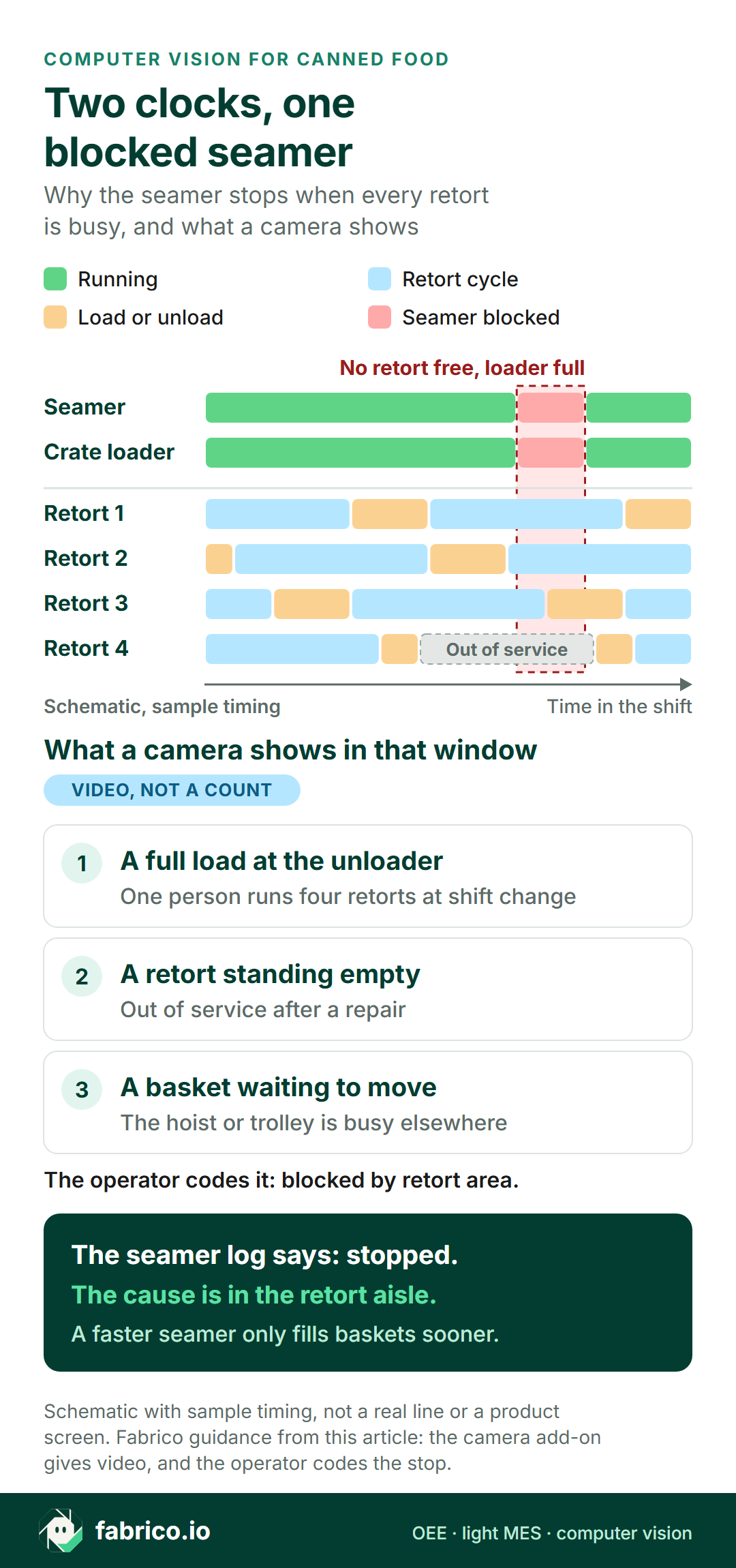
When every retort is mid-cycle and the crate loader has filled its last basket, the seamer has to stop. The seamer PLC logs a stop. The retort controller logs nothing unusual, because every retort is doing what it should.
So the minutes land on the seamer, unless the retorts get their own OEE and those minutes go to the retort area.
The camera's job is the part no controller records: the aisle. A basket waits for a hoist or a trolley. A full load sits at the unloader because one person runs four retorts at shift change. A retort stands empty after a repair. Video at the crate loader and the retort doors shows which it was.
If you run a continuous rotary or hydrostatic sterilizer instead, there are no baskets to wait for. Its controller times it, and the first camera goes to the seamer infeed and the labelling line.
Seamer jams and the checks after them
For low-acid canned foods such as vegetables, beans, soups and fish, the US closure rule, 21 CFR 113.60, says visual seam checks should be made at intervals not to exceed 30 minutes, and teardown examinations at intervals not to exceed 4 hours. It also requires an extra visual closure inspection right after a jam in the closing machine, after an adjustment, and after a start-up following a long shutdown.
So a seamer jam costs more than the jam. In many plants, the line waits for that closure check before it runs at speed again. Code the two apart, "jam" and "closure check after jam", so each gets its own minutes. Plants elsewhere follow their own rules, often with similar checks.
A camera at the seamer infeed shows what jammed: a can down, a misfed lid, a crushed body at the infeed starwheel. For how to code seam checks, see can seamer OEE.
Pack season and changeovers
Fruit and vegetable canning follows the crop. In California, the 2025 processing tomato harvest began in the first week of July, Tomato News reported.
In the season, a plant runs long hours on few products, often with temporary staff. Out of season, many plants switch to products made from stored or dried ingredients, such as beans or soups, with more and shorter runs. One line, two loss profiles in one year.
Can size changes, product changes and allergen cleans each get their own code and standard time. Time each from the signal and let the operator pick the type. An allergen clean is measured, never cut.
In the first weeks of the season, when new staff code many stops, video lets a shift leader check an unsure reason.
Bright cans and the labelling line
Many canneries seam and retort cans without labels, store these "bright" cans, and label them to order later. For scale, Canned Food UK reports, from Kantar data, that nearly 2.8 billion units of canned food were sold in the UK in 2024.
The labelling line then runs weeks after the seamer, with its own stops and its own OEE. The labeller may give a usable signal, but the trays, shrink packs and cases at the end often don't. A camera at the case packer or palletiser counts finished cases there. See case packer downtime on camera and palletizer downtime on camera for where those cameras go.
Line map: where a camera goes on a food canning line
Here is who owns each job, from empty can to pallet.
Start at the crate loader and retort aisle, where the seamer's lost minutes begin, and at the end of the labelling line.
Camera, sensor or operator: station by station on a canning line
A first pass for your own line list. Ask each vendor to complete the same table.
| Station | Who times and counts | Camera's part |
|---|---|---|
| Filler | Filler PLC, or the seamer count | Little. Its signal shows the wait for product |
| Seamer | Seamer PLC, the line's counter | Video for jams at the infeed and lid feed |
| Seam, fill and code checks | QA, checkweigher, inspection | None. Reject counts feed quality |
| Crate loader | PLC run state | Video: full baskets, no free retort, loader jams |
| Retorts | Retort controller | Not the process. Video of baskets waiting |
| Basket unload and return | Often nothing | Video where people move the baskets |
| Labeller | Labeller signal, if any | Video of label and glue faults |
| Case packer, palletiser | PLC run state | Case count, plus video for coding stops |
The operator still gives the reason in every row. The camera adds counts and evidence, nothing more.
Want to map your own cannery? Book a demo and bring a station list from the seamer to the pallet, retorts included.
Worked example: a seamer that waits for the retorts
Sample data for one shift on a vegetable canning line. Not a customer's line, and not a product screen.
The seamer is rated at 240 cans a minute for a 400 g can and feeds four batch retorts. Planned production time is 450 minutes, and the seamer PLC logged 78 minutes of stops.
- Availability: 450 minus 78 leaves 372 minutes of run time. 372 of 450 is 82.7%.
- Performance: 372 minutes at 240 a minute is 89,280 cans. The seamer counted 83,500, so performance is 93.5%.
- Quality: seam, fill and dent rejects and cans lost at unloading came to 1,000, leaving 82,500 good. Quality is 98.8%.
- OEE: 82.7% x 93.5% x 98.8% = 76.4%. Check: 82,500 good cans of the 108,000 possible in 450 minutes is also 76.4%.
Without video, the 41 minutes blocked by the retort area went into the log as "seamer stopped". The operators opened the crate loader and retort aisle video and split them: 19 minutes waiting for unloading and basket return, 14 minutes with one retort out of service, and 8 minutes of crate loader jams. None of it was the seamer.
The 21 minutes at the seamer were six jams. Each took about 1.5 minutes to clear and 2 minutes for the closure check before restart. Coded as one, they look like a bad seamer. Coded apart, they show the checks take longer than the jams.
At 240 a minute, the 41 retort area minutes are 9,840 cans. At an assumed contribution of €0.08 a can, that is about €790 a shift. If the pattern held for a 60 day season at two shifts a day, it would be about 1.2 million cans. Agree with your controller whether those cans could have been sold before you count the money.
The fix sits in the retort aisle: a second pair of hands at shift change, or baskets back sooner. A faster seamer would only fill the baskets sooner.
Eight questions for a canned food computer vision vendor
Ask each supplier, Fabrico too, using one real shift from the pack season and one from the rest of the year.
| Ask | How to test the answer |
|---|---|
| Who gets the minutes when the retorts are full? | Take one real "baskets full" stop and ask where the report puts it. |
| Can retort OEE sit next to line OEE? | Ask which signals each retort can give, and how they reach the software. |
| Will it touch our process records? | It should not. Ask what it reads from the retorts, and confirm it writes nothing back. |
| How are jams and closure checks coded? | Ask to see a jam and the check after it as two codes, each with its own minutes. |
| Can the labelling line be its own line? | Ask to see it with its own planned time, rates and OEE, apart from the seamer. |
| How fast can we set up for the season? | Ask how long new SKUs, ideal rates and stop codes take, and who does it. |
| Will the camera last in a cannery? | Ask about steam near the retorts, washdown, and how often a lens needs cleaning. |
| Who can see the video? | Ask whether it is kept, where, for how many days, and what seasonal staff will be told. |
To test one line before the crop arrives, use a computer vision OEE pilot plan. For a wider shortlist, start with the OEE software guide or our OEE and MES overview.
Privacy, seasonal staff and the works council
A camera at the crate loader or in the retort aisle will see people, because people move the baskets. Say so plainly.
- Frame the baskets and the machines. Aim at the loader, the rail and the retort doors, not the break area.
- Tell seasonal staff on day one. Harvest staff need the same explanation as the core team: what the camera is for, and what it is not.
- Put the video rule in writing. Fabrico's standard setup streams video only when someone asks for it, and keeps none of it in Fabrico.
- Agree it before the season. Agree the purpose and access in writing with the works council or staff representatives, well before the crop arrives.
Masking people out of the frame automatically, beyond what exists now, is roadmap. Check what is live before you rely on it. For the legal side in Europe, read GDPR and production line cameras. For mounting near steam and washdown, see camera placement and lighting.
Retort records stay in your process systems
Thermal process records are not OEE data, and OEE software should not try to own them. Under the US rule for low-acid canned foods, 21 CFR 113.100 says processing information must be entered at the time the retort operator observes it. The forms include the retort number, the container size and the approximate number of containers per coding interval, and the rule sets a 3-year record retention period.
Keep those records in your retort control and recording system. What OEE software adds is the time around them: how long baskets waited, and which line they held up. Electronic retort records must also meet 21 CFR Part 11, which is your recording system's job.
Where Fabrico fits on a canning line
Fabrico is an OEE and light MES platform in the cloud. Some jobs it does today, some are roadmap, and some stay with the systems you already run.
- Machine signals: the seamer PLC, or a sensor or counter on a machine that has none, gives stop times and counts. Operators add the reason at the line from a tablet or phone.
- Reports: OEE, downtime and losses per line and per shift, with each loss in money. Web, iOS and Android.
- Cameras, an add-on on request: AI cameras count output, also at manual steps and at machines without a usable signal. Pick any moment on the shift timeline and open the camera video for it. In the standard setup, video is streamed on request and is not stored in Fabrico.
- Exports: REST API, webhooks, Excel and CSV.
- On the roadmap, not live: stops found by the camera alone, jam zones at the seamer infeed, and a suggested reason for the operator to confirm.
- Jobs for other systems: seam inspection, fill weight, code and label checks, and thermal process control and records. Keep them, and pass their reject counts into quality. For planning around the pack season, ask us in the demo.
If your retorts give a run signal, ask us how they would show next to the line.
Test our answers like any vendor's. Book a demo, or talk to us about your retorts.
What people ask next
Can an OEE camera check double seams?
No. Seam integrity needs visual closure checks and teardowns by trained people, or a seam inspection system. A camera at the seamer shows what happened during a jam, not whether the seam is good.
Will a camera cope with steam near the retorts?
Plan for it. Mount it away from retort doors and vents, protect it for washdown, and agree who wipes the lens and how often. Ask any vendor, us included, to show a camera running near your retorts before you buy.
Can a camera help in the retort room?
Yes, as video. A camera at the crate loader or the retort doors shows baskets waiting, a full load at the unloader or a retort standing empty, and the operator codes the stop. Counting baskets is not a standard spec: ask us to show it on your basket type and rail before you plan on it.
Does Fabrico replace our retort records?
No. Thermal process records stay in your retort control and recording system and your process forms. Fabrico measures OEE, downtime and losses around them.
When should a cannery install cameras?
Before the pack season, not during it. Run the pilot on an out of season product, agree the stop codes, and go into the harvest with a baseline.
What drives the cost of computer vision on a canning line?
The number of lines and cameras, where they mount, the network in the hall and the retort room, and training, including for seasonal staff. Hand every vendor the same station list, retorts included, so you can compare the quotes.
Want to see it on a canning line? Book a demo.
Related articles












Real Fabrico tiles, sample data.