


 Login
 Blog
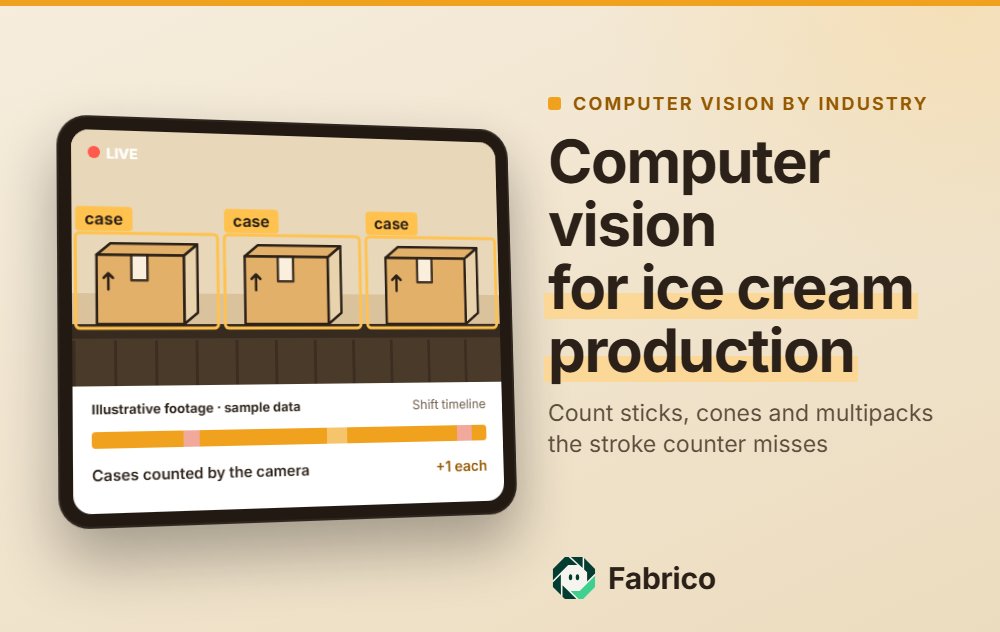
Computer Vision for Ice Cream Production: Fix 8 Ways the Output Count Goes Wrong

In short: an ice cream plant needs a camera add-on only where its count goes wrong: tunnel exit, wrapper infeed and hand multipack tables.
- Strokes times lanes is what the filler was set to make; the tunnel exit count is what arrived.
- Litres include air: count saleable units and keep overrun next to OEE.
- Flush product, rerun, QC samples and holds each need one written booking rule.
- Coating, lid, code and weight checks stay with the inspection systems.
- In the example cone shift, the sheet shows 84.7% OEE and the audit 80.2%.
Computer vision helps an ice cream plant where its output count goes wrong: between the stroke counter and the wrapper, and at hand multipack tables.
The camera add-on counts output; checking coating, lids, codes and fill weight is inspection work for vision systems and checkweighers.
Computer vision in ice cream production: the miscount table
Each row names a miscount, its fix and the station whose count is final; a camera add-on owns a count only where that station has no usable machine signal. The general case is in why your OEE number is wrong.
| Miscount | What goes wrong | The fix | Count owner |
|---|---|---|---|
| 1. Strokes counted as product | Includes bars left in moulds, pulled sticks and empty cone pockets. | Count units after the last loss point. | Wrapper infeed or tunnel exit: camera add-on |
| 2. Litres counted as output | Litres of ice cream rise with overrun. | Count saleable pieces; watch overrun. | Line count; freezer and lab for overrun |
| 3. Packs added to pieces | 4-packs, single sticks and 2 L tubs in one total. | Count each SKU in its own unit. | Cartoner exit or hand table: camera add-on |
| 4. Flush product called good | Start-up rows pass the stroke counter. | Tally them as a quality loss. | Line lead at the filler |
| 5. Rerun counted twice | Reclaimed rerun is frozen a second time. | Count units once; book rerun litres apart. | Line count; mix plant |
| 6. QC samples lost | Lab units never reach a case. | Tally samples separately. | QC lab and line lead |
| 7. Holds counted twice | Counted at the tunnel and again at release. | Count once; the hold is stock status. | Tunnel exit; ERP |
| 8. Cases and pallets as output | Wrong pack count; pallets scanned twice. | Cases as a cross-check; pallets in the WMS. | Case packer PLC; WMS |
Rows 1 and 3 need a camera add-on. Rows 2 and 4 to 7 are booking rules that no camera fixes, and row 8 is the warehouse's number. Settle the booking rules first: they cost a meeting, not a camera.
Explainer presented by Iris, Fabrico's AI-generated presenter: how an add-on camera counts output where a machine has no signal. Book a demo.
Plays from YouTube. Google may set cookies when you press play. Privacy policy.
Strokes counted as sticks and cones
A stick line or cone filler counts strokes, and the PLC multiplies by moulds or lanes: what the machine was set to make. Some of it leaves the line before the wrapper, already counted.
Moulded and extruded stick lines
On a moulding line, moulds travel through a cold brine, the stick goes in while the product is partly frozen, and the hard bar is pulled out by its stick, then dipped and wrapped, with no hardening tunnel in between. A bar left in the mould, a stick that pulls out, a bar dropped in the coating bath: the stroke counted all three. On an extrusion line, cut bars get their sticks, are enrobed and ride the hardening tunnel before the wrapper.
Cone and cup fillers
A cone filler drops cones into pockets, sprays chocolate inside, doses a row a stroke, then tops and lids it. A pocket the dispenser missed is still counted, and so is a cracked cone lifted off by hand. Cones and cups leave the tunnel for a cartoner or case packer, not a flow wrapper; cup fillers that also run dairy desserts are covered in computer vision for dairy processing.
The fix. Count units after the last point where product leaves: the wrapper infeed for moulded bars, the tunnel exit for extruded bars, cones and cups. Keep strokes as the rated output to compare with. At an example 40,000 bars an hour, a 2% gap between strokes and wrapped bars is 800 bars an hour. A flow wrapper counts its cycles, and a cycle with a gap in front of it still counts, so this count belongs to a camera add-on.
Overrun: litres of ice cream are not output
Ice cream is made from mix by weight and sold by volume, with air in between. The University of Guelph Ice Cream Technology e-book defines overrun as "the % increase in volume of ice cream greater than the amount of mix used to produce that ice cream", and its example reads "500 L mix gives 980 L ice cream", a 96% overrun. Eurostat counts the EU's 2025 output as 3.44 billion litres of ice cream: a market measure, not a line count, since a litre at 100% overrun is half air.
The miscount. A cone filler doses by volume. If overrun drifts from 100% to 110%, the same 1,000 L of mix makes 2,100 L instead of 2,000 L, and 16,800 cones of 125 mL instead of 16,000. The count rises 5% and OEE looks better while each cone carries less mix.
Where the rule bites. The e-book gives ice cream density as mix density divided by (overrun/100 + 1): a mix of 1,100 g a litre at 100% overrun gives 550 g a litre. In the US, 21 CFR 135.110 says ice cream "weighs not less than 4.5 pounds to the gallon", about 539 g a litre, so with that mix overrun tops out near 104%. Other markets set their own rules.
The fix. Count saleable pieces or packs. The freezer and the lab own overrun, the checkweigher owns pack weight, and overrun sits beside OEE on the shift view, so a count that rises with air gets questioned; see OEE vs yield.
Multipacks, single sticks and tubs: one count per variant
A stick line may wrap singles in the morning and feed a 4-pack cartoner after lunch; a tub filler switches between 900 mL and 2 L. A sheet that adds packs, pieces and tubs into one total adds numbers with no shared unit, and one rated speed in pieces a minute is wrong for a station that makes packs.
The fix. Count each station in its own unit, convert with the running SKU's units per pack, and set the rated speed per SKU. A hand multipack table has no counter; a camera add-on above its exit counts closed packs by the hour. Cartoner losses are covered in multipacker OEE.
Tubs add a weight rule. OIML R 87, the international recommendation for prepackages, says "The average actual quantity of product in prepackages shall be at least equal to the nominal quantity." For 1 to 10 litres it allows a tolerable deficiency of 1.5%, or 30 mL on a 2 L tub. Plants overfill a little to stay safe, and that give-away shows in checkweigher data, not in a count; see checkweigher rejects and OEE quality.
Rerun and flush product: called good, then counted twice
Flush product called good. After a flavour change by flush, or a restart after cleaning, the first rows are off spec and pass the stroke counter like any other. Untallied, they land in the good count.
Rerun counted twice. The e-book's chapter on post-pasteurization contamination calls rerun "an unavoidable part of the ice cream operation", keeps it out of the flavour tank and sets the rule: "All rerun which can be reclaimed through filtration and blending should be repasteurized and blended with fresh mix." The same ice cream then passes the mix plant and the freezer twice. Output reported as litres of mix frozen counts it twice; a count of units at the end of the line counts it once.
The fix. Tally flush product and rerun in units or kilograms where they leave the line, as a quality loss to the shift that made them. The mix plant books reclaimed rerun apart from fresh mix, and rerun that cannot be reclaimed "must be clearly segregated from the reclaimable material". See rework and good count in OEE.
QC samples and hardening holds: made, not yet shipped
Samples leave after the count. Commission Regulation (EC) No 2073/2005 sets a Salmonella criterion for ice cream made with milk ingredients with a sampling plan of n = 5, where "n = number of units comprising the sample", and absence required in 25 g. One test takes five finished units that never reach a case.
Counted at the tunnel exit, samples sit in the good count but not in the shipped count; counted at the case packer, they vanish. Either works, and switching between them is the miscount. Tally samples separately, where they are pulled, and write down once whether OEE treats them as good.
Holds counted twice. Where a plant holds product after hardening until lab results come back, the units in it were counted once, at the tunnel exit. Counting them again at release inflates the release day. Keep the hold as stock status in the ERP; if a held batch is scrapped, book it as a quality loss to the shift that made it and note the decision date, because a past shift's OEE changes.
Cases and pallets: the last count before the cold store
Case packers and palletisers have PLCs and count cases. The GS1 Logistics Label Guideline defines a logistic unit as "an item of any composition established for transport and / or storage which needs to be managed throughout the supply chain", and says "The SSCC is the single mandatory element for all logistics labels." The pallet count belongs to the warehouse, under that code.
Two miscounts sit here. Cases converted with the previous SKU's pack count after a change from 24 to 12 cones a case double the output for that hour. Pallet scans are stock movements, so a pallet scanned out and back in appears twice.
The fix. OEE counts the line in pieces, and cases times the active pack count is an hourly cross-check, set per SKU with the rated speed. Pallets stay in the WMS. Case packer stops are covered in case packer OEE.
Where the count should come from: PLC, camera add-on or tally
A camera add-on earns its place at three stations; elsewhere a PLC, a reject counter, the lab log or the WMS already holds the number.
| Station | Count source today | Camera add-on? |
|---|---|---|
| Mix plant, freezer | Batch control and PLC: litres, flows | Adds little |
| Stick line, cone and cup fillers | PLC: strokes times moulds or lanes | Adds little |
| Wrapper infeed, moulded bars | Wrapper cycles, not bars | Yes: counts bars |
| Hardening tunnel exit | No count of units | Yes: bars, cones, cups |
| Hand multipack tables | A tally sheet, or nothing | Yes: closed packs |
| Checkweigher, metal detector | Own reject counters | No |
| Case packer | PLC: cases | Adds little |
| Samples, rerun, flush | Lab or line lead tally | No |
| Palletiser, cold store | WMS: pallets | No |
What a camera can and cannot count
A camera counts what it sees as separate units. A peer-reviewed study of camera counting on conveyor belts notes that earlier methods "provide an incorrect counting rate because some of the abalones tend to entangle, resulting in counting two or more abalones as one". A peer-reviewed checkout study, where products pass a camera in people's hands, names "object occlusion, blurring from scanning motion, and similarity in scanned items".
So count at the tunnel exit, where pockets and rows keep units apart, not where cones bunch in a carton. At a hand table, aim at the station exit, where packs are closed and spaced, not at the hands. Ask for a test at your line speed and lighting. Fog and frost on the lens are covered in cameras in a frozen food packing hall; how an add-on tally turns into OEE is in OEE with computer vision, and the product is on Fabrico computer vision for OEE.
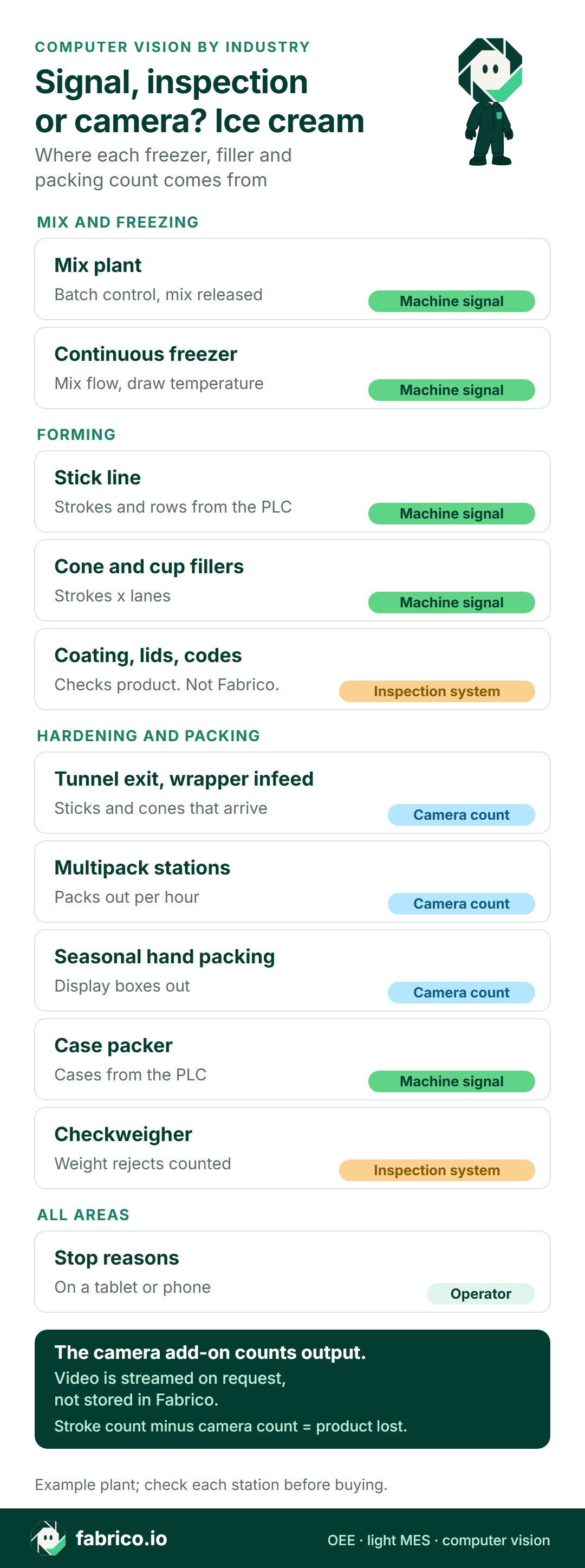
Text version of this infographic
- Mix plant: machine signal, mix released
- Continuous freezer: machine signal, mix flow, draw temperature
- Stick line: machine signal, strokes and rows
- Cone and cup fillers: machine signal, strokes x lanes
- Coating, lids, codes: inspection system, not Fabrico
- Tunnel exit, wrapper infeed: camera count, sticks and cones that arrive
- Multipack stations: camera count, packs out per hour
- Seasonal hand packing: camera count, display boxes out
- Case packer: machine signal, cases
- Checkweigher: inspection system, weight rejects
- Stop reasons: entered by the line crew on a tablet or phone
- Camera add-on: counts sticks, cones and packs; its video is streamed when asked for, with no copy kept in Fabrico
- Stroke count minus camera count = product lost
To see a stroke count and a camera add-on count side by side for one ice cream line, book a demo.
Worked example: a cone line shift, sheet against audit
Example numbers, no real plant. A 12-lane cone filler is rated at 18 strokes a minute for this product: 216 cones a minute. The early shift, 06:00 to 14:00 with a 30-minute break, has 450 planned minutes. The PLC times stops and counts strokes, a camera add-on at the tunnel exit counts cones before the cartoner, the checkweigher counts rejects and the line lead tallies flush product.
Availability. A flavour change by flush took 20 minutes, cone dispenser jams 14 minutes in stops longer than two minutes, and a carton magazine jam at the cartoner stopped the tunnel and blocked the filler for 11 minutes. Stops total 45 minutes, so the filler ran 405 of 450 minutes: 90.0%.
Performance. In 405 minutes the filler could make 405 x 216 = 87,480 cones. The PLC counted 6,912 strokes, or 82,944 pockets; the camera add-on counted 80,352 cones at the tunnel exit. That is 91.9% on the camera count and 94.8% on strokes.
Quality and OEE. The line lead tallied 1,728 start-up and flush cones and the checkweigher rejected 648, so good cones are 80,352 minus 2,376 = 77,976, or 97.0%. OEE is 90.0% x 91.9% x 97.0% = 80.2%. Check: 77,976 cones at 216 a minute is 361 minutes, 361 of 450 planned; and 361 good, 11 rejected, 33 speed loss and 45 stops make 450.
| Same shift | Shift sheet | Audit |
|---|---|---|
| Cones made | 82,944 (strokes x 12 lanes) | 80,352 (camera add-on, tunnel exit) |
| Rejects | 648 (checkweigher) | 2,376 (checkweigher + flush) |
| Good cones | 82,296 | 77,976 |
| A / P / Q | 90.0% / 94.8% / 99.2% | 90.0% / 91.9% / 97.0% |
| OEE | 84.7% (381 good minutes) | 80.2% (361 good minutes) |
The sheet is right about each machine. It counts strokes as cones and calls the flush cones good, and the two errors add 4,320 cones: 20 minutes, or 4.4 points of OEE. Twelve of the 33 speed loss minutes are the 2,592 cones the strokes counted and the tunnel exit never saw. The hourly camera counts put most of that gap right after a cone magazine change; the line lead opened the video for the minute of the short stop at that change and found gaps in the rows. The method for the whole line is in OEE for ice cream production.
In money. Take an example contribution margin of EUR 0.12 a cone. For scale,The Magnum Ice Cream Company reported for 2025 that "Europe & ANZ delivered an Adjusted EBITDA margin of 13.1%". That margin comes after fixed costs, so a per-cone contribution margin sits above it and comes from the plant's own SKU costing.
Margin counts only while orders wait. In a sold-out summer week, the 450 minutes had room for 97,200 cones; the audit found 77,976 good, so 19,224 went unmade: EUR 2,306.88 of margin on one shift. The sheet shows 14,904 unmade, EUR 1,788.48. The gap, 4,320 cones or EUR 518.40 a shift, is the miscount; over ten such shifts it is EUR 5,184 that no report shows. In October, when the line waits for orders, the same minutes cost crew time and energy, not margin.
Rework at crew time. The cartoner jam crushed 60 cartons, and two packers moved the cones into new ones in 15 minutes. Those cones were counted good and ship the same day, so price the crew time, not margin: 30 minutes at an example EUR 32 an hour, or EUR 16.
Questions for camera vendors, and the works council
Test each answer against one week of shift reports from the first line.
| Ask the vendor | A good answer |
|---|---|
| Which unit does the count use for each SKU? | Pieces for the line, packs at the cartoner, units per pack set per product. |
| Where does the camera count? | After the last point where product leaves the line. |
| How are touching or bunched units counted? | Shown in a test at your line speed, with your packs. |
| How do flush product, rerun and samples enter the count? | As tallies in units, never as good. |
| Can the camera keep its view in cold, wet air and wash-down? | A housing, mount and lens routine in writing. |
| How do checkweigher rejects reach quality? | From the reject counter or signal, not typed in. |
The same six questions apply to Fabrico. For the wider buying guide, read OEE software.
Ice cream plants hire extra people for the summer, and many work at the multipack tables where a camera would go. Before anything is mounted, settle with staff what the count is for, and tell seasonal crews on their first day. In a German plant with a works council this is a legal duty: section 87 of the Works Constitution Act lists "the introduction and use of technical devices designed to monitor the behaviour or performance of the employees" among the matters the works council co-determines. Aim the lens at the station exit, publish counts by station and shift, not by name, and see GDPR and production line cameras for the data side.
Where Fabrico fits in an ice cream plant
Fabrico runs in the cloud and covers OEE and light MES. Here it does three jobs:
- At the freezer, fillers and stick line it takes run state, stops and strokes from the PLCs, so flushes, CIP and dispenser jams show as stop time with the reason the operator adds on a tablet or phone.
- At the tunnel exit, wrapper infeed and multipack tables Fabrico's camera add-on counts sticks, cones and multipacks; where it covers a station, the video for the minute of a stop can be opened from the shift timeline, streamed on request and not stored in Fabrico.
- Across the line checkweigher reject signals can feed quality, and losses are priced from the plant's own SKU price or margin.
It runs on the web, iOS and Android; reports export to Excel, and Fabrico also has a REST API and webhooks. Outside Fabrico: mix plant control, overrun and lab checks, coating, lid and code inspection, fill weight, metal detection and the cold store WMS.
For the plant-wide software picture, see ice cream manufacturing software; for the sites around it, MES for dairy processing and frozen food processing software.
Questions ice cream teams ask
Should QC samples count as good output?
Decide once and write it down. Samples are made to spec but never shipped, so tally them in units where they are pulled, and the OEE count, shipped count and lab log will agree.
Does rerun count as output?
Only once, when it reaches a saleable pack. Reclaimed rerun is repasteurised and blended with fresh mix, so it passes the mix plant and the freezer twice; book its litres apart from fresh mix.
Can an OEE camera check chocolate coating or cone fill?
No. Coating, shape, lid and code checks belong to an inspection vision system, and fill weight belongs to the checkweigher. Inspection stays with those systems, and the rejects they count still lower the quality figure, as set out in checkweigher rejects and OEE quality.
Which ice cream station should get the first camera?
The hardening tunnel exit or wrapper infeed of the stick or cone line with the most output, because that is where the stroke count and the real count part. A hand multipack table, which has no counter at all, is the other candidate. For mounting in the cold, read cameras in a frozen food packing hall.
Want to see strokes, camera add-on counts and rejects for an ice cream line on one timeline? Book a demo and walk through one shift, sheet against audit.
Related articles













Real Fabrico tiles, sample data.