


 Login
 Blog
Computer Vision for Building Materials: Bags, Blocks and Precast

In short: computer vision for building materials plants earns its place as a counter: cameras count bags, block cubes and precast elements where the packer, cuber or yard gives no usable count, and let you open the video of a stop. They do not inspect the product.
- Surface, edge, dimension and bag weight checks are inspection. That is a different job, done by inspection systems and checkweighers.
- The losses hide in mould changes, curing waits, short stops at the bag placer, and forklift and kiln car waits.
- Where a packer, block machine or board line PLC gives a run state and a count you trust, use it. Put cameras at manual or older bagging and palletizing, cuber exits, precast finishing and packing with no usable signal.
- Fabrico's AI camera add-on counts output and lets you open the video for any moment on the shift timeline. The operator adds the stop reason.
Your rotary packer has a PLC. Your block machine counts its cycles. Your precast yard has a crane, a curing tent and a crew with trowels, and nothing counts what leaves it.
This page is for plant managers, operations and CI leads in building materials: precast concrete, blocks and pavers, bricks and tiles, plasterboard, insulation and roofing, and the bagging lines for cement, mortar and plaster.
It shows where a camera earns its place, where the machine signal is enough, and what to ask each vendor.
Computer vision for building materials: counting, not inspection
Two kinds of camera system get sold to building materials plants under one name. Inspection systems check the product: tile surfaces, board edges, block height, the weight of a bag. OEE cameras count good output and show you what happened at a stop.
| Job in the plant | Inspection system | OEE camera |
|---|---|---|
| Tile and board surface defects | Yes | No |
| Block and paver dimensions | Yes, or a gauge | No |
| Bag weight | A checkweigher | No |
| Count bags, cubes or elements | Sometimes counts what it checks | Yes, also at manual steps |
| Video of a stop | Defect images, not stop video | Open the video for that minute |
| Feeds OEE through | Its reject count | The output count |
The two work side by side. A checkweigher's or a board line's reject count, read from its PLC or a counter signal, can feed the quality part of OEE, so a rejected bag or board counts once.
Where the losses hide in a building materials plant
These plants mix fast machines with slow, manual and outdoor work. Much of the lost time sits where the two meet: at the bag placer, the cuber, the kiln car and the yard.
Bagging lines for cement, mortar and plaster
A rotary packer is fast. Haver & Boecker, one packer maker, lists its ROTO-PACKER RV valve bag packers with up to 16 filling spouts and a capacity between 1,000 and 6,000 bags an hour (on its site on 12.11.2026). Those are the maker's ratings for its own machines, not a line average.
At those rates, a short stop costs bags quickly. The usual ones sit around the packer, not in it: the empty bag magazine runs out, the bag placer misses a spout, a bag bursts and the spouts need cleaning, or the palletizer backs up because no forklift came.
Older and smaller lines, and many mortar and plaster plants, still place bags or build pallets by hand. There, nothing counts the bags that reach the pallet.
For scale, the US Geological Survey estimates shipments of portland and blended cement in the United States and Puerto Rico, including imports, at 76.4 million metric tons for January to September 2025, and masonry cement at 1.62 million. Much of that moves in bulk, but every bagged tonne passes a packer, and a thousand tonnes in 25 kg bags is 40,000 bags.
Count at the packer for performance, and count good bags at the palletizer for quality. For open-mouth and form fill seal bags, see bagging line stops. For the stacking end, see palletizer downtime.
Block and paver machines: mould changes and curing waits
A block machine runs in short cycles, and its PLC knows each one. Use that signal for run state and cycle count.
The loss is around it. A mould change takes the machine down, and a plant with many paver shapes changes moulds often. Colour changes add face mix changeovers on top. Book mould changes with their own code inside planned time, or they vanish from the report.
After the machine, boards of fresh product ride a rack or a finger car into the curing chambers. If the chambers are full or the cuber is slow, the machine waits. Book that as blocked time, not as a breakdown.
At the cuber exit, cubes go to a strapper and a forklift. A camera there counts good cubes, and the video shows whether the gap at 10:40 was the cuber, the strapper or the forklift.
Precast concrete: the yard has no PLC
Precast elements are cast in moulds or on beds, cured, stripped, finished by hand and moved by crane to the yard. A cycle takes hours, not seconds.
Curing sets the pace. The National Precast Concrete Association advises applying elevated temperatures after the initial set of the fresh concrete, which it says is usually 2 to 4 hours. It also notes that most precast plants speed up normal curing to support aggressive production schedules.
So the mould is the bottleneck. In precast, OEE is often measured at the mould or bed: elements per mould per day, and how long a mould stood empty, waiting for stripping, cleaning, reinforcement or the crane.
A camera at the finishing bay or the yard gate counts the elements that leave. Waiting causes come from the crew. For more on manual work, see computer vision OEE for manual assembly.
Bricks and tiles: the kiln runs, the ends wait
A tunnel kiln runs around the clock, and its control system knows the push rate. The losses sit at both ends: the setting machine that loads green bricks onto kiln cars, and the unloading, sorting and packing after the kiln.
When a kiln car waits for the setter or for unloading, the kiln slows or runs with a gap. Log kiln car waits with their own code. Count the packs leaving the packing line, with a camera where sorting and packing are manual or the packer gives no count.
Plasterboard, insulation and roofing
Board, insulation and shingle lines are continuous and well instrumented. Use their PLCs for run state, length and count.
Cameras earn a place at the end of these lines: manual stacking, bundle and pallet packing, and older wrappers that give no usable count.
Dust, rain and washdown
These are hard places for a lens. Cement and plaster dust settles on the glass. Yards are outdoors, with sun, rain and frost. Block plants and precast halls get hosed down.
Dust is a health issue first. OSHA lists manufacturing brick, concrete blocks and ceramic products among the work that exposes people to silica, and says about 2.3 million people in the US are exposed to silica at work. Good dust control protects people, and it also keeps a lens clean for longer.
Ask for a housing rated for dust and water, a hood against sun and rain, and lighting that does not change with the time of day. Mount cameras clear of the spouts, the crane and the forklift path. See camera placement and lighting on a production line.
Where a camera goes in a building materials plant
Here is one example plant.
To count cameras for a full site, see how many cameras per line.
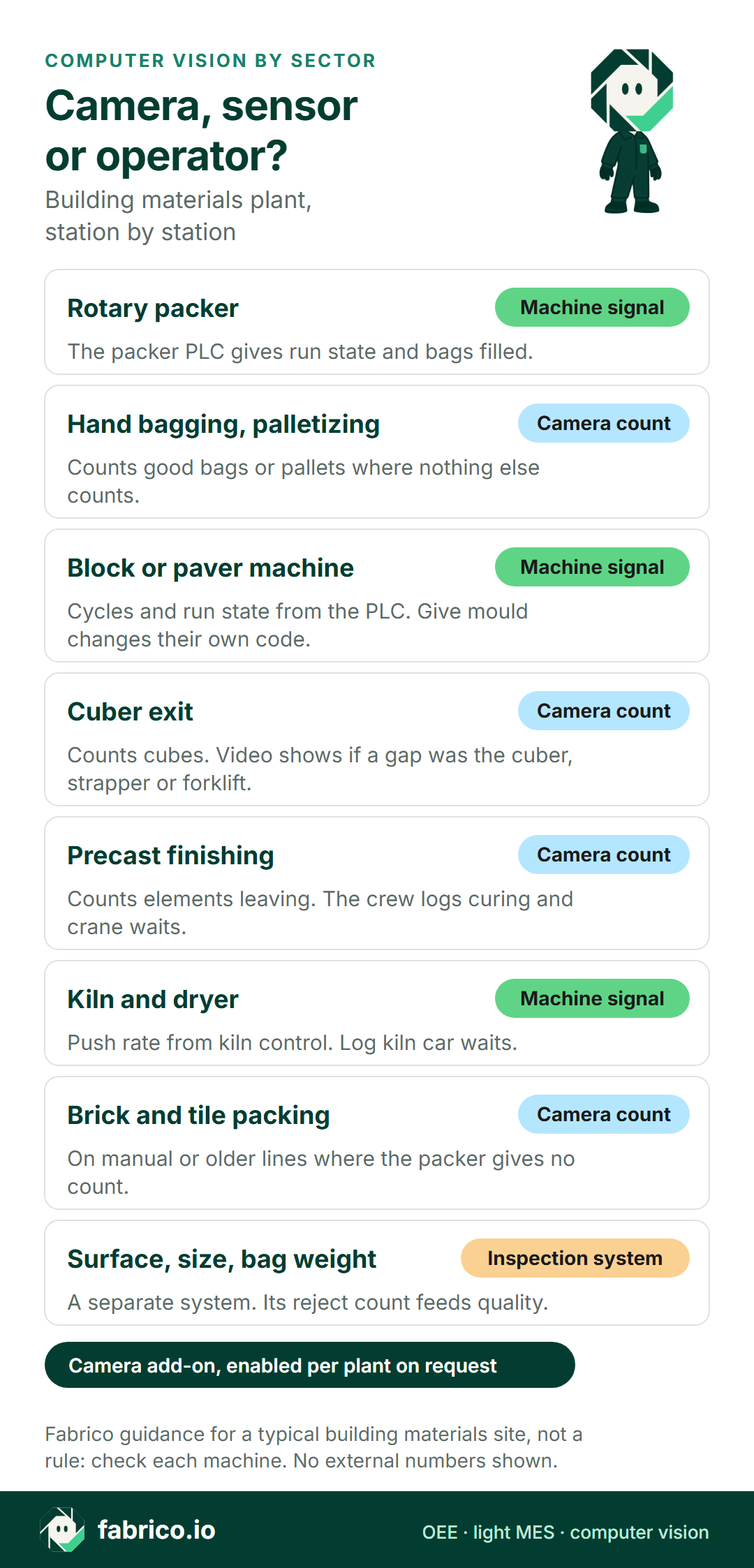
Camera, sensor or operator: station by station
This is typical for a building materials site, not a rule. Check each machine.
| Station | Count and stops from | What a camera adds |
|---|---|---|
| Rotary packer | Packer PLC | Video at the bag placer and spouts |
| Manual bag placing or palletizing | Nothing, or a hand tally | Count of good bags or pallets |
| Palletizer, stretch wrapper | PLC, if you can reach it | Count at the exit if you cannot |
| Block or paver machine | Machine PLC: cycles and run state | Little. Use the signal. |
| Cuber and cube conveyor | Cuber PLC on newer plants | Count of cubes where nothing counts |
| Precast moulds and finishing | The crew and a mould log | Count of elements leaving finishing |
| Kiln and dryer | Kiln control: push rate | Little. Use the signal. |
| Brick and tile packing | Packer PLC, or nothing on hand lines | Count of packs on old or manual lines |
| Board, insulation, shingle lines | Line PLC | Count at manual stacking and bundling |
| Stop reasons, all lines | The operator, on a tablet or phone | Video to check a disputed reason |
You rarely need a camera at every station. The card below shows where one pays off.
Bring your station list and one week of stop sheets to a demo, and we will go through it station by station.
Worked example: one shift on an older cement bagging line
These are example numbers, and they describe no real plant. An 8-spout rotary packer with an ideal rate of 40 bags a minute runs one 480-minute shift.
The packer PLC gives the run state and counts bags filled. The palletizer is old and gives no count anyone can reach, so a camera at its exit counts the good bags stacked. Burst bags and weight rejects make up the difference.
Stops took 110 minutes: short stops at the bag placer 30, burst bags and spout cleaning 20, the palletizer blocked and waiting for a forklift 25, a cement type change 15 and one breakdown 20. Run time is 370 of 480 minutes, so availability is 77.1%.
At 40 bags a minute, 370 minutes could fill 14,800 bags. The packer counted 13,320, so performance is 90%. The gap is 37 minutes of slow running.
The camera counted 13,054 good bags on pallets. That leaves 266 burst and rejected bags, so quality is 98.0%. Those 266 bags are about 7 minutes of packer time.
OEE is 77.1% x 90% x 98.0% = 68.0%. Check it the short way: 13,054 good bags of 19,200 possible is also 68.0%.
The forklift wait matters most. Without a view of the palletizer, those 25 minutes look like a packer fault. With the camera count and the video for those minutes, the operator can book them as blocked time and anyone can see why no forklift came.
Eight checks for any building materials camera or OEE vendor
Run these with every vendor, and with us. Bring one real shift from last week as the test case.
| Ask | How to test the answer |
|---|---|
| What exactly does the camera count? | Bags, layers, pallets, cubes or elements? Run it next to a hand count for one shift. |
| Does it cope with dust, rain and sun? | Ask for the housing rating, how the lens is kept clean, and what happens to the count in low sun or at night. |
| Where does each camera mount? | Ask for each position on a drawing, clear of spouts, cranes and the forklift path. |
| How are mould changes and curing waits booked? | Ask for their own codes inside planned time, and minutes over standard for each mould. |
| How does blocked time show? | Ask how a palletizer or kiln car wait shows as blocked, not as a packer or machine fault. |
| Can the ideal rate change by product? | Ask to see the rate change with bag size, block shape or element type. |
| How do rejects get in? | Ask if checkweigher and board line rejects feed quality, so they count once. |
| Is video kept, and who can open it? | Ask where it lives, for how long, and who sees it. |
Test on one line before you roll out across the site. See our guide to a computer vision OEE pilot. If you are comparing camera OEE tools, see computer vision OEE software compared.
Cameras, privacy and the works council
Packers, cubers and finishing bays have people at them, and a camera will see some of them. Tell staff before any camera goes up. In many European countries, talk to the works council first.
Frame the camera on the bags, cubes or elements, not the crew. Report by line and shift, not by person. Ask each vendor, us included, what privacy masking is live today and what is still roadmap.
Fabrico's camera add-on counts product, not people. For a fuller checklist, read production line cameras without surveillance.
Where Fabrico fits
Fabrico is a cloud OEE and light MES platform. Here is what it does in a building materials plant today.
- Stops and counts: from the machine signal, through the packer, block machine or line PLC, a sensor or a counter.
- Stop reasons: the operator adds them at the line, on a tablet or phone.
- OEE and losses: OEE, downtime and losses by line and shift, with losses shown in money. On the web, iOS and Android.
- Cameras, an add-on on request: AI cameras in the add-on count output where the machine gives no usable signal, such as manual bagging and palletizing, cuber exits and precast finishing; test each station in a pilot first. With the add-on, you can open the camera video for any moment on the shift timeline. In the standard setup, add-on video is streamed on request, not stored in Fabrico.
- Your data: it leaves through a REST API, webhooks and Excel or CSV export.
Roadmap, not live today: stops detected by the camera add-on, jam zones on the video, and the add-on proposing a stop reason.
What Fabrico does not do: inspection, which stays with your checkweighers and inspection systems and feeds Fabrico's quality figure through the reject signal or counter. Fabrico does not control packers, kilns or curing chambers. For planning and scheduling, ask us in the demo.
For the full product, see the Fabrico computer vision add-on for OEE. For cement and concrete plants comparing platforms, see MES and OEE platforms for cement and concrete, and our guide to OEE software. All eight checks above apply to us too.
Bring one shift's stop sheet from a bagging line or a block machine to a demo, and ask us to show which numbers we can fill and which we cannot.
What people ask next
Which station in a building materials plant should get the first camera?
Usually the one with the weakest count: hand bagging or palletizing, a cuber exit with no counter, or a precast finishing bay. A packer or block machine with a PLC count you trust comes last.
Can a camera check tiles, boards or blocks for defects?
Yes, but that is an inspection camera, not an OEE camera. Surface, edge and dimension checks are done by inspection systems. Fabrico does not sell inspection. The inspection system's reject count can feed the quality part of OEE.
Does computer vision work in a dusty cement packing plant?
It can, if the housing is rated for dust and the camera sits clear of the spouts. Ask each vendor how the lens is kept clean and what happens to the count when dust builds up.
Can a camera count precast elements in an outdoor yard?
It can count elements leaving a finishing bay or passing a yard gate, if the view is clear and the light is steady. Test it in low sun, in rain and at night before you trust it. See camera placement and lighting.
Is the camera video stored?
Not in Fabrico. In the standard setup, video from the camera add-on is streamed on request, and you can open it for any moment on the shift timeline. Ask every vendor the same question, and where their video lives.
What drives the cost of computer vision in a building materials plant?
Pricing is set per quote. The drivers are the number of lines and cameras, housings for dust and weather, mounting, the network to the hall or yard, and training. Give each vendor the same station list so the quotes compare.
Want to see it on a line like yours? Book a demo and bring one shift from a bagging line or a block machine.
Related articles












Real Fabrico tiles, sample data.