


 Login
 Blog
Computer Vision for Ceramics and Sanitaryware: Casting, Kilns, Packing

In short: computer vision in ceramics earns its keep as a counter at the hand-worked stations: casting benches, glazing booths, kiln car loading, repair and packing in sanitaryware and tableware plants, where nothing else counts the ware. Tile presses, printers and roller kilns already have PLC signals.
- Grading tiles on the sorting line, finding cracks in a WC pan and guiding a glazing robot are other camera jobs, done by other systems.
- Kilns run around the clock, so kiln OEE is about kiln car throughput: loaded cars, full slots and first-fire good ware.
- Sanitaryware losses start upstream: a short night at the casting benches shows up as empty kiln car slots a day or two later.
- Fabrico's camera add-on counts casts and glazed pieces; tap a gap on the kiln day and the bench video streams for that minute. The caster or line lead adds why the bench stood.
A tile press logs its strokes. A caster at a bench of plaster moulds, a glazer in a hand booth and the crew loading a tunnel kiln car leave nothing behind but a paper tally at the end of the shift.
This page covers ceramic wall and floor tiles, sanitaryware such as WC pans, basins and cisterns, and tableware in porcelain, stoneware and earthenware. For bricks, roof tiles, blocks and cement bagging, see computer vision for building materials.
Computer vision in ceramics: which camera does which job
A ceramics plant can be offered three different camera systems: one checks the ware, one guides a glazing robot, one counts output. Only the third gives you OEE.
| Job in a ceramics plant | Done by | OEE camera? |
|---|---|---|
| Grade tiles for shade, size, surface | The sorting line's vision system | No |
| Find cracks and glaze faults in sanitaryware | Inspectors and function tests | No |
| Guide a glazing robot's spray path | Robot vision or a taught program | No |
| Count pieces demoulded at casting benches | A paper tally, if anything | Yes |
| Count pieces and empty slots on kiln cars | The loader's sheet | Yes |
| Count packed pieces | Pallet labels, often late | Yes |
| Show what happened at a stop | The shift log | Open the video for that minute |
They work side by side. The sorting line's grade counts, and the inspection bench's first-fire rejects from its own log or a reject counter, feed the quality part of OEE. The camera count feeds output. Fabrico does not inspect ware or grade tiles.
The ceramic tile line, from press to kiln to packing
A tile line is the most automated part of the industry. Spray dried powder goes to a hydraulic press, the green tiles pass a dryer, then a glazing line with bells, airless sprays and a digital inkjet printer, then a roller kiln, then storage, sorting and packing. Each of those machines has a PLC. In the US, ball clay is mostly a tile raw material: the USGS Mineral Commodity Summaries 2025 estimate that 61% of US ball clay went into floor and wall tile in 2024.
Press, glazing line and printer
The press counts strokes, and the printer logs what it printed. The losses are format changes, when the die set and punches are swapped, and short belt stops for a broken tile or a printer head cleaning. Book a format change with its own stop code. A camera adds little here.
Roller kiln: OEE is throughput
A roller kiln runs continuously. In one Ceramics-Silikáty study, test tiles fired in a factory roller kiln had a total firing cycle of no more than 45 minutes. The kiln does not stop when the glazing line does; it fires an empty stretch, and that capacity never comes back. Measure the kiln on what entered it: square metres an hour against the nominal rate for that format.
Cerame-Unie says energy accounts for up to 30% of total production costs in the ceramic industry, and a kiln stays at temperature whether the rollers carry tiles or not. Give kiln gaps their own stop code, with the upstream cause.
Sorting and packing
The sorting line has its own vision system that grades tiles for surface, shade and size and counts first choice, second choice and rejects. That system is not part of Fabrico, and a second counter there adds nothing. Read the grade counts into quality. A tile plant gains from a camera at the hand work around the line: special pieces such as steps and skirting, small runs packed by hand, and old palletizers whose count you cannot reach.
Sanitaryware: casting benches, booths and kiln cars
Sanitaryware is the opposite of a tile line: hand work, days from casting to packing, and a paper tally for a count.
Casting
In bench casting, casters fill rows of plaster moulds with slip, wait for the wall to build, drain the moulds and demould the pieces by hand. A plaster mould gives a limited number of casts before it is replaced, and wet moulds need time to dry between casts. Pressure casting machines with resin moulds cast faster, and their PLC counts cycles.
A bench has no counter. A camera add-on over the bench rows can count pieces demoulded per bench and per shift, and you can open the video for the hour a row fell behind. Whether a piece cracked at demoulding is for the caster and the inspector to judge, not the camera.
Finishing, drying and glazing
Green pieces are fettled and sponged by hand, dried, and checked by hand with a lamp before glazing. That white ware check is inspection work and stays with the inspectors. Glazing is done by robots, whose controllers count cycles, or by hand in spray booths, which count nothing. A camera add-on at a hand booth exit counts pieces glazed per hour, so you know early whether the kiln car loaders will have enough ware. For hand work in general, see computer vision for OEE on manual assembly.
Kiln cars, tunnel and shuttle kilns
Glazed pieces are set on kiln furniture on kiln cars and pushed through a tunnel kiln at a fixed push rate. Smaller runs and refires go to shuttle kilns. The tunnel kiln counts pushes. It does not count what was on each car. Empty cars and empty slots are the losses that matter, and the loading area is where a camera add-on earns its place: pieces per car, by product, with the empty slots visible.
Inspection, repair and packing
After firing, pieces are inspected and many get a function test, such as a flush test on a WC pan. Pieces with small faults are repaired and fired again; count them as good once, never as first-fire good. See rework and the good count in OEE. Repair benches and packing are hand work, so a camera add-on can count pieces repaired and pieces packed, by the hour.
Tableware: forming, two firings, decoration
Plates are formed on roller heads or isostatic presses, and jugs and teapots are cast in moulds. Forming machines count their cycles. Cup handles are often fixed by hand, and decals go on by hand at decoration benches.
Porcelain is often fired twice, biscuit and then glost, and decorated ware gets a third, lower firing. Each kiln loading point is a place where a camera add-on can count pieces set on the car or belt, along with the handle benches, decal benches and packing.
Which ceramic stations have a count today
Example stations from the three kinds of plant; few sites have all three. Check each machine before you buy anything.
| Station | Count and stops from | What a camera adds |
|---|---|---|
| Tile press, glaze line, printer | PLCs and the printer log | Little. Use the signal. |
| Sorting line | Its own vision system: grades | Nothing. Feed grades to quality. |
| Casting benches | A caster's tally | Pieces demoulded per bench |
| Pressure casting, glazing robot | Machine controller | Little. Use the signal. |
| Hand glazing booth | Nothing | Pieces glazed per hour |
| Kiln car loading | Push count only | Pieces and empty slots per car |
| Inspection bench | Inspectors' log | Nothing. Feed rejects to quality. |
| Repair, packing, decals | Paper sheets | Pieces off the bench |
To size a full site, see how many cameras a line needs for OEE.
Take last week's casting shop tally and kiln car sheet, mark which numbers a machine already gives you, and walk through the gaps with us in a demo.
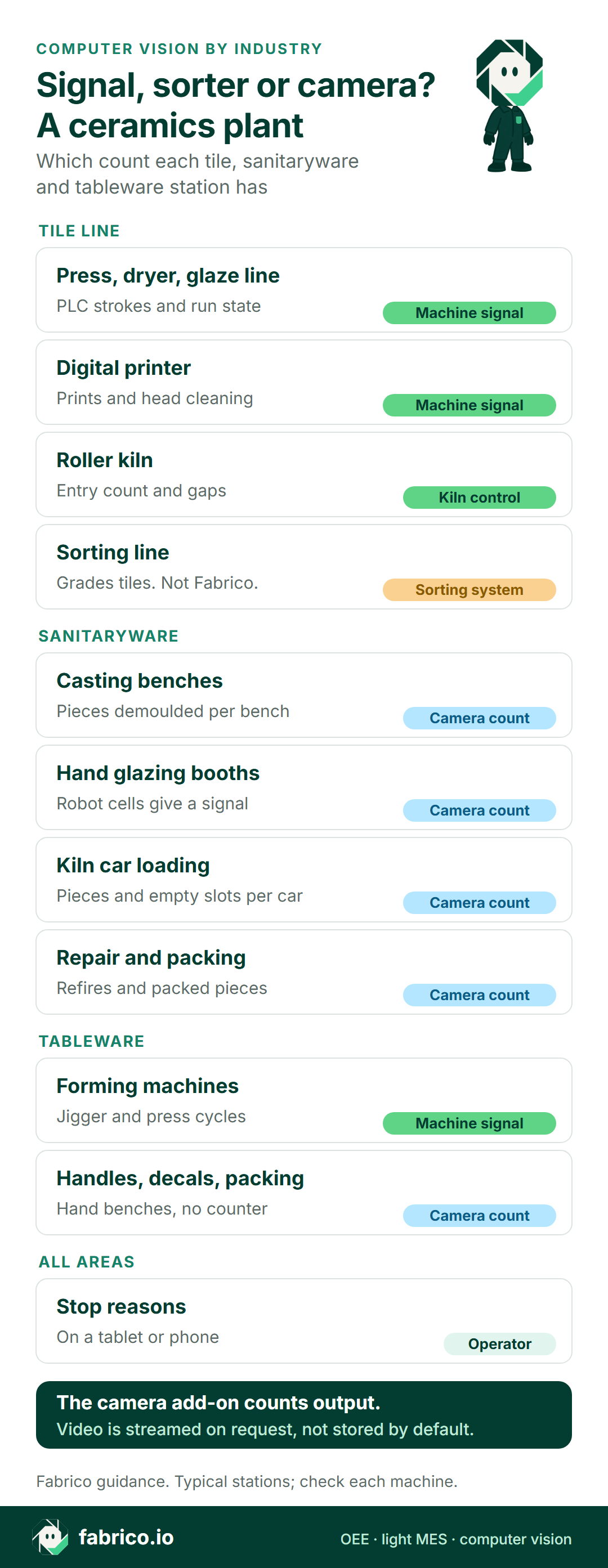
Text version of this infographic
- Tile line: press, dryer, glaze line: machine signal
- Tile line: digital printer: machine signal
- Tile line: roller kiln: kiln control
- Tile line: sorting line: sorting system, not Fabrico
- Sanitaryware: casting benches: camera count
- Sanitaryware: hand glazing booths: camera count
- Sanitaryware: kiln car loading: camera count
- Sanitaryware: repair and packing: camera count
- Tableware: forming machines: machine signal
- Tableware: handles, decals, packing: camera count
- All areas: stop reasons: operator
- The camera add-on counts output; video is streamed on request, not stored in Fabrico
Worked example: one tunnel kiln day in a sanitaryware plant
Example numbers, no real plant. A tunnel kiln fires WC pans, pushing one car every 30 minutes around the clock: 48 cars a day of 12 pans each, or 576 piece slots. The kiln never stops, so its OEE is counted in slots, not minutes. The kiln counts pushes, a camera add-on at the loading area counts pieces on each car, and the inspection bench's log gives first-fire rejects.
Loaded cars (availability). Three cars went through empty because the glazing robot cell stopped for about 90 minutes, and no glazed ware was ready for those three pushes. 45 of 48 cars carried ware: 93.8%.
Load per car (performance). The 45 loaded cars had 540 slots. The camera add-on counted 486 pieces, so 54 slots ran empty: 90.0%.
First-fire good (quality). Inspection passed 432 of the 486 pieces the first time. The other 54 went to repair or scrap: 88.9%.
OEE. 93.8% x 90.0% x 88.9% = 75.0%. The quick check: 432 first-fire good pieces of 576 slots is 75.0%.
The empty slots started upstream. The casting bench counts from the camera add-on showed two bench rows short on a night shift two days earlier, during a mould change. Green ware can spend a day or more drying, so a casting gap reaches the kiln car later, and without a bench count the loaders get the blame.
Refired pieces count in the shuttle kiln's output, never as first-fire good here. A car holds fewer pans than basins, so set the full-car count by product, as you would an ideal cycle time.
Eight questions for a ceramics camera or OEE vendor
Put them to every vendor on the shortlist. Use one week of kiln car sheets and casting tallies as the test.
| Question | What a good answer shows |
|---|---|
| What does the camera count at a casting bench? | Pieces demoulded, not moulds opened, and how a cracked piece is handled. |
| Can it count ware on a kiln car without counting kiln furniture? | Pieces apart from batts, props and setters, with empty slots shown. |
| How is the full-car count set by product? | Its own full car for a pan, a basin and a cistern. |
| How do refires count? | Once, in the refire kiln, never as first-fire good. |
| What happens to the lens at a spray booth? | A housing and cleaning routine for overspray and slip. |
| How close can a camera sit to a kiln entry or exit? | A mounting distance and a heat-rated housing, on a drawing. |
| How do the tile line's PLC counts come in? | Press, printer and sorting counts read from their controllers. |
| How are bench counts kept apart from piece-rate pay? | Counts by bench row and shift, and a written answer on who opens bench video. |
Start with one casting shop or one kiln car loading area, and read camera placement and lighting on a production line before mounting anything near a booth or a kiln. To compare vision-based OEE tools, see the comparison of computer vision for manufacturing OEE; for the wider software choice, see OEE software for glass and ceramics manufacturing.
Casters, glazers and the works council
A camera over a casting bench or a glazing booth will see people. Where casters are paid by the piece, a bench count is read as a pay tool the day it goes up. Agree what the count is for with staff, and in many European countries the works council, before any camera is mounted.
Aim the lens at the mould rows or the booth exit rather than at the caster. Publish casting counts per bench row and per shift, never per caster, and keep them out of the piece-rate sheet unless that was agreed. Ask any vendor which masking of people works now and which is roadmap. The Fabrico camera add-on is set up to count pans, basins and plates, not people; for the full checklist, read production line cameras without surveillance.
Where Fabrico fits in a ceramics plant
Fabrico is a cloud OEE and light MES platform. Three things it does in a ceramics plant today:
- On a tile line it takes run state and counts from the press, glaze line, printer and kiln PLCs, and the first choice, second choice and reject counts from the sorting line's own signal or counter.
- In a casting shop or decoration hall the camera add-on, on request, counts pieces leaving casting benches, hand glazing booths, repair benches, decal benches and packing. When a casting bench goes quiet, the supervisor taps that minute and the add-on streams the bench video; it is streamed on request, not stored in Fabrico.
- At a tunnel or shuttle kiln the pieces the camera add-on counts on each car become the kiln's output, set against full cars at the nominal push rate, so empty cars and empty slots show up as lost output in the kiln report.
Casters, glazers and kiln loaders enter stop reasons on a tablet or phone. OEE and losses show per kiln, line and shift, valued in money, on the web, iOS and Android. Kiln and casting figures go to the ERP through a REST API or webhooks, or as an Excel or CSV export.
Roadmap, not live today: the camera add-on spotting an idle casting bench or a kiln car that missed its push slot by itself, and the add-on proposing why.
Not Fabrico's job: grading tiles, checking ware for cracks, steering glazing robots or running kilns and dryers. The sorting line, the inspectors, the robot cell and the kiln control keep those jobs, and their counts feed the quality figure.
For the full product, see Fabrico computer vision for OEE and our guide to OEE software. For how camera add-on counts turn into OEE, see OEE with computer vision. Hold Fabrico to the eight questions above as well.
What ceramics teams ask next
Which sanitaryware station should get the first camera?
Usually the kiln car loading area, because it shows empty slots on the day they happen, or the casting benches, because that is where most shortfalls start. Tile presses, printers and glazing robots already give you counts.
Can a camera grade tiles or find cracks in a WC pan?
Not an OEE camera. Tiles are graded by the sorting line's own vision system, and cracks and glaze faults are found by inspectors and function tests. Fabrico does not inspect ware. The grade counts and first-fire rejects can feed the quality part of OEE.
How do you measure OEE on a tunnel kiln that never stops?
Measure it on throughput: cars that carried ware against the push schedule, pieces loaded against full cars, and first-fire good pieces against pieces fired. Empty cars and empty slots are the losses.
How should refired sanitaryware count in OEE?
Count a repaired piece once, in the output of the kiln that refires it. Never count it as first-fire good in the tunnel kiln, or quality looks better than casting and glazing really were.
Can cameras work next to glazing booths and kilns?
Yes, with the right housing and position. Keep the lens out of the overspray at a booth, mount it clear of the heat at the kiln entry and exit, and compare its count with a hand count for a week before you trust it.
Want to check this against a real kiln log? Bring one week of the kiln car sheet and the casting shop's shift report to a demo.
Related articles



Latest from our blog




Real Fabrico tiles, sample data.