


 Login
 Blog
Computer Vision for Ready Meal Production: From Topping to Sleeve

In short: computer vision for ready meal production pays off where people set the pace and nothing counts: the hand topping belt, manual sleeving and case packing. At the tray sealer and the sleever, the PLC already counts, and video shows what happened in the short stops.
- Seal, weight, metal, label and date code checks belong to inspection systems. Their reject counts can feed OEE quality.
- At the sealer, waiting for trays hides several causes. Upstream signals explain some; the camera at the topping belt explains the rest.
- A camera in high care has to fit your hygiene rules: washdown, materials and the glass policy.
- Fabrico builds OEE from machine signals and operator stop reasons. Its camera add-on counts output and opens the video for any moment of the shift.
A chilled ready meal line is part machine, part kitchen and part crew. Trays come off a denester, sauce and rice drop from depositors, and then a crew adds the toppings by hand before the sealer.
So people often set the pace, and many of the lost minutes never reach a fault code. The sealer knows it waited. It does not know why.
This page is for the plant manager or CI lead choosing cameras and OEE software for those lines: where a camera earns its place, where the PLC is enough, and what to ask. For the OEE maths, including ideal rates on a crewed line, read OEE for ready meal production.
We sell Fabrico, so check our claims as you would any vendor's.
What computer vision does on a ready meal line, and what it doesn't
Two kinds of camera system are sold as computer vision, and on a ready meal line they often sit a few metres apart. Inspection vision looks at every tray and rejects the bad ones. An OEE camera counts trays and opens the video for the minute a station stopped. Many high-care halls need both.
| Job | Inspection system | OEE camera |
|---|---|---|
| Seal check, food in the seal | Seal inspection, if fitted | No |
| Weight and foreign bodies | Checkweigher, metal detector or X-ray | No |
| Label, allergens, use-by date | Label and code vision | No |
| Topping present on each tray | Inspection vision, if fitted | No |
| Count trays off a hand topping belt | Not its job | Yes |
| Show why the sealer ran empty | No | Video for that minute |
The two meet at the reject count. If the checkweigher or the label check gives a reject signal or counter, OEE software can use it for the quality part of OEE. It knows how many trays were rejected, not why.
With many recipes and allergens, label checks deserve their own system. We cover that split in label and code vision vs an OEE camera, and the reject side in checkweigher rejects and OEE quality.
Where a camera finds the lost minutes on a ready meal line
Ready meal lines lose time in five places, and only some have a machine that explains itself.
The hand topping belt
Grated cheese, herbs, a chicken portion, a slice of lemon: each topping station is one or two people working from a tub. When one station falls behind, the line lead slows or stops the belt while they catch up, or trays come off to be finished by hand.
No PLC counts what leaves the crew, and no fault code fires when a tub runs empty; the sealer just waits. A camera over the belt exit counts trays as they leave the crew section. Set that count beside the denester's cycle count and you can see whether a gap started at the crew or before it. Add the sealer's cycles, and the difference shows trays taken off for hand finishing.
Our page on OEE for a manual packing station explains how a hand station joins the line's OEE.
Depositors and the denester
Depositors for sauce, mash and rice have a cycle count, and so does the denester. A double-fed tray, a dripping nozzle or a sticky component bridging in the hopper each cost a minute or two at a time.
At the sealer, all three look the same: waiting for trays. If the denester and depositors are connected, their own signals show which one stopped. Video helps where the code is vague, like a dripping nozzle.
The tray sealer
The sealer has the best signals on the line: run state, cycles, film faults and tool changes.
A camera here adds video, not counts, for the stops the fault code can't explain, like a tray riding up in the tool. For empty cavities, washdown and seal rejects, read tray sealer OEE.
The sleever and case packing
Many ready meals leave the sealer into a printed card sleeve. Sleevers jam on warped board, glue faults and skewed trays. On smaller lines, sleeving and case packing are done by hand, with a tally sheet as the only count. There, a camera gives the count the line is missing.
Changeovers and allergen clean-downs
Recipe changes come several times a shift, from quick topping and sleeve swaps to full allergen clean-downs, like a cheese sauce meal followed by a dairy-free one. The signal times each one and the operator picks the type. Our allergen changeover matrix shows how to sort them, and OEE for high-mix food lines how to set a fair target.
Short shelf life changes what a lost hour costs
Many chilled ready meals are tray sealed under a modified atmosphere. In England, Wales and Northern Ireland, the Food Standards Agency guidance on vacuum and modified atmosphere packed chilled foods sets out the extra controlling factors needed when such a product has a shelf life of more than 10 days. The bacterium it targets, non-proteolytic C. botulinum, can grow and produce toxin at 3°C and above.
Whatever the exact life of your products, there is little room to build stock, so many plants make close to the order. A lost hour today is often a short delivery tomorrow.
The Chilled Food Association puts the UK chilled prepared food market, of which ready meals are one part, at £10.5 billion for 2022, excluding cooked sliced meat.
Line map: where a camera goes on a chilled ready meal line
Here is a typical chilled tray line from empty tray to case, with the system that owns each job.
Two places get a camera first: the exit of the hand topping belt, because nothing else counts there, and any station where people sleeve or pack by hand. The sealer and sleever get one only if their fault codes leave too many stops unexplained.
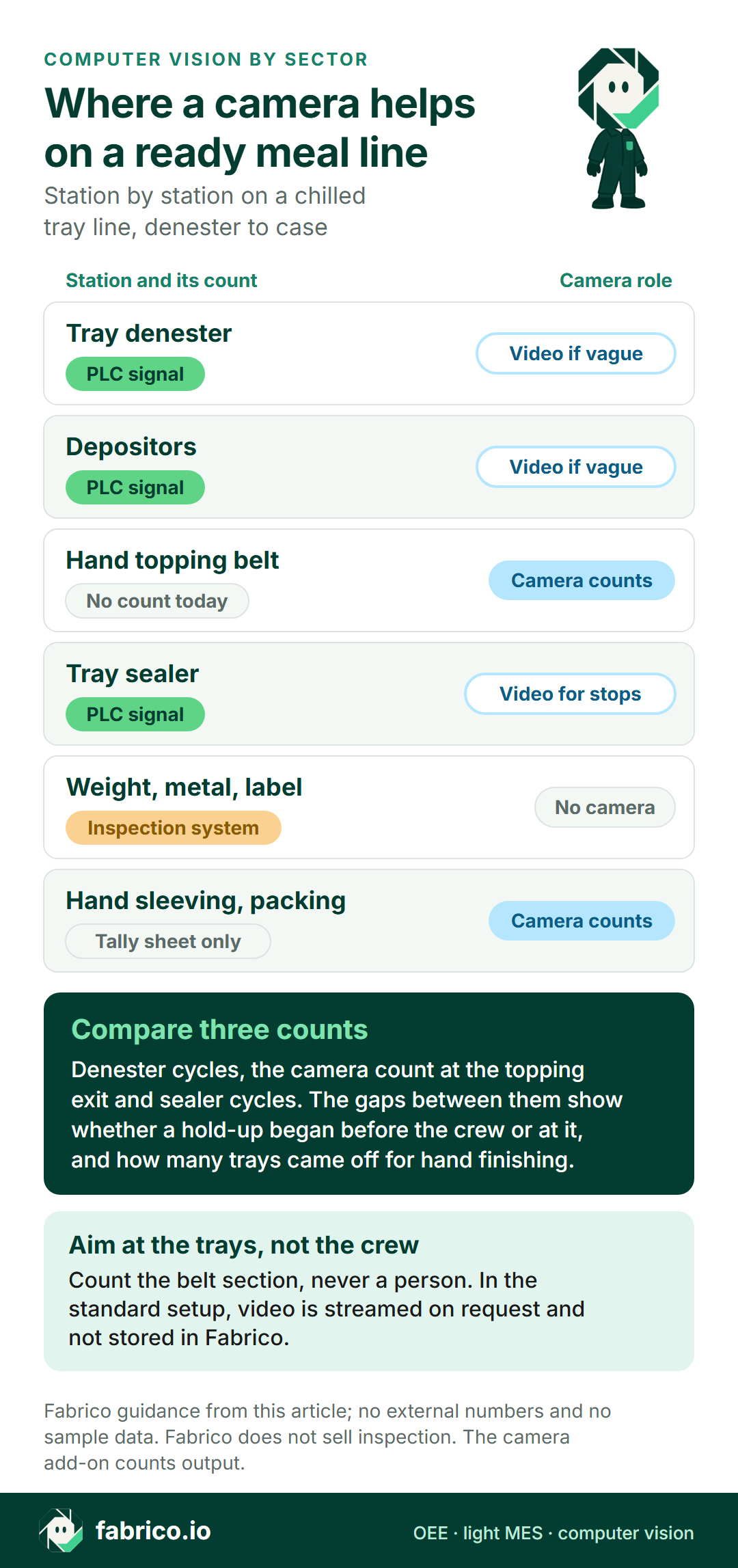
Camera, sensor or operator: station by station
Start here for each line. The operator gives the stop reason in every row; the camera gives them video to check it.
| Station | Counts and stops from | Where a camera helps |
|---|---|---|
| Tray denester | PLC cycles | Video only if its codes leave stops vague |
| Depositors | PLC cycles | Video for drips and bridging, if codes are vague |
| Hand topping belt | Nothing, or a tally | Counts trays leaving the crew |
| Tray sealer | PLC cycles and faults | Video for stops the code can't explain |
| Checkweigher, metal detector | Inspection system | None. Its rejects feed quality |
| Sleever | PLC, if automatic | Video for jams, or counts if sleeved by hand |
| Case packing by hand | Nothing, or a tally | Counts cases |
Want to map your own line? Book a demo and bring the station list, with what each station can signal today.
Cameras in high care: what to check before install
Cooked components are usually assembled in a high-care or high-risk zone, between cooking and sealing. That is where hygiene rules are tightest, and where a camera hangs over open food.
High care is there to stop cooked food being contaminated again before it is sealed, and Listeria is one of the bacteria it guards against. It is rare but serious: EFSA and ECDC report that in 2024 it caused the highest share of hospitalisations and deaths among foodborne infections reported in the EU. About 7 in 10 people infected needed hospital care, and 1 in 12 died. Those are figures about patients, not factories, but they are why your hygiene team will question every device over open food.
Before a camera goes in, check four things with your hygiene and engineering teams:
- Washdown. Ask for the housing's IP rating and what it was tested against. Our page on the IP69K rating explains the test.
- Glass and hard plastic. A lens is a brittle item over open food. Ask how the housing fits your glass and brittle plastics policy, and add it to your register.
- Where it mounts. A camera above the belt, aimed down, is easier to keep clean than one on a stand. Cables through a high-care wall need a sealed entry.
- Who may touch it. Agree who cleans, aims or swaps a camera, and whether they must change into high-care clothing first.
Steam from hot-filled sauces, where you have them, and mist from chilled air can blur the view too, so judge the counts in the real room, on a normal shift.
Worked example: one shift on a curry and rice tray line
This is sample data for one shift on a chilled two-compartment curry and rice line. It is not from a customer, and it is not a product screen.
Planned production time was 450 minutes. With the standard crew, the ideal rate is 40 trays a minute, counted at the sealer.
The line stopped for 95 minutes in all, timed by the sealer's signal. That leaves 355 minutes of run time, so availability is 355 of 450, or 78.9%.
In 355 minutes at 40 a minute, the ideal is 14,200 trays. The sealer counted 12,780, so performance is 90.0%.
The checkweigher, metal detector and label check rejected 260 trays, leaving 12,520 good. Quality is 12,520 of 12,780, or 98.0%.
OEE is 78.9% x 90.0% x 98.0% = 69.6%. As a check, 12,520 good trays of the 18,000 possible in 450 minutes is also 69.6% (method: OEE calculation).
Now the camera part. The sealer logged 34 minutes under one code: waiting for trays. The denester and depositor signals explain 21 of them: denester jams (12) and depositor refills (9). No machine explains the other 13. The camera count at the topping belt exit and its video split them into gaps from the topping belt (8) and late kitchen components (5).
One vague loss became four owners: engineering for the denester, the line lead for refills, the crew plan for the belt, and the kitchen for timing.
At an assumed contribution of €0.60 a tray, 34 minutes at 40 trays a minute is 1,360 trays, or about €816 in one shift. The changeover is a separate question. If your standard for an allergen clean-down is 35 minutes, the extra 10 minutes are the loss to chase. Agree the costing rule with your controller first.
Questions to ask any vendor of computer vision for ready meal production
Run these with every vendor, us included. Bring a real shift and your recipe list.
| Ask | How to test the answer |
|---|---|
| Can it count trays off a hand topping belt? | Film one run with gaps and belt stops, count it by hand, and compare. |
| Which housing goes into high care? | Ask for the IP rating, the materials, and how the lens fits your glass policy. |
| How does it split "waiting for trays"? | Take one real starved minute at the sealer. Ask who would code it, and from what. |
| How are ideal rates set for many recipes? | Ask who sets a rate per recipe and crew size, and who keeps it current. |
| Where do inspection rejects go? | Ask how the checkweigher's reject signal reaches OEE quality. |
| Is video stored, and who sees it? | Ask where the video sits, for how long, and who can view it. |
| What does a pilot look like? | One line, a few weeks, and a hand count to compare. Agree it before you sign. |
Our guide to running a computer vision OEE pilot has a plan you can reuse.
Privacy and the works council
A camera over a topping belt sees hands, arms and often faces, because the crew stands close to the trays. In many European plants, the works council will want to agree first.
- Frame the belt, not the crew. Aim at the trays leaving the section, not at the people working along it.
- Count the line, not the person. The count belongs to the belt section and the shift. No rates per person.
- Say what happens to video. In Fabrico's standard setup, video is streamed on request and not stored in Fabrico.
- Tell every crew member. Put the notice in the languages your crews speak, where agency staff will see it too.
Roadmap: more automatic masking of people in the frame. Ask us what is live before you write it into the agreement. Our guide to production line cameras without surveillance covers the full approach.
How Fabrico does it
Fabrico is a cloud platform for OEE and light MES. This is what it does on a ready meal line today, and what it doesn't.
- Stops and counts: from the machine signal, whether a PLC, a sensor or a counter. The operator adds the stop reason at the line, on a tablet or a phone.
- OEE and losses: OEE, downtime and losses for each line and shift, with the losses priced in money. It works on the web, iOS and Android.
- Computer vision add-on: AI cameras count output, including at hand topping, sleeving and packing. Pick any moment on the shift timeline and open the camera video for it. In the standard setup, that video is streamed on request, not stored in Fabrico.
- Your data: take it out through the REST API, webhooks, or Excel and CSV exports.
- Roadmap: cameras that detect stops on their own, mark jam zones at the denester or sleever, and offer a likely reason for the operator to confirm. None of this is live today.
- Not Fabrico: seal, weight, metal, label and date code inspection. Keep those systems and feed their reject counts into OEE. For production planning, ask us in the demo.
Still comparing platforms in general? Our OEE software guide sets out what to compare. For plants that make more than ready meals, see computer vision for FMCG manufacturing.
Book a demo or talk to us about your line.
What people ask next
Can a camera check that every tray has its topping?
Not an OEE camera. Checking each tray against a spec is inspection, and needs an inspection system. An OEE camera counts trays and opens the video for any moment.
Can cameras go into a high-care area?
Yes, if the housing, mounting and cleaning fit your high-care rules. Check the IP rating, the materials and the fit with your glass policy together with your hygiene team.
Will the camera tell us why the sealer stopped?
Today the sealer's signal times the stop and the operator picks the reason, with the video for that minute to check it. A camera offering a likely reason is on the roadmap. It is not live today.
Is camera video stored?
Not by default. In Fabrico's standard setup, video is streamed on request and not stored in Fabrico. Put the same question to every vendor, and get each answer in writing for your works council.
Where should the first camera go on a ready meal line?
At the exit of the hand topping belt, just before the sealer: the busiest station with no count. Hand sleeving or case packing comes next.
What drives the cost of computer vision on a ready meal line?
The quote depends on the number of lines and cameras, mounting in high care, the network and training. Ask every vendor to quote the same line and station list.
Want to see the count on a topping belt like yours? Book a demo.
Related articles












Real Fabrico tiles, sample data.