


 Login
 Blog

Computer Vision for Lock Manufacturing: Pinning, Lock Cases, Key Sets

In short: computer vision for lock manufacturing earns its keep as a counter at the hand stations: cylinder pinning benches, lock case and padlock assembly, the electronic lock box build, the key-turn check and the boxing table, where cylinders and locks leave without a controller recording them. Die casting cells, CNC lathes, key cutters and automatic pinning machines already count their own cycles.
- Key gauging, plating checks, cycle tests and attack tests stay with inspectors, test rigs and the lab, outside Fabrico.
- Count in lock plant units: cylinders pinned, lock cases closed, padlocks assembled, keys cut, key sets boxed.
- A key cutter counts keys, not locks: with three or five keys to a cylinder, count the cylinder at pinning and the set at the boxing table.
- Fabrico's camera add-on is a counter; where it covers a station, the video for the minute of a stop can be opened from the shift timeline, streamed on request and not stored in Fabrico.
A CNC lathe knows how many plugs it turned. A pinner loading bottom pins and master pins into a cylinder from a pinning chart leaves a tick on the order sheet, if that.
Computer vision in lock manufacturing: counting next to inspection
Vision systems sold to lock plants check parts: key profiles, pin lengths, a plated finish. A counting camera does something else. It supplies the output figure OEE needs, where nothing else records it.
| Job in a lock plant | Done by | OEE camera? |
|---|---|---|
| Gauge key cut depths | Key gauge, inspector | No |
| Find plating flaws on lock bodies | Inspectors, surface vision | No |
| Try each key in its cylinder | Key-turn check station | Counts cylinders through, not the result |
| Cycle or attack test a sample lock | Test rig, the lab | No, read the rig log |
| Count cylinders off a pinning bench | A tick on the order sheet | Yes |
| Count lock cases closed at assembly | The shift report | Yes |
| Count key sets boxed per order | The packing list | Yes |
| Show the minute of a 10:40 bench stop | Nobody's notes | Video streamed on request |
Cylinders that bind at the key-turn check and bodies rejected for plating reach OEE quality as that station's reject figure, while the good count comes from the camera add-on. Inspection is not something Fabrico does.
The hand stations matter for the plant figure. In a Chalmers study of OEE data from 23 companies and 884 machines, average OEE was 65%, almost half of the recorded losses could not be classified, and 90% of the classified stop time came from supporting work done by operators rather than from the automatic process. Waiting for pins, a chart or a key set is that kind of support work, and a tick on an order sheet records none of it.
What you see: the line screen, stops and waste on sample lines. The video shows the software, not the camera. Book a demo.
Plays from YouTube. Google may set cookies when you press play. Privacy policy.
Casting, machining and key cutting already count
Lock bodies, padlock bodies and cylinder housings are die cast in zinc alloy or machined from brass bar, and mortice lock cases are stamped from steel. A die casting cell reports shots from its controller and the trim press after it counts strokes. A shot is not a part on a multi-cavity die, so set parts per shot on each item. Shot cycles, die changes and scrap on the casting side are covered in OEE for high pressure die casting, and the casting cell itself on computer vision for foundries.
The plug is the precise part. It is turned from brass bar, or cast first: one cylinder lock patent calls it typical that the plug is cast as a cylinder with its keyway, and the pin chambers are then machined into it as a secondary operation. A CNC lathe, multi-spindle automatic or rotary transfer machine counts its own cycles, so plugs and bodies leave the machine shop already counted. A camera add-on adds little there.
Keys are cut from blanks on code cutting machines. In the system of the pinning patent cited below, the key code data tells the key cutting machine the position and depth of each notch to cut in a blank. The machine counts keys. A cylinder may ship with three, five or more keys, and a master-keyed order adds master keys on top, so keys cut rarely equal cylinders made. Count the cylinder where it is pinned and the set where it is boxed.
Bodies then go to plating or powder coating, in house or out. A plating line PLC counts racks or barrel loads, not parts, so book returns by lot at goods in.
Cylinder pinning: the bench where counts go missing
Pinning sets each chamber of a cylinder to a key code: a bottom pin to the depth of the key cut, a master pin where the order has a master key, then a top pin and a spring. Standard keyed-different cylinders can run through an automatic pinning machine, which counts its own cycles. Custom and master-keyed orders are different. As one pinning patent explains, custom pinning is a small share of a factory's output, needs more complex coding, and so is usually done by hand. The same patent says its automated system turns a manual alteration of several minutes per cylinder into a few seconds, which is why standard runs go to the machine and the hand bench keeps the orders that need special coding.
A hand pinning bench is a tray of pins sorted by size, a pinning chart for the order, a follower and a pinner, who also closes the chambers and fits the cam. Its output is cylinders set down in the out tray. A camera add-on above the out tray counts cylinders as they are set down, so an empty pin compartment or a question about the chart shows up in the hour it happens.
Keep the pinning chart and the key code screen out of the frame. A master key chart is a security document, and a camera that films it is a risk the plant then has to manage. Aim the lens at the out tray, and settle before mounting who may open the bench video and why.
A cylinder that binds at the key-turn check goes back to the pinning bench to be re-pinned: book it a single time, under rework, and keep it out of the good count. A euro double cylinder has two plugs, usually pinned to the same code, so count the cylinder, not the plugs.
Lock cases, padlocks and electronic door locks: hand assembly
A mortice lock case starts as a stamped steel case and cover, and the press counts its strokes. The US OSHA mechanical power press standard requires a clutch/brake control that selects Off, Inch, Single Stroke or, where fitted, Continuous, so read the stroke count in single or continuous mode only: inching the slide during a die set makes no case. The latch, deadbolt, follower, levers and springs then go in by hand, and the cover is riveted or screwed down. One case takes several rivets or screws, and a hand screwdriver counts nothing, so a camera add-on above the bench counts closed cases, not fasteners.
Padlocks bring together a body, a hardened shackle and a locking mechanism such as pin tumblers, wafers, discs or combination wheels. The shackle is bent, machined and hardened in a furnace that knows its loads, not its pieces. The step where shackle, mechanism and body come together is hand work, so count padlocks closed at that bench.
Electronic door locks add a box build: a circuit board, bought in or made in a separate electronics cell, a motor or solenoid, a battery holder, a keypad or card reader and the housing. Firmware loading and the function test rig log their own results; the hand fitting step between them is where a camera add-on counts units built.
Bench counting in general is on camera measurement at manual assembly stations, and mixed halls of machines and benches on tracking OEE on manual and hybrid assembly lines. Fitting finished locks into frames is a different plant, covered on computer vision for window and door plants.
Key-turn check, test rigs and the boxing table
Where a plant tries each cylinder with its keys before it ships, master keys are included on a master-keyed order. Some do it by hand at a check station, others on a rig. A rig logs its own count and results. A hand check station is a queue: a camera add-on over its in and out trays counts cylinders arriving and cylinders passed on, which shows whether pinning or checking is holding the order up. The pass or fail stays with the checker.
Cycle tests and attack resistance tests are sample or type tests, run on rigs and in the lab against the specifications the plant works to. Fabrico does not run them or hold their results.
Retail cylinders and padlocks go into blister cards on a sealing machine that counts its cycles. Trade and master-keyed orders are boxed by hand with their keys and key card, sometimes as keyed-alike sets. A camera add-on above the boxing table counts closed boxes per order, so a cylinder or key set that never arrived is logged as a wait at boxing rather than as packers working slowly.
Count sources across a lock plant
The card assumes a plant that casts, machines, cuts keys, pins, assembles and packs in house. Plants that buy in plugs or send plating out will differ, so walk the hall before counting cameras; sizing is in how many cameras per line for OEE.
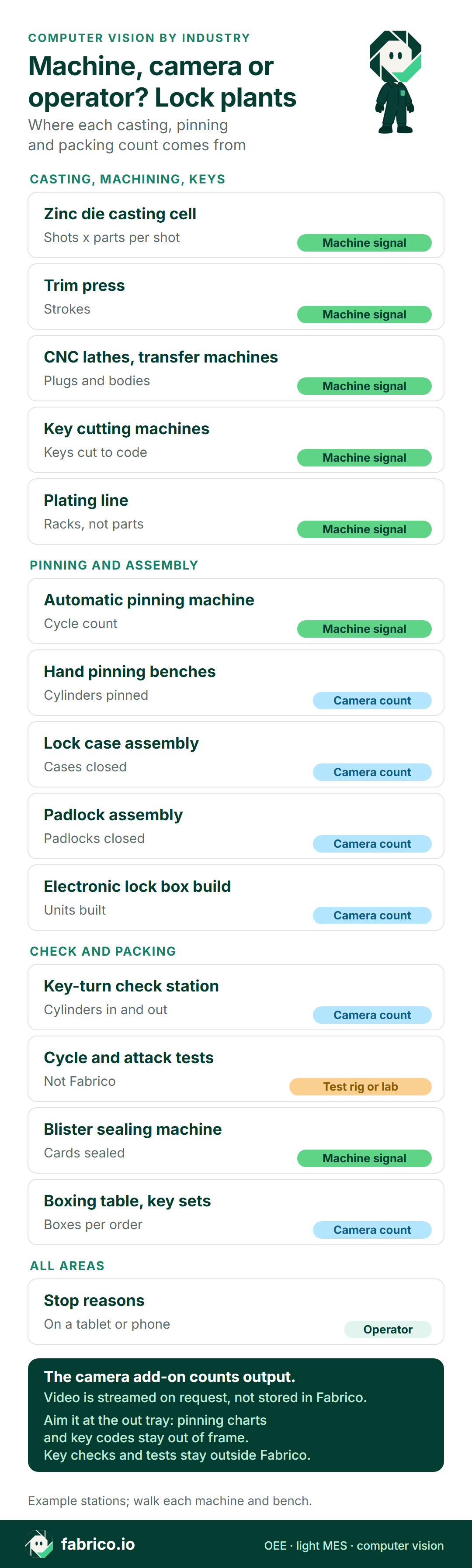
Text version of this infographic
- Casting, machining, keys: zinc die casting cell: machine signal, shots x parts per shot
- Casting, machining, keys: trim press: machine signal, strokes
- Casting, machining, keys: CNC lathes and transfer machines: machine signal, plugs and bodies
- Casting, machining, keys: key cutting machines: machine signal, keys cut to code
- Casting, machining, keys: plating line: machine signal, racks, not parts
- Pinning and assembly: automatic pinning machine: machine signal, cycle count
- Pinning and assembly: hand pinning benches: camera count, cylinders pinned
- Pinning and assembly: lock case assembly: camera count, cases closed
- Pinning and assembly: padlock assembly: camera count, padlocks closed
- Pinning and assembly: electronic lock box build: camera count, units built
- Check and packing: key-turn check station: camera count, cylinders in and out
- Check and packing: cycle and attack tests: test rig or lab, not Fabrico
- Check and packing: blister sealing machine: machine signal, cards sealed
- Check and packing: boxing table, key sets: camera count, boxes per order
- All areas: stop reasons: operator, on a tablet or phone
- Footer: output is counted by the camera add-on; video streams on request and Fabrico keeps none of it
- Footer: aim it at the out tray, so pinning charts and key codes stay out of frame
- Footer: key checks and tests stay outside Fabrico
Book a demo to see hand pinning, lock case assembly and key set boxing counted next to die casting and key cutting on one shift timeline.
Worked example: one early shift at a master-key pinning bench
Sample numbers, no real plant. One pinner works a master-keyed order of euro double cylinders at one bench on an early shift from 06:00 to 14:00. With the 30-minute break out, 450 planned minutes remain. Each cylinder has two plugs, and each chamber takes a bottom pin, a top pin and a spring, plus a master pin wherever the change key and the master key are cut to different depths, so the order sets the ideal pace at 5 minutes a cylinder, or 12 an hour. The camera add-on watches the out tray for finished cylinders; the pinner types the reason for a stop into a tablet.
Availability. The bench stood 30 minutes waiting for one size of master pin from stores, and 20 minutes for the change to a second order: new chart, trays emptied and refilled. That leaves 400 running minutes out of 450, an availability of 88.9%.
Performance. At 5 minutes a cylinder, 400 minutes allow 80 cylinders. The camera add-on counted 74 set down in the out tray: 92.5%.
Quality. At the key-turn check, 3 cylinders would not turn with the master key: a master pin one size off in one chamber. They went back to the bench and were re-pinned, so they count as rework: 71 of 74 were good first time, 95.9%.
OEE. 88.9% x 92.5% x 95.9% = 78.9%. The quick check: 71 good cylinders x 5 minutes = 355 of 450 planned minutes, or 78.9%.
The 30 slow minutes are 6 cylinders. In the hour after the order change the bench closed 9 cylinders instead of 12 while the pinner worked to the new chart: 3 cylinders, or 15 of the 30 minutes. The other 15 are spread across the shift. Each keying type and cylinder length gets its own pace, set the way an ideal cycle time is set.
What the lost time costs
The shift lost 95 of 450 planned minutes: 50 standing, 30 slow and 15 on re-pinning. At 5 minutes a cylinder, that is 19 cylinders the bench did not make. Two example inputs turn that into money; replace both with the plant's own figures.
- Margin, example input: EUR 6 contribution margin per master-keyed double cylinder. 19 x EUR 6 = EUR 114 a shift. Over 230 shifts a year (one shift, five days, 46 weeks) that is EUR 26,220 for one bench.
- Labour, sourced rate: if the late order is made up on overtime, that is 95 minutes of pinner time. Eurostat puts average hourly labour costs in EU industry at EUR 33.9 in 2024, so about EUR 53.70 a shift before any overtime premium.
By cause, the 30-minute pin wait alone is 6 cylinders, or EUR 36 at the example margin. It is a stores and kitting loss, not a pinning one, and the cheapest to fix: kit master pins per order before the shift starts. Fabrico values each loss from the plant's own price or margin per item, so these inputs are set once per cylinder type.
Three things a lock plant can do this week
- Pull one week of pinning order sheets and mark every hour without a tick: those are the hours a camera add-on count would explain.
- Ask stores how often a pin size ran out at a bench, and kit master pins per order before the shift.
- Agree with key security and the works council where a camera could look at the out tray with the chart out of view.
Eight questions to put to a lock plant camera or OEE supplier
Run every supplier through the list against one week of pinning order sheets and key cutter counts.
| Ask | A sound reply |
|---|---|
| At a pinning bench, what exactly is counted? | Cylinders set in the out tray, not plugs or pins. |
| How is a euro double cylinder counted? | As one cylinder, once both plugs are pinned. |
| How is a cylinder re-pinned after the key-turn check counted? | Under rework, a single time; the good count stays as it was. |
| Can the pinning chart stay out of the frame? | Yes: the lens points at the out tray, agreed with key security before mounting. |
| How are die casting shots and key cutter counts read? | From the machine control or a sensor, with parts per shot and keys per cylinder set on the item. |
| Can counts be split by order, length and keying? | One item per cylinder length, finish and keying type, each with its own ideal pace. |
| How is the key-turn check queue shown? | Cylinders into and out of the check station, so waiting time is visible. |
| Who may view footage from the bench, and through what? | Named roles, from the shift timeline only, with the data flow shown to the works council before the first bracket goes up. |
Before a bracket goes up over a pinning bench, read the camera placement and lighting guide.
Pinners, assemblers and the works council
Any camera over a bench also sees the pinner, assembler or packer working there. In the EU, the European Data Protection Board's guidelines on video devices note that collective agreements, including works agreements, may set specific rules for processing employees' data, and that employers should in most cases not rely on consent. Explain the count to the people at the bench, and to the works council where there is one, before a bracket is fixed. Report by bench and shift only. Where pinning is paid per piece, agree up front whether the camera add-on count is used for pay at all. More steps are in production line cameras without surveillance.
Where Fabrico fits in a lock plant
In a lock plant, Fabrico works as cloud OEE software with light MES functions:
- Casting, machining and key cutting: shots, cycles and keys cut come from the machine control or a sensor, so die changes, tool changes and bar changes show up as stop time waiting for a reason.
- Pinning, case and padlock assembly, box build, key-turn check and boxing: the camera add-on counts cylinders pinned, cases closed, padlocks assembled, units built, cylinders checked and boxes closed. When a pinning bench stopped at 10:40, the team lead opens that stop on the shift timeline and the camera add-on streams the video for its minute on request; nothing is stored in Fabrico.
- Per item: each cylinder length, finish and keying type gets its own ideal pace, so a keyed-different single cylinder and a master-keyed double cylinder are each measured against a pace of their own.
Stop reasons come from the pinner, assembler or machine operator, typed on a phone or tablet at the station. Results come per station and shift, with losses priced in money, on the web and in iOS and Android apps; exports go out through the REST API, webhooks, or Excel and CSV files.
Roadmap: a camera add-on that flags an idle pinning bench on its own and offers a possible cause for the pinner to accept or correct.
Outside Fabrico: key gauging, plating inspection, key-turn check results, cycle and attack tests, and pinning charts and key code records.
The add-on itself is described on Fabrico computer vision for OEE. How to evaluate OEE software covers the wider software choice, and manufacturing vision systems for OEE walks from camera add-on counts to availability, performance and quality. Put the eight questions above to Fabrico as well.
What lock makers ask next
Where should a lock plant put its first camera?
Over the out tray of the hand pinning benches, or over the boxing table for master-keyed orders. Cylinders and key sets leave both all shift with no controller recording them, while die casting cells, CNC lathes and key cutters already count.
Can an OEE camera check key cuts, pin lengths or plating?
No. Key cuts are gauged, pins are checked by their supplier or at goods-in, and plating by inspectors or a separate inspection vision system, none of it in Fabrico. Their rejects still feed OEE quality through the checking station's own count.
Should the key cutter or a camera count keys?
The key cutter. It cuts each key to its code and counts what it cuts. Keys are not the unit of output, though: count cylinders at the pinning bench and key sets at the boxing table.
How is a cylinder counted that fails the key-turn check?
Once. It goes back to the pinning bench to be re-pinned and is booked as rework, so the bench is not credited twice for it.
Will a camera over a pinning bench film the master key chart?
It should not. Mount it above the out tray, keep the chart, the key code screen and the order sheet out of the frame, and agree the view with whoever owns key security before the bracket goes up.
How do you count keyed-alike sets packed together?
Count closed boxes per order at the boxing table, and count cylinders where they are pinned. A missing cylinder or key then appears as waiting time at the boxing table, apart from packing speed.
Want to see cylinders, lock cases and key sets counted on one shift timeline? Book a demo.
Related articles





Latest from our blog





Real Fabrico tiles, sample data.