


 Login
 Blog
Computer Vision for Aerospace Manufacturing: Find and Fix the Five Output Miscounts

In short: computer vision in aerospace manufacturing pays off by counting finished harnesses, kits and sub-assemblies at hand stations, where the traveller count goes wrong.
Inspection is a different job: CMMs, NDT and continuity testers judge the part, while a counting camera only records that a finished unit left.
- Five miscounts inflate aerospace output: traveller stamps, short kits, part-built assemblies, rework and MRB loops, and parts counted where customers buy shipsets.
- Each miscount has an owner: the board exit, the kitting table, the team lead at the jig, the NCR log or the packing bench.
- In the example harness cell, the shift tally says 80.0% OEE; the audited count says 59.4%.
- A camera near controlled work needs the site's security and export-control sign-off before anyone mounts it.
- Fabrico's camera add-on counts finished harnesses, kits and shipset crates; operators add stop reasons on a tablet or phone.
This audit is for operations, quality and CI leads in aerostructures, harness, composites and avionics shops. Machining centres, ATL and AFP heads, ply cutters and autoclaves report through their controllers; the hand stations between them do not, and that is where the output number goes wrong.
The aerospace miscount table: five ways the output number goes wrong
Most aerospace output figures are built from traveller stamps and end-of-shift tallies. Five habits inflate them, and every one is a version of the gap between good count and total count. Read the table first; each row has its own section below.
| Miscount | What the tally does | The fix | Who owns the count |
|---|---|---|---|
| 1. Traveller stamps | Counts stamped operations, often batched at shift end, as finished units | Count the one operation that closes the unit, when it happens | Board exit: camera add-on at the hand-off rack |
| 2. Kits | Counts plies cut, so a short kit looks like output | Count complete kits leaving; a short kit is a stop where work waits | Kitting table exit: camera add-on |
| 3. Partial assemblies | Credits percent complete, then credits the unit again when done | Hours earned only when the closing operation is done | Board exit; team lead at the jig for multi-day work |
| 4. Rework and MRB loops | Counts a failed part as good, then again after rework | Count once; an MRB part is never first-pass good | Quality: the NCR and MRB log, with the tester |
| 5. Shipsets | Counts parts when the customer buys complete sets | Report parts and complete shipsets as two numbers | Packing bench: camera add-on on crates; ERP holds set contents |
Two of the five also hide time: a short kit and a first article buy-off both stop a station, and booked as running they vanish into performance. In the worked example below, the five move one harness cell from 80.0% OEE on the tally to 59.4% after the audit.
Explainer presented by Iris, Fabrico's AI-generated presenter: how an add-on camera counts output where a machine has no signal. Book a demo.
Plays from YouTube. Google may set cookies when you press play. Privacy policy.
Counting is not inspection: what a camera can and cannot see at a bench
Aerospace buyers often expect a camera to inspect. That is a separate system: CMMs measure machined parts, ultrasonic, X-ray and CT find voids and delaminations, and continuity testers prove harness wiring. Camera-based part counting is a narrower job. Fabrico does no inspection; NDT and test results reach OEE quality through the reject and NCR counts those cells already keep.
What a published test says about counting at a hand bench
A peer-reviewed study in the Journal of Imaging tested a camera that counted pieces placed by hand on an assembly table in an Italian plant. Over 200 pieces, 94% of pieces were correctly counted within 1 second after placing. The authors name the weak spot plainly: "the motion phases are the main source of error for counting algorithms". In their test, the remaining 2% of pieces were not counted, all in one situation: both operators reaching into the frame at once. They also added a light ring around the lens, because daylight from outside kept changing the image.
Read it with its limits: one plant, dark steel lighting devices about 10 cm tall, one table, fixed light. A harness board is far bigger, two or three people work over it, and a harness is a flexible bundle. So put the count zone where one finished unit leaves at a time: the hand-off rack after lift-off, the kit cart, the closed shipset crate. Light it evenly, and have any vendor count one week against audited travellers before you trust the number.
Miscount 1: a traveller stamp is not a finished unit
The traveller is the quality record of the work, and it should stay that way. In the US, FAA guidance for production approval holders lists the records to keep: inspection and test records, calibration records, supplier records, special process certifications, MRB records, and production travelers. A traceability record is a poor output counter, though: stamps are per operation, often several at once at the end of the shift, and the shift report counts stamps.
Harness shops feel this most. A 2022 peer-reviewed case study in the journal Robotics reported that wire harness assembly tasks in its industry are carried out 90% manually, so nothing on the board sends a signal. Pick the one operation that closes a unit, here 050, lift-off, count it when it happens, and let the routing credit its standard hours. Cutting and crimping are covered in OEE for wire harness assembly.
The time side: first article inspection
A new part number, a new revision or a process change triggers first article inspection under AS9102. IAQG describes its 9102 standard as one that "standardizes FAI process requirements to the greatest extent possible". FAI takes real hours, often including a wait for the quality engineer's buy-off. Give it its own stop code, or a month with three new revisions reads like a month of slow assemblers.
Miscount 2: kits counted at the cutter, not where they leave complete
In a composites shop the automated ply cutter reports nests cut and its run state. Kitting is hand work: plies are peeled from the cutting table, labelled and stacked in layup order into a kit for one tool. Hand work carries on after it. A peer-reviewed study in Composites Part B found that manual layup remains a significant part of the composite industry. If output is read at the cutter, a kit missing two plies counts as done, and the shortage only shows when a laminator stops work.
Count complete kits as they leave the kitting table, and book a missing ply as a stop with a reason at the station that waits. Harness shops have the same problem with connector kits: count the kit at the kitting bench exit, not when parts are picked. Layup rooms are clean rooms, so the camera housing and its cleaning routine must suit the room's contamination rules.
Downstream, count tools leaving the layup room for bagging, never single plies. At the autoclave the cure log already shows each cure; the count that matters is tools per load against the load plan, since a tool that missed the load is lost capacity even when the cure ran its full cycle.
Miscount 3: partial assemblies and hours not yet earned
Units per minute make no sense at a station that finishes three harnesses a shift. Low volume, high mix shops use earned hours: each completed operation earns its routing standard hours, set against the hours the station ran. OEE for aerospace manufacturing explains the method.
Earned hours break as soon as partial work is credited. Book a harness as 60% done at shift end and as complete the next day, and you have credited 160% of it. The rule is strict: a unit earns its hours only when the closing operation is done. Partial work carries over as work in progress; WIP tracking software compares ways to see it. Single shifts swing more as a result, so read the weekly figure.
Jigs are the exception to camera counting. A wing or fuselage jig takes days for one assembly, so there is no unit per shift. Use the traveller sign-offs as completions, entered by the team lead at the jig, and book waits for parts, tools, inspection and engineering answers as stop reasons.
Miscount 4: rework and MRB loops that count one part twice
Every production approval holder runs a nonconformance loop. For a US production approval holder, 14 CFR 21.137 requires procedures for the identification, documentation, evaluation, segregation, and disposition of nonconforming products, and the FAA guidance adds that PAHs should have procedures that ensure a material review board (MRB) is established, documented, and operational. That loop is where tallies double count. A harness fails continuity on a swapped pin, goes to rework, is retested, and comes back through the hand-off rack as a second "new" harness.
The same guidance asks that parts reworked after test acceptance be retested, and that the record keeps "the original rejection indication" after repair. OEE needs the same idea:
- Count once. A reworked harness returns by a route the camera add-on does not count, or the operator marks it as rework at the hand-off.
- Read the NCR log, not a second tally. OEE quality takes rejects from the nonconformance record quality already keeps; see nonconformance vs defect.
- Repaired is good, never first-pass good. A repaired harness ships, but stays out of first pass yield, and its rework is priced at crew time, as scrap vs rework explains.
Use-as-is and repair dispositions are where plants disagree (rework vs repair sets out the difference), so write the rule down once and apply it to every cell.
Miscount 5: parts counted where the customer buys shipsets
Aerostructures suppliers sell sets. FACC, an Austrian supplier of aerostructures, engine and cabin parts, says in its 2024 annual report that reporting is structured around shipsets rather than individual parts or materials, and its glossary defines a shipset as "a complete set of parts for an aircraft". Its aerostructures segment sold 4,409 series shipsets that year. A cell that makes 40 brackets of one part number and none of the other has made parts, not sets.
Report both numbers: parts per shift show whether a station runs at its standard, complete shipsets whether the customer's line can build. Count sets at the packing bench, when the crate for one set closes and leaves. A camera add-on can count crates; the ERP holds what belongs in each set. How parts and sets link in the record: traceability vs genealogy.
Who owns each count: the plant flow and the station map
In the example plant below, a composites feeder and a harness feeder meet in one queue before sub-assembly and packing. The queue is where miscounts surface: if the tally says kits and harnesses were finished but the queue is empty, the counts on either side of it show which feeder is wrong.
The station map adds the machine shop and the inspection cells.
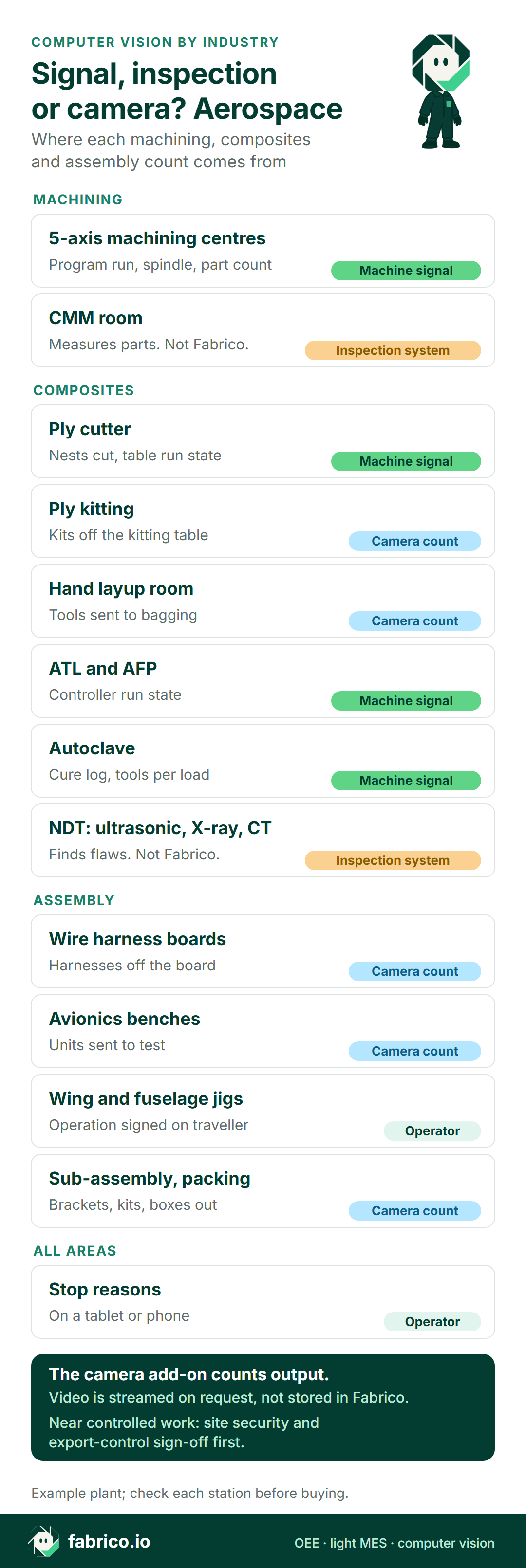
Text version of this infographic
- Machining: 5-axis machining centres: machine signal, program run, spindle, part count
- Machining: CMM room: inspection system, not Fabrico
- Composites: ply cutter: machine signal
- Composites: ply kitting: camera count, kits off the kitting table
- Composites: hand layup room: camera count, tools sent to bagging
- Composites: ATL and AFP: machine signal
- Composites: autoclave: machine signal, cure log, tools per load
- Composites: NDT, ultrasonic, X-ray, CT: inspection system, not Fabrico
- Assembly: wire harness boards: camera count, harnesses off the board
- Assembly: avionics benches: camera count, units sent to test
- Assembly: wing and fuselage jigs: operator, operation signed on the traveller
- Assembly: sub-assembly and packing: camera count
- In every area, stop reasons come from the operator on a tablet or phone
- Camera add-on: counts output; video for the minute of a stop streams on request and Fabrico keeps no copy
- Near controlled work: site security and export-control sign-off first
Book a demo to see harness boards, kitting tables and packing benches counted on one shift timeline.
Worked example: one harness cell, tally against audit, in money
Example numbers, no real plant. A harness cell runs two form boards from 06:00 to 14:15 with a 30-minute lunch: 7.75 planned hours per board, 15.5 board hours for the cell. Board A builds a harness with a routing standard of 2.0 hours, board B one at 2.6 hours. The camera add-on counts harnesses at the hand-off rack, the tester logs results, and the team lead enters stop reasons. The stamp-based shift report says the cell ran all shift with no rejects; the audit applies the five fixes.
| Figure | Shift tally | Audited | Which miscount |
|---|---|---|---|
| Run time | 15.5 h | 13.75 h | Kit wait and FAI buy-off booked as running (2, and the FAI time side of 1) |
| Earned hours | 12.4 h | 11.2 h | Part-built harness credited at 60% (3) |
| Good earned hours | 12.4 h | 9.2 h | Failed harness counted good before rework (4) |
| OEE | 80.0% | 59.4% | All of the above |
Availability. Board B stood 1.25 hours for a connector kit that kitting had sent short, and 0.5 hours for the quality engineer's FAI buy-off on the first harness of a new revision. Run time was 13.75 of 15.5 board hours: 88.7%.
Performance. Board A ran all 7.75 hours and lifted off 3 harnesses, earning 6.0 hours. Board B ran 6.0 hours and lifted off 2, earning 5.2 hours. That is 11.2 earned hours from 13.75 hours of running: 81.5%.
Quality. One harness from board A failed the continuity test on a swapped pin and went to rework under a nonconformance report. Its 2.0 hours leave the good figure: 9.2 of 11.2 hours, or 82.1%.
OEE. 88.7% x 81.5% x 82.1% = 59.4%. The quick check: 9.2 good earned hours of 15.5 planned board hours is 59.4%. The tally's 80.0% is 12.4 of 15.5, with availability and quality both at 100%.
Of board A's 1.75 slow hours, 1.2 sit in a fourth harness, about 60% built, which earns its 2.0 hours next shift; real slow running is 0.55 hours on A and 0.8 on B. The loss to chase is the kit shortage, and the kitting table count shows it started in kitting, not at the board.
In money. Aerospace orders wait: FACC's report says the order books of the large aircraft makers were well filled with firm orders for 17,163 aircraft from airlines at the end of 2024. While orders wait, a lost hour here is output a customer wanted, so it is priced at margin. Take an example contribution of EUR 120 per earned hour, an input to replace with your margin per harness divided by its standard hours. Public figures will not give you this number: FACC reported a 4.4% EBIT margin for its aerostructures segment in 2024, and EBIT is struck after fixed costs that a lost hour does not save.
Stops (1.75 hours) and real slow running (1.35 hours) make 3.1 lost hours: EUR 372 (3.1 x 120). The 1.2 hours in the part-built harness come back next shift and are not priced. The failed harness ships after rework, so it is priced at crew time: 0.75 hours to de-pin, re-pin and retest at an example EUR 48 an hour is EUR 36. The shift lost EUR 408. The kit shortage alone cost EUR 150 (1.25 x 120); if a shortage like that hits once a week, 44 working weeks make it EUR 6,600 a year from one cell. Fabrico prices losses the same way, from the plant's own SKU price or margin.
Questions for a camera vendor, and the export-control gate
| Question | What a good answer shows |
|---|---|
| Where on a harness board does the camera count? | At the hand-off rack, not over the board where hands move. |
| What if two people reach into the count zone? | A plain answer on missed counts, and a zone placed to avoid it. |
| When does a completion earn standard hours? | At the closing operation, never by percent complete. |
| How are short kits booked? | As a stop where work waits, not as kits out. |
| How does a reworked or MRB part count? | Once; quality from the NCR log; never first-pass good. |
| Can it report parts and shipsets separately? | Parts per station; sets as crates leave packing. |
| How are FAI runs booked? | Their own loss code, not slow work. |
| Where does video go near controlled work? | A written data flow security and export-control officers can review. |
People at the board, and the works council
A camera near a harness board will see people. Agree with staff, and in many European countries with the works council, what the count is for before anything goes up. Aim at the hand-off rack, not the assembler, and publish counts per board and shift, never per person. Checklist: cameras on the line without surveillance.
Export control comes first near controlled work
A camera near a defence programme, controlled drawings or a restricted area needs sign-off from the site's security and export-control officers first, covering position, field of view and where the video goes. The reason is in the definition: under the US ITAR, technical data includes information in the form of blueprints, drawings, photographs, plans, instructions, or documentation, so a frame showing a controlled drawing is a question for them, not for the camera vendor. Fabrico makes no export-control or ITAR compliance claim. Ask each vendor for a written data flow.
Where Fabrico fits in an aerospace plant
Fabrico is cloud OEE software with light MES functions. Against the five miscounts it does three things today:
- In the machine shop it reads run state and part counts from CNC controllers, so setups, prove-out and FAI waits show as stops with a reason.
- At harness boards, kitting tables and packing benches the camera add-on counts harnesses at the hand-off, complete kits leaving and shipset crates closed. Where a camera add-on covers the station, the video for the minute of a stop can be opened from the shift timeline, streamed on request and not stored in Fabrico.
- Against the routing you set each part number's ideal cycle time to its routing standard hours, so a counted completion earns those hours and performance reads in earned hours rather than units per minute.
Assemblers, laminators and machinists type stop reasons on a tablet or phone. Fabrico shows OEE and losses by station and shift, with the losses in money, on the web, iOS and Android. Figures reach the ERP or quality system by REST API, webhook, or Excel and CSV; how holds and rework sit beside OEE is in quality holds and OEE.
On the roadmap, not available today: a camera add-on that flags an idle harness board without being told, and proposes the likely cause.
Outside Fabrico: CMM measurement, NDT, continuity testing, robot guidance, cure control and the traceability record. Serial numbers, lots, the traveller, the MRB disposition and the FAI report stay in the ERP and the quality system of record.
The product page is Fabrico computer vision for OEE; OEE with computer vision shows how camera add-on counts become an OEE figure, and the wider buying guide is OEE software. See also OEE software for AS9100 aerospace manufacturing and OEE software for aerospace and defense manufacturing. Put Fabrico through the eight questions above too.
What aerospace teams ask next
Can a counting camera inspect composite parts or harnesses?
No. NDT finds voids, a CMM measures machined parts and a continuity tester proves harnesses. A counting camera only records that a finished unit left; reject and NCR counts from those systems feed OEE quality.
Does a reworked harness count as good output?
It ships, so it counts as output once, but never as first-pass good. Count it at first pass, keep the failure in the NCR log, and price the rework at crew time rather than lost margin.
How do you count output when one assembly takes days?
Use the operation sign-offs on the traveller as completions, entered by the team lead at the jig, and credit each with its routing standard hours. Read OEE weekly, because unfinished work earns nothing until the operation closes.
Should an aerospace plant count parts or shipsets?
Both, as two numbers. Parts per shift show whether a station runs at its standard; complete shipsets leaving packing show whether the customer's line can build.
Can cameras be used near export-controlled work?
Only after the site's security and export-control officers have approved the position, the field of view and the data flow. Fabrico makes no export-control or ITAR compliance claim.
Want to see harness boards, kitting tables and shipset crates counted on one shift timeline beside your 5-axis machining centres? Book a demo.
Related articles










Real Fabrico tiles, sample data.