


 Login
 Blog

Computer Vision for Aluminum Extrusion: Find the Station That Holds the Press Back

In short: computer vision counts profiles where no PLC does, so the counts into and out of each queue show which station holds the press back.
- The queue test: if the cooling table stays full while the stacking count stays flat, stacking is the constraint, not the press.
- Press, puller, stretcher and saw already report through their PLCs; hand stacking, racking and packing benches usually do not.
- Count baskets and bundles, not single profiles in a stack: published counting research still struggles to separate stacked objects.
- Price lost press minutes at margin only while orders wait for that die; scrap metal goes back to the cast house.
This is counting, not inspection: gauges, the lab and surface checks still judge each profile against its specification, such as ASTM B221 for extruded bars, rods, profiles and tubes, and a camera add-on only counts what leaves a station.
Most extruders know their press numbers: pushes, dead cycle and die changes sit in the press PLC. What they rarely know is whether the press ran slow on its own or waited for the people behind it. The answer sits in the queues between stations.
The queue test: where the count stops on an aluminium extrusion line
An extrusion line is a chain of stations with a buffer between each pair. Profiles pile up in front of the slowest one and the stations behind it run dry. That gives a simple test with three readings per queue: what went in, what came out and what sits in between.
- Full queue, flat count out: the station after the queue is the constraint.
- Empty queue, station waiting: the station is starved; look upstream.
- Queue that fills and empties: a batch station, such as the ageing oven, setting its own rhythm.
| Queue | Count in | Count out | Full queue means |
|---|---|---|---|
| Billet store to heater | Billets loaded, heater PLC | Billets to the press, press PLC | The press is waiting on a die, a hot die or the puller |
| Run-out and cooling table | Strands cut by the hot saw | Strands into the stretcher, stretcher PLC | Stretcher, saw or stacking is slower than the press |
| Saw table | Cuts, saw PLC | Layers into baskets: stacker PLC or camera add-on | Stacking is the constraint |
| Baskets before the oven | Full baskets off stacking | Baskets loaded, oven log plus a count | Oven capacity or oven scheduling |
| Aged baskets | Baskets out of the oven | Profiles racked, hung or bundled: camera add-on | Finishing or packing |
Line builders design for this. A Light Metal Age report on a new 9-inch line in Quebec describes a runout table with under-table coolers, a 75 ton automated stretcher, and a layer conveyer for seamless batch changes without bottlenecks. Most plants run older lines with less buffer and more hand work after the saw, which is where the test earns its keep. The general method is in bottleneck analysis; what follows is the extrusion version.
Explainer presented by Iris, Fabrico's AI-generated presenter: how an add-on camera counts output where a machine has no signal. Book a demo.
Plays from YouTube. Google may set cookies when you press play. Privacy policy.
Which station holds output back in an extrusion plant?
There are five usual suspects, and each leaves a different trace in the counts:
- The press: die changes, die corrections, a slow hot die. The cooling table runs empty.
- The puller: slow grips at the start of a push, puller faults. The press waits with metal in the container.
- Stretcher and finish saw: awkward sections, blade changes. The cooling table fills.
- Stacking: two people lifting lengths into baskets, or a stacker fault. The saw table, then the cooling table, fill.
- Ageing oven, finishing and packing: baskets wait for a load, a rack or a bench. The press runs on until floor space runs out.
Only the last two usually lack a machine count. That is why a search for the bottleneck or constraint on an extrusion line so often blames the press: it is the only station that reports its own time. The flow below is an example plant with one press and three finishes.
Book a demo to see press signals and stacking counts on one shift timeline.
Press and puller: what the press PLC already reports
Start at the press, because its PLC gives the cleanest data in the plant. Each billet cycle has two parts. A 2025 study of puller design from AGH University of Krakow in Archives of Metallurgy and Materials gives the operating time for 6xxx alloys as approximately 3 minutes, depending on billet length, and the dead time between billets as about one minute, or twenty seconds on an advanced press. It also cites a reported 0.7 to 1.0% productivity gain for every second cut from dead time.
So the dead cycle is the press number to watch, and the first question is why it stretched. The same paper finds that feeding the profile into the puller by hand takes approximately 60 to 90 seconds in practice. That is a press loss. A dead cycle that stretches because the run-out is still full is not: the press is blocked from downstream, and the fix is elsewhere.
Book die changes and die corrections under their own stop codes. A day of new dies then reads as die time, not as a slow press. Plastic lines face the same split between line stops and scrap in OEE for pipe and profile extrusion, and where a blocked minute belongs is set out in availability loss versus performance loss.
Cooling table and stretcher: the buffer that tells the truth
After the quench, the hot saw cuts strands to table length and the cooling table carries them sideways to the stretcher. That table is the line's main buffer. It holds a few billets' worth of metal, and its level says more about the constraint than any single machine signal.
- Table filling, stretcher cycles steady: the stretcher keeps pace with what it gets, so the hold-up is further down, at the saw or stacking.
- Table filling, stretcher cycles falling: the stretcher is the constraint; long or twisted sections and jaw changes are the usual reasons.
- Table empty, press dead cycle long: the press is starving the line, so go back to dies, billets and the puller.
Both counts already exist in the hot saw and stretcher PLCs. What most lines miss is the two numbers side by side per quarter hour, under the press pushes. More on starved and blocked time in starvation, blocking and line balance.
Finish saw and stacking: where a camera earns its count
The finish saw cuts stretched strands to order length and cuts off the ends. Its PLC counts cuts, and the scrap scale beside it weighs butts, ends and rejects. From here the counting usually stops.
New lines stack automatically. The Quebec line uses an automatic stacker and basket lifter to reduce labour after the saw, and the report says the plant can be run with three operators and a supervisor. Many presses still have two people at the end of the saw table, lifting lengths into ageing baskets with spacers between layers. Their output appears on a tally sheet at shift end, if anywhere. When one of them is called away, stacking slows, the saw table fills, then the cooling table, and the press waits in its dead cycle. In the press log that loss looks like a slow press.
A camera add-on above the stacking table counts layers or full baskets leaving it. That single count closes the gap in the queue test: saw cuts in, layers out. It also tightens the quality figure. A University of Michigan study of extrusion scrap estimates that around 40% of the billet is likely to be scrapped before the profile ends up in a product, across the whole extruded supply chain, with the transverse weld between billets one of the largest sources. One press sees only its share of that, but the share is booked here, in kilograms at the saw.
Ageing oven: a batch station with its own clock
Most 6xxx profiles get their temper in a batch oven. The Aluminum Extruders Council process guide says that after sufficient ageing, whether in an ageing oven or at room temperature, profiles move on to finishing, fabrication or packing. On the Quebec line, baskets are loaded into the oven automatically and the oven runs several temper recipes.
A batch station breaks the simple queue test, because baskets are meant to wait for a full load. The question changes from "is the queue full" to "is it full at the wrong time":
- Baskets waiting at the end of most shifts: the oven, or its schedule, holds output back. Count baskets in and out per shift.
- Loads leaving half empty: the oven is not the constraint, but it is losing hours. The oven log shows a clean cycle, not how full it was.
- Aged baskets piling up after the oven: the constraint has moved to finishing or packing.
For how batch time fits into OEE, see OEE for batch processes.
Finishing and packing: racks, hooks and bundles
After ageing, profiles go three ways: to anodising, to powder coating or straight to packing as mill finish. Each route has a hand station with no count of its own.
- Anodising racking: profiles are clamped by hand onto jigs on a flight bar. The hoist PLC knows bars, not profiles per bar.
- Powder coating hang-on: profiles hang on hooks through pretreatment, booth and oven. The conveyor PLC knows chain speed, not empty hooks.
- Packing: lengths are interleaved, wrapped and strapped. The Quebec plant runs two semi-automated packaging lines; older halls pack at a bench with a list filled in at shift end.
A camera add-on at racking, hang-on or the packing bench counts profiles racked, profiles hung or bundles closed, so aged baskets in and finished output out can be compared. Before automating a packing bench, measure the manual packing first.
Where to start counting, and what a camera cannot count
Count in this order, and stop as soon as the constraint is clear:
- Press PLC signals: pushes, dead cycle, die changes. They cost nothing new and set the baseline.
- Hot saw and stretcher cycles: already in their PLCs; they show whether the cooling table is filling.
- The queue you suspect: usually layers leaving hand stacking, counted by a camera add-on.
- Baskets into and out of the oven: a count per shift, from the stacker, the oven loader or a camera add-on.
- Racking, hang-on or packing: only if aged baskets pile up.
Be clear about the camera's limits. Peer-reviewed counting research is useful here because it states them. A 2024 paper in IEEE Transactions on Industrial Informatics by researchers at Wuyi University, South China University of Technology and the University of Milan starts from the point that counting workpieces by hand is an error-prone task, then notes that it is currently difficult to perfectly resolve subparts of stacked objects, and that the detector may fail to detect workpieces that are completely obstructed. Its answer for stacked bundles is to count each bundle as one target and multiply by the fixed number per bundle. The paper tests images of workpieces in general, not an extrusion plant, and its figures are not a Fabrico accuracy figure.
For an extrusion line that means three rules. Count layers or full baskets, not single profiles inside a stack. Mount the camera where the layer is laid down in clear view, not where the stacker's arms cover it. And plan for glare off bright metal and heat haze over a saw table. How the counts become OEE is in OEE from computer vision counts.
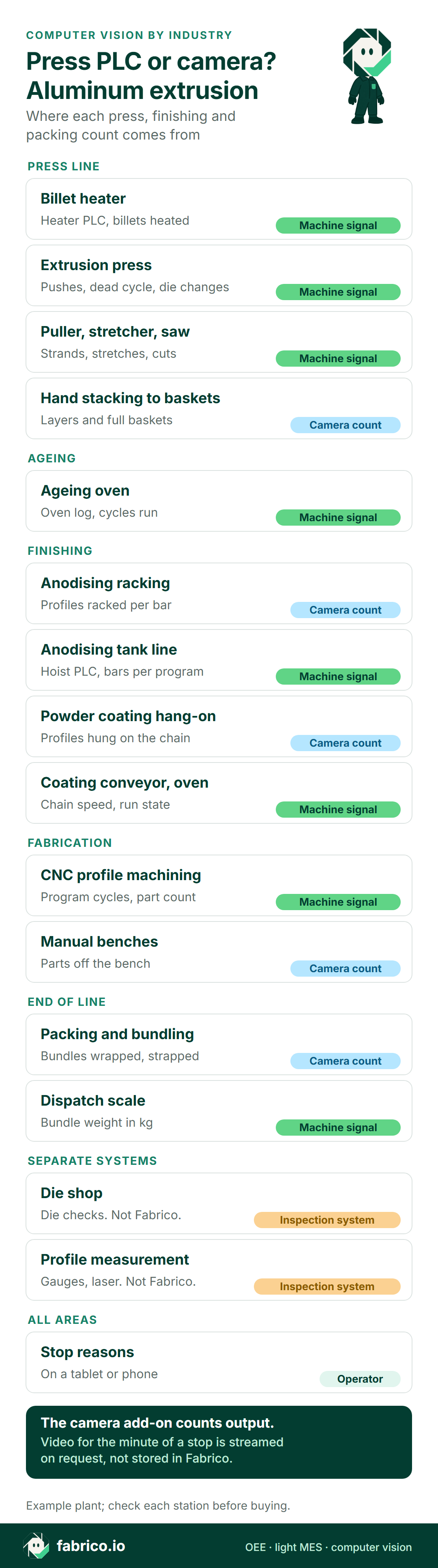
Text version of this infographic
- Press line: Billet heater: machine signal, Heater PLC, billets heated
- Press line: Extrusion press: machine signal, Pushes, dead cycle, die changes
- Press line: Puller, stretcher, saw: machine signal, Strands, stretches, cuts
- Press line: Hand stacking to baskets: camera count, Layers and full baskets
- Ageing: Ageing oven: machine signal, Oven log, cycles run
- Finishing: Anodising racking: camera count, Profiles racked per bar
- Finishing: Anodising tank line: machine signal, Hoist PLC, bars per program
- Finishing: Powder coating hang-on: camera count, Profiles hung on the chain
- Finishing: Coating conveyor, oven: machine signal, Chain speed, run state
- Fabrication: CNC profile machining: machine signal, Program cycles, part count
- Fabrication: Manual benches: camera count, Parts off the bench
- End of line: Packing and bundling: camera count, Bundles wrapped, strapped
- End of line: Dispatch scale: machine signal, Bundle weight in kg
- Separate systems: Die shop: inspection system, Die checks. Not Fabrico
- Separate systems: Profile measurement: inspection system, Gauges, laser. Not Fabrico
- All areas: Stop reasons: operator, On a tablet or phone
- Camera add-on: counts output; video for the minute of a stop is streamed on request, not stored in Fabrico
Questions for an extrusion OEE or camera vendor
Put one week of press shift reports in front of each vendor and ask:
| Question | What a good answer shows |
|---|---|
| Can it show counts in and out of a queue on one timeline? | Press pushes, stretcher cycles and stacking layers side by side per quarter hour, so a full cooling table is visible. |
| How is a blocked press told from a slow press? | A rule that uses the downstream count, not the press signal alone, before speed loss is booked to the press. |
| Can each die carry its own ideal billet cycle? | An ideal per die and alloy, push plus target dead cycle, not one rate for the press. |
| What does the camera count at hand stacking? | Layers or full baskets leaving the table, not single profiles in a stack and not people. |
| How are oven loads shown? | Baskets loaded against oven capacity, and cycles run against cycles planned. |
| Where does the stacking table video go? | A written data flow the works council can read before a bracket goes up. |
One early shift, priced: the stacking table held the press back
Example inputs, not a real plant. A 7-inch press works 06:00 to 14:00; after the 30-minute break, 450 minutes are planned. It runs a 6063 window section on a two-hole die from 60 kg billets. The die's ideal billet cycle is 2.0 minutes: about 80 seconds of push for this light section plus a 40-second target dead cycle, inside the range the AGH paper gives. That is an ideal of 30 billets or 1,800 kg an hour; the Quebec 9-inch line is rated at around 4,750 lb, about 2,150 kg, an hour. On this die one billet fills about one basket layer.
Availability. The 10:30 die change took 30 minutes, the new die needed a 20-minute correction after its trial pushes, and a puller fault cost 10. The press ran 390 of its 450 planned minutes: 86.7%.
Performance. 169 pushes at 2.0 minutes is 338 ideal minutes in 390 run minutes: 86.7%. That leaves 52 slow minutes, and the press log puts all of them on the press.
Quality. 169 billets of 60 kg is 10,140 kg. Butts, end scrap and one rejected basket weighed 1,080 kg, or 18 billets. Good output was 9,060 kg: 89.3% recovery, or 302 of 338 minutes.
OEE. 86.7% x 86.7% x 89.3% = 67.1%. Check: 302 of 450 minutes is 67.1%, and 9,060 kg over 7.5 hours is 1,208 kg an hour against 1,800, also 67.1%.
The queue test. Now put the stacking count next to the press count. At 08:30 one of the two stackers went to help at the finish saw.
| Half hour | Billets pushed (press PLC) | Layers stacked (camera add-on) | Billets' worth on the cooling table at the end |
|---|---|---|---|
| 08:00 to 08:30 | 15 | 15 | 2 |
| 08:30 to 09:00 | 12 | 8 | 6, full |
| 09:00 to 09:30 | 8 | 8 | 6, full |
| 09:30 to 10:00 | 8 | 8 | 6, full |
| 10:00 to 10:30 | 15 | 21 | 0 |
From 08:30 the stacking count drops to 8 layers a half hour and stays there. The cooling table is full by 09:00, and from then on the press pushes exactly what stacking takes away. In those 90 minutes the press pushed 28 billets, worth 56 ideal minutes: 34 of the 52 slow minutes. When the second stacker came back at 10:00, stacking cleared the table at 21 layers and the press went straight back to 15 billets a half hour. The press was blocked, not slow. The remaining 18 slow minutes are spread over the rest of the shift and do belong to the press.
Money. At the ideal cycle, 450 minutes would have made 225 billets, or 13,500 kg. The shift made 9,060 good kilograms, so 4,440 kg went missing. At an example contribution margin of EUR 0.80 per good kilogram, which the plant replaces with its own, that is EUR 3,552 for one shift, and it is lost margin only while orders wait for this die. The 34 blocked minutes are 17 billets, 1,020 kg and EUR 816. The fix is not a faster press; it is a second person kept at the stacking table, or a stacker.
The 1,080 kg of scrap is not priced at metal value. It goes back to the cast house as new scrap, as most recycled aluminium in the US does: the USGS reports that about 56% of the 3.6 million tons recovered from purchased scrap in the US in 2025 came from new manufacturing scrap. Remelting saves the metal, not the press time, energy and die time spent on it, which is why the minutes, not the kilograms of metal, carry the cost. Fabrico prices losses the same way, from the plant’s own price or margin per product. For the yield side, see yield versus scrap rate.
Where Fabrico fits on an extrusion line
Fabrico is a cloud OEE platform with light MES functions. For a constraint hunt on an extrusion line, that means:
- Press signals. Pushes, billet count, dead cycle and die changes come from the press PLC, and run state from heater, puller, stretcher and saw. Die changes, corrections and puller faults appear as stops, and the press operator gives the reason.
- Counts at the queues. The camera add-on counts layers and baskets at hand stacking, profiles at racking or hang-on, and bundles at packing, so counts in and out of each queue sit on one shift timeline. Where a camera add-on covers the station, the video for the minute of a stop can be opened from the shift timeline, streamed on request and not stored in Fabrico.
- Ideal per die. Each die gets its own ideal billet cycle, so performance is judged against the die that ran.
Stackers, rackers and press operators enter stop reasons on a tablet or phone. OEE and losses, also in money, show per press, line and shift on the web, iOS and Android. Data leaves by REST API, webhooks, or Excel and CSV export.
Stackers and rackers will be in the picture. In Germany, Section 87 of the Works Constitution Act gives the works council a right of co-determination over technical devices designed to monitor the behaviour or performance of employees, so agree the purpose and the data flow before installation. Point the lens at the basket, flight bar or bundle, not the person, and report per press and shift only.
Roadmap, not yet available: a camera add-on that spots an idle stacking table or racking station by itself and proposes a likely cause.
Outside Fabrico: die inspection and correction, profile measurement, surface inspection, film and coating tests, oven temperature control, and cast and heat-treatment records, which stay in the ERP and quality system.
See the computer vision for OEE feature page and the guide to evaluating OEE software.
Extrusion bottleneck questions
How do I tell a slow press from a blocked press?
Look at the cooling table. If it stays full while the stretcher or stacking count is flat, the press is blocked and the loss belongs downstream. If the table is empty while the dead cycle stretches, the press, die or puller is slow. A drum-buffer-rope schedule then paces the line to the real constraint.
Which extrusion station gets the first camera?
The queue you suspect, usually hand stacking onto ageing baskets or the packing bench. Both release profiles all shift with no machine count, while press, puller, stretcher and saw already report through their PLCs.
Can a camera count single profiles inside a stacked basket?
Not reliably. Count layers or full baskets as they leave the table and multiply by the known pattern, which is how published counting research handles stacked bundles too.
Is the ageing oven ever the constraint?
Yes, when full baskets wait in front of it on most shifts. Count baskets in and out, and loads against oven capacity: a half-empty load loses oven hours even with a clean oven log.
Should butt and end scrap count against quality?
Either rule works if every press uses it. Counting them shows the full recovery loss, so gains from shorter butts and longer billets become visible; leaving them out shows rejects only.
Want to see the queue test on an extrusion line? Book a demo to see the press, the stacking table and the packing bench counted on one shift timeline.
Related articles











Real Fabrico tiles, sample data.