


 Login
 Blog

Computer Vision for Can Manufacturing: Find Where Your Can and End Counts Go Wrong

In short: Computer vision for can manufacturing counts what PLCs miss: bags of end sticks, pallets released from hold and hand-packed orders. Machine counters handle the rest.
Inspection is a different job: light testers and inside-can vision judge each can, while a counting camera only says how many left a station.
- A cupper counts cups and a bodymaker counts strokes; neither is the number of good cans that shipped.
- Spoilage between two counters is counted nowhere unless each chute has a counter or a scale.
- Pallets on hold are not output until released; re-sorted cans count once, after the re-sort.
- Fabrico's camera add-on counts bags, pallets and cartons where no machine counter sits; Fabrico does no inspection.
A can plant is full of counters, and that is the trouble. The cupper, every bodymaker, the light tester and the palletizer each report a number, and no two agree. The shift report takes whichever one somebody picked.
This page audits those numbers: eight miscounts, the fix for each, and the station that should own the count. It covers the can maker's side only. Filling, seaming and the retort happen at the canner; read the computer vision guide for canned food lines for that side, and can seamer OEE for the lid feed.
The can plant miscount table: eight errors, eight owners
Each row is a miscount, where it hides, the fix and the station that should own the number. The tags come back in the plant diagram below.
| Tag | Miscount | Where it hides | Fix | Station that owns the count |
|---|---|---|---|---|
| M1 | Cups booked as cans | The cupper counts cups, before any can exists | Cupper count as input only | Each bodymaker |
| M2 | Line total hides a bodymaker down | The line counter runs on during one punch change | Count and run state per bodymaker | Each bodymaker |
| M3 | Spoilage between counters | Tear-offs, kick-outs and necker jams | A counter or scale at each reject chute | Machine with the chute |
| M4 | Light tester rejects read as a cause | The count says how many leaked, not why | Count into quality; QA sets the cause | Light tester (count only) |
| M5 | Ends counted at the press | Ends ship in sticks inside bags | Closed bags times the count per bag | Bagging table |
| M6 | Held pallets counted as good | Counted when wrapped; some never ship | Out of good output until released | HFI area |
| M7 | Sheets booked as bodies | One sheet holds many blanks | Count bodies at the welder | Welder |
| M8 | Hand-packed orders never counted | Short runs bypass the palletizer | Count cartons at the bench | Packing bench |
Five of the eight are fixed with signals the plant already has, plus a rule about which number counts. Only M5, M6 and M8 need a new count, because bags, held pallets and hand-packed cartons leave with no counter behind them. That is where a camera add-on earns its place.
Explainer presented by Iris, Fabrico's AI-generated presenter: how an add-on camera counts output where a machine has no signal. Book a demo.
Plays from YouTube. Google may set cookies when you press play. Privacy policy.
Cupper, bodymaker or palletizer: which count is the output?
On a two-piece line, the Can Manufacturers Institute says the cupping press “punches out hundreds of cups per minute from huge coils of aluminum or steel”. The cups feed a bank of bodymakers, and the UK's National Physical Laboratory notes each body is formed in one punch stroke by a bodymaker “in about one fifth of a second”, with a single line making up to 500 million cans a year.
Three counts, three meanings:
- Cupper (M1): cups made, the bodymakers' input. A cup that tears in a bodymaker was counted here and never becomes a can.
- Bodymakers (M2): strokes per machine, which give each bodymaker its own availability and speed.
- Palletizer: cans on pallets, the closest to output, but still including pallets that will go to hold (M6).
The usual mistake is to read OEE from the line counter after the necker. With one of eight bodymakers out, it still shows thousands of cans a minute, so nobody records a stop. NPL explains why this is frequent: the punches “need to be removed regularly for maintenance”. Each punch change is a stop on one bodymaker and belongs on its record; see OEE for beverage can making. Speed works the same way: set the ideal rate per bodymaker from the tool pack and can size running, as in rate loss on high-speed lines.
The rule: the palletizer, corrected for holds, owns output; each bodymaker owns its availability and speed; the cupper owns metal in. A camera here would only repeat a working counter.
Spoilage: cans counted twice or not at all
Between the bodymakers and the palletizer, cans leave the line at several points, and each one is a gap between two counts (M3). The body wall is thin enough that a torn can is routine: a peer-reviewed study in Materials Transactions describes drawing, re-drawing and three ironing passes, after which “the thinnest part of the can wall after 3rd ironing is about 0.1 mm”. A tear-off at that gauge stops the bodymaker and sends metal to scrap.
Further down, the washer, decorator and necker kick out cans too. Without counters there, the plant knows only bodies formed minus cans palletized: spoilage with no machine to pin it on.
The fix has two parts:
- Count at the chute. Most reject gates already fire a signal; read it as a count and book it on the machine that ejected the can. Where a chute has no signal, a photo eye is usually enough.
- Weigh the scrap each shift. Divide bin weight by one body's weight and compare with counted rejects. If they drift apart, a chute has no counter, or a counter double counts.
One percent spoilage on a line making 500 million cans a year is 5 million cans of metal that went through presses, washers and ovens for nothing. Give each spoilage type its own code; a starting list is in this scrap and rework reason code taxonomy.
Light tester rejects: inspection gives a count, never a cause
After necking and flanging, the CMI guide notes that “each can is mechanically tested for leakage”. In a two-piece plant this is the light tester, which rejects any can that lets light through.
The light tester does its job. The miscount (M4) is in how its number is read. A reject count says how many cans leaked, not why. A pinhole can come from a worn punch, a scratched ironing die, the coil or the conveyor. Booked as a light tester problem, it blames the tester for what a bodymaker made.
Book it this way:
- The reject count goes into the quality part of OEE as a number.
- The cause is a separate field set by QA or the shift lead. If a reject trend lines up with one bodymaker's tool change, the cause goes on that bodymaker.
- If the reject rate trips a limit and pallets go to hold, that is M6, counted at the HFI area.
Cans formed and cans passed are what OEE calls total count and good count; see good count vs total count. Fabrico does no inspection, and it does not replace the light tester, inside-can vision or the QA lab.
End counts: shells, lined ends and bags of sticks
An end plant has its own chain of counts (M5). The shell press stamps shells, the curler rolls the edge, the compound liner lines the curl, and the conversion press forms the tab and scores the opening. US air rules treat lining as a step of its own: 40 CFR 63.3481 says the end coating subcategory “includes the application of end seal compounds and repair spray coatings to metal can ends”. So the liner keeps its own count, and shells lined are not yet ends converted.
Ends are also formats: ISO 5099 “specifies classification and the key dimensions of easy-open ends and peel-off ends”, in plate no more than 0.49 mm thick. Each type has its own tooling and rate, so count per end type. On the CMI's three-piece example, ends are stamped “at the rate of 650 ends per minute”.
Every press counts strokes, and strokes times the outs in the die give shells or ends, as in OEE software for stamping and press operations. The count goes missing at the end. The CMI guide notes that “finished ends are packed into tubes for delivery”: ends are stacked into sticks, sticks go into paper bags, and in many plants people close and stack the bags. Nobody counts how many were packed.
Can a camera count the ends themselves? Not inside a stick. A 2025 EPFL study at ICCV, a peer-reviewed computer vision conference, notes that counting methods struggle with stacked objects “in which most objects are hidden by those above them”, and found the task “truly challenging even for humans”. Their method needs several views and a container; it is research, not a bagging table tool. Hands over the table, overlapping bags and glare on a shiny bag hide things from any camera.
So the camera add-on counts closed bags leaving the table exit, and a fixed count per bag turns bags into ends. Press count minus bag count is ends made but not packed.
Three-piece and aerosol lines: a sheet is not a body
A three-piece food can line starts from flat sheet, so the first count is sheets (M7). The CMI guide describes coil cut into sheets “at the rate of 160 sheets per minute on the shear press”, with up to 35 body blanks per sheet. Blanks are then rolled, welded, flanged, beaded and closed with the bottom end.
A sheet count serves metal yield and the coating and printing lines. It is not output. Count bodies at the welder, one per can, and take spoilage at the flanger and beader at the chute, booked to the machine.
Losses here are format losses: a new diameter or height changes slitter, welder, flanger and beader tooling. Time each change from the PLC; the operator picks the type: size, design, or first-off release. Aerosol lines add short runs packed by hand into trays or cartons (M8); a camera add-on at the packing bench counts the trays.
Held pallets: built is not shipped
When the light tester trips a reject limit or the QA lab finds a fault, the pallets built in that window go to hold (M6). The palletizer already counted them. Later some are released, some re-sorted and some scrapped. Taken from the palletizer, the night that made a held pallet looks better than what the warehouse received.
Four booking rules fix it:
- A held pallet leaves good output at once, for the shift that made it.
- A released pallet returns to that shift's good output.
- Re-sorted cans count once, after the re-sort, as good or scrap.
- A scrapped pallet is a quality loss for the shift that made it.
The data usually sits in a paper HFI log. A camera add-on over the HFI area or re-sort table can count pallets released and rebuilt, so quality moves when a pallet leaves hold. Designing the hold is covered in quality hold process design, and one record for holds, rework and release in quality holds and OEE.
Where a camera counts: one plant's flow, mapped
One example plant: a cupper feeding eight bodymakers, plus an end line in the same building. Real plants differ, so walk each machine first.
Green boxes already count; the amber light tester hands over a reject count; the blue boxes are where output leaves uncounted. At the palletizer output splits into shipped and held; see palletizer OEE.
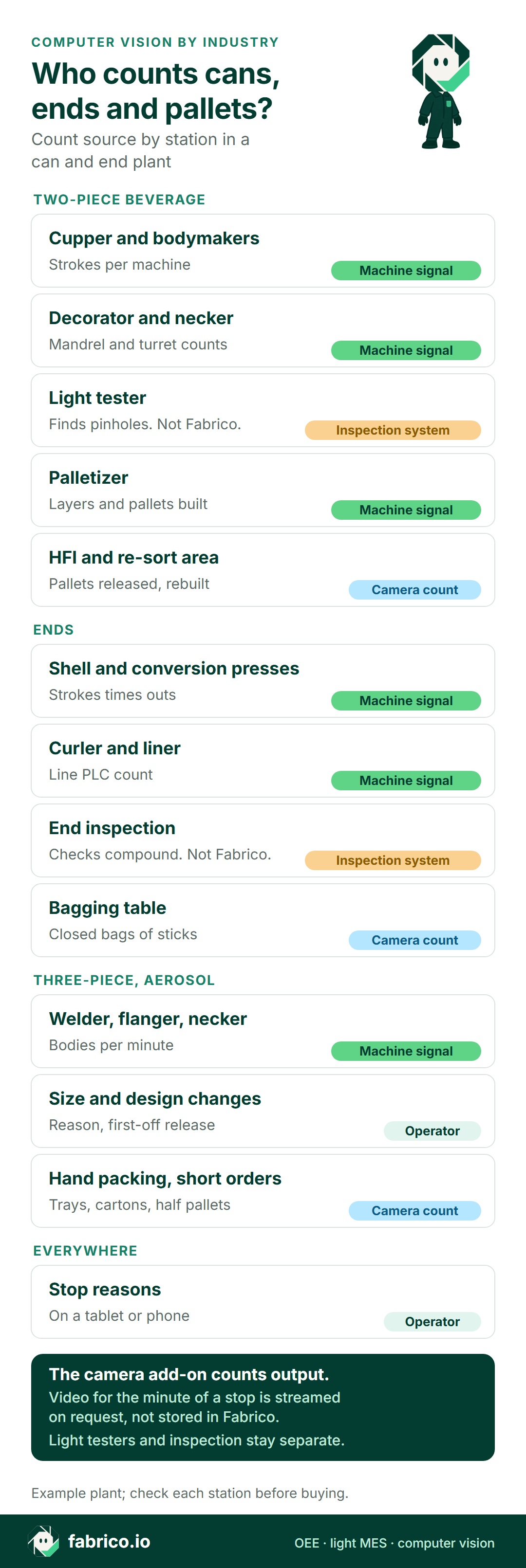
Text version of this infographic
- Two-piece: cupper and bodymakers: machine signal, strokes per machine
- Two-piece: decorator and necker: machine signal, mandrel and turret counts
- Two-piece: light tester: inspection system, finds pinholes, not Fabrico
- Two-piece: palletizer: machine signal, layers and pallets built
- Two-piece: HFI and re-sort area: camera count, pallets released and rebuilt
- Ends: shell and conversion presses: machine signal, strokes times outs
- Ends: curler and liner: machine signal, line PLC count
- Ends: end inspection: inspection system, checks compound, not Fabrico
- Ends: bagging table: camera count, closed bags of sticks
- Three-piece, aerosol: welder, flanger, necker: machine signal, bodies per minute
- Three-piece, aerosol: size and design changes: operator, reason and first-off release
- Three-piece, aerosol: hand packing of short orders: camera count, trays, cartons, half pallets
- Everywhere: the operator enters the stop reason on a tablet or phone
- The camera add-on counts output; video for the minute of a stop is streamed on request, not stored in Fabrico
- Light testers and inspection stay separate
- Example plant; check each station before buying
Book a demo to see bodymaker, palletizer and bagging table counts on one shift timeline.
Worked example: the bagging sheet said 80.4%, the audit says 75.7%
Example numbers, no real plant. An end plant's afternoon shift runs 14:00 to 22:00 with a 20-minute break, so the bagging table behind one conversion press is planned for 460 minutes. Two packers close and stack bags. The sample ideal rate is 2 bags a minute, taken from the press's rated output and the count per bag. The camera add-on counts closed bags leaving the table, the press PLC records the press's own stops, and the shift lead enters the reasons.
The same shift, read from the hand bagging sheet and from the audited count:
| Figure | Bagging sheet | Audited count | Why they differ |
|---|---|---|---|
| Stops | 25 min | 60 min | The sheet has the bag supply wait only; the press tooling stop (20) and the forklift wait (15) were not written down |
| Bags closed | 740 | 712 | In three hours the sheet carries the hourly target of 120 bags instead of a count; those hours hold the 28 extra bags |
| Bags sent back by QA | 0 | 16 | Re-bagged bags go on the QA log, not the bagging sheet |
| Availability | 435 / 460 = 94.6% | 400 / 460 = 87.0% | Missing stops |
| Performance | 740 / 870 = 85.1% | 712 / 800 = 89.0% | Fewer running minutes, fewer bags |
| Quality | 740 / 740 = 100% | 696 / 712 = 97.8% | QA returns |
| OEE | 80.4% | 75.7% | 44 good bags on paper that never shipped |
The audited OEE. The table stood 25 minutes when paper bags ran out, 20 while the press changed tooling and sent no ends, and 15 with a full pallet waiting for a forklift: 400 of 460 minutes running, 87.0%. At 2 bags a minute that allows 800 bags; the camera add-on counted 712, 89.0%. QA sent 16 bags back for a wrong stick count or a tear, leaving 696 of 712 good, 97.8%. 87.0% x 89.0% x 97.8% = 75.7%, and 696 of the 920 bags that 460 minutes allowed is 75.7% too. In minutes: 348 good, 8 on bags sent back, 44 slow and 60 stopped, which adds back to 460. The sheet checks the same way: 740 of 920 is 80.4%.
Press tooling minutes belong to the press: code them as starved. The bag supply wait is the one to fix at the table, with a reorder point.
In money. No can maker publishes a price per bag of ends. The nearest public figure is a margin band: Ardagh Metal Packaging, which sells beverage cans and ends, reported for its European business Adjusted EBITDA of USD 257 million on revenue of USD 2,161 million for 2024, about 12 cents per dollar of sales. That is segment EBITDA, not contribution per bag, but it says margins are thin and the money is in volume. The EUR 2.50 contribution per bag used here is an example input; the plant puts in its own.
Stops and slow running cost 208 bags: 120 in the 60 stopped minutes and 88 in the 44 slow ones. At EUR 2.50 that is EUR 520 in one afternoon, but only while orders wait for ends and the table sets the pace for its press. The bag supply wait alone cost 50 bags, EUR 125; on 21 afternoon shifts a month, EUR 2,625. The 16 bags sent back are not lost: they are re-bagged and ship later. Re-bagging took one packer 20 minutes, at an example crew cost of EUR 30 an hour EUR 10. Fabrico does this pricing from the plant's own SKU price or margin, which puts the cheapest fix at the top of the list.
The sheet's 4.7 extra points are not money lost but money promised: a planner booking trucks from the sheet expects 44 good bags the warehouse will never receive.
Questions to put to a camera or OEE vendor at a can plant
Each question maps to a miscount above. A vague answer usually means the vendor has not been in a can plant.
| Question | What a good answer shows |
|---|---|
| How is each bodymaker's stroke counter read? (M2) | A count and run state per bodymaker, not one line total. |
| Where do cupper cups show up? (M1) | As input and metal yield, never as output. |
| How are reject chutes counted? (M3) | Per chute, booked to the machine that ejected, with a scrap weight cross-check. |
| How do light tester rejects reach OEE? (M4) | As a count for quality, with the cause entered by people and no inspection claim. |
| What does the camera count at an end bagging table? (M5) | Closed bags leaving the table, with a fixed count per bag and end type, not ends in a stick. |
| How are held pallets booked? (M6) | Out of good output until released, back to the shift that made them, re-sorted cans counted once. |
| Where can a camera sit near presses, washers and ovens? | A mount isolated from press vibration, out of washer spray and oven heat, with even light on the table. |
| Where does the video go, and who sees what? | A written data flow the works council and IT can review, with reports per table and shift. |
A camera over a bagging table or HFI area sees packers and forklift drivers. Tell them what the count is for before the bracket goes up, and in many European countries settle it with the works council first. Aim at the table exit or the pallet, not faces, and report per table and shift, never per person; see GDPR and production line cameras.
Where Fabrico fits in a can plant's count
Fabrico is a cloud OEE platform with light MES functions. In a can and end plant, three jobs are live today:
- At the machines it takes run state and counts from the cupper, the bodymaker stroke counters, the decorator, the necker, the end presses and the palletizer PLC, so a single bodymaker punch change is logged as lost time just like a whole-line stop.
- At bagging tables, HFI areas and hand packing the camera add-on counts bags, pallets and cartons. Where a camera add-on covers the station, the video for the minute of a stop can be opened from the shift timeline, streamed on request and not stored in Fabrico.
- At the light tester it takes the reject count or signal into quality as a number, without any judgement on the can.
Operators and shift leads type stop reasons on a tablet or phone. OEE and losses show per machine and shift, priced in money, on the web or the iOS and Android app, and feed the ERP over a REST API or webhooks.
Roadmap, not live today: a camera add-on that spots a stalled palletizer on its own and offers a probable cause for the shift lead to confirm.
Outside Fabrico: light testers, inside-can vision, print and end inspection, the QA lab, and lot traceability.
For how a camera count becomes an OEE number, read vision systems for OEE. The camera add-on itself is on the computer vision for OEE product page, and the wider platform on the MES and OEE software overview. The vendor questions above apply to Fabrico in the same way.
What can makers ask about camera counts
Which count is a can plant's real output?
Good cans or ends that reached the warehouse: the palletizer count minus pallets on hold. Cupper and bodymaker counts measure machines, not output.
Can a camera count the ends inside a bag?
Not reliably. Ends sit stacked in sticks, so most of them are hidden. The camera add-on counts closed bags leaving the table, and a fixed count per bag turns bags into ends.
Can an OEE camera replace a light tester?
No. The light tester checks each can for leaks and Fabrico does no inspection. Its reject count can still feed the quality part of OEE as a number.
How should held-for-inspection pallets count in OEE?
Keep them out of good output until they are released. Count cans from a re-sort once, after the re-sort, and book scrapped pallets as a quality loss for the shift that made them.
Where does the first camera go in a can plant?
Where output leaves without a counter: usually the end bagging table, the HFI area or a hand packing bench for short orders. Cuppers, bodymakers, decorators and presses already count.
Want to see your bodymakers, HFI area and end bagging tables counted on one shift timeline? Book a demo.
Related articles













Real Fabrico tiles, sample data.