


 Login
 Blog

Computer Vision for Animal Feed Mills: Find the Station Holding Output Back

In short: computer vision in an animal feed mill counts bags where no scale or PLC does, so you can see which station holds output back.
It is counting, not inspection: pellet durability tests, NIR, checkweighers and metal detectors keep their own jobs.
- The queue test: a station with a full bin in front and room behind is the constraint. Price only its lost minutes.
- On a night of bagged orders, a semi-automatic bag line can be slower than the pellet mill, so the constraint moves with the order mix.
- The camera add-on counts bags at hand stacking, the repair bench and small-bag packing; batch, pellet and loadout counts stay with the PLC and scales.
- Where a camera add-on is fitted, the video for the minute of a stop can be opened, streamed on request and not stored in Fabrico.
The batch controller knows which recipe it mixed. A pellet mill PLC knows its motor load. A net weigher knows how many weighments it dumped. None of them knows which of the three held the night's output back. The bins between them do.
Computer vision for animal feed mills starts with the queue test
A feed mill is a chain of stations with a bin between each pair: ingredient bins before batching, a mash bin over the pellet mill, finished bins over the bag line and the loadout spouts. Each bin is a queue.
The test has three readings. A full bin in front and room behind: the station is the constraint, the one whose lost minutes cost the mill output. An empty bin in front: it is starved, and the cause sits upstream. A full bin behind: it is blocked, with capacity to spare. Reading them on linked stations is covered in finding the real constraint on linked lines.
No level probe is needed: counts in and out give the level. Batches go in and totaliser tonnes come out of the mash bin; totaliser tonnes go in and weighments come out of a finished bin. The count most mills lack is the last one, bags that reach a pallet at hand stacking. That gap is where a counting camera earns its place.
Most mills suspect the pellet mill first, with reason. In a study of an Egyptian poultry feed plant in Scientific Reports, the authors write: "This production line has a bottleneck in the pelleting machine which increases the total downtime in the production line." Die jamming was 58% of all stoppages, 44 hours a month, with output falling "from an average of 11.58 tons per hour to zero". The queue test checks that suspicion, because the answer changes with the order mix.
Explainer presented by Iris, Fabrico's AI-generated presenter: how an add-on camera counts output where a machine has no signal. Book a demo.
Plays from YouTube. Google may set cookies when you press play. Privacy policy.
One bagged night, read at the bins
Example mill and night, not a real plant. The pellet line makes about 15 t an hour of layer pellets, close to the 15.35 t that plant reached on 4 mm dies, into finished bin A (10 t). It restarts on layer pellets when bin A falls to 4 t and spends spare time on a bulk broiler order. Bin B holds calf pellets from the day shift. The bag line's ideal rate is 8 bags of 25 kg a minute, or 12 t an hour.
| Queue | Count in | Count out | The night | Reading |
|---|---|---|---|---|
| Mash bin | Batch controller | Pellet totaliser | Never empty; the mixer waited for space | Batching has spare capacity |
| Bin A, 10 t, layer | Totaliser: 30.5 t | 1,540 weighments: 38.5 t | 8 t at 22:00, full twice, empty 01:16 to 01:46, 0 t at 02:30 | The pellet mill outruns the bag line |
| Bin B, calf | 36 t from the day shift | 1,260 weighments: 31.5 t | 4.5 t left at 06:00 | The bag line never waited |
| Bag line to pallets | 2,800 weighments | 2,760 bags, camera add-on | 40 bags to the repair bench | Quality loss to trace |
| Pallets out | 69 pallets of 40 bags | Forklift to the store | Never full | Dispatch is not the constraint |
Batching never starved the pellet mill. The pellet mill filled bin A faster than the bag line emptied it, twice, so the operator moved it to the bulk order. Behind the bag line nothing filled up. On this night the bag line, not the pellet mill, set the pace for bagged feed.
Its one starved spell started upstream. At 00:54 the die choked just as the pellet mill restarted at bin A's 4 t mark. At the night's pace of about 7.2 bags a minute, 4 t is 160 bags, or 22 minutes of bagging. The choke took 50 minutes to clear, so the bag line stood from 01:16 to 01:46.
The tally sheet said 2,800 bags, because the stacker wrote down weighments. The camera add-on over the pallet counted 2,760, the constraint's real output.
Worked example: price the bag line's minutes, not the pellet mill's
Example inputs, no real mill. The bag line is staffed from 22:00 to 06:00, less a 20-minute break: 460 planned minutes. The ideal rate, 8 bags a minute, is the best the crew has held with 25 kg bags. The bagging lead types in why the line stopped.
Availability. The product change from bin A to bin B took 25 minutes, the wait for pellets after the choke 30, and thread breaks at the sewing head 15. Run time was 390 of 460 minutes: 84.8%.
Performance. The scale dumped 2,800 weighments. At 8 bags a minute, 390 minutes allow 3,120: 89.7%.
Quality. The camera add-on counted 2,760 bags onto pallets. Of the 40 missing, 26 tore at the sewing head and 14 were checkweigher rejects; all went to the repair bench. Good bags: 2,760 of 2,800, or 98.6%.
OEE. 84.8% x 89.7% x 98.6% = 75.0%. Check: 2,760 good bags of the 3,680 that 460 minutes allow is 75.0%, or 69 t of good feed.
In money, at the constraint only. Price the bag line's lost minutes, and only on a night when bagged orders were waiting. For a margin band, ForFarmers reported 2024 gross profit of EUR 518.3 million on a total volume of 9,021 thousand tonnes: about EUR 57 a tonne before operating costs such as energy, staff and delivery. Take an example contribution margin of EUR 50 a tonne, or EUR 1.25 a bag, and swap in your own per formula. Stops and slow running cost the bag line 110 minutes, or 880 bags: EUR 1,100. Slow running is EUR 400 of it, the pellet wait EUR 300, the product change EUR 250, thread breaks EUR 150.
The 40 re-made bags ship later, so they are not lost margin. At an example 2 minutes a bag and EUR 30 an hour of bench time, they cost EUR 40, plus 40 new bags.
The wrong way. Price the choke at the pellet mill and you get 50 minutes at 15 t an hour: 12.5 t, or EUR 625. Only 6 t of it, the 240 bags behind the 30 starved minutes, was lost at the constraint, so the choke cost EUR 300. The pellet mill's waits for bin space cost nothing: they were spare time.
The fix needs no hardware. Keep bin A near its top while a bagged order runs, and move the bulk run to the hours when bin B feeds the bag line. At the night's pace, 9 t in bin A covers a 50-minute choke. That is drum-buffer-rope applied to one bin.
To see starved and blocked time on one shift timeline next to the counts, book a demo.
Around the constraint: the pellet mill, die and conditioner
On a bulk night the bag line stands idle and the pellet mill is the suspect again. Its PLC knows run state, motor load, feeder rate and steam, and a totaliser after the screener gives the tonnes, so it needs no camera. It needs the right rate and the right reasons.
Set the ideal rate per die. In the Scientific Reports plant, 3 mm dies averaged 11.58 t an hour and 4 mm dies 15.35, and jamming fell from 44 to 10 hours a month after the switch. One rate for both would have shown the 3 mm runs as a speed loss that was really a die choice. Rates per formula and die are set out in OEE for animal feed mills.
Keep the die record beside the stop log. Kansas State University's feed manufacturing guide on pelleting says "tons per die, hours of use and die specifications should be recorded with each pelleting run." The longest usual choke in that record, times the bag line's pace, is what the finished bin should hold while bagged orders run.
Name the trade-off. The guide notes that "Longer conditioner retention times can improve pellet quality by increasing heat and moisture absorption but decrease pellet mill throughput," and that added moisture "Above 18% can cause pellet mill plugging". Give a moisture choke its own reason, and decide per formula whether the ideal rate allows for its retention time.
Count good tonnes after the screener. Fines "should be returned to the pelleting machine for reprocessing", as the Scientific Reports study of an Egyptian poultry feed plant puts it, and tonnes that go round twice used pellet mill time twice.
Upstream: intake legs, batching and medicated sequencing
Upstream of the mash bin the counts exist. Weighbridge tickets give intake tonnes, and elevator legs report run state through their starters. OSHA's grain handling standard defines a choked leg as "a condition of material buildup in the bucket elevator that results in the stoppage of material flow and bucket movement": a stop with a motor signal, not a counting problem.
The batch controller logs each batch. When a hand-added premix is late, it holds the batch and the wait is in its log; the operator adds the reason, so the hand-add needs no camera count. More in OEE for batch manufacturing.
Medicated feed fixes the sequence. In the US, 21 CFR 225.65 allows cleanout by "flushing, and/or sequential production of feeds", and sequential production of medicated feeds "shall be on a predetermined basis designed to prevent unsafe contamination of feeds with residual drugs." The order of formulas, and the changeovers it causes, is planned. Flush material "shall be properly identified, stored, and used": give flush and sequence time at the mixer its own loss code, keep flush tonnes out of the good count, and check the sequence before blaming the pellet mill for a slow night.
Downstream: the bag line, the stacker and the repair bench
A fully automatic open-mouth line counts bags in its controller. In a 2022 talk on feed mill manufacturing, Charles Stark of Kansas State University notes that automated packaging lines use "Microswitches and electric eyes" to locate the bag and the pallet. There a camera add-on only adds the view: the video for the minute of a stop can be opened from the shift timeline, streamed on request and not stored in Fabrico. See pet food bagging line stops and palletizer OEE.
Many mills still run semi-automatic lines for 25 kg and 50 lb bags: a net weigher, a person holding the bag on the spout, the sewing head, checkweigher and metal detector, then hand stacking. The scale counts weighments; the pallet count lives on a tally sheet. At 12 t an hour such a line is slower than a pellet mill making 15.
The gap between weighments and bags on pallets is the bags made twice: torn at the sewing head, burst on the conveyor, or pushed off by the checkweigher and emptied back in. A bag the metal detector rejects is held for checking, never tipped back in, but it still shows in the gap. Checkweigher rejects reach quality through their own count, as in checkweigher rejects in OEE quality.
Torn bags go to a repair bench to be emptied, re-filled and re-sewn; a camera add-on above it tallies re-made bags. Small bags of 5 to 20 kg and mineral buckets are often packed by hand, and a camera add-on at the case outfeed counts packs and cases.
Bulk loadout versus bagged orders: the constraint moves
Stark's feed mill key performance indicators include "Changeovers", "Tons per run", "Bagged tons per day" and "Load-out waiting time". Read together, they show where the constraint sits this week: load-out waiting time climbing on bulk days points at the pellet mill, bagged tons per day falling on bagged days points at the bag line.
Bulk loadout gets its tonnes from the loadout scale or the weighbridge, so it needs no camera count. When a load stops, the dispatch lead books the reason against the loadout: a truck waiting for a bin, a driver or a compartment change. On a bulk night, keep the mash bin full and plan die changes outside the runs trucks wait for. Tools for this are compared in bottleneck analysis software.
What to count first, and where a camera adds little
Count first where the constraint's output leaves without a number. In a mill whose bag line sets the pace, that is the stacking station.
| Station | Count already there | What a camera add-on adds | Count it first? |
|---|---|---|---|
| Hand stacking, semi-automatic line | Weighments; a tally sheet | Bags on pallets, the good count out of the constraint | Yes, first |
| Bag repair bench | None | Re-made bags per shift | Yes, next |
| Small-bag hand packing | None | Packs and cases out | Yes, if it runs most shifts |
| Automatic bagger, robot palletiser | Controller counter, sensors | The view for the minute of a stop | Adds little |
| Pellet mill, cooler, screener | PLC, totaliser tonnes | Nothing: a camera cannot weigh | No |
| Bulk loadout | Loadout scale, weighbridge | Nothing | No |
Where the camera hangs decides how well it counts. In a peer-reviewed study of camera counting at a retail checkout, the authors put it plainly: "Several problems stem from real-world scenarios such as object occlusion, blurring from scanning motion, and similarity in scanned items." Their system named and counted over 100 kinds of product moved by hand past the camera, and ranked second in the 2022 AI City Challenge with an F1 score of 0.4783 (precision 0.44, recall 0.52). A bag station is simpler, one bag type and no names to learn, but the same problems apply: the stacker's body hides bags, dust blurs the lens, touching bags look alike. Frame the pallet or the outfeed conveyor, not the hands, and check the count against weighments over several shifts. The add-on is on the camera-based OEE feature page.
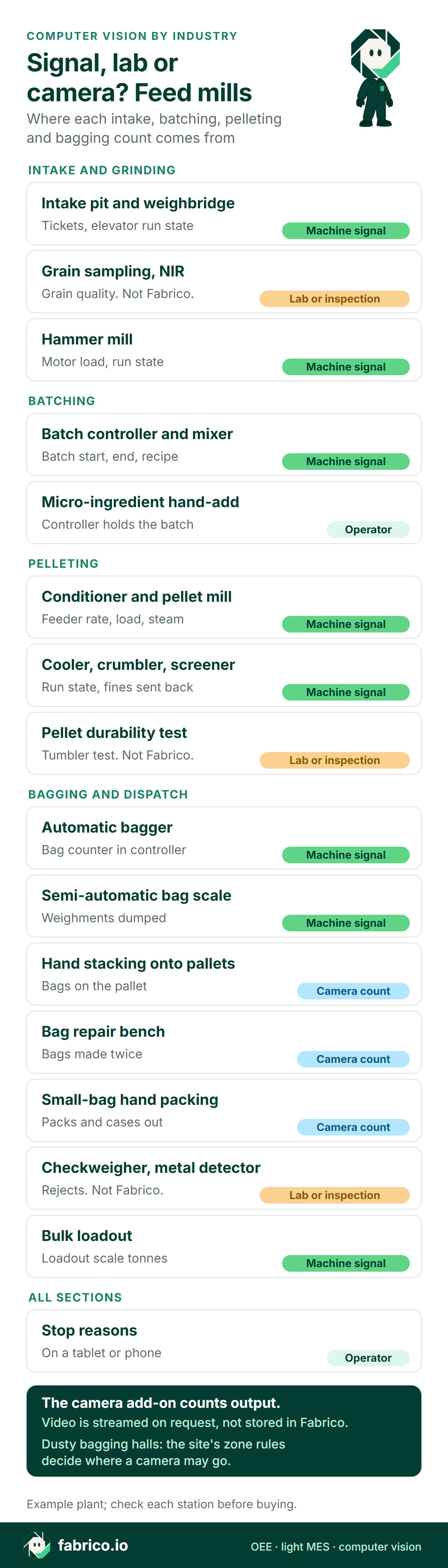
Text version of this infographic
- Intake and grinding: intake pit and weighbridge: machine signal, tickets and elevator run state
- Intake and grinding: grain sampling and NIR: lab or inspection, grain quality, not Fabrico
- Intake and grinding: hammer mill: machine signal, motor load and run state
- Batching: batch controller and mixer: machine signal, batch start, end and recipe
- Batching: micro-ingredient hand-add: operator, the controller holds the batch
- Pelleting: conditioner and pellet mill: machine signal, feeder rate, load and steam
- Pelleting: cooler, crumbler and screener: machine signal, run state, fines sent back
- Pelleting: pellet durability test: lab or inspection, tumbler test, not Fabrico
- Bagging and dispatch: automatic bagger: machine signal, bag counter in the controller
- Bagging and dispatch: semi-automatic bag scale: machine signal, weighments dumped
- Bagging and dispatch: hand stacking onto pallets: camera count, bags on the pallet
- Bagging and dispatch: bag repair bench: camera count, bags made twice
- Bagging and dispatch: small-bag hand packing: camera count, packs and cases out
- Bagging and dispatch: checkweigher and metal detector: lab or inspection, rejects, not Fabrico
- Bagging and dispatch: bulk loadout: machine signal, loadout scale tonnes
- All sections: the operator enters stop reasons on a tablet or phone
- The camera add-on counts output; video streams on request and is not stored in Fabrico
- Dusty bagging halls: the site's zone rules decide where a camera may go
Dust zones, the stacker and the works council
Grain and meal dust can be combustible. In the US, 29 CFR 1910.272 applies to "grain elevators, feed mills, flour mills" and requires "a written housekeeping program" for fugitive grain dust. In Great Britain, HSE's guide to the DSEAR regulations lists "dusts from foodstuffs" among dangerous substances and tells employers to "identify and classify areas of the workplace where explosive atmospheres may occur".
Two things follow. Book housekeeping rounds as planned cleaning stops, and on a bagged night put the bag line's round into the product change or the break, so cleaning does not eat constraint minutes. Whether a camera add-on may hang in a classified area is the site safety team's call; Fabrico claims no ATEX or hazardous-area approval.
The stacker will be in the picture too. Tell the bagging crew, and the works council where one exists, what the count is for before a bracket is drilled. In Germany, section 87 of the Works Constitution Act gives the works council a say over "the introduction and use of technical devices designed to monitor the behaviour or performance of the employees", so that agreement comes first. Frame the pallet, not the stacker, and report bags per station and shift, never per name. See the works council approval guide for OEE monitoring.
Questions for any camera or OEE vendor at a feed mill
Hold every answer up against several shifts of your own tally sheets, batch reports and bin readings.
| Ask | A sound answer |
|---|---|
| Can it show starved and blocked time per station? | A starved and a blocked reason per station, tied to the bins around it. |
| How are weighments and stacked bags kept apart? | Weighments as the total, bags on the pallet as the good count. |
| Can the ideal rate change with product, bag size and die? | A rate per product and bag size, and per die where the die changes the rate. |
| What is in the frame at hand stacking? | The pallet and the bags landing on it, never a count of people. |
| Who can open the bag station video? | Named roles, streaming only, and a data flow on paper for the works council. |
For the wider choice, see how to evaluate OEE software.
Where Fabrico fits in a feed mill constraint hunt
Fabrico runs in the cloud as OEE software with light MES features. In a feed mill that means:
- At the mixer and the pellet mill it takes run state, batch ends and totaliser signals from the controller and the PLC, so chokes, die changes, flushes and waits for bin space show as stop time.
- At hand stacking, the repair bench and small-bag packing the camera add-on counts bags onto pallets, re-made bags and cases out. If stacking stopped at 03:10, the bagging lead opens the video for the minute of that stop from the shift timeline, streamed on request and not stored in Fabrico.
- Starved and blocked can be stop reasons the plant sets up, so the queue test reads off the shift timeline; the ideal rate is set per product and bag size.
Baggers and mill operators choose why a station stopped from a short list on a phone or tablet. Each section and shift gets OEE, downtime and losses priced from the plant's own SKU price or margin, in the browser or the iOS and Android apps; figures reach the ERP over a REST API or webhooks, or leave as Excel or CSV files.
Roadmap: a camera add-on that notices a stalled stacking station by itself and offers a probable reason for the operator to confirm.
Stays outside Fabrico: NIR and lab tests, pellet durability, checkweighing, metal detection, recipe control, and the medicated feed and lot records. Fabrico inspects nothing.
Computer vision for OEE explains how a bag count becomes availability, performance and quality. For formulation, batching and lot software across the mill, start with feed mill software.
Feed mill constraint questions plant teams ask
Where should a feed mill put its first camera?
Over the hand stacking station of the bag line that holds bagged output back, framed on the pallet, with the repair bench next. Batches and tonnes already come from the controller, the PLC and the scales.
Is the pellet mill always the bottleneck in a feed mill?
No. It is the first suspect, and one published poultry feed plant study found the bottleneck there. On a night of bagged orders, a slower semi-automatic bag line can hold output back instead. The bins show which.
Can a camera check pellet quality or bag weight?
Not an OEE camera. Durability is a tumbler test in the lab, grain goes to NIR, and bag weight belongs to the scale and the checkweigher. Their rejects can still lower the OEE quality figure.
How accurate is camera counting at a bag station?
No figure is promised here. It depends on what hides the bag: the stacker's body, dust on the lens, bags that touch on a layer. Check the count against weighments over several shifts before you trust it.
Want bins, bag counts and stops on one shift timeline? Book a demo to see weighments, stacked bags and re-made bags counted side by side.
Related articles






Latest from our blog





Real Fabrico tiles, sample data.