







 Login
 Blog
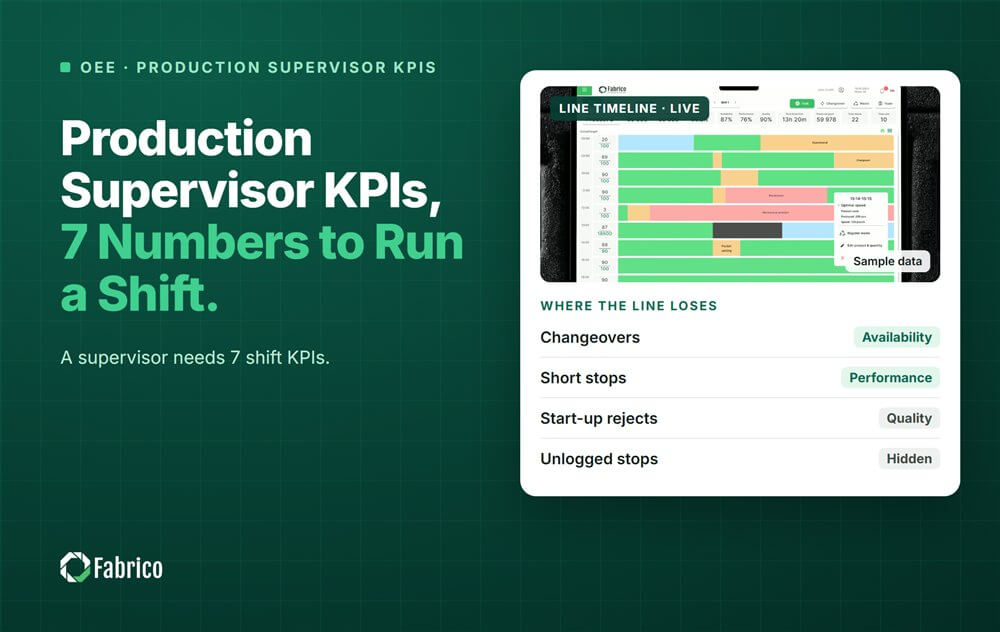
Production Supervisor KPIs: 7 Numbers to Run a Shift

Key takeaways
- Check output against plan every hour. It shows a slipping shift first.
- The other six explain the gap. Review them at handover.
- Every KPI needs a target set before the shift.
- Report by line and shift, not by named operator.
A production supervisor has eight hours and too many numbers. The ones worth watching are the ones the supervisor can still change before the shift ends.
Fabrico, OEE and light MES software with AI cameras, shows these shift KPIs live for each line from the machine signal. This guide lists the seven, how to calculate each one and when to look at it.
Which KPIs should a production supervisor track?
Pick KPIs the shift can act on today. Cost per unit and yearly trends matter, but they belong to the plant manager's review.
| KPI | How to calculate | Target comes from | When to check |
|---|---|---|---|
| Output vs plan | Good units / planned units | The shift plan, per SKU | Every hour |
| OEE | Good units x ideal cycle time / planned time | Line's own recent average | Mid shift and handover |
| Top 3 stops | Minutes and count per reason | Last week's top 3 | Every hour |
| Changeover time | Last good unit to first good unit at rated speed | Standard per format pair | After each change |
| Scrap rate | Rejected units / total units | Line's own recent average | Every hour |
| Safety | Incidents and near misses reported | Zero incidents, every near miss logged | Start and end of shift |
| Open actions | Actions opened and closed this shift | Nothing left without an owner | Handover |
Which KPI matters most on a single shift?
Output against plan, checked every hour. It is the only KPI the whole crew understands at a glance, and it tells you early when the shift is slipping.
An hourly view catches a slow first hour or a long stop while there are still hours left to recover. Our guide to target vs actual production tracking shows how to set the hourly targets.
The other six KPIs explain the gap. When output falls behind, the top 3 stops and the changeover time usually say why.
How do I set a target for each KPI?
- Set it before the shift, in the plan, not after a bad hour.
- Use the line's own history for OEE and scrap. A line at 65% will not jump to 85% because a poster says so.
- Set changeover standards per format pair. Going from 200 g to 400 g packs is not the same job as a flavour change.
- Keep safety separate. Never trade a safety step for output.
Worked example: what does one shift's KPI scorecard look like?
Sample line (illustrative numbers, not a customer): a biscuit line with a flow wrapper rated at 120 packs a minute. The shift has 450 planned minutes. The plan is 75% of rated output: 120 x 450 x 0.75 = 40,500 packs.
- Output vs plan: 37,800 good packs / 40,500 = 93.3%. The shift is 2,700 packs short.
- OEE: 37,800 / (120 x 450) = 37,800 / 54,000 = 70.0%.
- Top 3 stops: metal detector reject stops 4 x 5 = 20 minutes, film splices 9 x 2 = 18 minutes, case erector jams 12 x 1 = 12 minutes.
- Changeover: 42 minutes against a standard of 30. That is 12 minutes over.
- Scrap: 930 rejected of 38,730 packs made = 2.4%.
- Safety: 0 incidents, 1 near miss reported.
- Open actions: 3 opened, 2 closed, 1 handed over with an owner.
Now link the numbers. The changeover overrun alone cost 12 x 120 = 1,440 packs, more than half the 2,700 pack gap. The other 1,260 are spread across stops, speed and scrap.
At a sample contribution of $0.12 a pack, the overrun cost $172.80, or €172.80 in a euro plant at €0.12 a pack. The supervisor's first action is clear: find out why the changeover ran long.
Which KPIs should a supervisor not be judged on?
Some numbers belong to other people. If a supervisor is judged on them, the shift spends its time explaining instead of fixing.
- Cost per unit depends on prices and volumes the shift does not control.
- Repair KPIs such as mean time between failures belong to maintenance. The supervisor reports the stops; maintenance owns the fix.
- Scores for named operators. Measure the process, never the person. A ranking by name stops people logging stops honestly.
For the difference between a busy shift and a good one, see our guide to OEE software for shift supervisors.
How often should a supervisor review the KPIs?
Three rhythms work on most FMCG lines:
- Every hour: output vs plan, the stop that cost most this hour, scrap.
- At the tier 1 meeting: yesterday's top 3 stops and the open actions. Keep it short and standing. Our guide to tier meetings covers the format.
- At handover: all seven KPIs, plus what the next shift must watch. Use a shift handover checklist so nothing is left out.
How do I cut changeover time when it tops the list?
Measure from the last good unit of the old product to the first good unit of the new one at rated speed. Then sort each step into internal (the line must stop) and external (it can be done while the line runs).
Move external steps before the stop: parts on a trolley, film and labels staged, settings written down per format. This is the core of SMED, and it is often the fastest win a supervisor can lead.
Where Fabrico fits
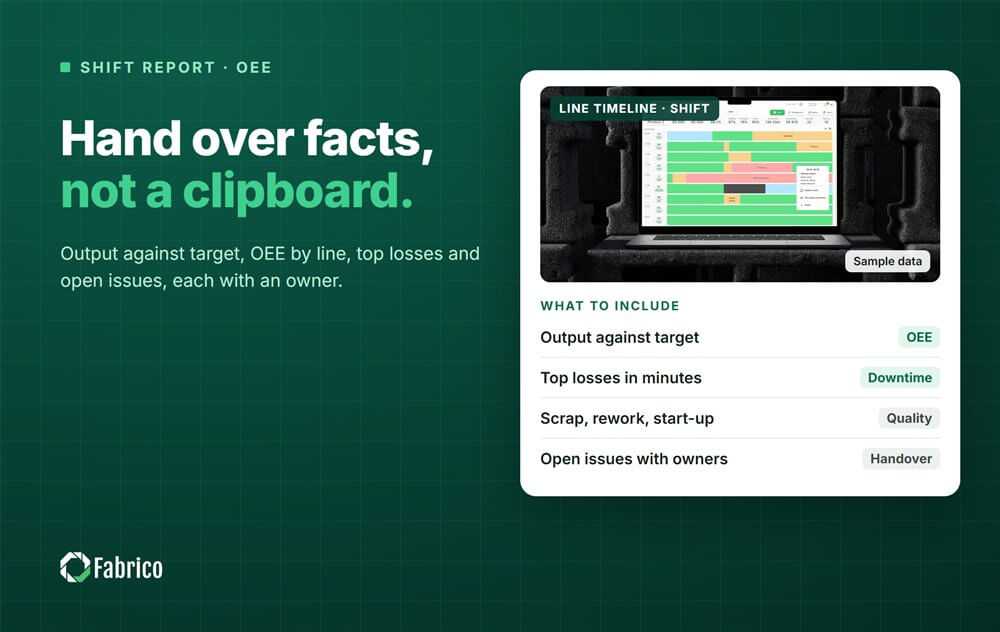
Fabrico is a computer vision enabled Manufacturing Performance Platform. OEE and light MES come first. It gives supervisors the seven KPIs without the clipboard.
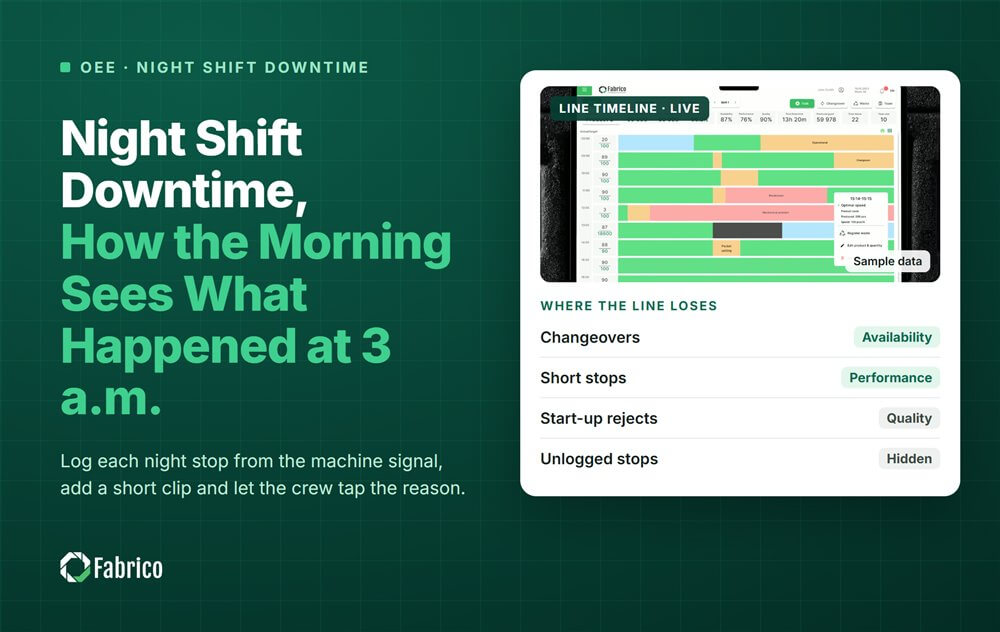
- OEE live by line and shift, with output against the hourly plan.
- Automatic downtime logging, and the operator confirms the reason in one tap.
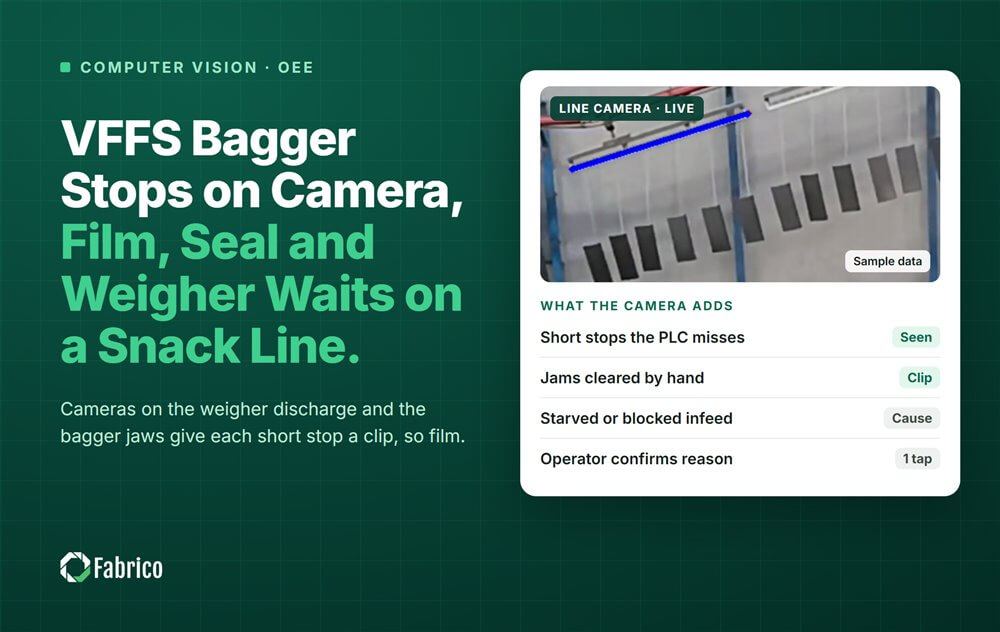
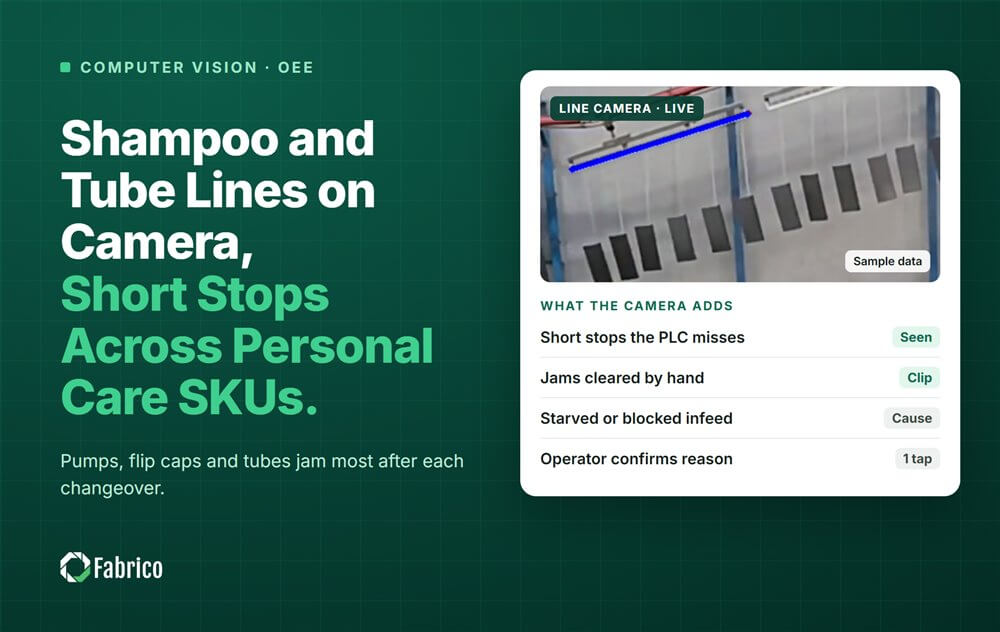
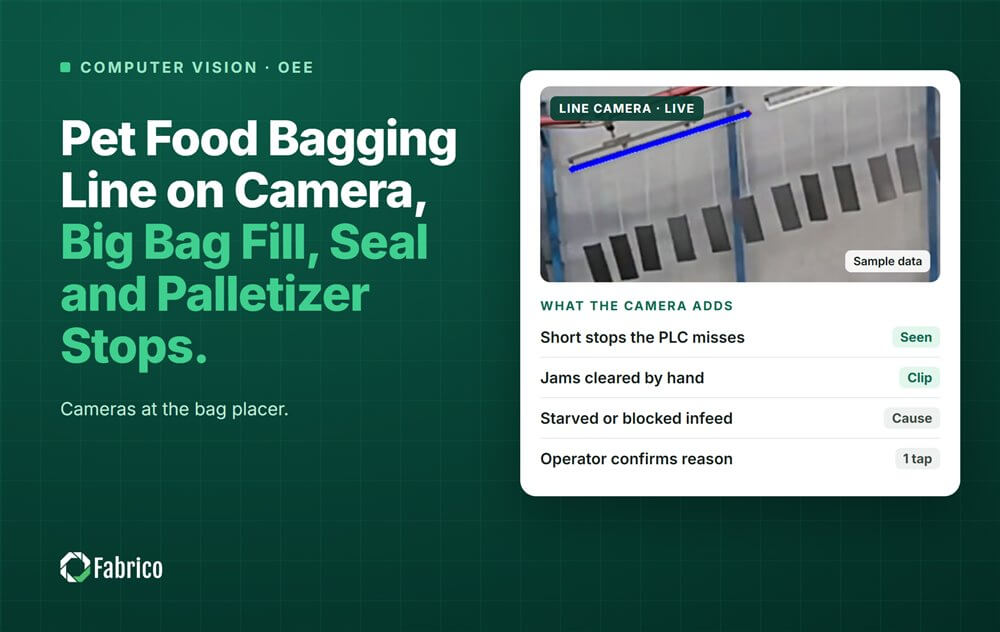
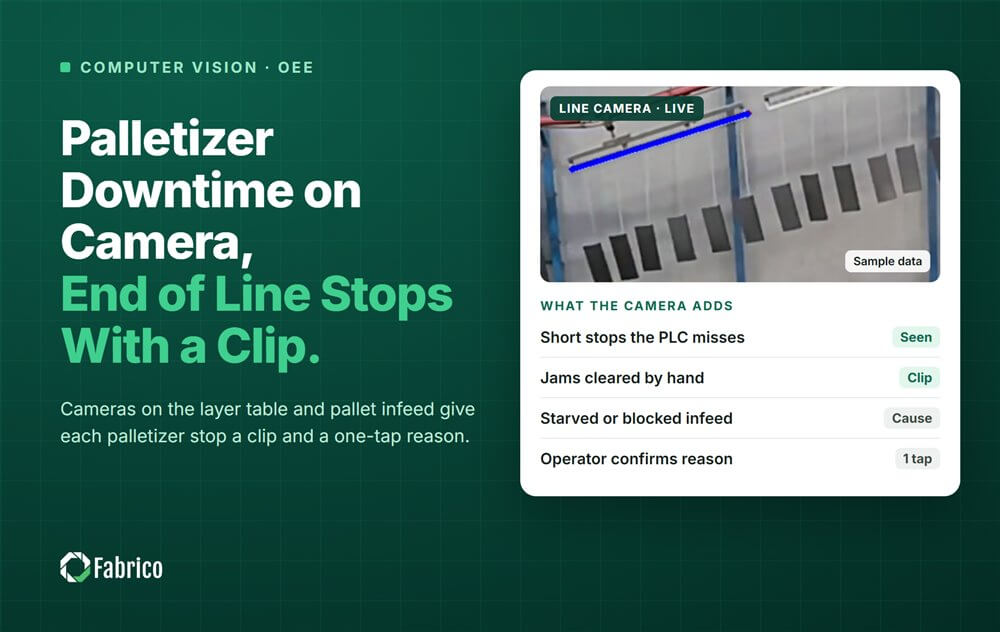
- A camera clip as evidence for a stop, so the conversation is about the machine, not the person.
When a stop is a breakdown, a work order goes to the right technician with its cost. You start with a pilot on one line. There is no free plan and there are no tiers: each plant gets a quote. See how stops are caught on camera on our computer vision OEE page.
Frequently asked questions
What are the KPIs for a production supervisor?
The core set is output against plan, OEE, the top 3 stops by minutes, changeover time against standard, scrap rate, safety and open actions. Each needs a target set before the shift. Output against plan is checked every hour, and the full set is reviewed at handover.
How many KPIs should a supervisor track?
Five to seven is enough for one shift. More than that and nobody reads them. Pick the numbers the shift can still change before it ends. Longer trends, cost per unit and plant totals belong in the plant manager's weekly and monthly reviews instead.
What is a good OEE target for a shift?
Start from the line's own recent average, on the same counting rules, and aim a few points higher. Most manufacturers score closer to 60% OEE. The 85% often quoted comes from Nakajima's 1984 work on Japanese car plants, so it is not a fair target for every FMCG line.
Should supervisor KPIs be shown to operators?
Yes, at line level. A screen with output against the hourly plan and the main stop helps the crew react without waiting for the supervisor. Show the line's numbers, never a ranking of named people. That keeps the focus on the machine and the process.
How is output vs plan calculated?
Divide good units made by the units planned for the same period, then multiply by 100. If the plan for the shift was 40,500 packs and the line made 37,800 good packs, output vs plan is 93.3%. Calculate it per hour as well as per shift.
Bring one line and last week's shift reports to a Fabrico demo. We will show the seven KPIs for your line, or contact us with a question.
Related articles

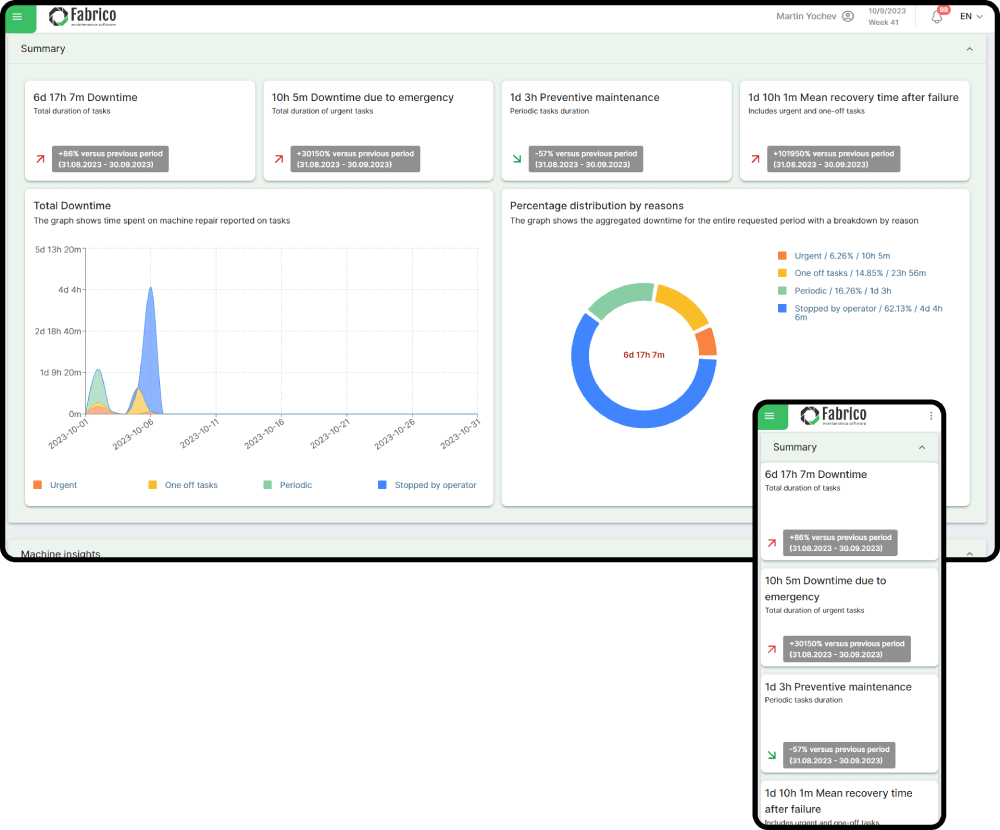




Real Fabrico tiles, sample data.