


 Login
 Blog

Computer Vision for Faucet Manufacturing: Prove the Count at One Bench First

In short: in faucet plants, computer vision earns its OEE place counting at hand benches; prove it in a plant-run, one-station pilot.
Judging chrome finish, gauging threads and leak testing stay with inspectors and testers; the camera add-on only counts what leaves a bench.
- Pilot at the cartridge assembly benches of one mixer cell, where the leak tester's own count can referee the camera add-on.
- Count by hand first, write the counting rule and tolerance down, then mount one camera add-on over the bench drop point.
- Proof is three counts that reconcile, block by block: camera add-on, leak tester and paper tally, through a finish change.
- Stop if hands or chrome glare keep the counts apart after one fix, or if the bench crew and works council say no.
- Video for the minute of a stop is streamed on request and not stored in Fabrico; the team lead adds the reason.
This plan is for faucet (tap) and mixer plants that make brassware: kitchen and basin mixers, bath and shower valves, and the hoses packed with them. It runs at one station, the cartridge and hose benches of one mixer cell, before anyone decides to buy cameras for the whole site. Basins and WC pans are on computer vision for ceramics and sanitaryware, and casting shops are on computer vision for foundries.
Computer vision for faucet manufacturing: counting, not inspection
Ask three vendors for "computer vision" in a brassware plant and you may get a finish checker, a robot guide and a counter. A pilot tests one claim: can a camera add-on count mixers at a hand bench as reliably as the leak tester counts them a few metres downstream?
| Task on the brassware floor | Recorded by | Pilot uses it as |
|---|---|---|
| Judge chrome or PVD finish | Inspectors under the light | Out of scope |
| Gauge threads and cartridge seats | Plug gauges, the CMM | Out of scope |
| Leak test finished mixers | The pressure decay tester's counter | The referee count |
| Count mixers off the cartridge benches | A tally sheet, if anything | The count under test |
| Say why a bench went quiet | The team lead's memory | Stop reasons typed at the bench |
Rejects from the finish check and fails from the leak tester still feed the quality part of OEE. Fabrico does no inspection.
Explainer presented by Iris, Fabrico's AI-generated presenter: how an add-on camera counts output where a machine has no signal. Book a demo.
Plays from YouTube. Google may set cookies when you press play. Privacy policy.
The pilot at a glance: seven steps at one cartridge bench row
Each step ends in one piece of evidence, and that evidence opens the next step.
| Step | Bench work | Next step opens when |
|---|---|---|
| 1. Choose the station | Cartridge and hose benches of one mixer cell, one product family | The leak tester sees every mixer from those benches |
| 2. Count by hand | A tally per bench and time block, with a written counting rule | The team lead signs the rule and the tolerance |
| 3. Agree the purpose | Bench crew, and the works council where one exists, hear what the count is for | Nobody objects to a count per bench and shift |
| 4. Mount one camera add-on | Above the drop point onto the tester tray | Glare and hands are checked on chrome and matt black parts |
| 5. Reconcile three counts | Camera add-on, tester and tally per time block | Every gap has a reason: queue, rework or a logged stop |
| 6. Price one shift | A x P x Q and the lost mixers in money | The team lead agrees the stop reasons behind the money |
| 7. Decide | Proven, fix and repeat, not needed, or stop | The plant signs one outcome |
This plan has no timetable: the plant sets its own pace, and the last column says when the next step opens.
Step 1: choose a station the leak tester can referee
A camera count is worth trusting only once something else has checked it. In a mixer cell, that is the leak tester: every mixer built at the cartridge and hose benches passes through it, and its counter records tested, passed and failed. Put the pilot just upstream of a counter the plant already trusts, and the proof is built in.
The flow below is an example layout. Many brass faucet bodies start as forged billets and some as gravity die castings; both meet again at machining, polishing, plating and assembly, with queues in between.
Why not forging, machining, buffing or rack loading
Presses, rotary transfer machines and CNC centres already count through their controllers, as on OEE for forging lines, and their pace moves with the alloy rather than the crew. In the US, the EPA summary of the Safe Drinking Water Act defines lead free as a weighted average of 0.25% lead across the wetted surfaces of plumbing fittings and fixtures, so many plants run lead-free brass for those markets and other alloys for the rest. In a peer-reviewed machining study comparing leaded CuZn38Pb3 with near lead-free CuZn42 brass, the main role of lead was to break the chip into short pieces, lowering cutting forces, friction and process temperature. An ideal cycle per alloy is a job for controller data, not a camera.
Hand buffing benches are the bigger blind spot, but nothing downstream checks their count directly: bodies go to racks, plating and the finish check, and rejects come back to be polished again. Rack loading has its own problem. A University of Florence team that built a counting machine for small parts on electroplating frames called the high reflectivity of the parts an incredible challenge for any kind of optical acquisition system. Both make good second pilots.
Start with one family, for example single-lever kitchen mixers in chrome for one market; a pull-out kitchen mixer takes far longer to build than a basin mixer. The station card shows where each count comes from across the site.
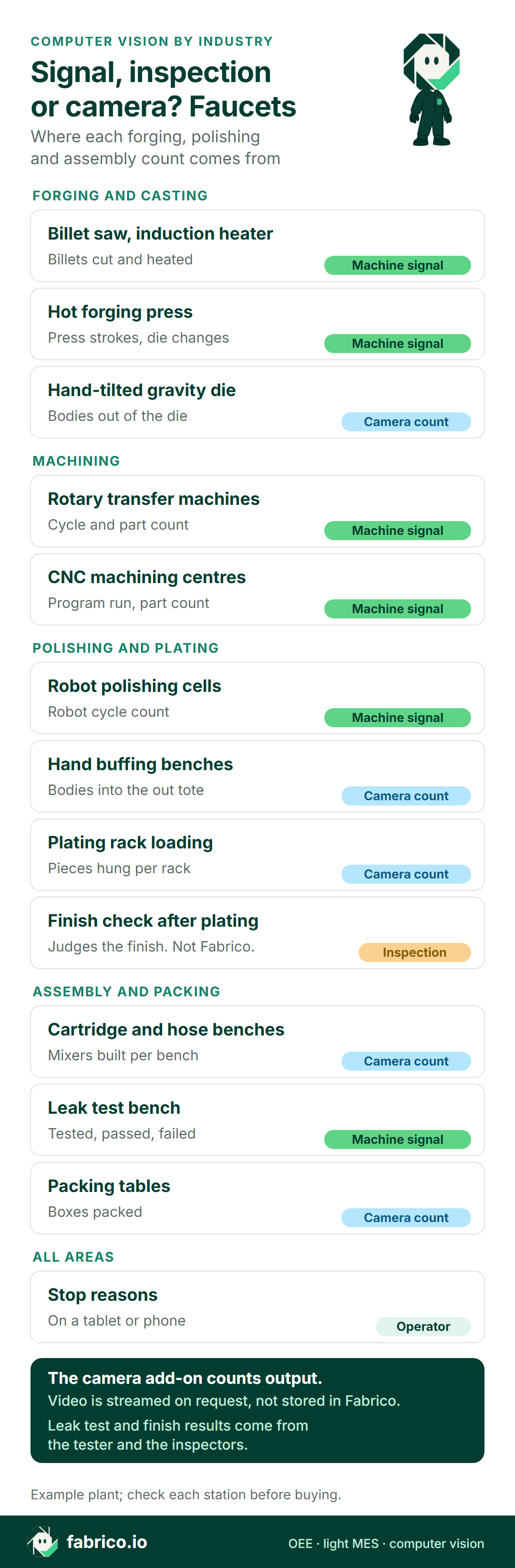
Text version of this infographic
- Forging and casting: billet saw and induction heater: machine signal
- Forging and casting: hot forging press: machine signal
- Forging and casting: hand-tilted gravity die: camera count
- Machining: rotary transfer machines: machine signal
- Machining: CNC machining centres: machine signal
- Polishing and plating: robot polishing cells: machine signal
- Polishing and plating: hand buffing benches: camera count
- Polishing and plating: plating rack loading: camera count
- Polishing and plating: finish check after plating: inspection, not Fabrico
- Assembly and packing: cartridge and hose benches: camera count
- Assembly and packing: leak test bench: machine signal
- Assembly and packing: packing tables: camera count
- All areas: stop reasons: operator
- Box: the camera add-on counts output; video is streamed on request, not stored in Fabrico
- Leak test and finish results come from the tester and the inspectors
- Footer: Example plant; check each station before buying.
Step 2: count by hand and write the counting rule down
The hand count sets the rule the camera add-on will be judged by. Before anything is mounted, the team lead writes four things on one sheet:
- What counts. A mixer counts once, when it is set on the tray that feeds the leak tester. That tray edge is the drop point.
- What does not. A mixer lifted back for a handle fix, a body returned to the kit trolley, a sample pulled for the lab.
- The time blocks. The same blocks the tester log can be read in, split at the break and at any finish change.
- The tolerance. How far bench and tester counts may drift apart once the mixers waiting on the tray are added back. It is the plant's own number, written before the camera goes up.
The tester is the right referee because it is the plant's own check. The scope of EN 817:2024 for mechanical mixing valves covers leaktightness, pressure resistance, hydraulic performance, endurance and acoustics, and says its tests are laboratory type tests, not the factory production control tests carried out during manufacture. The in-line pressure decay test is the plant's own gate. Keep its tested and first-time passed figures apart from the start, as in good count vs total count.
Step 3: tell the bench crew and the works council what the count is for
People sit at cartridge benches, so a camera there sees hands and arms. Where assemblers earn a piece rate or bonus, they will read any bench count as a pay check from its first shift.
In Germany, section 87 of the Works Constitution Act gives the works council co-determination over "the introduction and use of technical devices designed to monitor the behaviour or performance of the employees", and over job and bonus rates as well. Other countries have their own rules. Settle the purpose with the staff, and with the works council where one exists, before a bracket goes on the wall; works council approval for OEE monitoring lists what such an agreement covers. Write down that the camera add-on aims at the tray, not the assembler; that counts are reported per bench and shift, never per person; that pilot counts stay off the bonus sheet unless agreed; and who may open the video for the minute of a stop.
Questions for the camera vendor before Step 4
Put the same eight to each shortlisted supplier, and to Fabrico's camera add-on too.
| Before Step 4, ask | What a straight reply contains |
|---|---|
| Where on the cartridge bench is the count taken? | At the drop point onto the tester tray, with a written rule for lifts and put-backs. |
| How does it cope with chrome glare and matt black parts? | A mounting angle and light tested on both finishes first. |
| What happens when a hand covers the tray? | It names the miss and shows where to put the tray. |
| How does the leak tester count come in? | From the tester's own output or counter, never retyped. |
| How is a reseated mixer counted? | Once at the bench; the first-time fail feeds quality. |
| How are product family and finish set? | From the work order, not guessed from the image. |
| What masking of people runs today? | What runs now, named separately from what is still planned. |
| Who owns the pilot counts if we stop? | The plant does, with an export by Excel or CSV. |
Agree data ownership and exit terms in writing; OEE pilot agreement terms covers the clauses. Fabrico's camera add-on is configured for bodies, mixers and boxes rather than faces.
Step 4: mount one camera add-on over the drop point
Mount one camera add-on above the drop point from Step 2, aimed at the tray, so that it sees a mixer arrive and little else. One view, one counting line, one rule.
Then test the light, because chrome and matt black mixers throw it back very differently. The Florence study counted the same frames with three lighting set-ups: the frontal light architecture showed proper counting of the number of the items in nine cases (45%), while the lighted background-based architecture was successful in eight cases (40%), and a rear-projection set-up matched the actual number on all 20 test frames. Read it with its limits: small fashion accessories of 10 to 80 mm, hung still in front of a purpose-built canvas, with no hands in view and no faucets. What carries over: light and background, not software alone, decided whether bright metal got counted, so run test counts on both finishes first.
Hands are the other limit. The assembler's hand covers the tray as the mixer goes down, so place the tray where the hand leaves it clear, and watch for two mixers set down together. Read camera placement and lighting on a production line before choosing a bracket. The camera add-on counts output and does not judge the mixer, and where a camera covers the station, the video for the minute of a stop can be opened from the shift timeline, streamed on request and not stored in Fabrico.
Book a demo to see cartridge benches and a leak tester counted on one shift timeline.
Step 5: reconcile three counts, block by block
Each pilot shift ends with one table: camera add-on, tester, paper tally and the reason for every gap. The figures are example data that show the method, not a measured accuracy figure for any camera.
| Time block | Camera add-on | Leak tester | Paper tally | Gap explained by |
|---|---|---|---|---|
| 06:00 to 08:00 | 70 | 70 | 70 | None; 40 stopped minutes logged as waiting for chrome bodies |
| 08:00 to 10:00 | 108 | 108 | 110 | Tally rounded up at the break |
| 10:30 to 12:30 | 77 | 77 | 80 | 25 minute finish change, then bench 3 slow; tally filled in after |
| 12:30 to 14:00 | 78 | 75 | 85 | 3 mixers on the tray at 14:00; tally written at handover |
| Shift | 333 | 330 | 345 | Camera add-on and tester agree once the 3 waiting mixers are counted |
- The queue is real. Mixers on the tray at the end of a block belong to the bench count; queues grow and shrink with variability. Count them at handover, or the camera add-on looks wrong when it is right.
- Rework is counted once. A mixer that fails pressure decay and passes after its O-ring is reseated was built once and tested twice; it is never first-pass good. See first pass yield and scrap vs rework.
- The tally is evidence, not the referee. Here it ran 15 mixers high and showed nothing of the morning wait.
Step 6: price one pilot shift in minutes and money
Example numbers, no real plant. Three cartridge and hose benches, a leak tester and a packing table build single-lever kitchen mixers, rated at one mixer a minute for the cell. The early shift runs from 06:00 to 14:00, less a half hour break: 450 planned minutes.
Availability. The cell stood for 65 minutes: 40 waiting for chrome bodies, a plain case of starvation at a hand-off, and 25 changing every bench from chrome to matt black parts and boxes. It ran 385 of 450 minutes: 85.6%.
Performance. 385 minutes at one a minute should give 385 mixers. The tester counted 330: 85.7%, with 55 minutes of slow running. The bench counts showed part of it: bench 3 ran at half pace from 11:25 to 12:25 after the finish change, about 10 mixers short, because its matt black handles came in a bulk carton, not in kits.
Quality. 12 mixers failed pressure decay. Each passed after its O-ring was reseated, but none was right the first time, so 318 of 330 were first-pass good: 96.4%.
OEE. 85.6% x 85.7% x 96.4% = 70.7%, and 318 good minutes in 450 planned minutes is 70.7%. Set the rated pace per product family, as you would an ideal cycle time.
In money. No maker publishes its margin per mixer, so the page uses an example contribution margin of EUR 12 per kitchen mixer, which each plant replaces with its own from the SKU's price and cost. For a public band, Masco, which owns the Delta and hansgrohe faucet brands, said on its fourth quarter 2024 results call that "Plumbing margin expanded 100 basis points to 19%". That is an operating margin across a segment, not a contribution per unit; at 19%, EUR 12 is the margin on a mixer selling for about EUR 63.
Price lost output only while orders wait for it. Stops and slow running cost 65 + 55 = 120 mixers, which is 120 x EUR 12 = EUR 1,440 for the shift if the market would have taken them; the chrome wait alone is 40 mixers, or EUR 480. The 12 reseated mixers shipped, so they cost crew time, not margin: about 3 minutes each, 36 crew minutes at an example EUR 40 an hour, EUR 24. Fabrico prices losses the same way, from the plant's own SKU price or margin.
The wait started the night before. The night's rack sheets showed the plating run going in at about two thirds fill because the buffing benches were short, and a rack that goes in two thirds full takes the same tank time and hoist cycle as a full one. The pilot cannot see that, because no camera covers the racks, and it is the strongest argument for a second station.
Step 7: weigh the proof, then stop, fix or start a second station
The pilot ends on a recorded outcome, not on a date. Proof means three things together: camera add-on and tester reconcile within the Step 2 tolerance once the tray is counted; they do so through at least one finish change and one family change; and every gap has a reason.
| Outcome | What the pilot showed | What the plant does next |
|---|---|---|
| Proven | Counts reconcile, and Step 6 names a loss the shift report missed | Widen to rack loading (pieces per rack, not racks) or the buffing benches |
| Fix and repeat | Gaps cluster at one cause, such as glare or hands over the tray | Move the camera add-on, the light or the tray once, then repeat Step 5 |
| Not needed | The tester count alone answers the plant's question | Stop; a camera adds nothing at this station |
| Stop | An objection is unresolved, or counts still disagree after the fix | Stop and write down why |
For a pack-out bench after the tester, the same method works with boxes instead of mixers; see OEE for a manual packing station. For the wider rules of a pilot that proves something, read how to design a manufacturing software pilot.
Where Fabrico fits in a faucet pilot
Fabrico runs in the cloud and covers OEE plus light MES. For this pilot, three jobs are live now:
- At the cartridge benches the camera add-on counts mixers at the drop point. When the benches stand waiting for bodies at 06:20, the team lead opens the video for the minute of that stop from the shift timeline, streamed on request and not stored in Fabrico.
- At the leak tester it reads tested, passed and failed from the tester's counter.
- On the shift timeline the team lead adds the stop reason from a tablet or phone, and Fabrico prices each loss per cell and shift from the plant's own SKU price or margin.
It runs in a browser and on iOS and Android apps, and passes figures on by REST API, webhook, Excel or CSV. When the pilot widens to forging and machining, run state and counts come from the controllers; for routings and work orders, see MES for metal fabrication.
Roadmap: a camera add-on that flags on its own that a cartridge bench has stood idle, and offers a likely cause for the team lead to confirm.
Not Fabrico's job: judging the finish, gauging threads, leak testing, steering polishing robots, running the plating line or keeping alloy lot and conformity records. The European Commission dates the application of EU hygiene requirements for materials in contact with drinking water to December 2026; those declarations stay in the ERP and quality system, and a pilot count sits beside them.
Start with the computer vision feature page, read how vision counts turn into OEE for the maths, and use the guide to evaluating OEE software for the wider shortlist.
Faucet pilot questions
Which faucet station should host the first camera pilot?
The cartridge and hose assembly benches of one mixer cell, because the leak tester downstream counts every mixer they build and can referee the camera add-on. Buffing benches and rack loading make better second pilots.
Can an OEE camera judge chrome finish or find a porous casting?
No. Pits, blisters and haze on the finish are judged by inspectors under the light, and porosity shows up at the leak tester or in the casting shop's own checks. Fabrico does no inspection. Their reject counts still feed the quality part of OEE.
What should end a faucet camera pilot?
A recorded outcome, not a date: the three counts reconcile through a finish change and a family change, or glare, hands over the tray or an unresolved objection keeps them apart after one fix.
Should leak test fails count against OEE quality?
Yes. A mixer that fails pressure decay and passes after its O-ring is reseated was not right the first time. Take pass and fail from the tester's own counter, and price the reseat at crew time.
Can a camera tell a chrome mixer from a matt black one?
Do not rely on it. Set the product family and finish at the bench from the work order, and use the camera add-on count for how many. Book the finish change as a changeover with its own code, and watch the stops after changeover that follow it.
Want to see your cartridge benches, leak tester and packing table counted on one shift timeline? Book a demo.
Related articles






Latest from our blog







Real Fabrico tiles, sample data.