


 Login
 Blog
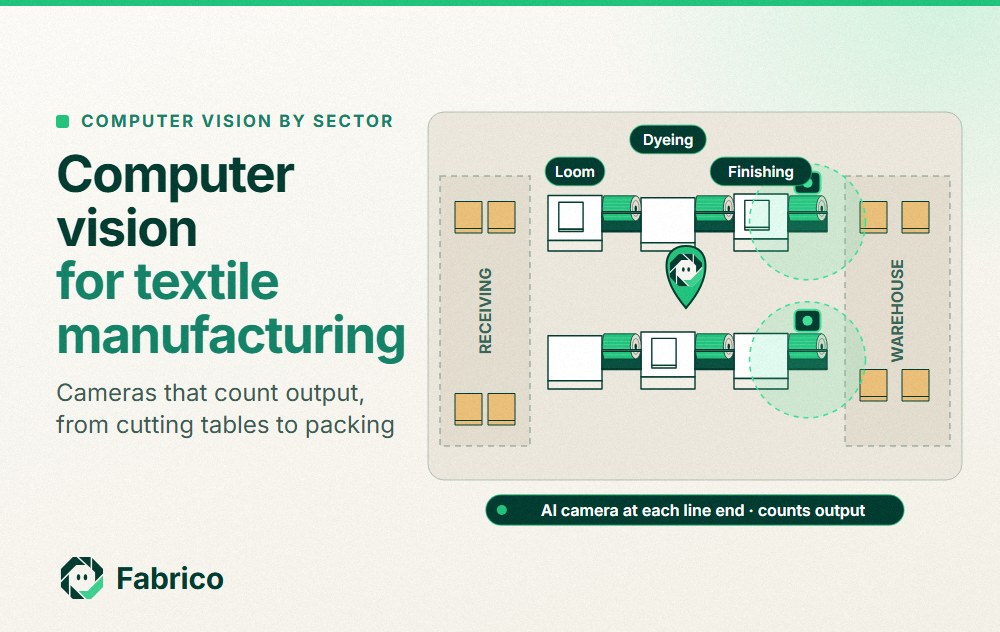
Computer Vision for Textile Manufacturing: Cameras That Count Output

In short: computer vision for textile manufacturing pays off as an output counter: cameras count cut bundles, finished garments and packed cartons where no machine gives a usable count, and let you open the video of a stop. Looms and knitting machines usually report through their own signals.
- Fabric defect detection and inspection is a different system. Fabrico does not sell it.
- Textile losses hide in warp and yarn breaks, style and colour changes, waiting for beams, fabric or cut work, and unbalanced sewing lines.
- Read the loom and knitting machine signals. Put cameras at cutting tables, sewing line ends, manual checking, folding, packing and on older machines.
- Fabrico's AI camera add-on counts output, not people, and lets you open the video for any moment on the shift timeline. The operator adds the stop reason.
Your looms count picks. Your knitting machines count revolutions. Your sewing floor counts on paper, once an hour, if someone has time.
This page is for plant managers, operations and CI leads in spinning, weaving, knitting, dyeing and finishing, and garment making who are choosing cameras and OEE software.
It shows where a camera earns its place, where the machine signal is enough, and what to ask each vendor.
Computer vision for textile manufacturing: two different jobs
Two kinds of camera system get sold to textile plants under one name. Inspection systems look at the fabric or the garment and grade it. OEE cameras count output and show you what happened at a stop.
Comparing platforms rather than cameras? See OEE software for textile manufacturing. Fabric defect detection is a different system. This page is about the OEE camera.
| Job in a textile plant | Inspection system | OEE camera |
|---|---|---|
| Holes, stains, broken ends in fabric | Yes | No |
| Shade and width checks | Yes, or a lab and a gauge | No |
| Seam and stitch faults on garments | Yes, or people at checking | No |
| Count bundles, garments or cartons | Rarely | Yes, also at manual steps |
| Video of a stop | Defect images, not stop video | Open the video for that minute |
| Feeds OEE through | Its reject count or graded metres | The output count |
The two work side by side. A fabric inspection system's reject count, read from its own export or a counter signal, can feed the quality part of OEE, so a fault is counted once.
Where the losses hide in a textile plant
Textiles are a big, labour-heavy industry. In Europe alone, EURATEX, the European textile and clothing trade body, reports 1.2 million jobs and nearly 200,000 companies across the EU-27 in its 2026 Facts and Figures. Much of that work, such as cutting, sewing, checking and packing, happens at stations a PLC never sees.
The losses look different at each stage, so go stage by stage.
Spinning: yarn breaks and doffing
Ring and rotor spinning lose time to end breaks, piecing and doffing. Many modern frames report their own stops and output, and spindle monitoring tells you where ends are down. Where you have that, use it.
A camera adds little on a frame with good monitoring. It earns a place on older frames with no usable signal, and at manual steps such as creel loading and packing yarn packages.
Weaving: warp and weft breaks, beam and style changes
Breaks drive loom efficiency. A 2018 study of Picanol rapier and air-jet looms in Bangladesh, published in the Scholars Journal of Engineering and Technology, states it plainly: efficiency depends on the time lost to loom stoppages, and warp and weft breakage is a common barrier to production.
The same study lists the loom's own warp detection, an electric dropper pin system, and electronic weft stop motion. That is why a modern loom is a signal job: it knows when it stops, and often why, by warp or weft.
What a loom signal cannot tell you is why the long stops happen. The study also names looms standing for want of suitable warps. Beam changes, style changes, waiting for a beam from sizing, and waiting for a weaver who minds many looms all show as one long idle. The operator's reason code matters more here than any camera.
Knitting: yarn breaks, needles and roll doffing
Circular and flat knitting machines stop on yarn breaks, needle faults and feeder trouble, and they count revolutions or pieces. Read that signal, and set the ideal rate per article, because gauge, feeders and yarn change the speed.
Cameras fit at the manual end: roll doffing, weighing and checking, and old machines with no usable output signal.
Dyeing and finishing: shade, batches and the stenter
Dyehouses lose time to colour changes, machine cleaning between shades, re-dyes when a shade misses, and waiting for fabric or for lab approval. Dye machines and stenters have controllers that know run state, speed and metres.
For OEE, the questions are booking ones. Is a cleaning cycle between dark and light shades a changeover? Does a re-dye count as a quality loss, or as a second batch? Agree that before you buy anything. A camera on a stenter adds little: shade and width checks are inspection.
Cutting rooms: spreading, cutting and bundling
Cutting is half machine, half people. An automatic cutter has a controller, but spreading, marker changes, ticketing and bundling are often manual. When the cut room falls behind, the sewing floor waits.
A camera over the bundling area or the output side of the table can count lays or bundles leaving, so the cut room's output by hour stops being a guess. That count also tells the sewing floor what is coming.
Sewing lines: line balance and waiting for work
A sewing line is a manual assembly line. Each operator does one or a few operations, and the slowest station sets the pace. Line balancing is where much of the performance loss hides.
A 2023 case study at a shirt line in Ethiopia, published in the Ethiopian Journal of Engineering and Technology, found the existing line had 41 workstations with a line efficiency of 67.6%. Rebalancing on paper gave 34 workstations at 85.9%. That is one line in one plant, worked out by calculation, but it shows the size of the gap that balance alone can hold.
A sewing machine has a motor but rarely a useful count: one garment needs many seams on many machines. The count that matters is finished garments leaving the line. Style changes, waiting for cut work, missing trims and machine breakdowns cause the stops. A camera at the line end counts output, and the video shows when the flow stopped.
For more on cameras at manual stations, see computer vision OEE for manual assembly.
Folding, packing and finished goods
Folding, tagging, bagging and boxing are mostly manual, and the carton count is often the first number anyone trusts. A camera over the packing table or the carton outfeed gives that count by hour, not just at shift end. See OEE at a manual packing station.
Where a camera goes in a textile plant
Here is one example: a vertical plant with weaving or knitting, a dyehouse and a garment floor.
For a longer list by machine type, see camera or sensor for OEE, machine by machine.
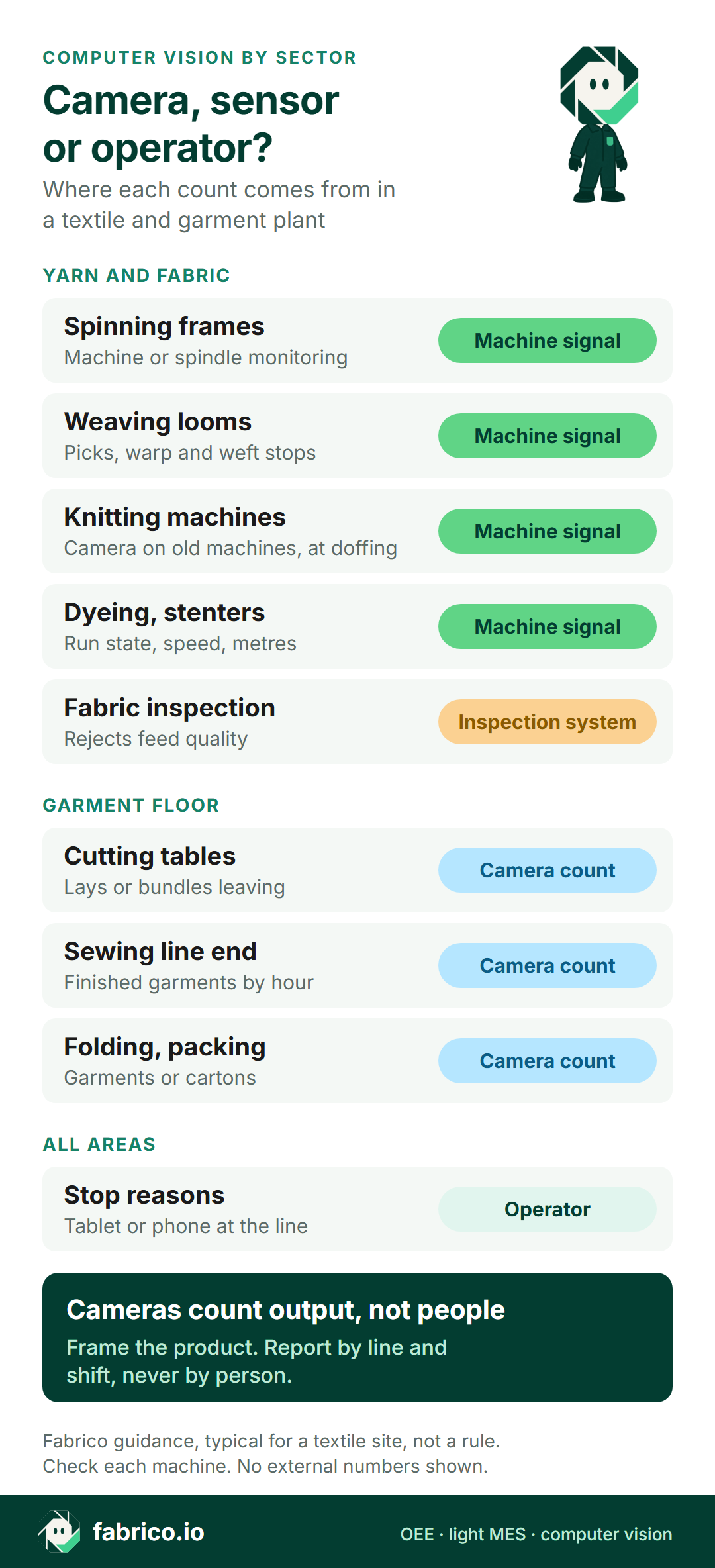
Camera, sensor or operator: station by station
This is typical for a textile site, not a rule. Check each machine.
| Station | Count and stops from | What a camera adds |
|---|---|---|
| Spinning frames | Machine or spindle monitoring | Little. A count on old frames. |
| Weaving looms | Loom controller: picks, warp and weft stops | Little. Use the signal. |
| Knitting machines | Revolution or piece counter, stop motions | A count on old machines, video at doffing |
| Dye machines, stenters | Controller: run state, speed, metres | Little. Shade is inspection. |
| Fabric inspection | Its own grading or reject count | Nothing. Feed rejects to quality. |
| Cutting tables | Cutter controller, or nothing at manual spreading | Count of lays or bundles leaving |
| Sewing line end | Paper sheets, or nothing | Count of finished garments by hour |
| Folding and packing | Paper, or a carton count at shift end | Count of garments or cartons |
| Stop reasons, all areas | The operator, on a tablet or phone | Video to check a disputed reason |
You rarely need a camera at every station. The card below shows where one pays off, and the guide on how many cameras a line needs helps you size it.
Bring your station list and one week of production sheets to a demo, and we will go through it station by station.
Worked example: one sewing line shift
These are example numbers, and they describe no real plant. A shirt line has an ideal rate of 2 garments a minute at the line end, set from the style's standard minutes and the number of operators on the line. It runs one 480-minute shift.
A camera at the line end counts the garments that leave. People at end-of-line checking pull garments for repair and log them. The supervisor records the stop reasons on a tablet.
Stops took 100 minutes: one style changeover 40, waiting for cut work 30, a machine breakdown 20 and short stops 10. Run time is 380 of 480 minutes, so availability is 79.2%.
At 2 garments a minute, 380 minutes could make 760 garments. The camera counted 646, so performance is 85.0%. The gap is 57 minutes of slow running, mostly from line imbalance: the slowest stations could not keep that pace.
Checking sent 18 garments for repair, so 628 passed first time and quality is 97.2%. Those 18 garments are 9 minutes of line time.
OEE is 79.2% x 85.0% x 97.2% = 65.4%. Check it the short way: 628 good garments of 960 possible is also 65.4%.
Two things change when the count comes by hour instead of at shift end. The 30 minutes of waiting for cut work show up as a gap at a known time, and the cutting room can see it too. And when the hourly count sags after a style change, someone can open the video for those minutes instead of guessing.
Eight checks for any textile camera or OEE vendor
Run these with every vendor, and with us. Bring one real shift from last week as the test case.
| Ask | How to test the answer |
|---|---|
| Can you read the loom and knitting signals? | Ask how picks, revolutions and stop states reach the software, machine by machine. |
| How does the ideal rate change with the style? | Ask to see the rate change per article or style, so performance means something. |
| What exactly does the camera count? | Garments, bundles or cartons? Run it next to a hand count for one shift. |
| How do you book a style or colour change? | Ask for changeover codes by type, and minutes over standard. |
| How is waiting for material shown? | Ask for a code for waiting for beams, fabric or cut work, and who owns it. |
| How do inspection rejects get in? | Ask if fabric grading or end-of-line checking feeds quality, so faults count once. |
| Is video kept, and who can open it? | Ask where it lives, for how long, and who sees it. |
| Does the camera frame product or people? | Ask for each position on a drawing, and what reports by person exist. |
Before you roll out across the site, test on one line first. See our guide to a computer vision OEE pilot.
Cameras on a sewing floor: privacy first
A sewing floor is full of people, often sitting close together, often paid by the piece. A camera there can feel like a supervisor that never leaves. Get this part right before anything else.
Cameras count output, not people. Frame each camera on the product: the line end, the bundle rack, the packing table. Report by line and shift, never by operator. Tell staff before any camera goes up, and in many European countries talk to the works council first.
Ask each vendor, us included, what privacy masking is live today and what is still roadmap. For a fuller checklist, read production line cameras without surveillance and the notes on GDPR and production line cameras.
Where Fabrico fits
Fabrico is a cloud OEE and light MES platform. Here is what it does in a textile plant today.
- Stops and counts: from the machine signal, a PLC, sensor or counter on the loom, knitting machine or stenter.
- Stop reasons: the operator or supervisor adds them at the line, on a tablet or phone.
- OEE and losses: OEE, downtime and losses by line and shift, with losses shown in money. On the web, iOS and Android.
- The camera add-on, on request: AI cameras count output, including at cutting tables, sewing line ends, folding and packing, and on machines with no usable signal. With the add-on you can open the camera video for any moment on the shift timeline. In the standard setup, video is streamed on request, not stored in Fabrico.
- Your data: it leaves through a REST API, webhooks and Excel or CSV export.
Roadmap, not live today: stops detected by the camera add-on, jam zones on the video, and the add-on suggesting a stop reason.
What Fabrico does not do: fabric or garment inspection, which stays with your inspection systems and your checkers and feeds Fabrico's quality figure through a reject count. Fabrico does not balance your sewing lines for you, but it shows where the time goes. For planning and scheduling, ask us in the demo.
For the full product, see Fabrico computer vision for OEE. If you are still comparing platforms, read our guide to OEE software. All eight checks above apply to us too.
What people ask next
Can a camera find fabric defects?
Yes, but that is a fabric inspection system, not an OEE camera. Defect detection on greige or finished fabric is inspection. Fabrico does not sell inspection. The inspection system's reject count or graded metres can feed the quality part of OEE.
Do looms and knitting machines need cameras?
Usually not. Most modern looms and knitting machines report run state, stops and picks or revolutions through their own controls. Read that signal first. A camera helps on old machines with no usable signal.
Where should the first camera go in a garment plant?
Usually at the end of the sewing line, where finished garments leave for checking, or at packing. Those counts are often written on paper. Cutting tables come next.
Does a camera on a sewing line watch the operators?
It should not. Frame the camera on the product, at the line end or the packing table, and report by line and shift, never by person. Fabrico's camera add-on counts output, not people. Talk to staff and the works council first.
Is the camera video stored?
Not in Fabrico. In the standard setup of the camera add-on, video is streamed on request, and you can open it for any moment on the shift timeline. Ask every vendor where their video lives.
What drives the cost of computer vision in a textile plant?
Pricing is set per quote. The drivers are the number of lines and cameras, mounting, the network to the floor, and training. Give each vendor the same station list so the quotes compare.
Want to see it on a line like yours? Book a demo and bring one shift from a sewing line or a weaving shed.
Related articles










Real Fabrico tiles, sample data.